
The idea that a mental health leave automatically ruins your Match is a myth that quietly destroys more careers than the leave itself.
Let me be blunt: the leave isn’t what kills people’s chances. The silence, shame, and bad handling of it are what do the real damage.
You’re probably here because you’re in that awful limbo. You’re barely keeping things together. You’re wondering if you should step away. And on top of everything, you’re hearing that sinister little voice: “If you take a leave now, no one will ever rank you. You’ll never match. You’ll be that cautionary tale.”
I’ve watched people spiral with that exact fear. I’ve also watched people take leaves, regroup, pass Step, get strong letters, and match into solid programs—some into competitive ones. The difference wasn’t whether they took a leave. It was how they survived it, framed it, and came back from it.
Let’s walk through this like we’re quietly talking in a call room at midnight, because that’s probably where your brain is right now.
First: You’re Not the Only One (Even If It Feels Like It)
You feel like the one broken person in a sea of machines. You’re not.
Most schools now have at least a small but very real number of students taking leaves each year—for depression, anxiety, burnout, family crises, medical issues, all of it. You don’t hear about them because no one wants to be “that person.” They disappear for a bit and then… they’re just “the M4 who took a non-traditional route.” People forget the details shockingly fast.
Here’s the part no one says out loud: a lot of residents in your hospital already had some kind of interruption. A failed Step. A repeat year. A research year that was actually a mental health break with a fancy name. You only see the CV version, trimmed and polished.
Look at how common interruptions actually are:
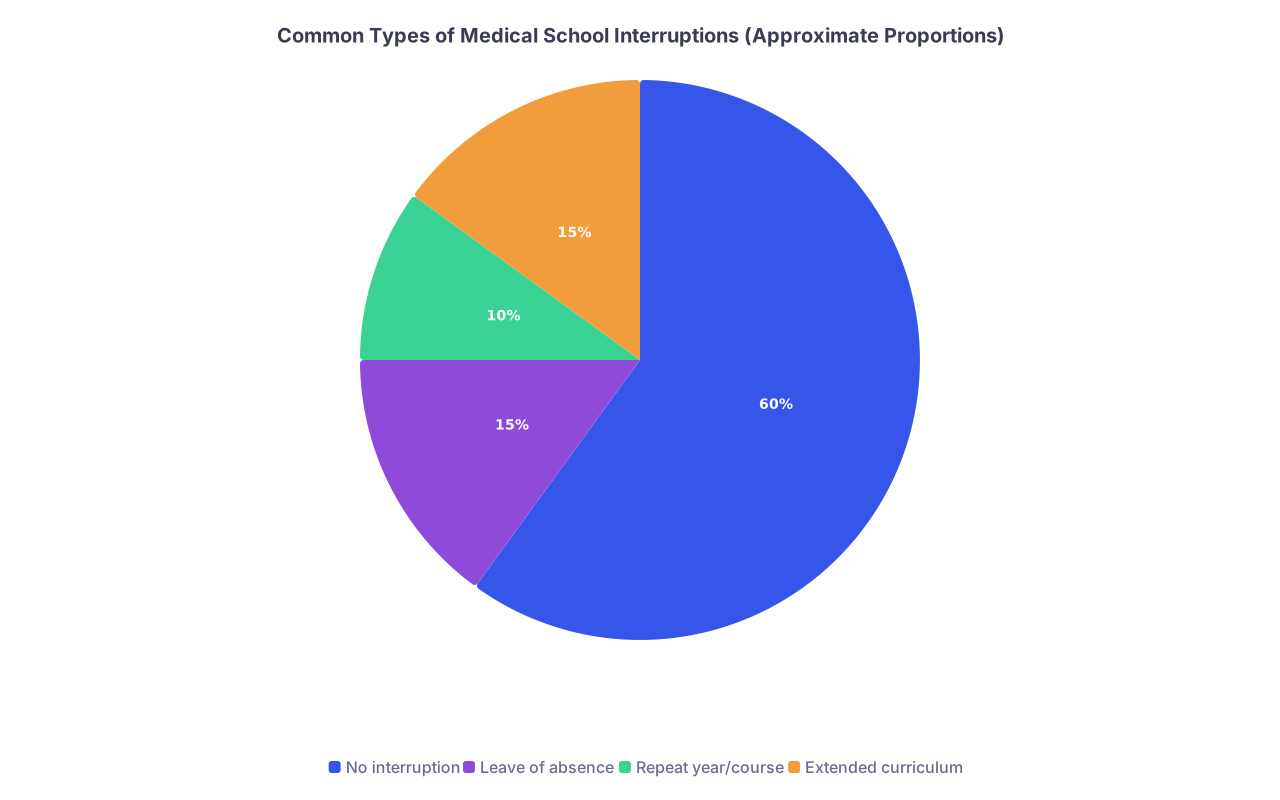
| Category | Value |
|---|---|
| No interruption | 60 |
| Leave of absence | 15 |
| Repeat year/course | 10 |
| Extended curriculum | 15 |
Does every leave equal “mental health leave”? No. But a good chunk are. People just don’t talk.
You’re imagining you’ll be the only applicant with a gap, like every PD will circle it in red ink and cackle. Reality is way more boring. They’ve seen it before. Often many times.
The Ugly Fear: Will Programs See Me as “Unstable”?
This is the core panic, right? Not just “Will I match?” but “Will they think I’m unsafe, unreliable, a walking liability?”
Here’s what most residency programs actually care about, beneath all the performative compassion:
- Can you safely take care of patients?
- Will you show up?
- Will you pass your boards?
- Will you be a headache for them?
Cold, but true.
A leave by itself doesn’t answer “yes” or “no” to any of those. What matters is the pattern around it.
A single, clearly explained leave with a strong return, good clerkship performance, and solid Step scores? That reads more like: “Life punched me in the face, I got help, I stabilized, came back, and function at a high level now.”
Multiple unexplained gaps, failures after returning, inconsistent attendance, vague letters? That’s when programs start thinking “unstable, high-risk.”
So the real anxiety question isn’t “Does a leave ruin me?” It’s “Can I come back and build a stable, coherent story after the leave?” And that depends way more on your support, your treatment plan, and school policies than on some absolute rule about leaves.
How the Leave Actually Shows Up in Your Application
Let’s talk about the paper trail, because that’s what keeps people up at night.
What gets seen?
This can vary a bit by school, but typically:
- Your MSPE (Dean’s Letter) will show your timeline. If you took an extra year, it’ll be obvious you didn’t do the 4-year straight shot.
- Sometimes there’s a line about “interruption in training.” Occasionally with a generic phrase like “personal reasons” or “medical reasons.”
- Your transcript may show “Leave of Absence” dates.
- ERAS has a place where you can explain “gaps” if you want.
Programs don’t usually see your private disability/mental health records. They’re not getting your therapy notes. They’re not reading your psychiatry history. They see: time, scores, clerkship grades, narrative comments, and what you choose to tell them.
| Item | How It Usually Appears |
|---|---|
| MSPE timeline | Shows extra time / delayed graduation |
| Transcript | May list "Leave of Absence" dates |
| ERAS application | Optional explanation of gaps |
| Letters of rec | May or may not mention interruption |
| Scores/grades | Performance before vs after leave |
Here’s the part that makes you want to throw up: yes, you’ll probably need to acknowledge it somewhere. But you have more control over that narrative than you think.
The Worst-Case Scenarios Your Brain Is Obsessing Over
Let’s drag the nightmare thoughts into daylight for a second.
“They’ll think I can’t handle residency.”
If your story is: “I was drowning, refused to step back, crashed during a rotation, kept melting down, and failed multiple courses before anyone intervened,” then yes—that looks like someone who can’t recognize limits.
If instead your story is: “Things were sliding, I got care, took structured time away, and came back performing consistently with strong evaluations,” that looks totally different.
Programs actually like evidence of insight and course-correction. Because guess what? Residency is harder. If they see you can recognize when you’re in trouble and proactively stabilize, that’s safer than the guy who forces himself through 10/10 burnout until a patient gets hurt.
“No competitive specialty will ever touch me.”
I’ve seen people with leaves match into things like anesthesia, radiology, EM, even some surgical subs. Not everyone, obviously. But it’s not some absolute wall.
What does crush competitive specialty chances is:
- Mediocre scores and a leave
- Weak letters
- No clear commitment to the field
- Pattern of inconsistency
So yes, if you want derm and you’ve got a leave, a marginal Step 2, and average grades, that combo is tough. But that’s not just “because of the leave.” That’s the whole package.
If you’re aiming for IM, FM, peds, psych, neurology, pathology, etc., a well-handled mental health leave is very, very survivable. Provided you rebound.
“They’ll ask triggering questions in interviews and I’ll fall apart.”
Most programs don’t want to get sued. They’re not going to pry into your diagnosis.
What they might ask is some soft version of: “I see your training was extended—can you tell me about that?” or “I noticed a leave in your MSPE—what was going on and how did you handle it?”
That’s where you need a practiced, boring, emotionally neutral script. Something like:
“I had a health issue that required me to step away from school for a period of time. I used that time to get appropriate care, establish long-term supports, and when I returned, I was able to perform at a high level consistently. Since then I’ve completed all my clinical rotations and Step 2 without interruption.”
You don’t have to say “major depressive disorder” or “panic attacks” unless you want to. Medical issue is true. Mental health is health.
The Part No One Wants to Admit: Sometimes You Do Need to Step Away
Let me say the thing your brain is trying to outrun: if you are at the point where you’re not safe—suicidal thoughts, self-harm, unable to study or function, terrified to open your email, dreading waking up—pretending you’re fine to “save your Match chances” is how people end up actually losing everything.
You know how many students I’ve seen white-knuckle through severe depression to “avoid a leave,” only to fail Step 1 or Step 2, then need remediation, then get a horrible MSPE paragraph, then still end up taking a leave after the damage is worse? Too many.
A clean, early, intentional leave is often less damaging than a long, messy decline.
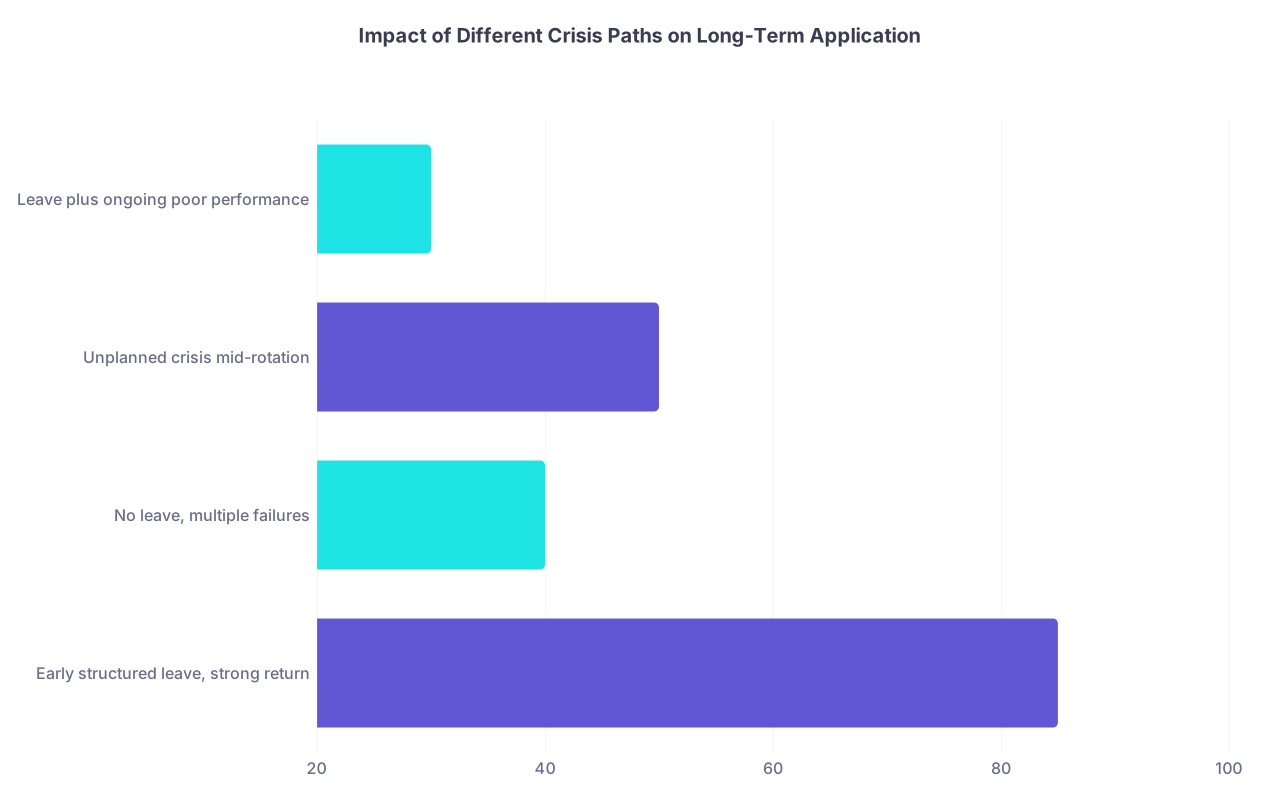
| Category | Value |
|---|---|
| Early structured leave, strong return | 85 |
| No leave, multiple failures | 40 |
| Unplanned crisis mid-rotation | 50 |
| Leave plus ongoing poor performance | 30 |
(Think of those numbers as “relative chance of a stable, explainable story,” not actual percentages.)
Taking a leave doesn’t magically fix your brain. But it creates space to get care before everything burns down around you.
And yes, people will gossip for five minutes. Then someone else will fail a shelf or break up with their partner or bomb an OSCE, and you’ll stop being the main character in their mental drama.
How to Take a Mental Health Leave Without Destroying Your Future
There’s a smart way and a chaotic way to do this.
The chaotic way is: disappear, send a vague email, don’t engage with student affairs, let rumors fly, don’t get treatment, and hope things just “feel better” later. That path does wreck applications.
The smarter (less terrible) way:
First, get a real clinician involved. A psychiatrist, therapist, or at least your PCP. Not just “I’m talking to a friend.” You want documentation, an actual treatment plan, and someone who can write a note if needed. It also keeps you safer.
Second, talk to student affairs before everything collapses. Yes, this is awful and humiliating. I know. But they are the ones who control whether your transcript says you withdrew in disgrace or took an official LOA with school support. Be honest enough to get help, but you don’t need to pour your entire trauma history out.
Something like: “I’ve been struggling with my mental health, I’m in treatment, and my psychiatrist and I think I need some structured time away to stabilize so I can return and perform safely and consistently.”
Third, clarify exactly what the leave looks like. Is it a semester? A year? Are you expected to return at a set time? Can it be extended? How will it be labeled? Is there a “medical LOA” category? What do they usually write in the MSPE for these situations? Ask them directly. You’re allowed.
Fourth, keep some connection with the school. Check in as required. Don’t ghost. If they want periodic updates from your clinician (with your consent), build that into your care plan. This isn’t to punish you; it’s to prove later that this was a structured, supported process.

| Step | Description |
|---|---|
| Step 1 | Recognize crisis |
| Step 2 | See clinician |
| Step 3 | Contact student affairs |
| Step 4 | Discuss LOA options |
| Step 5 | Formal LOA approved |
| Step 6 | Treatment & stabilization |
| Step 7 | Clearance to return |
| Step 8 | Re-entry into curriculum |
Is it dehumanizing to have to “prove” you’re stable to come back? Yeah. It can feel like that. But in the residency world, having that documented, well-managed arc actually helps.
How to Talk About Your Leave in Your Application Without Oversharing
Here’s the balance you’re trying to hit: honest but not confessional, clear but not diagnostic.
You do not need to pour your soul into ERAS. You are not obligated to disclose a specific mental health diagnosis.
Very usable structure for a short explanation (if needed):
Brief cause category
“I experienced a significant health issue that required me to take a leave from medical school.”What you did during that time (in broad strokes)
“During this period I focused on treatment, recovery, and building sustainable strategies for managing my health.”Evidence you came back stronger/stable
“Since returning, I have completed [rotations/Step 2/clinical work] without interruption and have consistently strong evaluations.”
That’s it. No sob story. No trauma details. No “I was suicidal every day.” That belongs with your therapist, not your PD.
If asked in interviews, you just expand that slightly, but keep the same spine. Calm. Rehearsed. Boring.
What Actually Helps You Match After a Leave
Once you’ve taken the leave, here’s what matters way more than the leave itself:
- Passing Step 2 with a solid score (or at least not tanking it)
- Strong clinical evaluations after you return
- At least a couple of letter writers who explicitly say you are reliable, mature, and someone they’d trust with patients
- No new drama (no professionalism flags, no new failures, no ghosting on responsibilities)
You want your story to read like: “Yes, there was a bump. It’s over. Look at the last 12–24 months: stable, consistent, functional.”
If you can, get at least one letter from someone who worked with you post-leave and can comment on your current functioning. They don’t have to say “after his mental health leave.” They just need to say you’re solid.

And yeah, your specialty choice matters. If your scores are average and you’ve got an LOA, maybe don’t choose the single most competitive field with a 50-page research expectation. But that’s true even without a leave.
If you’re aiming at something more middle-of-the-road competitiveness-wise, and your post-leave performance is strong, your odds are much better than your panicked brain is telling you at 3am.
The Part That Hurts: Your Brain Will Still Tell You You’re Screwed
Even if you do everything right, this fear doesn’t magically evaporate. You will scroll SDN threads of people saying, “Any red flag ruins you” and internalize all of it. You will obsess over tiny phrases in your MSPE. You will imagine every interviewer seeing “LOA” and mentally tossing your file in the trash.
You’re not going to logic that anxiety away fully. But you can at least separate:
- The catastrophic voice saying “You’re done, don’t even try”
- From the pragmatic reality: “You have a bump. You need to be strategic. But you’re still in the game.”
And here’s a brutal reframe: if you don’t take care of your brain and push through until something breaks—an attempted suicide, a public meltdown on the wards, a major professionalism event—you’re not dealing with theoretical Match damage anymore. That stuff follows you in a way a clean, documented LOA never will.

Your job right now is not to present as flawless. It’s to still be alive, somewhat intact, and capable of training in a year or two.
Quick Reality Check Before You Spiral Again Later Tonight
Let me strip this down to the bare, uncomfortable truth.
A mental health leave does not automatically ruin your Match. Programs care much more about what happened after the leave than the fact that it happened.
A messy, unaddressed downward spiral with failures and professionalism issues is often way more damaging than a clean, early, supported leave.
You control more of the story than your anxiety wants you to believe: how you document it, how you treat your mental health, how you perform after, and how you talk about it when the time comes.
You’re allowed to step away without forfeiting your entire future. The goal is not to be the perfect uninterrupted robot. The goal is to still be here, and still be capable, when it’s time to take care of patients for real.