
The worst crises in medical school don’t wait for a free weekend. They show up 24–72 hours before an exam.
The brutal truth about crises and exams
Here’s the reality nobody likes to say out loud:
Sometimes you absolutely should not sit for that exam.
Sometimes you absolutely must sit for it anyway.
And the hard part is knowing which is which when your life is on fire.
I’m not talking about “I’m stressed” or “I didn’t study enough.” I mean:
- A parent in the ICU
- A breakup that shattered you
- Receiving your own scary diagnosis
- A code on your patient that you can’t stop replaying
- Assault, harassment, or a serious safety issue
- A roommate ODing the night before your NBME
This is a triage problem. Like in the ED. You cannot fix everything at once, so you decide what’s most critical, what’s salvageable, and what has to wait.
This guide is how you make that call when a personal crisis lands right before a major exam in medical school.
Step 1: Name the crisis and its severity (no euphemisms)
First move: stop calling it “some stuff going on.” Minimizing it will push you to make the wrong decision.
Ask yourself, very concretely:
- What exactly just happened?
- When did it start?
- What has changed in the last 24–48 hours in my ability to:
- Think clearly
- Sleep
- Eat
- Read and retain information
- Sit still and focus for 2–4 hours
If your brain is ping‑ponging, write it down in 3 sentences max:
- “My dad had a stroke last night. I didn’t sleep. I’m flying home tomorrow. My exam is in 36 hours.”
- “Partner ended our 7‑year relationship two days ago. Haven’t eaten properly, crying randomly every hour, exam tomorrow at 8am.”
- “Got called for a disciplinary hearing about a professionalism complaint; can’t concentrate; exam is in 3 days.”
Then place it—roughly—in one of these buckets:
| Level | Description | Typical Impact on Exam Performance |
|---|---|---|
| Mild | Upset but functional, can still focus in blocks | −0 to −5% performance |
| Moderate | Intrusive thoughts, poor sleep, focus impaired | −5 to −15% performance |
| Severe | Panic, dissociation, cannot read/retain, safety concerns | −15% or worse; possible exam failure |
Do not overthink the percentages. The point is: severe means you’re not just “off your game.” You’re functionally impaired.
If you’re in severe territory, your default should be: do not sit the exam unless there is literally no alternative.
Then work backwards from there and see if that default needs to be overridden for logistical reasons.
Step 2: Decide what you’re optimizing for
You can’t optimize for everything simultaneously. You must choose:
- Protect mental health and long‑term function
- Protect academic standing and progression
- Protect finances/visa status (for some students)
- Protect relationships/family responsibilities
You need to know what’s non‑negotiable for you in this moment.
Ask two questions:
“If I bomb this exam, what are the actual, concrete consequences?”
- Fail the course?
- Need remediation?
- Delay Step/Level exam?
- Just drop your grade from honors to pass?
“If I suppress my crisis and push through, what are the risks?”
- Worsening depression/anxiety/PTSD?
- Safety risk (self‑harm, reckless driving, substance use)?
- Losing trust with family/partner because you’re absent for a true emergency?
Here’s a harsh but real pattern I’ve seen:
Students destroy themselves emotionally to avoid relatively small academic hits (going from honors to high pass). Then they’re shocked when it shows up months later as burnout, panic attacks on the wards, or total apathy.
If the worst case is “I don’t get honors in this block,” think very hard before sacrificing your mental stability.
Step 3: Map your actual options (not the imaginary ones)
Students in crisis tend to think in false binaries:
- “Either I take it tomorrow or I ruin my career.”
- “If I postpone, they’ll think I’m weak and I’ll be screwed.”
- “If I tell anyone, I’ll get labeled.”
Reality is usually more flexible—if you move early and communicate clearly.
Here’s what typically exists in a med school or during exams like NBME, shelf exams, OSCEs, and sometimes Step/Level:
| Option | When It’s Realistic | Cost/Risk |
|---|---|---|
| Same-day exam as planned | Mild–moderate crisis, functioning mostly intact | Mental strain, performance dip |
| Short postponement (days–weeks) | School exams, some NBME/shelves | Admin hassle, schedule shifts |
| Long deferral (block/course repeat) | Major medical/psychiatric/family crisis | Delayed graduation, financial impact |
| In-exam accommodations | Panic, acute distress mid-exam | Possibly voided score, documentation needed |
| Withdraw from course/leave of absence | Severe ongoing crisis | Big but sometimes necessary reset |
You need to find out what actually exists at your institution, not what third-years gossip about.
That leads to the next step.
Step 4: Your first five calls/messages (within a few hours)
If this crisis is serious and the exam is within 72 hours, you should not try to “handle it alone” and then email someone at 2am the night before. That’s how you back yourself into a corner.
Here’s the order I recommend, adjusted depending on your situation:
Student health / counseling / mental health services
- Tell them: “I have a major exam on [date]. A serious personal crisis just happened. I need urgent guidance and documentation.”
- Your goal: rapid assessment + a note if needed.
- Many schools have same‑day urgent slots once you say “impairing academic function.”
Course director or block/clerkship director
- Short, factual email. Examples:
“Dr. X, I’ve had an acute family medical emergency that has significantly impaired my ability to prepare and function for the [exam name] scheduled on [date]. I’m in contact with student health and can provide documentation. I’d like to discuss options for deferring or rescheduling the exam. Please let me know the best way and earliest time to speak.” - Do not write your life story. You can share details verbally if needed.
- Short, factual email. Examples:
Office of student affairs / dean of students
- These people exist for exactly this. Use them.
- Ask: “What are the formal policies on exam deferral, incomplete grades, or leaves in the context of acute personal/medical crises?”
Trusted faculty mentor or upperclassman who’s been through something similar
- Not for permission. For strategy. “If I defer this exam, what happens in clerkship scheduling? What did you see other students do?”
Family or support person (if appropriate)
- You might need help with logistics: travel, child care, food, not studying for 6 hours while you sit in shock.

| Step | Description |
|---|---|
| Step 1 | Personal Crisis |
| Step 2 | Assess severity |
| Step 3 | Schedule urgent counseling |
| Step 4 | Contact student health |
| Step 5 | Email course director |
| Step 6 | Contact student affairs |
| Step 7 | Exam in <= 72 hours? |
| Step 8 | Options: sit, defer, LOA |
Move fast on this. Administrators are much more willing to work with “this happened yesterday and I’m reaching out now” than “this has been going on for two weeks and I said nothing.”
Step 5: How to decide: sit or defer?
Now the actual triage decision. Use this like a checklist, not philosophy.
You should strongly lean toward deferring if:
- You have active suicidal ideation, self-harm urges, or can’t promise your own safety.
- You’re having panic attacks, dissociation, or can’t read a single page and recall what you read.
- You’re about to get on a plane or drive long distance for a family emergency and are sleep‑deprived.
- A therapist/psychiatrist/physician explicitly advises against taking the exam right now.
- The exam is not a once-in-a-lifetime event (e.g., not the final available Step 2 window before graduation) and your school has a deferral mechanism.
You might consider still sitting if:
- Crisis is real but your core functioning is intact: you can read, retain, stay seated for 2 hours.
- You have protective factors lined up (meds stable, good support, reasonable sleep the night before).
- The consequences of deferral are extremely high: visa issues, delayed graduation by a year, financial catastrophe—and your mental health team thinks you can tolerate the exam.
- It’s a lower-stakes exam (quiz, mid-block exam) and you’ve banked solid scores earlier.
But here’s the line I draw very clearly:
If you’re in a state where you know you might walk out mid‑exam, blank on entire sections, or start sobbing in the testing room, you’re gambling your transcript for no good reason. That tends to backfire badly.
Step 6: If you do sit for the exam
Sometimes you’ll sit anyway. Maybe there’s no make‑up exam for months. Maybe family pressures you. Maybe you just don’t want to delay.
Fine. Then treat that decision like a tactical operation.
Adjust your performance expectations
You are not going for a personal best. You are going for “good enough to pass” or “minimize damage.” This is not the day for perfectionism.Strip the 24 hours before the exam down to three priorities
- Sleep as best you can (even 4–5 hours)
- Eat actual food
- Do light review of high-yield facts you already know
No last‑minute new material. Your brain is already overloaded.
Day‑of plan
- Arrive early so you’re not adding adrenaline from rushing.
- Bring water, simple snacks, and anything allowed that grounds you (stress ball, sweater, etc.).
- Before starting, take 60 seconds: slow breathing, name “I’m in crisis and I’m still here doing this.”
In the exam
- Use a mechanical strategy:
- One pass: answer what you can.
- Flag truly tough items without obsessing.
- Don’t check the timer every 30 seconds.
- When your mind spirals to the crisis, don’t fight it philosophically. Just say “not now” and pull your eyes back to the question stem.
- Use a mechanical strategy:
If you hit the wall mid‑exam
- If you’re about to bolt out of the room or have a panic attack, pause. Raise your hand. Get the proctor.
- Some institutions allow exam to be stopped and voided in acute medical situations, with documentation afterward. You need to know that policy in advance from student affairs if possible.
Step 7: If you defer or miss the exam
Deferring is not academic death. But it does have consequences. You manage them, you don’t pretend they don’t exist.
Get documentation squared away immediately
- From student health, therapist, physician, or hospital if it’s a family emergency.
- Send it exactly where your school tells you—usually student affairs, not just the course director.
Clarify the academic plan in writing Email student affairs something like: “Following up on our conversation today, I understand that I’ll be deferring the [exam name] originally scheduled for [date]. The current plan is to:
- Take the make-up exam on [proposed dates] OR
- Receive an Incomplete for the course and complete requirements by [timeframe].
Please confirm this plan or let me know what else you need from me.”
Be honest about your capacity in the recovery period You might be tempted to load everything back on your plate the second the immediate crisis calms a little. That’s how people boomerang into a second crash.
Check: can you start studying consistently again? Can you show up for clinical duties? Are you actually sleeping?
If the crisis is ongoing, ask about temporary modifications Examples I’ve seen:
- Partial leave (reduced load)
- Excused from certain non-essential activities (evening small groups, optional labs)
- Shift in clerkship order to put lighter rotations closer to the crisis period
Step 8: Protect your future self from this happening again (as much as you can)
You can’t stop crises from hitting bad timing. But you can blunt the damage.
Here are a few preventative “infrastructure” moves that help enormously later:
Know your school’s policies now, not when you’re sobbing in the library
Spend 15 minutes reading the handbook for: exam deferral, incomplete grades, leaves of absence, mental health accommodations.Have student health or counseling already established
If you’ve seen them once or twice before, getting seen urgently during a crisis is usually smoother.Keep your baseline studying steady
People who cram the last 5 days before an exam get absolutely wrecked by crises. If your knowledge is built over weeks, losing 48–72 hours doesn’t tank you as badly.Tell at least one trusted faculty member about your life context
Primary caregiver for a parent? Partner with unstable health? Single parent? They can advocate faster if a crisis hits.
A quick word about Step/Level and licensing exams
These are higher stakes, so the calculus shifts, but the triage framework is the same.
Special considerations:
- Score can follow you for years. Sitting while severely impaired and scoring way below your potential is not a “brave” move. It can close doors later.
- Many students don’t realize you can sometimes reschedule (with fees) even relatively close to the date. Money hurts, but a bad permanent score usually hurts more.
- If you’re in a truly severe crisis within a week of Step/Level, at least call NBME/USMLE/COMLEX support and your dean. Ask explicitly what options exist for emergency reschedule, medical withdrawal, or voiding if you’re acutely ill.
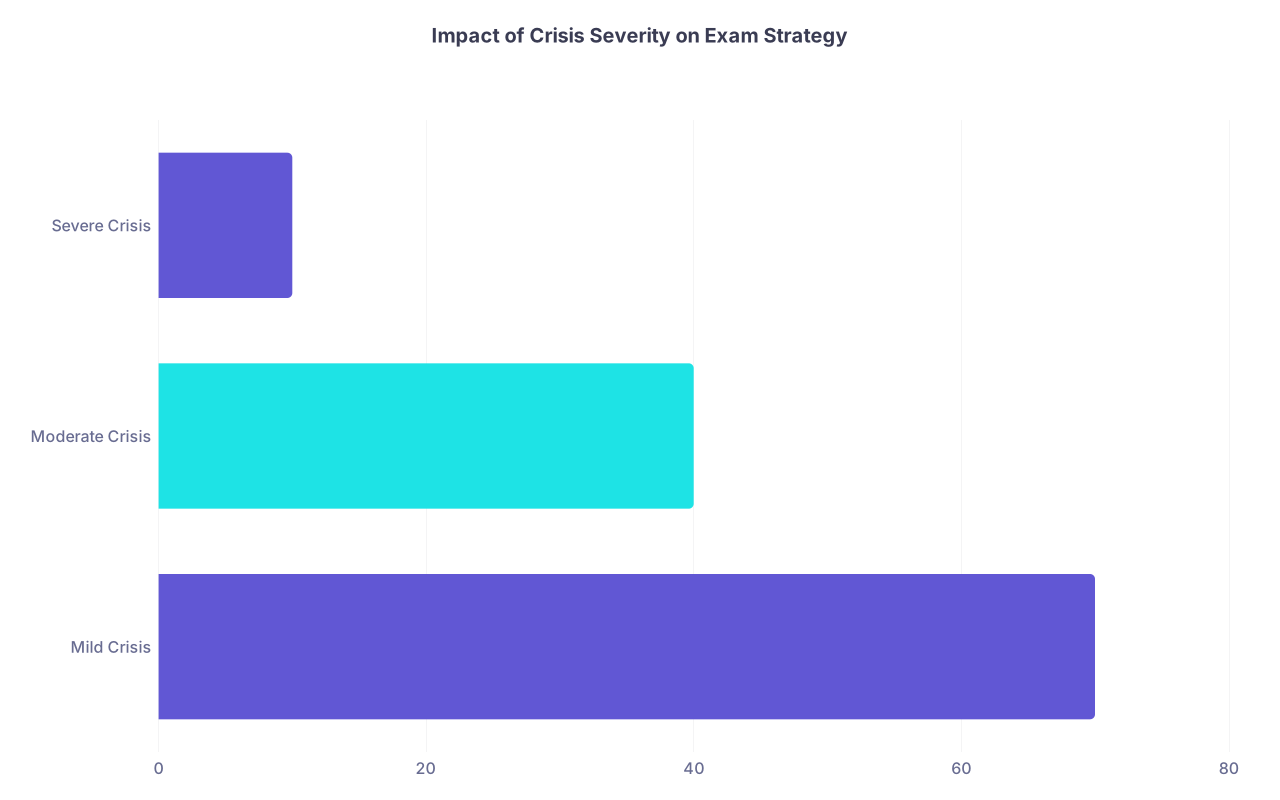
| Category | Value |
|---|---|
| Mild Crisis | 70 |
| Moderate Crisis | 40 |
| Severe Crisis | 10 |
Think of it like this: as crisis severity goes up, the percentage of scenarios where you should still sit for the exam goes down. Dramatically.
Emotional fallout: the shame, the “weakness” story, and what to do with it
Many med students would rather fail silently than email and say, “I’m not okay.”
Here’s my blunt take:
Taking care of your brain in the middle of a genuine crisis is professionalism. It’s judgment. It’s exactly the kind of triage you’re expected to use with patients.
If you catch yourself thinking:
- “Everyone else handles this stuff. I’m broken.”
- “If I ask for help once, they’ll think I’m gaming the system.”
- “Real doctors push through.”
Remember: you don’t see your classmates’ full stories. You don’t see the ones who went on leave quietly. You don’t see the ones who had panic attacks in parking lots.
What you will see, sooner or later, are attendings who are wrecked because they never learned to stop when life hit hard. Do not model yourself after that.
Visualizing the decision in 30 seconds
Here’s a quick mental model you can run when your brain is fried:

| Step | Description |
|---|---|
| Step 1 | Serious personal crisis |
| Step 2 | Lean strongly to defer; contact support now |
| Step 3 | Defer or request reschedule |
| Step 4 | Consult student health & dean today; consider sitting with modified expectations |
| Step 5 | Can I focus for 30 mins on a simple task? |
| Step 6 | Would failing this exam harm my long-term path more than delaying it? |
Run this with someone else—mentor, counselor, friend—if you can. Your judgment is distorted in the middle of grief, fear, or shock.
FAQs
1. “What if my school doesn’t see my crisis as ‘serious enough’ to defer the exam?”
This happens. Sometimes you’ll get a cold response or rigid policy. Your move is twofold: get professional documentation (from mental health or medical providers) and escalate to student affairs or your dean rather than arguing with a single course director. Use concrete language: “functional impairment,” “unable to safely complete a high‑stakes exam,” “acute psychiatric distress,” “bereavement,” “family member in critical care.” If your school truly stonewalls despite clear impairment, document everything in writing and, if needed, loop in an ombuds office or disability services. But don’t pre‑reject yourself by never asking because you assumed they’d say no.
2. “Won’t deferring an exam or taking a leave of absence ruin my residency chances?”
No, not automatically. What programs usually care about: pattern and explanation. A single deferral or short leave for a real crisis, with otherwise solid performance, is not a red flag. A long, vague academic history with multiple unexplained interruptions might raise questions—but even that can often be addressed with a clear narrative. Protecting your mental health enough to finish med school functioning is far more valuable than white‑knuckling through and exploding later during residency.
3. “How much detail should I share about my crisis with faculty or administration?”
Less than you think. They need to know: there is a genuine serious situation, it’s impacting your functioning, and you’re under the care of appropriate professionals. Specifics like “mother in ICU after sudden stroke” are usually enough; you don’t need to describe every emotional detail or traumatic event. If it’s something especially sensitive (assault, psychiatric hospitalization), you can say “acute trauma” or “acute psychiatric crisis,” and let your clinician’s documentation carry the weight. Remember: student health and counseling are confidential in a way course leadership is not.
4. “I pushed through an exam during a crisis and did badly. What should I do now?”
First, stop beating yourself up for not deferring; you made the best decision you could with the information and mindset you had. Then do three things: 1) Get the academic facts—what does this score mean for the course, for remediation, for progression? 2) Get mental health support; the combo of crisis + poor performance is a setup for a depressive spiral. 3) Meet with student affairs and a trusted mentor to plan the repair: retake, remediation, Step timing adjustments, maybe schedule lighter rotations around your next big exam. The key is to treat the bad score as data to incorporate into a smarter plan, not as a verdict on your worth or your future.
Keep three things in focus:
- A real crisis + a high‑stakes exam is a triage problem, not a test of your toughness.
- You almost always have more options—deferrals, documentation, schedule shifts—than your panicked brain is telling you.
- Protecting your long‑term mental health and function is not optional; it’s part of being the kind of physician patients actually need.