
The way most schools handle academic probation and burnout is broken. They act like you can “self-care” your way out of a system that’s chewing you up.
If you’re on probation and burning out, you are not dealing with a generic wellness issue. You’re balancing two live grenades: your mental health and your standing in medical school. Drop either one, and things get ugly fast.
I’m going to walk you through how to get out of this without imploding your career or your brain. Not theory. Actual step‑by‑step moves, with the politics and ugly realities included.
1. First, Stop the Freefall (Next 72 Hours)
If you’re on probation and crispy from burnout, your house is already on fire. You do not start by planning the renovation. You start by not dying in the blaze.
For the next 72 hours, your only goals are:
- Stop academic damage from getting worse.
- Lower the internal pressure enough that you can think clearly.
Forget optimizing. You’re in containment mode.
A. Triage your academic exposure
You need a brutally honest snapshot of where you’re bleeding points.
List, on paper, not in your head:
- Every course/rotation you’re currently in
- Current grade or approximate standing (pass/fail, borderline, failing)
- Next 3 high‑stakes events:
- Exams
- OSCEs
- Assignments
- Shelf exams
Then mark each as:
- Red = imminent risk of failing
- Yellow = at risk if things keep going this way
- Green = reasonably safe for now
That gives you a map. Most burned‑out students try to push everything equally. That’s how you fail multiple things at once.
Right now, your rule is:
- Protect the red items
- Contain the yellow
- De‑prioritize perfection on green
You’re not trying to be excellent. You’re trying to stop more “F”s and prevent more probation flags.
B. Admit how bad the burnout is
You do not push through severe burnout with more discipline. That’s fantasy.
Answer this bluntly—yes or no:
- Are you waking up heart racing, dreading the day, most days?
- Do you feel detached or numb even when big things happen (good or bad)?
- Are you rereading the same page and absorbing nothing?
- Any passive thoughts like “If I got hit by a car, at least I’d get a break”?
If you’re hitting yes on several of those, you’re not “tired.” You’re in real burnout, likely anxiety or depression layered on top.
That means:
- Your brain is not functioning at full academic capacity.
- You will not out‑grind your way out of this.
You need to accept lower short‑term productivity to salvage long‑term function. Counterintuitive, but true.
C. Put in a psychological safety net
Tonight. Not next week.
Pick one:
- Campus counseling/mental health
- Your primary care doctor
- Off‑campus therapist/psychiatrist if you already have one
Send the email or schedule online: “I’m a current medical student on academic probation and I’m struggling with burnout and anxiety. I’m worried about my ability to function academically. I need the earliest available appointment.”
That sentence does three things:
- Signals urgency
- Ties it explicitly to academic functioning
- Starts a documentation trail (which can later support leaves, accommodations, probation appeals)
No, you are not being dramatic. Students have crashed out of school because they waited “to see if it gets better.” I’ve watched it.
2. Understand the Game You’re Actually Playing
Medical schools love vague phrases: “academic probation,” “conditions,” “satisfactory progress.” You can’t rebuild strategically until you know the actual rules that decide if you stay or go.
A. Get your probation terms in writing
Do not rely on what you half‑remember from a stressful meeting.
You want:
- Official probation letter or email
- Any policy documents from the student handbook or academic progress committee
If you don’t have them: Email whoever handles this (Student Affairs, Academic Dean’s office):
“Dear Dr. ___ / Ms. ___,
I’d like to make sure I fully understand the terms of my current academic probation. Could you please send me the written probation conditions and any relevant policy about how and when probation is reviewed or lifted?”
Now you know:
- Exactly what you must avoid (e.g., “no more course failures,” “pass all remaining clerkships on first attempt”)
- Timeframe (one semester? one year? until graduation?)
- Who reviews you and when
B. Map your risk window
Once you have the terms, build a simple timeline from “now” to your next probation review.
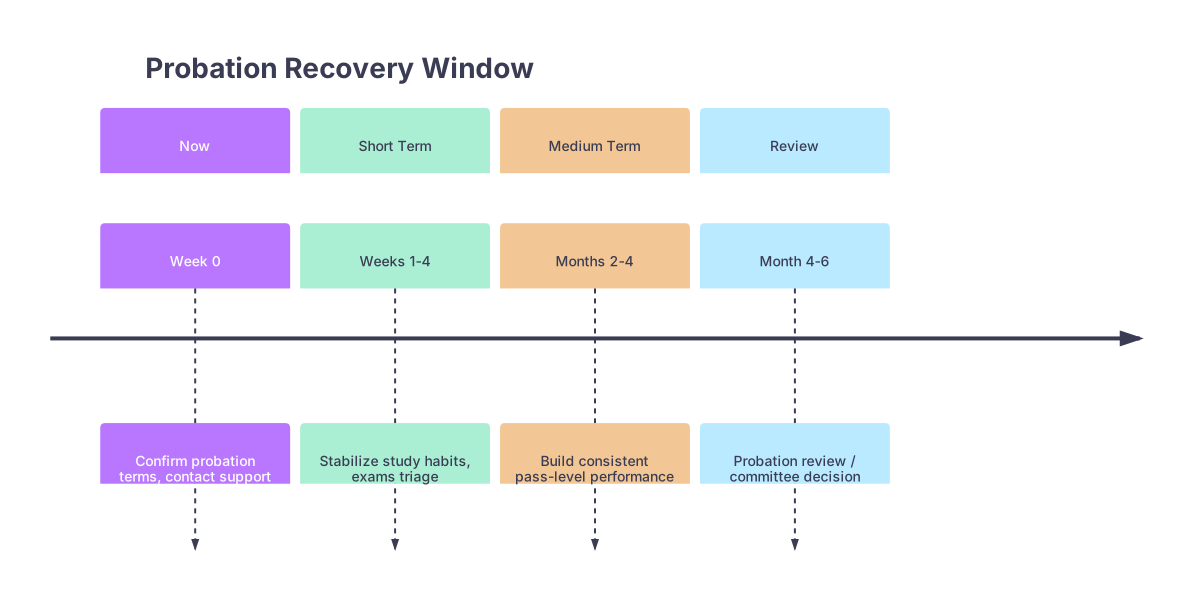
| Period | Event |
|---|---|
| Now - Week 0 | Confirm probation terms, contact support |
| Short Term - Weeks 1-4 | Stabilize study habits, exams triage |
| Medium Term - Months 2-4 | Build consistent pass-level performance |
| Review - Month 4-6 | Probation review / committee decision |
Put your big exams, clerkship ends, OSCEs, and the probation review on this timeline. This is your battlefield.
Now you can answer:
- Which specific exams/rotations will be evidence “for” you at review
- Which upcoming things would be catastrophic to fail
Once you see that clearly, decision‑making gets a lot less emotional and a lot more targeted.
3. Talk to the School Without Screwing Yourself
You’re probably afraid that if you admit how badly you’re struggling, they’ll see you as weak or unstable. Fair. Some schools do handle it badly. But going radio silent is worse.
You want to communicate three things:
- You understand the seriousness.
- You’re taking concrete action.
- You’re not a risk to patient care or professionalism.
A. Who you must talk to
Bare minimum:
- Your assigned dean/advisor/Student Affairs point person
- Course/clerkship directors where you’re currently vulnerable
And yes, you actually email them. Something like:
“Dear Dr. ___,
I wanted to update you on my situation. I’m currently on academic probation and have been experiencing significant burnout and anxiety that have been affecting my performance. I’ve scheduled an appointment with [student mental health / a therapist] and am working on a concrete academic plan to meet my probation conditions.
I would appreciate the chance to briefly discuss what expectations will be most critical in [this course/rotation] so I can prioritize effectively and avoid further issues. I’m committed to improving and want to be proactive about this.”
This shows:
- Insight
- Action
- Willingness to engage
That’s what academic committees look for when deciding if someone is “recoverable” or “unsafe/unchecked.”
B. What not to say
Do not:
- Blame specific faculty by name unless there’s serious misconduct
- Talk about hating medicine or regretting med school (keep that for therapy)
- Mention suicidal thoughts or self‑harm in an email—those belong in a clinical setting where someone can respond appropriately and document it correctly
If you are having active suicidal thoughts, that jumps above all of this. You call:
- Campus emergency/after‑hours mental health
- National crisis line
- Go to an ER
Your career is not worth your life. Full stop.
4. Rebuild a Bare‑Minimum Academic System That Actually Fits Burnout
You don’t need a perfect study system. You need a sustainable, “passes the exams” system that respects that your brain is running at maybe 60–70%.
Here’s the core mistake I see: Students on probation decide they’ll “finally do everything right”—all the resources, all the Anki, all the practice Qs, 12‑hour days. They last 4 days, crash, then spiral.
You’re going to do the opposite. Narrow and consistent beats broad and heroic.
A. Pick a primary and a secondary resource. That’s it.
For pre‑clinical courses:
- Primary: official course materials (lectures, slides, learning objectives)
- Secondary: one high‑yield board‑style resource (Boards & Beyond, Pathoma, Sketchy, etc. depending on subject)
For clerkships:
- Primary: UWorld or Amboss questions for that shelf
- Secondary: one concise text (e.g., Step‑Up, Case Files, OnlineMedEd videos)
Your rule:
- If you haven’t mastered the primary, you don’t touch a tertiary resource.
- No bouncing between 5 things because everyone on Reddit swears by a different combo.
B. Build a “minimum viable day”
You’re burned out. You need a daily routine you can hit even on a bad day. Then you scale up on better days.
Example for pre‑clinical, on probation:
- Morning (2–3 hours): Watch/review scheduled lectures at 1–1.5x, take minimal notes tied to learning objectives.
- Afternoon (2 hours): 20–30 practice questions from a trusted bank, with focused review.
- Evening (30–60 minutes): Review flagged cards/concepts only, not your entire Anki backlog.
On a really bad day?
- Cut the questions to 10–15.
- Still touch the material for at least 60–90 minutes.
The win is not intensity. It’s not having zero‑day blackouts where you disappear from work entirely, then binge‑panic later.
C. Use questions as your reality check
Your brain under burnout will lie to you:
- “I don’t know anything.”
- “I’m so behind I’ll never catch up.”
- “Everyone else is fine.”
Questions (UWorld, NBME style, school question banks) cut through that. They tell you:
- What you actually know
- Where you’re bleeding points
- Whether this level of studying is enough to pass
Set a realistic goal:
| Phase | Questions/Day | Main Goal |
|---|---|---|
| Pre-clinical | 20–30 | Build baseline |
| Light clerkship | 20–40 | Steady progress |
| Heavy clerkship | 10–25 | Maintain passing |
| Week before exam | 40–60 | Solidify weak |
You’re not chasing 100 Q/day Instagram study flexes. You’re aiming for consistent, targeted work that your burnt‑out brain can repeat.
5. Modify Your Environment So You’re Not Fighting on Hard Mode
If your current setup was working, you wouldn’t be on probation and fried. So you change the battlefield.
A. Trim the non‑essential obligations
Look at your week and ruthlessly ask:
- Does this help me pass and stay in school?
- Does this meaningfully support my mental health?
If the answer is no to both:
- Step down from the committee.
- Pause the new research project.
- Stop going to the optional lunch lecture that interrupts your only deep work block.
You can say: “Given my current academic standing, I need to step back from additional commitments this term to focus on stabilizing my performance. I appreciate the opportunity and hope to re‑engage once I’m on more solid footing.”
No long explanations. No guilt essays.
B. Change your physical study context
If you’ve been failing and melting down at the same desk every night, your brain now associates that place with panic and shame. That’s not motivational; it’s toxic.
Try:
- A different floor of the library
- A quiet coffee shop at off‑peak hours
- A specific “work only” corner of your home—with your bed off‑limits for studying
Also: phones. If your phone is in sight, you’re losing 15–25% efficiency. Minimum.
Put it:
- In another room
- In a timed lockbox
- Or use an app that literally blocks you from opening social media during set windows
Burnout makes your willpower worse. So you stop relying on willpower.
6. Use Professional Help Strategically (Not as a Box‑Checking Exercise)
Mental health support isn’t a moral statement. It’s a performance intervention. Treated brain = better executive function, better memory, better emotional control.
A. What to say in therapy as a med student on probation
Don’t just spend 10 sessions venting about how unfair school is. Useful, but incomplete.
Tell them:
- “I’m on academic probation.”
- “I’m struggling with burnout/anxiety/depression that affects my concentration and motivation.”
- “I need help with both coping skills and decisions about leave vs continuing.”
Areas to work on:
- Catastrophic thinking (“one more C and my life is over”)
- Perfectionism (“if I’m not honors, I’m trash”)
- All‑or‑nothing productivity (“if I can’t do 8 hours, I do zero”)
- Basic nervous system regulation (sleep, panic, intrusive thoughts)
B. Meds: not the enemy
I’m not going to armchair‑prescribe you anything, but I’ll say this: I’ve watched students finally pass Step 1, shelves, or stop spiraling only after treating undiagnosed:
- ADHD
- Major depression
- Generalized anxiety
If your mental state is tanking your cognition, no amount of “trying harder” fixes that. A psychiatrist or experienced PCP can help sort:
- Do you meet criteria for something treatable?
- Would medication plus therapy give you more bandwidth during this probation window?
You’re not weaker for needing chemical help in a system designed to fry you. You’re realistic.
7. Decide if You Should Take a Leave Before the System Decides for You
This is the nuclear option students avoid until it’s too late. Then they’re sitting in front of an academic committee being told, “We wish you’d come to us sooner.”
Sometimes the bravest, most career‑saving move is to step out, repair, then come back.
A. Red flags you might need a leave
Pay attention if:
- Your burnout and symptoms are getting worse despite trying to adjust.
- You’re failing repeated exams or rotations even when you’re actually studying.
- You’re having serious thoughts of self‑harm, hopelessness, or quitting medicine every week.
- You’ve completely lost the ability to care or connect with patients or colleagues.
That combination should trigger a real conversation with:
- Your therapist/psychiatrist
- Your dean/Student Affairs
Not Reddit. Not group chat.
B. The politics of requesting a leave
Schools actually often prefer a student request a voluntary, medically‑supported leave rather than force them out after more failures.
When you talk to your dean, the frame is: “I’m concerned that continuing right now in my current state puts me at risk of further failures and is not safe for my mental health. I’ve spoken with [therapist/psychiatrist], and we’re considering a medical leave to allow for treatment and stabilization so I can return able to meet the standards of the program. Can you walk me through how a leave would work here and what the implications would be for my record?”
Notice:
- You’re not saying “I can’t do this.”
- You’re saying “I want to meet the standards, and right now I need time and treatment to realistically do that.”
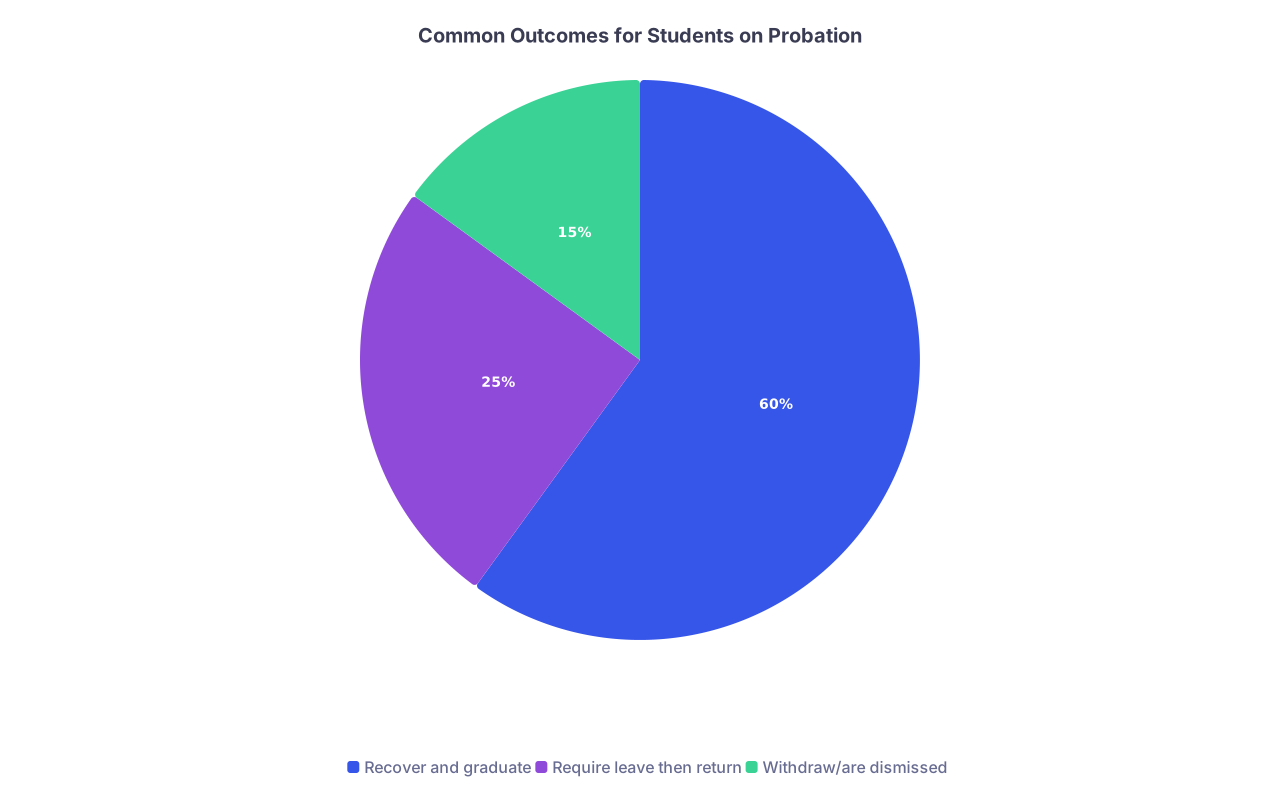
| Category | Value |
|---|---|
| Recover and graduate | 60 |
| Require leave then return | 25 |
| Withdraw/are dismissed | 15 |
Those numbers are approximate, but the point stands: a lot of students recover, and a significant chunk do it with a leave. You’re not an outlier if you need one.
8. Handling Shame, Comparison, and the “I’m Not Cut Out for This” Loop
Probation plus burnout is a shame accelerator. Your brain will weaponize everything:
- Classmates matching derm
- Group chats flexing Step scores
- Faculty saying “this is the minimum expected”
Here’s the raw truth: grades and probation status are poor proxies for whether you’ll be a decent doctor. I’ve seen brilliant, kind physicians who failed courses, repeated years, even changed schools. And I’ve seen A+ students who were emotionally dangerous around patients.
A. Rewrite the story you’re telling yourself
If your internal narrative is:
“I’m on probation because I’m fundamentally incapable,”
you’re going to study like someone already doomed.
Shift it to: “I’m on probation because my current system and mental state don’t match this environment’s demands. I’m testing a different system and getting actual treatment.”
That’s not cheesy affirmation. That’s accurate.
B. Set your own metrics of success for this phase
Right now, your goals are not:
- Honors in everything
- Publications
- Being top quartile
Your goals are:
- Pass the next exam or shelf (even at the lowest passing score)
- Attend X% of your scheduled clinical days present and prepared
- Keep 3–5 days per week with at least 90–120 minutes of real, focused studying
- Maintain sleep above 6 hours/night most nights
You’d be surprised how often simply hitting those metrics for 2–3 months is enough to climb out of the danger zone.
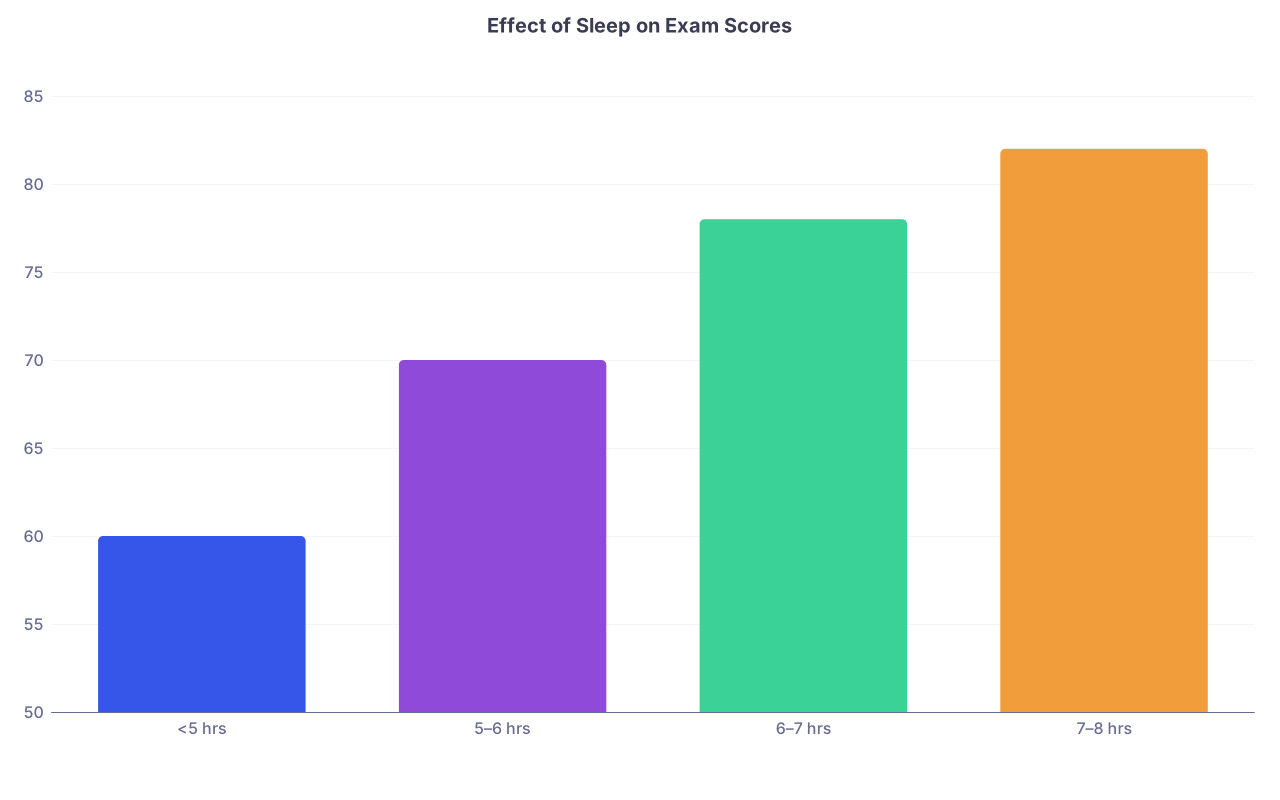
| Category | Value |
|---|---|
| <5 hrs | 60 |
| 5–6 hrs | 70 |
| 6–7 hrs | 78 |
| 7–8 hrs | 82 |
That’s why I keep harping on sleep. It’s not “wellness fluff.” It’s literally free points.
9. A Concrete 4‑Week Reset Plan
Let me lay this out so you’re not leaving with just theory. Here’s how a 4‑week “stabilization block” could look while on probation.
Week 1: Clarity + Containment
- Get probation terms and key dates in front of you.
- Email dean/advisor + key course/clerkship directors.
- Schedule or attend first mental health visit.
- Set up environment changes: study spot, phone boundaries, cut non‑essential commitments.
- Start minimum viable study day: aim for 60–120 minutes of focused work daily, even if fragmented.
Week 2: Build Consistency
- Lock in a weekly template: blocks for class/clinic, questions, review, rest.
- Start tracking: sleep, study minutes, question counts, mood.
- Hit baseline question goals (even at low numbers) 4–5 days this week.
- Have a concrete follow‑up plan with your therapist/doctor.
Week 3: Adjust and Target
- Use question performance + exam scores to identify 2–3 weak domains.
- Add 1 short “repair” block per day for those weak areas (30–45 minutes).
- If exams/OSCEs are coming, focus on pass‑level prep, not perfection.
- If you’re still completely non‑functional most days, escalate the leave conversation.
Week 4: Prepare Evidence of Improvement
- Have something you can show:
- Passed exam
- Improved quiz scores
- Clerkship feedback that’s at least “satisfactory”
- Brief check‑in with dean/advisor:
- “Here’s what I’ve changed.”
- “Here’s my current performance metrics.”
- “Here’s my plan for the next block.”
This sets you up so that, when your probation is reviewed, you’re not just saying “I tried harder.” You can point to actual, documented behavior and performance changes.

10. What If You Still Fail Something While Doing All This?
Let me be blunt: it might still happen. You can do a lot right and still fail an exam, a shelf, a rotation. That doesn’t mean this was pointless.
If it happens:
- Do not disappear. That’s how you look unsafe.
- Immediately inform:
- Course/clerkship director
- Your dean/advisor
- Be concrete:
- What you changed
- What improved (if anything)
- What didn’t work
- What support you’re actively using
Sometimes that honest, documented effort is what persuades a committee to:
- Allow remediation instead of dismissal
- Support a medical leave with return
- Modify your plan going forward
I’ve seen students with multiple failures still graduate because they showed a pattern of insight, engagement with treatment, and gradual improvement. And I’ve seen students with fewer failures get dismissed because they stayed opaque, defensive, and isolated.
You choose which category you land in by what you do now.

Final Word: What Actually Matters From All This
Three things.
You can be on probation and burned out and still become a competent, compassionate physician. Probation is data, not destiny.
Doing nothing—or just “trying harder” in the same broken way—is what gets people dismissed. Thoughtful changes, documented effort, and real mental health care are what save careers.
You do not have to solve your entire life right now. Your job in the next month is simpler: stabilize, build a minimum viable system, and involve the right people before the situation decides for you.
Start with the next 72 hours. One email. One appointment. One small, honest study block.
Then keep going.