
You walk out of the exam hall. Your heart is still pounding. Someone in the hallway asks, “What did you put for the anion gap question?” and your stomach drops because you suddenly realize: you did the math wrong.
You get in your car or on the bus, and your brain starts the loop:
“I knew that. Why did I change it?” “If I fail this block, I am done.” “How could I miss that obvious murmur stem?”
By the time you get home, you are not reviewing. You are replaying. Obsessively. You open the answer key or your friend’s text thread, and it explodes: regret, shame, catastrophizing. You are not learning from questions; you are using them to beat yourself up.
This is the problem: most students “review” exam questions in a way that supercharges rumination and regret. They confuse emotional self-flagellation with academic improvement.
Let me break down how to do it differently—specific methods for question review that actively reduce rumination and regret while still improving your performance.
The Core Problem: Your Brain Treats Question Review as a Threat
Rumination loves ambiguity and “what ifs.” Exam review, done badly, feeds both.
Two bad patterns show up all the time:
(See also: Decision Fatigue in Clinical Rotations: A Framework to Preserve Focus for more.)
Post‑exam autopsy with friends
The “What’d you get for #37?” circle of misery. Everyone throwing out answers, half-remembered stems, and half-baked rationales. No actual data. Maximum anxiety, minimal learning.Punishment‑style solo review
You open your marked exam or UWorld block and your self-talk sounds like:
“I’m so stupid.”
“How did I miss this?”
You read the explanation three times, but you are not encoding it; you are surviving it.
The brain learns poorly in a high-threat state. Cortisol up, working memory down. So the more your review feels like a judgment of your worth as a future physician, the less actual learning happens.
The goal is simple: turn question review from a threat into a technical debrief.
That requires structure. And some strict rules.
Step Zero: Build a Protective Frame Before You Open Questions
If you jump straight from emotional reactivity into answer keys, you are asking for rumination.
I want you to set the ground rules before you look at anything:
Define the purpose of review in one sentence
Write it down at the top of your notebook / iPad:
“Purpose: identify 2–3 fixable patterns I can change for next time.”
Not “see how badly I did.” Not “confirm I’m a fraud.” Patterns only.Limit the review window
No “I’ll just look through everything.” That turns into hours of spiraling.
Set a literal timer: 25–45 minutes. When it goes off, you stop. You can schedule another session later, but review lives in containers, not all day in your head.Detach identity from performance (explicitly)
I like a short statement—written, not just thought:
“This exam sampled what I knew and how I thought on one day. It is not a referendum on my value or my future career.”
Sounds corny? Maybe. But students who skip this step slide straight into shame review mode.Decide in advance what you will not do
Examples:- No checking answers with classmates
- No re-reading group chats about the exam
- No scrolling Reddit / Discord exam threads
This is where most rumination is outsourced and amplified.
You do this before the score releases, before you get your exam back, before you open UWorld.
You are telling your brain: “We are about to do technical work, not self‑attack.”
A Precise, Low‑Rumination Method for Reviewing Practice Questions
Let us start with practice questions (NBME forms, UWorld, AMBOSS, Rx, whatever). This is where you should be doing the bulk of your high-yield review.
Here is the method I have medical students use who both improve scores and sleep at night.
1. Classify Each Question in 10 Seconds
When you finish a block and see your answers, do not disappear into explanations yet.
For each question, label it with a short code. Keep this fast and almost mechanical.
I use four:
- K – Knowledge gap
- M – Misread / misprocessed stem
- S – Strategy error (test-taking, not content)
- C – Careless error
You can add a fifth if you want:
- G – Guessed / truly did not know
You are not writing essays. Just a quick label next to Q #1, #2, etc.
Why this helps:
It prevents you from sticking on “I got it wrong = I am bad” and pushes you toward “I got it wrong because [X category].” Rumination thrives on vague global conclusions. Classification breaks things into solvable problems.
2. Choose Only a Subset to Deep Review
You do not need to dissect every single question. That is overkill and fuels compulsive checking.
General rule:
- Deep review all K and S questions
- Skim review M and C questions (you mainly need process fixes)
- Glance at correct questions that you got right for the wrong reason
If you had 40 questions and missed 12, you might deeply review 8–10. That is it.
Your mind will tell you: “But what if the one I skip is important?” That is the OCD‑adjacent voice. You are not obligated to honor it.
3. Use a Structured Mini‑Template for Each Deep Review
This is where regret usually hijacks the process. So you need a script.
For each deep review question, write out four lines in a notebook or note app:
Q type / topic (short)
“Micro – Staph aureus bacteremia management.”
Not a paragraph. Just enough tagging that future you knows what this was.My original reasoning in 1–2 sentences (no self‑attack)
“I saw ‘IV drug user’ and ‘new murmur’ and fixated on endocarditis. I picked vancomycin without thinking about whether this was empiric vs targeted therapy.”What the test wanted & key learning point
“They emphasized ‘cultures grew MSSA’ → switch from vanc to nafcillin/oxacillin/cefazolin. Key: MSSA bacteremia = beta-lactam > vanc when no allergy.”Pattern / Process fix
“Create a mental checkpoint: whenever cultures mentioned, ask ‘Is this empiric or targeted therapy now?’”
That fourth line is where learning marries mental health. You are telling your brain, “Here is how to not repeat this,” which reduces the sense of helplessness that drives rumination.
You are not writing:
- “I am so dumb.”
- “I always mess up easy questions.”
You are writing:
- “I over-weighted one clue and ignored another. Next time I will force myself to answer: what stage of management is this?”

Handling Real Exams: What To Do When The Score and Questions Come Back
Practice blocks are one thing. Real high‑stakes exams trigger a different sort of emotional storm.
There are three phases that matter:
- Immediately after the exam
- When the score releases
- When/if you get question-level review or recall forms
Phase 1: Immediately After the Exam – Stop the Autopsy
The hallway / group chat post‑exam ritual is one of the most toxic traditions in medical training. It feels like “processing together.” In reality, it is anxiety contagion with no data.
You need a rule for yourself:
No question discussion for 24 hours.
Not “I will try to avoid.” A hard rule.
If someone asks, you say a version of:
- “I do better not rehashing questions; I’m happy to talk about how people felt, but not what we put.”
Then you change the subject.
Your goal in the first 24 hours is not to learn. It is to allow your nervous system to come down enough that later review does not become trauma reenactment.
Do something extremely non‑exam‑related in the first 2–3 hours:
- Call a non‑medical friend or family member
- Do physical activity (even a 20‑minute fast walk)
- Watch something idiotic and light
Not as “self care” jargon. As literal neurobiology: you are telling your brain, “Threat over, stand down.”
Phase 2: When the Score Releases – Separate Emotion from Plan
Score day is rarely calm. Even if the number is good, many students feel flat, anxious, or weirdly empty.
You handle score and review separately:
Allow a pure emotional window first
10–30 minutes where you only process emotion, no analysis:- If you are happy, let yourself be happy without immediately asking “Could it have been higher?”
- If you are disappointed, name specific feelings: “I feel ashamed / scared / angry.” Not, “I am a failure.”
You can write this out. Or say it aloud. Or voice memo.
Then schedule a later time for technical review
Not in the same sitting. Put a 24–72 hour gap if the score was painful. Emotional shock and high‑quality review do not mix.Define an upgrade, not a rescue mission
Your plan is not “How do I make up for this disaster?” It is:
“Given this score, here is the specific way I will upgrade my prep or exam behavior next time.”You are treating this as version 1.0 feedback, not a death sentence.
Phase 3: Reviewing Returned Exams Without Spiraling
Some schools release question‑level performance and even exam forms. This can either be gold for learning or pure gasoline on the rumination fire.
Rule set:
Do not re-take the whole exam as a fresh test.
You already did that. Now it is post‑game film, not a do‑over.Use the same K / M / S / C / G classification system.
But add one more label: E – Emotional trigger question (ones you keep replaying in your head).
For E questions, you add two extra lines to your mini‑template:
What story am I telling myself about this miss?
Examples:- “If I miss an easy one, I don’t belong here.”
- “Real doctors would never miss that.”
- “This proves I am lazy / not serious enough.”
Alternative grounded statement (not toxic positivity)
Something like:- “Even high‑scoring residents miss ‘easy’ questions under time and stress. This shows I need a process check for easy questions, not that I am unfit.”
- “This question pulled in a niche detail. The fix is to add that detail to my Anki and move on, not rewrite my entire self-concept.”
You are not trying to convince yourself the miss was good. You are aiming for accurate, sober interpretation instead of catastrophic storytelling.
Techniques To Directly Interrupt Rumination Loops
Let us be blunt: content review alone does not stop your 2 a.m. brain from replaying that one nephron question. You need tools aimed at the mental loop itself.
Here are methods that are concrete, not mystical.
1. The “5‑Question Containment” Rule
If your brain keeps replaying specific questions from an exam, give it a boundary.
Write down up to five questions (by topic, not full stem) that are haunting you.
Example:
- “ABG with metabolic acidosis vs mixed disorder.”
- “Kawasaki vs viral exanthem criteria.”
- “That one HCM murmur positional change question.”
Then:
- For each, write what you think the correct answer/logic was.
- Schedule a 20–30 minute block in the next 48 hours to actually look up those 5 topics (textbook, videos, question bank explanations).
The rule:
Outside that scheduled block, when your brain tries to restart the loop, you tell yourself:
“I have that saved for my 4 p.m. review block. I am not doing this mentally on repeat.”
It sounds simplistic. But giving your brain a plan and a container calms the compulsion dramatically.
2. Physical State Shift Within 90 Seconds
Rumination is not purely cognitive. It has a body signature: tight chest, clenched jaw, shallow breathing.
You need a quick “pattern break” you can trigger when you notice the loop.
Options that actually work under exam-stress physiology:
- 20–30 seconds of brisk stairs or fast walking
- Cold water on face and wrists for 30–60 seconds
- 10 slow exhalations, longer out-breath than in-breath (4 seconds in, 6–8 seconds out)
You do not use this to “escape” studying. You use it to reset enough that your prefrontal cortex comes back online and can use the structured review tools.
3. Time‑boxed Worry Period
If your brain insists on doing “what if I fail” scenarios, you corral it.
Pick a specific 10‑minute window daily (e.g., 6:30–6:40 pm) labeled “Worry Time.”
Whenever worry pops up outside that slot, you tell yourself, “Not now. I can worry about that at 6:30.”
During Worry Time, you sit down with a piece of paper and actually write out your fears, then sort them:
- What can I control?
- What can I influence but not fully control?
- What is fully outside control?
Then you generate a concrete action (if any) for the controllable category.
Over a week or two, your brain learns that worry has a scheduled place, not a 24/7 highway.
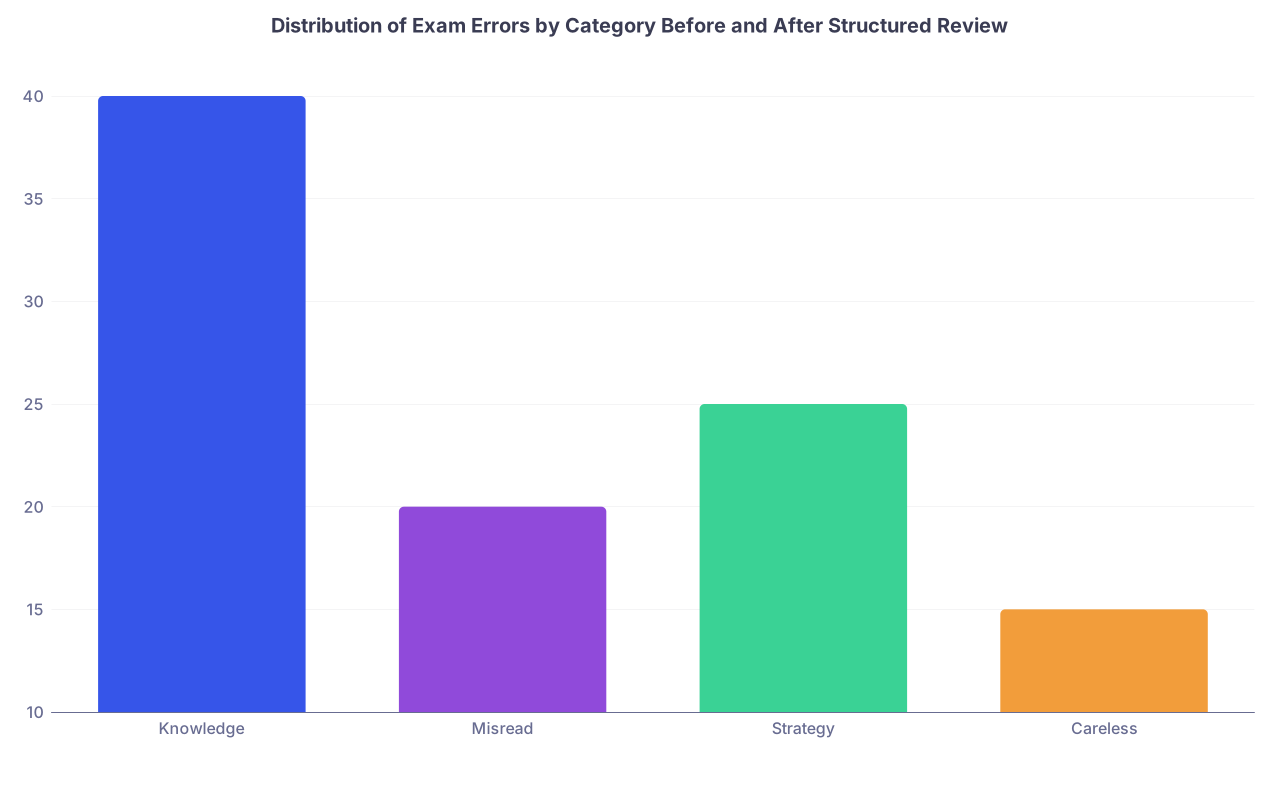
| Category | Value |
|---|---|
| Knowledge | 40 |
| Misread | 20 |
| Strategy | 25 |
| Careless | 15 |
(Example: a typical pre‑intervention distribution might look like this. With good review methods, “Misread” and “Strategy” usually drop first, even before raw knowledge improves.)
Avoiding Three Common “Review” Traps That Destroy Mental Health
I see the same mistakes over and over. They look like studying. They are not.
Trap 1: Re‑doing the Same Questions Until You Feel “Clean”
You miss a question on UWorld. You reset it. You do it again two days later. You get it right this time. You feel temporarily better.
This has nothing to do with learning and everything to do with compulsive reassurance.
Real learning:
- Requires retrieval in new contexts
- Generalizes the principle to novel stems
- Often still feels uncomfortable because you are tackling your weakest areas
If you catch yourself re‑doing questions primarily to feel better about that specific item, stop. Instead:
- Extract the underlying concept
- Write a 1–2 sentence “teaching” version in your own words
- Add one or two different practice questions on that concept from another resource
Trap 2: Endless Group Chat Debriefs
You know the pattern: someone drops, “What did you guys put for the pancreatitis fluid question?” and then 70 messages later, everyone is worse off.
Group chats are incredible for sharing resources, exam dates, quick clarifications. They are terrible for:
- Post‑exam item analysis
- Score comparisons
- “Is this normal?” anxiety crowdsourcing
You have two sane options:
- Mute or leave post‑exam threads without apology.
- Explicitly say, “I’m going to step out of question debriefs—they make me obsess. Message me directly if you want to hang or talk about something non‑exam.”
You are not responsible for tolerating environments that dysregulate you.
Trap 3: Turning Every Wrong Answer into a Global Life Story
I have watched students translate a single miss into these narratives:
- “This proves IM is too competitive for me.”
- “If I keep missing biochem, I will kill a patient one day.”
- “I can’t handle this stress; maybe I shouldn’t be in medicine.”
This is catastrophizing paired with over-identification. It is also logically wrong.
Reality:
- Exams are sampling tools, not comprehensive character assessments.
- Many brilliant clinicians had average Step scores.
- A single system can be weak while others are very strong.
When you catch this, force the scale to shrink:
- “This question shows I need a tighter approach to acid–base problems. Period.”
- “This score suggests I may need to adjust my specialty target or improve my prep and take again. That is a logistics problem, not a moral failure.”
A Concrete Weekly Review Routine That Protects Your Head
Let me give you something you can actually implement.
Assume you are in a heavy study block (e.g., prep for a shelf or Step 2). Here is a sample routine that balances learning and mental health:
| Day | Question Blocks | Deep Review Time | Mental Health Guardrail |
|---|---|---|---|
| Mon–Thu | 2 blocks/day | 45–60 min/day | No post-block group chat |
| Fri | 1–2 blocks | 60–75 min | Stop all review by 8 pm |
| Sat | 1 mixed block | 45 min | 3+ hrs totally off study |
| Sun | 0–1 light block | 30–45 min max | No scores/Q&A after 6 pm |
During each “Deep Review Time”:
- Classify all questions: K / M / S / C / G.
- Pick 8–12 for full mini‑template review.
- Log any repeated patterns (e.g., “I have had 5 M errors this week from rushing the last 10 questions.”).
- Create one specific process change for the next week (e.g., “I will force myself to read the last sentence of the stem twice on every question.”).
Guardrails are non‑negotiable. “No review after 8 pm” is not just vibes; it is acknowledging that nighttime review tends to drift into regret and catastrophizing.
When You Need More Than Techniques: Knowing When to Ask for Help
Sometimes rumination around exams is not just a study habit problem. It is part of anxiety, OCD, depression, or trauma patterns. Techniques still help—but you should not be white‑knuckling it alone.
Red flags I take seriously:
(Related: Hidden Support Systems in Med School You’re Probably Not Using)
- You regularly lose sleep replaying exam questions or scores.
- You have panic attacks before or after exams.
- You avoid starting review because it feels emotionally unbearable.
- Your self‑talk around exams includes phrases like “I hate myself,” “Everyone would be better off if I failed out,” or worse.
That is not “normal med student stress.” That is suffering you do not have to tough out.
At that point, the right move is:
- Contact your school’s counseling or mental health services.
- If that is useless (unfortunately common), look for a therapist familiar with high‑stakes testing, anxiety, or OCD.
- Let at least one trusted person (partner, friend, mentor) know what is going on so they are not fooled by your “I’m fine.”
You are not weak for needing help. I worry more about the student who turns every exam into a private war against themselves and calls it “motivation.”
Two Short Case Examples (Because Abstractions Get Old)
Student A: “I Can’t Stop Thinking About the ‘Easy’ Misses”
MS2, strong baseline, but tormenting herself over every simple question she misses. After each UWorld block, she spends 2 hours spiraling and then cannot study more.
What changed:
- We capped her deep review to 10 questions per block.
- She had to write the pattern/process fix, not just the explanation.
- She flagged “E” questions and wrote the story she was telling herself.
Three weeks later:
- Same number of total questions done.
- Improved percent correct by ~8–10 points.
- Reported “I still don’t like being wrong, but I think about it for 10 minutes now, not 3 hours.”
Student B: “Every Score Feels Like a Verdict on My Future”
MS3, on a rough clerkship. Barely passed the first two shelf exams. Convinced he could never match into any reasonably competitive residency. Started avoiding question review because it felt like “confirming the inevitable.”
What changed:
- We completely separated “emotional processing space” from “technical review time.”
- On score day, he had 30 minutes to write out feelings uncensored, then stopped.
- Review of missed questions was limited to 45 minutes the next evening with clear K/M/S/C/G labels.
- We also did a simple worry time exercise for “What if I never match?”
Three months later:
- Scores stabilized in the solid pass range, then crept up.
- But more important: he no longer interpreted every wrong answer as proof his career was over. It became, finally, just data.
Key Takeaways
- Question review is only useful if it is technical, time‑boxed, and identity‑separated. You are fixing patterns, not grading your worth.
- Use structure ruthlessly: error categories (K/M/S/C/G), mini‑templates, limited deep reviews. That structure is what starves rumination.
- Protect your nervous system: no post‑exam autopsies, hard stop times, and direct tools to interrupt loops. You are not fragile—you are just human, and humans learn best when they are not under constant self‑attack.