
The biggest threat to your performance in medical school is not your IQ. It is your thinking errors you keep mistaking for “being realistic.”
Let me be blunt: most medical students I have worked with are not burned out from the actual workload. They are burned out from the nonstop internal commentary about how they are failing, behind, not smart enough, and about to be exposed. That commentary is not “truth.” It is a specific set of cognitive distortions.
We are going to walk through six of the most common distortions in med school, how they actually sound in your head, how they directly tank exam performance and clinical functioning, and then how to reframe them in a way that is both accurate and usable under pressure.
This is not generic “positive thinking.” This is technical mental hygiene for people who take 200‑question exams for fun on weekends.
Why Cognitive Distortions Hit Med Students Hard
Med school is basically a cognitive distortion factory.
Selection bias: schools admit people who are perfectionistic, conscientious, and highly evaluative. Training environment: constant evaluation, high stakes, public comparison (honors/pass/fail, AOA, NBME percentiles). Culture: unspoken rule that suffering is normal and self‑criticism is a “motivator.”
Put that together and you get a brain that is very good at learning medicine and equally good at learning self‑attack.
Here is the pattern I see again and again:
- You hit a stressor (bad quiz, cold pimping on rounds, NBME score lower than classmates).
- A distortion fires automatically.
- Your emotion spikes (shame, panic, anger, hopelessness).
- Your behavior shifts (doom‑scrolling, avoidance, overstudying the wrong way, freezing).
- Performance actually worsens, confirming the distortion.
You do not fix this by “trying to be more positive.” You fix it by identifying the specific distortion, labeling it, and then deliberately reframing in a way that you can still believe at your worst.
We will use a simple structure for each distortion:
- What it is
- How it shows up in med school
- Why it is dangerous for your performance and mental health
- Concrete reframes you can actually use under exam stress
And yes, I am going to give you verbatim replacement thoughts. Scripts matter when your brain is flooded.
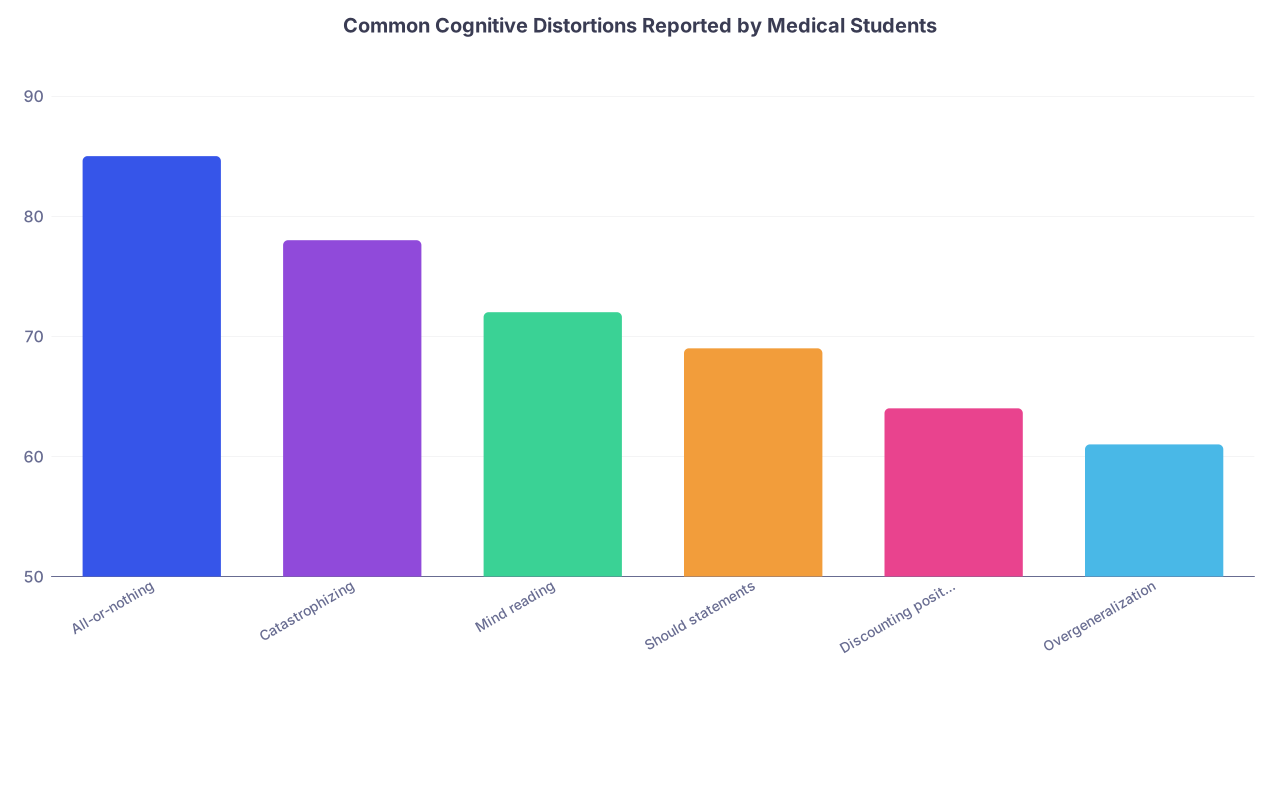
The 6 Cognitive Distortions That Dominate Med School
| Category | Value |
|---|---|
| All-or-nothing | 85 |
| Catastrophizing | 78 |
| Mind reading | 72 |
| Should statements | 69 |
| Discounting positives | 64 |
| Overgeneralization | 61 |
Percentages are approximate, but this distribution lines up disturbingly well with what students tell therapists and advisors.
We will go through them one by one.
1. All‑or‑Nothing Thinking: “Either I Honor or I Failed”
All‑or‑nothing thinking is the backbone of med school misery.
Definition: You see performance or worth in binary terms. Perfect or disaster. Honor or humiliation. Smart or stupid.
In med school, it sounds like:
- “If I do not honor this clerkship, I am screwed for residency.”
- “I missed 40 questions on that UWorld block. I know nothing.”
- “If I am not in the top quartile, I do not belong here.”
What this does to you:
- Turns every exam, OSCE, or presentation into a referendum on your identity.
- Makes “good enough” feel like failure, so you keep studying long past the point of diminishing returns.
- Triggers performance anxiety because the stakes feel absurdly high: one exam = your entire future.
I have sat with students after NBME practice scores of 225 who are sobbing because “I am failing Step.” That is classic all‑or‑nothing: 250+ = safe; anything below = doom.
How to Reframe All‑or‑Nothing
You do not need saccharine affirmations. You need gradations.
Name the distortion:
“I am doing the all‑or‑nothing thing again.”Replace absolutes with ranges and probabilities.
Instead of:
- “If I do not honor IM, I cannot match cards.”
Try:
- “Honors helps but is not a binary gate. Plenty of people match cards with passes and strong Step 2, letters, and research.”
- “This grade is one data point in a long record. Programs look at the pattern, not a single line.”
Instead of:
- “I missed so much on that block; I know nothing.”
Use:
- “I got 60% correct on a deliberately hard block. That means I know a meaningful chunk, and I now have targeted feedback on the rest.”
You are not sugarcoating. You are putting performance back on a spectrum where it belongs.
Quick Tactic
On any exam, ask yourself: “What percentage of this content do I need to be safe?” Not perfect, safe. For many exams, 60–70% is passing or better. Anything beyond that is margin, not survival.
Write that target down before a question block. It pulls your brain out of perfection mode and into sufficiency mode.
2. Catastrophizing: “This One Thing Will Ruin Everything”
Catastrophizing is med school’s favorite horror story.
Definition: You jump from a single setback to the worst‑case scenario and treat it as likely or inevitable.
Med school versions:
- “If I fail this quiz, I will fail the course, then I will get kicked out, then I will never match.”
- “I froze on that one question in front of the attending; they think I am incompetent; they will give me a terrible eval; my residency chances are shot.”
- “My Step 1 was average; competitive specialties are off the table now.”
On rounds, I hear: “If I say I do not know, they will think I am lazy or unprepared.” No. Often they will think: normal student, did not read that niche topic, moving on.
What this does:
- Keeps your nervous system in constant fight‑or‑flight.
- Makes studying feel like trying to outrun a disaster, not like building competence.
- Pushes you toward avoidance: if it all spells doom, why start Anki cards tonight?
How to Reframe Catastrophizing
Your goal is not to pretend everything is fine. Your goal is to force your brain to do actual probability estimates and planning.
- Force the “then what?” chain into the open.
Say you did poorly on a midterm.
Catastrophic chain:
“I bombed → I will fail the course → I will repeat the year → I will lose loans → I will never become a doctor.”
Interrupt it with:
“Ok, step one. What actually happens if I failed this exam?”
Usually something like:
- You meet with course director.
- You may need to remediate or do better on the final.
- You adjust your study plan.
- Worst case: repeat the course or year (painful, but people do it and still become good physicians).
- Separate “this hurts” from “this ends me.”
Reframe examples:
Instead of:
- “This shelf score destroyed my chances at derm.”
Try:
- “This score makes derm harder, not impossible. People match derm from non‑perfect profiles with strong research, letters, and Step 2. I need to decide if I want to pay that cost or adjust my goals.”
Instead of:
- “If I do not impress this attending, I am done.”
Use:
- “This attending’s evaluation matters, but it is one of many. I can still get excellent letters from others. Today is important, not final.”
- Add a contingency plan: “If X happens, I will do Y.”
Your brain calms down when it sees routes rather than dead ends.
3. Mind Reading and Comparison: “Everyone Else Gets It; I Am the Only Idiot”
You know this one. You walk out of an exam and everyone is saying, “That was fine,” and your stomach drops.
Definition: You assume you know what others are thinking or how they are performing, and you judge yourself against that imagined standard.
Med school flavors:
- “Everyone else has read all of Robbins. I am barely through Pathoma.”
- “My resident thinks I am slow and clueless.”
- “They all say they study 10 hours a day; I am only managing 6–7 so I am behind.”
You are trying to reconstruct other people’s internal reality from a few surface behaviors and offhand comments. You are always wrong, and usually in the most self‑punishing direction.

Why It Is So Toxic
- It makes you calibrate your effort against fantasy, not data.
- It amplifies imposter syndrome: “I’m the only one who is faking it.”
- It destroys collaboration—everyone becomes a threat or a mirror for your insecurity.
I have asked high‑performing students what they actually think of their peers. The answer: “Everyone seems smart and confused, just like me.” The imagined judgment is almost always harsher than the real thing.
How to Reframe Mind Reading
- Label it bluntly: “I am guessing their insides from their outsides.”
That phrase alone has snapped a lot of people out of spirals.
- Replace guesses with neutral possibilities.
Instead of:
- “The resident thinks I am incompetent because I missed that question.”
Use something like:
- “I do not know what they think. Residents are usually more focused on getting through the day than judging me. I missed a question; that is normal. If there is a problem, I will get direct feedback.”
Instead of:
- “Everyone is studying more than I am.”
Reframe:
- “People exaggerate and under‑report all the time. My job is not to match their hours, it is to build a plan that gets me the scores and knowledge I need.”
- Anchor to your own data:
- How are your practice questions trending?
- Are you hitting your Anki reviews consistently?
- Are you improving on NBMEs, even slowly?
Those numbers matter. Hallway vibes do not.
4. “Should” Statements: Weaponized Standards
“Should” statements are socially rewarded in medicine. They sound driven. Responsible. They quietly erode you.
Definition: You motivate and judge yourself using rigid rules about how you “should” feel, study, know, and perform.
Examples:
- “I should be studying every free minute on rotations.”
- “I should not need breaks; other people can handle this.”
- “I should already know this from pre‑clinicals; asking is embarrassing.”
- “I should not feel anxious; I have it easier than residents.”
These “shoulds” are usually stolen from half‑remembered advice, social comparison, or older residents who are romanticizing their own suffering.
| Distorted "Should" | Functional Reframe |
|---|---|
| I should study every free minute. | I will study in focused blocks and protect real off time. |
| I should already know this. | I learned this before; I am refreshing it under pressure. |
| I should not feel stressed. | Stress is normal here; my job is to manage it, not erase it. |
| I should be as good as interns. | I am a student; my role is to learn, not to be an intern. |
Why “Shoulds” Are So Damaging
- They produce guilt even when you are doing enough.
- They disconnect you from reality: your actual sleep needs, cognitive limits, and learning curves.
- They make asking for help feel like a moral failure rather than a smart move.
How to Reframe “Should” Statements
- Swap “should” for “I choose to” or “It would be helpful to.”
Examples:
Instead of:
- “I should be studying right now.”
Try:
- “It would help my goals to study a bit now, but I am exhausted. I am choosing to rest so tomorrow’s studying is not garbage.”
Instead of:
- “I should already know this.”
Use:
- “I have seen this before, but medicine requires repetition. Asking now helps me actually retain it.”
- Tie behaviors to specific goals, not vague standards.
Bad:
- “I should do more questions.”
Better:
- “I want to improve my cardio section score by 10 points; that probably requires 40–60 targeted questions this week.”
- Notice how often “should” appears when you talk about yourself. That is your internal policy manual. It may need a rewrite.
5. Discounting the Positive: “That Does Not Count”
Med students are experts at moving the goalposts.
Definition: You dismiss successes, positive feedback, or progress as meaningless, luck, or “not real.”
Classic moves:
- You get a solid shelf score: “Yeah, but the exam was easy.”
- Your attending gives you genuine praise: “They are just being nice; they probably say that to everyone.”
- You improve from 55% to 65% on a Q‑bank topic: “Still not good enough; I am behind.”
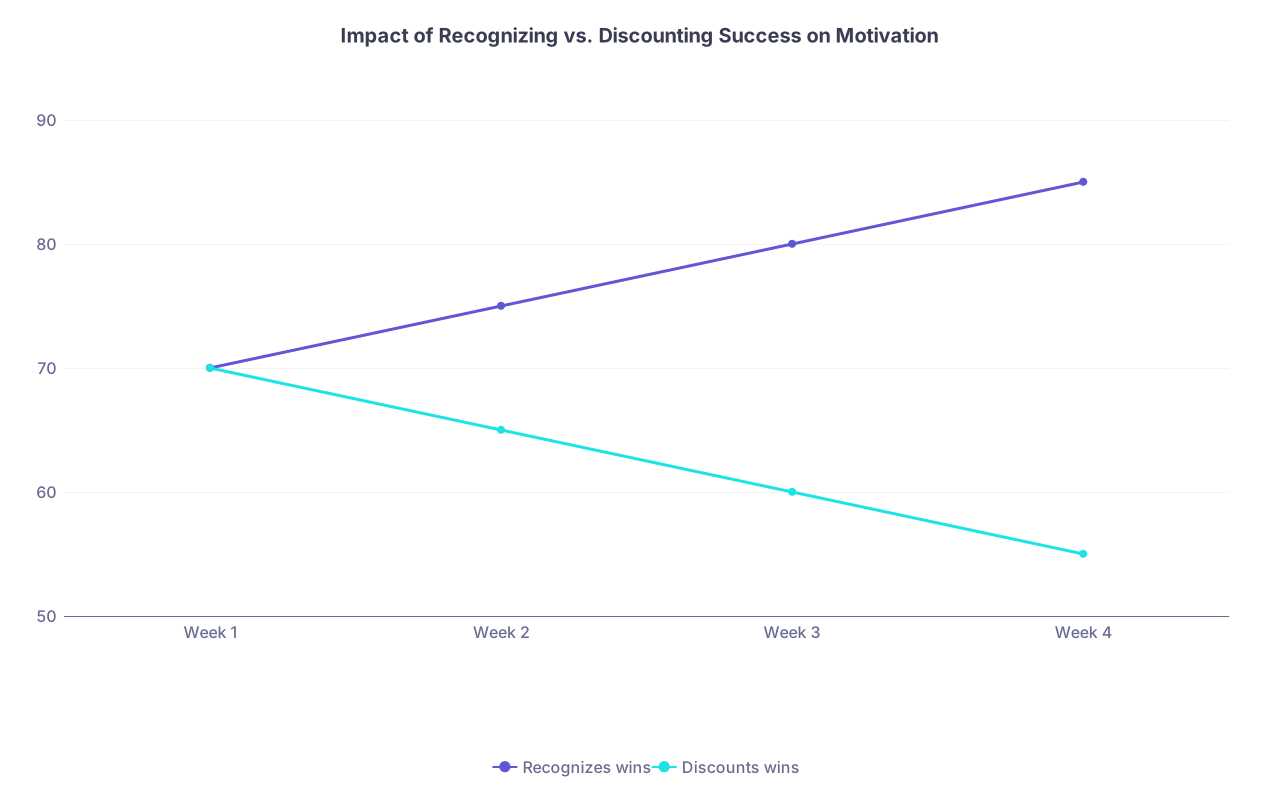
Why your brain does this: It thinks criticism keeps you sharp and success makes you complacent. In reality, constant self‑dismissal just burns out your reward circuitry.
| Category | Recognizes wins | Discounts wins |
|---|---|---|
| Week 1 | 70 | 70 |
| Week 2 | 75 | 65 |
| Week 3 | 80 | 60 |
| Week 4 | 85 | 55 |
Motivation is not magic; it is a running calculation: “Does my effort lead to anything?” If the answer is always “does not count,” you stop trying.
How to Reframe Discounting the Positive
- Force yourself to keep a tiny log of “objective wins.”
Not affirmations. Data. Things like:
- “UWorld GI: 48% → 61% in 10 days.”
- “Attending commented: ‘Good differential’ on 2 cases this week.”
- “Finished all Anki reviews 5 days in a row.”
These are not bragging points. They are counters to your brain’s “I am not progressing” narrative.
- When praise comes, do not argue with it.
If an attending says, “You did a nice job presenting that patient,” skip the reflexive “I messed up the assessment though.” Internally answer with:
- “Thank you. That feedback is data that I am not as behind as my brain tells me.”
- Change “but” to “and.”
Instead of:
- “I did well on that exam, but it was curved.”
Use:
- “I did well on that exam, and it was curved. Both can be true.”
The word “but” deletes the first clause in your emotional experience. “And” lets it stand.
6. Overgeneralization: “This One Data Point Defines Me”
Overgeneralization is taking a single event and turning it into a global rule about you.
Definition: You draw sweeping conclusions from one or a few experiences.
Examples in med school:
- Fail one biochem exam → “I am bad at standardized tests.”
- Get flustered once when pimped → “I am not good on my feet; I will be a terrible clinician.”
- Struggle with surgery hours → “I am not cut out for medicine; everyone else can handle this.”
You take a snapshot and call it the whole movie.

Why It Is Dangerous
- It freezes your identity around your worst moments.
- It blocks learning: if the conclusion is “I am just bad at this,” why experiment with new techniques?
- It feeds hopelessness and dropout fantasies.
How to Reframe Overgeneralization
- Shrink the conclusion down to the exact circumstances.
Instead of:
- “I cannot handle clinical pressure.”
Try:
- “I struggled to answer under pressure during that specific attending’s rapid‑fire questioning on day one of the rotation when I was sleep‑deprived. That is a very narrow situation.”
- Add “yet” aggressively.
- “I am not good at ECGs yet.”
- “I do not present as smoothly as interns yet.”
- “I have not found a study system that fits me yet.”
“Yet” is not a motivational poster word. It reclassifies the trait from fixed to trainable. That matters.
- Ask: “What is the base rate for someone at my level?”
Example: third‑year, first day of surgery, you fumble through your first H&P. Of course you did. The base rate for polished performance is low. You are aligning your expectations with attendings who have done this for 10–20 years. That is insane.
Putting It Together: A Simple Flow For Reframing
You do not have time in med school for a 30‑minute therapy session with yourself every day. You need something lean you can run in your head on the way between patients or blocks of questions.
Use this 4‑step loop:

| Step | Description |
|---|---|
| Step 1 | Trigger: exam, rounds, feedback |
| Step 2 | Notice emotion spike |
| Step 3 | Identify thought & label distortion |
| Step 4 | Write or say 1-2 accurate reframes |
| Step 5 | Choose next concrete action |
Concrete example: You get a 58% on a UWorld block.
Emotion: “I feel panic and shame.”
Thought: “I am not ready; I am going to fail Step.”
Distortions: Catastrophizing + all‑or‑nothing.
Reframe options:
- “UWorld is designed to be hard. 58% is near average for many people early on.”
- “This is an early diagnostic, not the real exam. My job is to extract patterns from the misses, not to predict my Step score from one block.”
- “If my scores stay this low despite changes, I will talk to my advisor about timing. One block does not decide that.”
Next action: “Review explanations for all wrongs; tag weak topics; schedule 20 questions tomorrow in those topics.”
Notice: no “I am amazing” nonsense. Just accurate, constraining language with a clear next step.
How Distortions Directly Affect Exam Performance
This is not just mental wellness fluff. These distortions change how your brain functions under pressure.
Working Memory and Panic
When you are catastrophizing or in all‑or‑nothing mode, your sympathetic nervous system spikes. Cortisol goes up, prefrontal cortex goes down. On exams, that looks like:
- Reading the same stem three times and still not processing it.
- Blank‑out on concepts you solidly knew the day before.
- Losing track of time management because you are ruminating about the last block you did poorly on.
Reframing pulls the threat level down from “existential” to “challenging but manageable,” which is the band where cognition actually works.
Question Interpretation
Mind reading and overgeneralization often lead to “the exam is out to trick me” thinking. Then you:
- Second‑guess straightforward answers because “they would not make it that easy.”
- Change correct answers to incorrect ones late because you do not trust yourself.
- Overcomplicate simple stems.
A reframe like, “Most questions test a single, central concept; I will look for the most direct explanation first,” can visibly improve your percentage just by preventing self‑sabotage.
Study Strategy
Discounting positives and “should” statements warp your planning:
- You ignore progress, so you keep switching resources, never building depth.
- You chase what you “should” do (everyone says 80 questions/day) instead of what your brain can actually handle with quality.
A realistic, reframed voice sounds more like:
- “My cardio scores are rising with this resource; I will stick with it another two weeks before changing.”
- “I retain more with 40 focused questions and full review than 80 rushed; my schedule will reflect that.”
Clinical Rotations: Distortions On Rounds
On the wards, cognitive distortions shift from exams to identity.
Common rotation‑specific versions:
- All‑or‑nothing: “If I do not know every answer, they will think I am not prepared.”
- Catastrophizing: “One bad eval and I am done.”
- Mind reading: “They looked annoyed; I am in trouble.”
- “Shoulds”: “I should stay until the resident leaves every day or I am slacking.”
- Discounting positives: “They said I did well presenting, but that was an easy patient.”
- Overgeneralization: “I was awkward with that patient; I am not good with people.”

Three tight reframes you can carry into rotations:
- “My job is to be prepared and engaged, not perfect.”
- “Feedback about a specific behavior is not a global verdict on me as a physician.”
- “If I am unsure what is expected, I can ask directly rather than guess.”
You would be amazed how many eval problems disappear when students stop mind‑reading and start asking:
- “What could I do differently tomorrow to be more helpful on the team?”
That question quietly kills a lot of distortions.
Training Reframing Like a Skill, Not a Vibe
You will not fix this in a weekend. But you can build it like you built biochemistry.
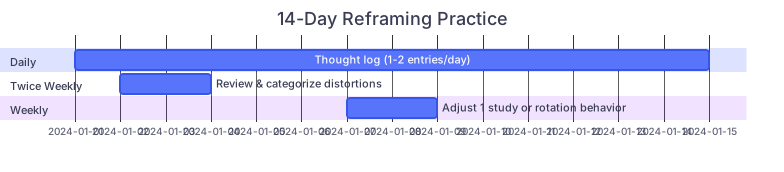
Here is a simple 2‑week experiment you can run.
| Task | Details |
|---|---|
| Daily: Thought log (1-2 entries/day) | a1, 2024-01-01, 14d |
| Twice Weekly: Review & categorize distortions | a2, 2024-01-02, 2d |
| Weekly: Adjust 1 study or rotation behavior | a3, 2024-01-07, 2d |
Daily (takes 3–5 minutes):
- Write down 1–2 emotionally intense moments (exam block, pimping, feedback).
- For each:
- What did I feel?
- What was the exact thought? (Verbatim.)
- Which distortion category fits best?
- What is 1 alternative thought that is more accurate and still believable?
Twice a week:
- Skim your entries. Notice patterns. Maybe 80% of your stress is from all‑or‑nothing about grades. Fine. Target that one first.
Once a week:
- Choose one small behavior to change that is consistent with the reframed thinking. For example:
- Stop checking class group chat after every exam.
- Limit “I should” language and rephrase it aloud when you catch it.
- Ask one attending or resident directly for concrete feedback instead of mind‑reading all week.
You are building a different default voice. That takes repetition. But it is doable. I have seen fourth‑years who used to spiral daily navigate match season with real, earned calm because they have drilled this.
Core Takeaways
Your suffering in med school is less about the workload and more about six specific cognitive distortions—especially all‑or‑nothing thinking and catastrophizing—running unchallenged.
Reframing is not “thinking positive.” It is labeling the distortion, tightening your language to what is actually true, and picking the next concrete action.
If you treat cognitive hygiene with the same seriousness you treat UWorld and Anki—short, consistent daily reps—you dramatically improve not only your mental health, but your exam performance and clinical functioning.