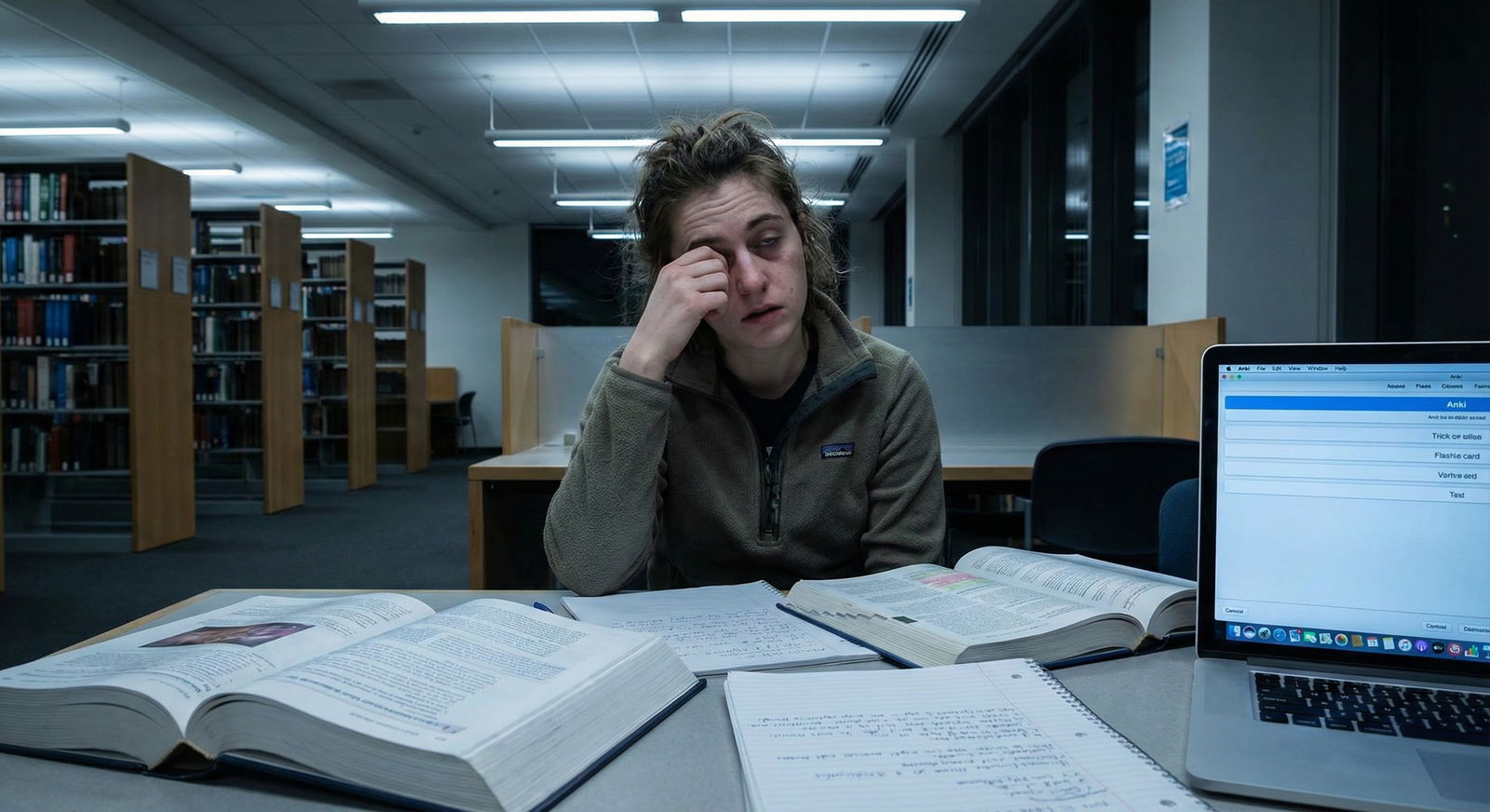
It is 11:47 p.m. You are on your third cup of coffee. UWorld is still open. Anki is glaring at you with 600 due cards. Your friend across the table looks strangely fresh, closing her iPad because she “just needs to review her concept map once more.” You, on the other hand, feel like your brain is trying to boot through molasses.
Same curriculum. Same exam next week. Very different levels of mental exhaustion.
You are not imagining this. How you prefer to learn—how you actually process information—has a direct impact on how mentally draining med school feels. And a lot of students are fighting their own brains with the wrong study methods, then wondering why they are chronically exhausted and borderline burnt out by November of M1.
Let me break this down specifically.
1. The Reality: Mental Fatigue Is Not Just “Being Tired”
Before we start pointing fingers at flashcards and lecture recordings, you need a clean definition.
Mental fatigue in med school is not simply “I stayed up late.” It is the cognitive and emotional crash that shows up as:
- Needing three reads to understand a simple sentence you would normally grasp instantly
- Slowed recall (“I know this… give me a second…”)
- Irritability and low frustration tolerance (pages of pathophys make you irrationally angry)
- Procrastination that feels more like paralysis than laziness
- Headaches and that “brain overheated” sensation after a long day of studying
Physiologically, you are looking at sustained high cognitive load, depleted attentional resources, and often poor sleep depth (not always poor sleep duration). Subjectively: you feel like you are dragging your brain through wet cement.
Now connect this to learning style: anything that forces you to work against your most efficient methods of encoding and retrieving information will raise your cognitive load unnecessarily. That excess becomes mental fatigue.
Not after one day. But relentlessly. Week after week.
2. The Learning Style Trap: What Actually Matters vs What Does Not
I am not going to sell you the simplistic VARK fairy tale (visual / auditory / reading / kinesthetic) as a magic key. That model is oversold and misused.
But the core idea—that people differ in how they most efficiently process and retrieve complex information—is absolutely correct. The evidence is just more nuanced.
Here is what does matter in med school:
Your dominant processing mode
- Do you think in images and spatial relationships?
- Do you think in words and sequences?
- Do you “get it” when you move, draw, or physically manipulate information?
Your preferred input format
- Reading text
- Listening to explanation
- Seeing diagrams / flowcharts / videos
Your retrieval style
- Do you recall best from structured outlines?
- From mental pictures?
- From repeated short prompts (flashcards)?
The mismatch problem is where mental fatigue explodes:
- Visual–spatial learner forcing themselves through hours of monotone audio lectures “because everyone speeds lectures at 2x”
- Verbal–logical learner spending all day in dense, unlabeled diagrams without building a narrative
- Strong kinesthetic learner trying to memorize pathways without ever sketching or explaining them out loud
That mismatch is like trying to write your final essay with your non‑dominant hand. You can do it. But it will cost you.
3. Four Common Learning Profiles in Med School (and How They Burn Out)
Let me outline the actual patterns I repeatedly see in med students, not just textbook categories.
3.1 The Visual–Spatial Organizer
You live in diagrams, charts, colors, and spatial relationships.
You tend to:
- Draw pathways
- Love well-designed slides
- Remember “where” on the page or slide a concept was
- Understand the big picture fast, then fill in details
Where you thrive:
- Pathways in pharmacology and biochem
- Anatomy with labeled diagrams
- Integrated systems-based questions where you see how organs interact
Where you get mentally destroyed:
- Endless plain-text handouts
- Hours of audiobook-style lecture with no visuals
- Trying to memorize lists without structure or visual grouping
What happens with fatigue:
- You start “reading” but not seeing
- Your mental whiteboard feels erased, you cannot keep pathways straight
- Anki cards with no images become intolerably exhausting
Mental fatigue drivers:
- High intrinsic load from complex topics without visual scaffolding
- High extraneous load from ugly, cluttered slides and non-visual resources
3.2 The Verbal–Sequential Explainer
You think in sentences, paragraphs, and “first this, then that” chains.
You tend to:
- Talk concepts out loud
- Write explanations in your own words
- Thrive with well-written textbooks or board review books
- Enjoy teaching peers with stepwise logic
Where you thrive:
- Explaining mechanisms, differential diagnoses, and algorithms
- Subjects like path, pharm, and internal medicine where narrative and reasoning matter
Where you get mentally destroyed:
- Massive unlabeled diagrams with minimal text
- Professors who skip logic and dump “facts”
- Being told to “just memorize the facts” without causal chains
What happens with fatigue:
- You read the same paragraph repeatedly and nothing “sticks”
- You cannot maintain a coherent mental narrative from beginning to end
- Question stems start feeling like noise rather than solvable stories
Mental fatigue drivers:
- Being forced into passive visual input with no verbal structure
- Overuse of visual mnemonics not tied to actual reasoning
3.3 The Repetitive–Drill Master (Spaced Repetition Heavy)
Your power is in deliberate, consistent repetition. You might not “get it” instantly, but you eventually never forget it.
You tend to:
- Use Anki or other flashcard systems religiously
- Be comfortable grinding through Q‑banks daily
- Prefer concrete prompts and short answers
Where you thrive:
- Memorization-heavy domains: pharm details, bugs and drugs, cancer markers
- Long-term board prep where small daily work compounds
Where you get mentally destroyed:
- Creating or doing thousands of low-quality cards
- Overloading reviews to 500–1000 cards per day with minimal understanding
- Relying only on cards without context, so each card feels random
What happens with fatigue:
- You click “Again / Hard / Good” mechanically, with zero processing
- Your review pile explodes and you feel hunted by your own deck
- You start dreading studying because every session is a marathon of tiny tasks
Mental fatigue drivers:
- Massive “switching cost” moving between hundreds of microscopically different prompts
- Lack of conceptual compression, so your brain must handle sheer volume
3.4 The Kinesthetic–Active Processor
You need movement, drawing, doing. Sitting still with text puts you to sleep.
You tend to:
- Pace when explaining concepts
- Use whiteboards, scribbling, drawing arrows
- Think best while teaching or tutoring
Where you thrive:
- Labs, clinical skills, OSCE prep
- Group discussions, chalk talk sessions, whiteboard teaching
Where you get mentally destroyed:
- Marathon solo reading sessions
- 3-hour lectures in a dark hall
- Trying to passively watch videos without interacting
What happens with fatigue:
- You physically cannot keep your eyes open with static materials
- Your attention shatters quickly, leading to prolonged “fake studying”
- You start needing huge amounts of stimulation (music, YouTube in the background) to sit still at all
Mental fatigue drivers:
- Fighting your need for movement and interaction
- Chronic under-stimulation followed by late-night panic cramming
4. How Learning Style Interacts With Cognitive Load (And Why You Crash)
Cognitive load theory actually explains your mental fatigue better than most “learning styles” discussions.
Three types of load:
Intrinsic load
Complexity inherent to the material. Glycolysis pathway? High. Memorizing 5 causes of hypocalcemia? Lower.Extraneous load
Everything wasteful about how the material is presented. Disorganized slides. Confusing wording. Bad audio. Overly busy diagrams.Germane load
The mental work that actually builds durable schemas: connecting new ideas, integrating with prior knowledge.
When your learning style mismatches your method, you pump up extraneous load.
Example:
Visual–spatial learner watches a 1.5x speed audio-only pharmacology lecture with no diagrams. The intrinsic load of pharm is already high. Now you add massive extraneous load because your brain has to constantly create its own mental visuals on the fly, from scratch. You start to fatigue at 45 minutes instead of 2–3 hours.
Another:
Repetitive–drill learner attends 3 straight days of dense pharm lecture with no immediate practice questions or flashcards. Intrinsic load: high. Extraneous: high, because the delivery does not match how your brain consolidates. You cannot convert what you are hearing into your habitual format. So it just sits as unprocessed sludge.
The mental fatigue formula in med school is usually:
High intrinsic load (med content) + chronic extraneous load (wrong methods for your style) + time pressure = [burnout trajectory](https://residencyadvisor.com/resources/med-student-mental-health/distinguishing-burnout-from-depression-and-anxiety-in-med-school)
You cannot lower intrinsic load. You can absolutely slash extraneous load if you stop blindly copying what everyone else is doing and match input/output methods to your cognitive strengths.
5. Concrete Study Patterns: Good vs Brain-Destroying For Each Style
Let us get specific and practical. This is where your day-to-day fatigue gets decided.
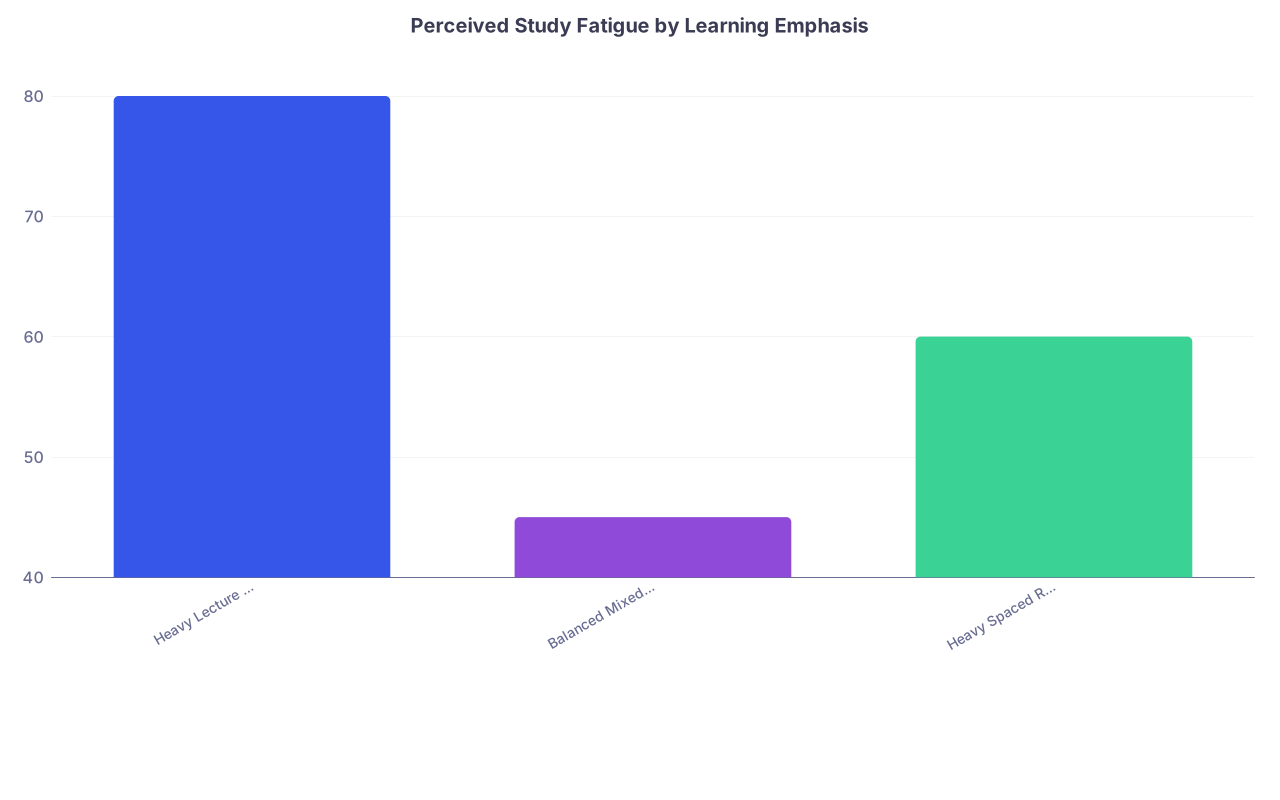
| Category | Value |
|---|---|
| Heavy Lecture Watching | 80 |
| Balanced Mixed Methods | 45 |
| Heavy Spaced Repetition | 60 |
5.1 If You Are Primarily Visual–Spatial
Brain-friendly patterns:
- Convert lectures to diagrams: pathways, annotated flowcharts, color-coded organ systems
- Use sketching to summarize: “one page per disease” visual overviews
- Use image-heavy resources (e.g., Pathoma diagrams, Boards and Beyond visuals, histology atlases) rather than text blocks
Brain-destroying patterns:
- Raw lecture binge-watching with minimal pausing / drawing
- Relying on monocolor, text-only Anki cards
- Trying to memorize long lists without grouping or visual structure
Study day example:
- 60–90 minutes: watch or skim lecture at 1.5x speed, pausing to redraw main diagrams
- 45 minutes: convert 1–2 topics into “one-pager” maps
- 45 minutes: Anki / Qbank, but tag cards with images or your own mini-diagrams where possible
You will feel less “fried” because your encoding and retrieval share a visual structure.
5.2 If You Are Primarily Verbal–Sequential
Brain-friendly patterns:
- Rewrite mechanisms and pathways in your own words, step-by-step
- Record your own short explanations and listen back at 1.5x speed
- Use outlines, not random bullet lists: path → mechanism → clinical features → investigations → management
Brain-destroying patterns:
- Overreliance on pure images or stories without underlying explanation
- Watching high-yield summary videos on repeat with no output
- Trying to use only premade decks without ever paraphrasing content
Study day example:
- 60 minutes: reading board-style text (e.g., Costanzo phys, Sketchy with transcript)
- 45 minutes: teaching an imaginary student out loud, stepwise
- 45–60 minutes: Qbank block, then writing 1–2 sentence narrative for each missed concept (“In DKA, insulin deficiency causes…” etc.)
You reduce fatigue by turning chaotic facts into coherent narratives that your brain naturally tracks.
5.3 If You Are Heavily Spaced-Repetition / Drill Oriented
Brain-friendly patterns:
- Limit daily new cards; focus on high-yield facts only
- Convert missed Qbank questions into compact, carefully written cards
- Use tags to keep related concepts grouped instead of 2000 random cards
Brain-destroying patterns:
- Deck bloat: thousands of low-yield or redundant cards
- Zero conceptual study: “If it is not on a card, it does not exist”
- Reviewing while half-awake, turning cards into background noise
Study day example:
- 30–45 minutes: concept overview from text or video for new material
- 60 minutes: creating 20–30 high-quality cards from that material
- 60–90 minutes: reviewing your due cards, split into 2–3 smaller sessions
Your mental fatigue falls when you stop trying to brute-force everything through repetition and start respecting diminishing returns.
5.4 If You Are Kinesthetic–Active
Brain-friendly patterns:
- Study standing at a whiteboard, pacing while explaining content
- Use mini “teaching sessions” to peers; even 10–15 minutes forces active processing
- Combine movement + audio (e.g., walking while listening to explanations you already understand, then pausing to rehearse aloud)
Brain-destroying patterns:
- Entire days at a desk scrolling PDF after PDF
- Binge-watching videos without pausing to move / draw
- Waiting until late evening to start “real” studying, then trying to sit still for 4 hours
Study day example:
- 30 minutes: outline new content quickly
- 45 minutes: whiteboard session where you draw and explain key concepts standing up
- 45 minutes: short Qbank block or cards, standing or on a high desk, talking answers out
You cut fatigue by allowing your nervous system to participate in learning instead of treating your body as a chair for your brain.
6. Matching Learning Style to Exam Phase: Preclinical vs Boards vs Clerkships
Your learning style’s effect on fatigue shifts with each phase. If you do not adapt, you will burn out exactly when stakes are highest.

| Step | Description |
|---|---|
| Step 1 | Preclinical Years |
| Step 2 | Boards Preparation |
| Step 3 | Clerkships |
| Step 4 | Heavy Content Intake |
| Step 5 | High-Yield Synthesis |
| Step 6 | Clinical Application |
6.1 Preclinical (M1–M2 Core Content)
Demands:
- Massive intrinsic load
- Huge volume, moderate pressure (depending on your school)
Mismatch risks:
- Visual learners drowning in poorly designed lecture slides
- Verbal learners stuck with slide decks with no coherent narrative
- Drill-focused students jumping into 5k-card decks before understanding basics
Fatigue mitigation:
- Ruthless resource pruning: one primary explanation resource + one practice format
- Early awareness of how long you can sustain different types of tasks before quality drops
6.2 Dedicated Boards / Step 1 or Step 2 Prep
Demands:
- Integration and application, not just raw memorization
- Sustained daily effort over 4–8 weeks
Mismatch risks:
- Visual learners over-indexing on cartoons/mnemonics without doing questions → fatigue from poor question performance
- Verbal learners spending too long re-reading texts instead of applying via Qbanks
- Drill learners suffocating under monstrous card backlogs while UWorld scores stagnate
Fatigue mitigation:
- For every style: daily questions are non-negotiable. Your method should support Qbank performance, not replace it.
- Convert your preferred style into board-relevant schemas: e.g., visual learners build “organ system maps” that link to common question patterns.
6.3 Clerkships / Clinical Years
Demands:
- Long days physically + new social / emotional load
- Distributed, less predictable studying windows
Mismatch risks:
- Kinesthetic learners may actually feel less fatigued if they lean into clinical learning but then get crushed when trying to cram from PDFs at 10 p.m.
- Visual/diagram-focused students relying too heavily on text summaries instead of algorithms and flowsheets
- Drill learners trying to maintain preclinical Anki volume while working 60–80 hours weekly
Fatigue mitigation:
- Short, high-yield bursts: 20–30 minute sessions aligned with your style (e.g., one algorithm sketch, one short Qbank block, 30–40 cards).
- Accept that your style may need to be partially subordinated to reality. Some clerkship topics will require brute-force adaptation.
7. How to Audit Your Own Learning Style for Mental Fatigue Risk
You are in med school. You do not have time for a week-long psychometric battery. Here is the efficient version.
| Pattern | If This Sounds Like You | Main Fatigue Risk |
|---|---|---|
| Visual–Spatial | "I remember the slide layout more than the sentence" | Text-heavy, non-visual resources |
| Verbal–Sequential | "I need to explain mechanisms step-by-step" | Image-heavy or 'story-only' mnemonics |
| Drill / SR-heavy | "I live in Anki and Qbanks" | Card overload and low-yield repetition |
| Kinesthetic–Active | "I think best when moving/teaching" | Long passive study blocks, sitting still |
Quick 3-day experiment:
Day 1–2:
- Study your usual way, but track:
- Time until your concentration drops (first significant dip)
- Subjective fatigue at the end on a 0–10 scale
- Question performance or recall quality in the last study block
Day 3:
- Flip one major variable to match a suspected style:
- Add diagrams / whiteboard if you think you are visual / kinesthetic
- Add out-loud explanations or outlines if you think you are verbal
- Add or cut card volume if you are drill oriented
Compare:
- Did time to first fatigue dip change?
- Did end-of-day “brain fried” feeling improve or worsen?
- Did question performance, even on a small sample, change?
You are not chasing comfort. You are looking for what makes high-quality thinking sustainable for more hours, not just what feels easy.
8. Mental Health, Not Just Scores: Why This Actually Matters
This is underappreciated: chronic, subtle mismatch between learning style and study method is a slow-burn mental health problem.
I have seen this pattern too often:
- Student uses a popular but mismatched method (e.g., 6–8 hours/day of cards for a conceptual learner).
- Mental fatigue escalates. Concentration crashes earlier and earlier.
- Grades stabilize or drop despite high effort.
- Student concludes: “I am just not smart enough for med school” or “Everyone else can do this but me.”
- Anxiety, depression, and imposter syndrome grow. Sleep suffers. Relationships strain.
The reality in many of these cases: they are fighting the material with the wrong weapon. Once they switch to a more aligned method, two things happen pretty reliably within 2–3 weeks:
- Perceived effort stays roughly the same or even decreases
- Output improves (better recall, better question performance, less dread)
Is this going to cure major depressive disorder or erase systemic pressures? No. But it removes one major, self-inflicted source of chronic cognitive stress. And in the brutal ecosystem of med school mental health, removing just one major stressor matters.

9. Putting It Together: A Simple Framework To Reduce Fatigue Next Week
Boil this down to an actual plan. Next exam block, do this:
Identify your likely dominant style
If you are not sure, look at which of these feels most “natural” when explaining something you actually know well to a friend:- Drawing a diagram
- Walking through steps verbally
- Testing them with rapid-fire Q&A
- Standing / moving around while talking
For each course:
- Choose one primary input resource that plays to your style (video with diagrams, board text, etc.)
- Choose one practice resource (Qbank, cards, or both)
Set “fatigue guardrails”:
- Cap any single study mode block at 60–90 minutes
- After each block, do 5 minutes of an alternate mode (e.g., whiteboard recap after reading, brief walk + verbal recap after cards)
Weekly review:
- Which tasks leave you most exhausted compared to what you actually gained?
- Can you:
- Add visuals?
- Add verbal explanation?
- Convert into questions or spaced repetition?
- Add movement / whiteboarding?
Cut one thing
This is non-negotiable. Drop or drastically reduce one high-fatigue, low-yield habit:- Rewatching entire lectures
- Endless highlighting
- Low-quality, redundant flashcards
- Last-minute all-nighters of passive reading
The underlying principle: your study system should feel like it is working with your mind, not fighting it. When aligned, you will still be tired. But you will not be shattered.
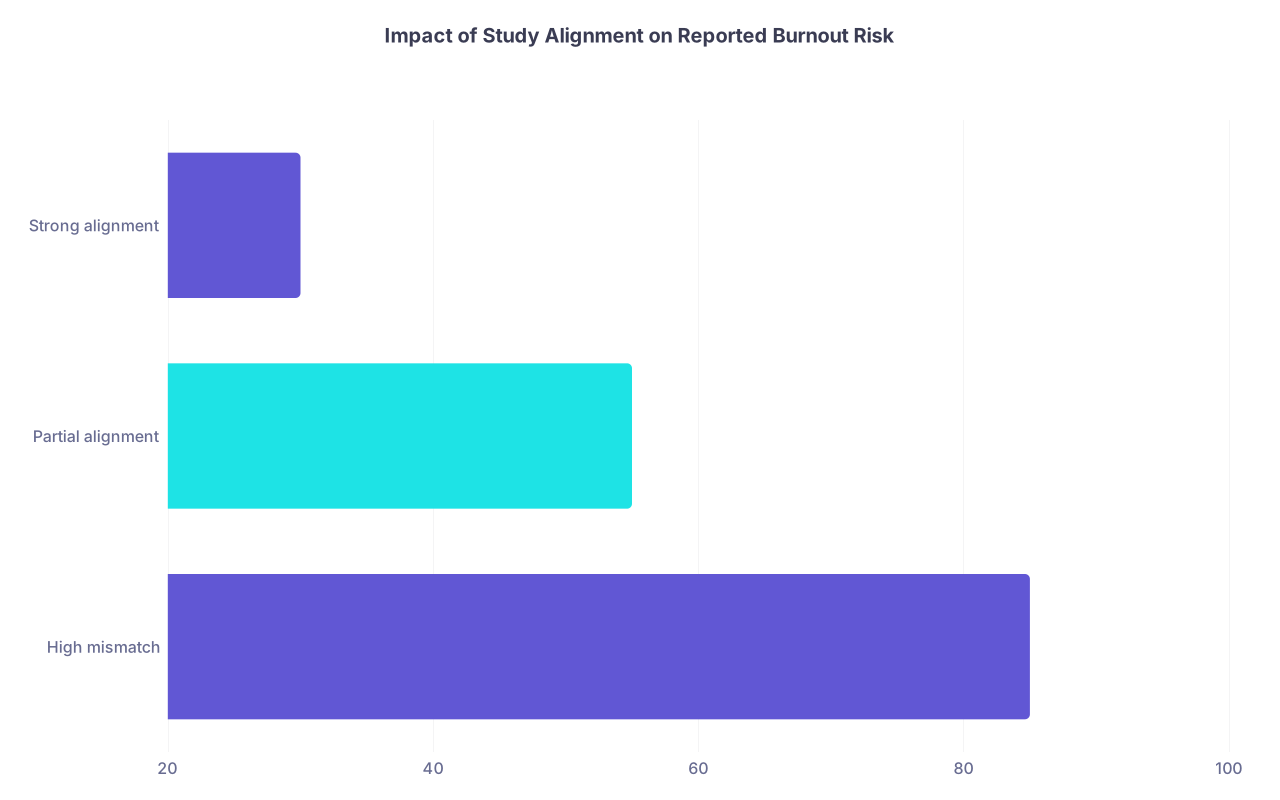
| Category | Value |
|---|---|
| High mismatch | 85 |
| Partial alignment | 55 |
| Strong alignment | 30 |

FAQ (Exactly 4 Questions)
1. Are “learning styles” even real, or is this just a myth?
The classic idea that teaching must perfectly match a labeled style (visual, auditory, etc.) to improve outcomes is oversimplified and not strongly supported. But individuals absolutely differ in how they most efficiently process, store, and retrieve complex information. In med school, those differences matter for fatigue even more than for raw performance. You can pass exams with mismatched methods, but it will cost you more cognitive energy and often more time.
2. If I am a visual learner, should I stop using Anki or other flashcards?
No. You should change how you use them. For visual–spatial learners, pure text cards are mentally expensive and forgettable. Adding simple sketches, diagrams, or color coding can massively reduce cognitive load. You can also use cards that reference a mental “map” you have drawn, rather than trying to pack the whole concept into a sentence.
3. How do I know if my mental fatigue is from learning-style mismatch versus depression or burnout?
Look at pattern and context. If your fatigue is tightly linked to specific study tasks and improves when you switch methods (for example, you feel significantly more alert when using diagrams or teaching a friend), then mismatch is likely playing a role. If you have pervasive low mood, anhedonia, sleep and appetite changes, and fatigue even on non-study days, you should assume a mood disorder or significant burnout might be present and talk to a clinician. These are not mutually exclusive; fixing study methods does not replace proper mental health care.
4. Can I change my learning style, or am I stuck with it?
You can absolutely build competence in non-preferred modes. In fact, med school basically forces you to. A visual learner can become solid with verbal explanations; a drill-focused student can improve conceptual reasoning. But under stress and time pressure, your brain defaults to its most efficient patterns. The smart approach is: lean on your dominant style for the bulk of your encoding and review, then deliberately train your weaker modes where exams and clinical work demand it. That blend minimizes fatigue while still making you a flexible, effective physician.
Key takeaways:
- Chronic mental fatigue in med school is often amplified by a mismatch between your natural processing style and your study methods.
- You cannot change the intrinsic difficulty of medicine, but you can drastically reduce extraneous cognitive load by aligning resources and techniques with how your brain actually works.
- Treat this not as a comfort preference, but as a performance and mental health strategy—aligned studying buys you both better scores and a more sustainable brain.