
The emotional load from difficult patients breaks more third-year students than any exam ever will. Not because you are weak, but because no one trains you properly for it.
Let me break this down specifically.
You are thrown into real patient care with the emotional skill set of a high-achieving test-taker. That mismatch is brutal. And predictable. I have watched stellar students crumble after one malignant interaction with a family member, or carry a single cruel comment from a patient for weeks while still somehow finishing UWorld blocks.
This is not about “resilience” in the motivational poster sense. This is about building a practical, clinical-grade system for handling emotional blowback from difficult patients so you do not burn out, become cynical, or start dreading every shift.
1. What “Difficult Patient” Actually Means in Clerkship Reality
People love vague labels. Attendings say “challenging interaction.” Residents say “he’s a tough one.” You feel wrecked and think maybe you’re just not cut out for clinical medicine.
Let’s be precise. There are patterns.

Common “difficult patient” scenarios you will meet as an MS3:
Verbally aggressive / demeaning patients
- Direct insults: “You’re useless. Get me a real doctor.”
- Sexist or racist comments towards you.
- Mocking your inexperience: “So you’re just practicing on me?”
Non-adherent or “demanding” patients
- Repeatedly refusing care then complaining about lack of progress.
- Pressuring you for opioids or specific tests: “I want an MRI now.”
- Threatening complaints or lawsuits if they do not get what they want.
Personality-disordered dynamics
- Splitting: telling you that you are the only good one and everyone else is incompetent.
- Love-bombing then sudden rage when boundaries appear.
- Constant crisis and emotional volatility.
Highly distressed or traumatized patients
- Trauma survivors who mistrust every provider.
- Patients whose fear comes out as hostility.
- Families lashing out because someone they love is dying.
Value-conflict patients
- Expressing racism / homophobia / transphobia directly at you or others.
- Dismissing the team’s recommendations as “stupid” for religious or political reasons while directing their anger at you as the lowest-status visible target.
You are not “too sensitive” for feeling gutted after a few of these in one day. Your brain is registering actual threat: status threat, identity threat, moral injury. You are also in the most precarious social position on the team. You have the least power and the most evaluation pressure.
So your nervous system ends up taking the hit.
2. Why MS3s Are Especially Vulnerable (And Why That Is Not a Character Flaw)
There are three structural reasons third-years get emotionally steamrolled.
2.1. The Role Mismatch
You are expected to:
- Be “the face” of the team to the patient (because you have the most time).
- Absorb repeated exposure to suffering and anger.
- Maintain “professionalism” no matter what they say to you.
- Accept that your own emotional reaction is irrelevant to the clinical note or the grade.
But you:
- Have almost no authority to change the plan.
- Cannot walk out or say “Enough.”
- Are constantly aware that someone might be later commenting on “emotional maturity” in your evaluation.
So you become the buffer. Without the power to protect yourself.
2.2. Identity Collision
Most MS3s up to this point have been rewarded for:
- Pleasing authority figures.
- Being “nice,” agreeable, and conscientious.
- Getting things right.
Then a patient yells at you, or calls you a racial slur, or says “You probably got in because of affirmative action” or “You look like a child, I don’t want you touching me.”
Your academic identity – high-achieving, respected, competent – collides with a new identity: disposable learner, easy target, lowest rung. That discrepancy is what hurts. Not just the words.
2.3. Chronic Evaluation Stress
You are never off-stage in third year. The same day you get:
- A patient screaming at you.
- A resident snapping, “Why is this not done yet?”
- An attending writing “professionalism: meets expectations” in your eval.
Your brain is trying to process emotional injury in an environment where showing injury could itself be graded. So it does what all smart brains do under chronic threat: suppress now, leak later.
Usually at 1 AM when you are staring at your phone, scrolling aimlessly, wondering why you feel numb and angry.
This is not sustainable. You need something more structured than “self-care” platitudes.
3. A Clinical-Grade Mental Model: Roles, Not Reflections
The most useful frame I have seen students adopt is simple and a bit ruthless:
Patients’ emotional behavior is mostly about their own nervous system and life history, not a reflection of your worth, competence, or character.
Obvious in theory. Hard in practice. So we operationalize it.
Imagine three layers in every difficult interaction:
Layer 1: Clinical content
- Vitals, labs, imaging.
- Diagnosis, treatment decisions.
Layer 2: Relational dynamics
- How the patient feels about the team.
- Power, trust, fear, transference, past experiences with healthcare.
Layer 3: Your internal response
- Shame, anger, fear, defensiveness.
- Old personal wounds that their behavior is poking.
Third-year students constantly confuse layers 2 and 3. Patient is angry (layer 2) → “I am incompetent / failing / unprofessional” (layer 3).
You need to start mentally separating:
- “This person is terrified and has learned to protect themselves by attacking first.” from
- “I am bad at this and do not belong here.”
You will still feel the sting. But you will not fuse your identity with their behavior.
A technique I push students to use:
Name the layer internally when you feel hit.
- “This is a layer-2 issue: they do not trust the team.”
- “My layer-3 reaction is shame and wanting to hide.”
- “The medicine (layer 1) here is straightforward.”
That small cognitive separation makes it easier to then deploy actual strategies instead of spiraling.
4. In-the-Moment Tactics When a Patient Blows Up at You
You need concrete scripts. Not vague “communicate empathetically.”
Let’s walk through realistic micro-strategies.

| Step | Description |
|---|---|
| Step 1 | Patient escalates emotionally |
| Step 2 | Step out and get help |
| Step 3 | Ground yourself: breathe once |
| Step 4 | Set boundary or acknowledge emotion |
| Step 5 | Step out, get resident/attending |
| Step 6 | Close interaction with clear next step |
| Step 7 | Immediate safety concern? |
| Step 8 | Need senior backup? |
4.1. First 5 seconds: Physiologic control
You feel the surge – heart rate jumps, stomach drops. If you do nothing, you will either:
- Shut down and freeze, or
- Over-explain and apologize excessively, or
- Get defensive.
So your first task is not “respond professionally.” It is “stall your amygdala.”
Micro-reset:
- Inhale through your nose for a count of 4.
- Exhale slowly for a count of 6–8.
- Drop your shoulders slightly.
- Feel your feet in your shoes.
Takes 3–5 seconds. No one notices. But it gives your prefrontal cortex a fighting chance.
4.2. Scripted boundaries
You do not have to accept abuse to be professional. Read that again.
Here are phrases that work and do not get you in trouble:
For insults or demeaning comments:
- “I hear that you are very frustrated. I want to help. I can best do that if we can speak to each other respectfully.”
- “I am here as part of your care team. I understand you do not want to talk to me right now. I can step out and let the resident know.”
For racist / sexist / identity-based attacks: (Use these with judgment and with an eye to your own safety and institutional culture.)
- “Those comments are hurtful and not appropriate. I am here to help with your medical care. I will step out and let the team know you prefer to speak with someone else.”
- If you do not feel safe saying that, bare minimum: “I am going to step out now and ask the team to come talk with you.”
For repeated boundary-pushing (e.g., meds, tests):
- “I hear that you want [X]. My role is to learn and to communicate your concerns to the team. I am not able to order that, but I will let the resident know what you are asking for.”
You are stating:
- You see their emotion.
- You define your role clearly.
- You set or reinforce a boundary without debating.
4.3. When to exit the room immediately
You are allowed to leave. You should leave if:
- You feel physically unsafe.
- The patient is escalating rapidly and not responding to de-escalation attempts.
- The content becomes directly threatening: “I know where you live,” etc.
Simple exit script:
- “I am going to step out for now and will ask the resident to come talk with you.”
Then you step out. You find your senior. You document if necessary. You do not re-enter alone unless you feel safe and the team agrees.
5. After the Encounter: How to Process Without Falling Apart
This is where most students fail, not because they are weak, but because they never learned how to metabolize the emotional junk they just absorbed.

You need a structured 15–20 minute post-encounter process. Not every time. But definitely after the ones that leave your hands shaking.
5.1. Step 1: Narrative download (no editing)
Find a quiet spot: empty family room, call room, even a bathroom stall if you have to. On paper or phone (notes app), write 5–10 lines, fast, no polishing:
- What did they say?
- What did I feel in my body?
- What story did I immediately tell myself? (“They hate me,” “I am incompetent,” etc.)
You are not writing a reflective essay for an attending. You are dumping raw data for yourself.
This moves the experience from implicit (in your body) to explicit (in language). That alone reduces intensity.
5.2. Step 2: Label the layers
Go back to the three-layer model:
- Layer 1: Any legitimate clinical concerns they had?
- Layer 2: Their patterns of distrust, fear, personality structure?
- Layer 3: Your particular trigger?
For example:
- Layer 1: They had uncontrolled pain overnight. Legitimately angry about being uncomfortable.
- Layer 2: They have a long history of feeling ignored by healthcare. So they attack early.
- Layer 3: I felt like a failure because I did not check on them sooner, and that hits my core perfectionism.
Clarity cuts shame.
5.3. Step 3: Very small “repair” action
Ask: is there any small, professionally appropriate action that could reduce future blowups or repair your own sense of agency?
Examples:
- Let the resident know and ask if they can join you on the next check-in.
- Clarify expectations with the patient: “We will round between 7–9 AM; I will not have updates before then.”
- Ask nursing what communication patterns have worked with this patient.
You are not responsible for fixing the patient’s entire emotional life. You are just reclaiming a small piece of your own control.
5.4. Step 4: Get witnessed by someone safe
Humans process pain socially. If you do not tell anyone, it will live in your nervous system.
You need at least one of:
- A resident you trust: “Can I run something by you? That last patient interaction really rattled me.”
- A peer: “That guy in 14B called me [X]. I know it is ‘part of the job’ but it sucked.”
- A mentor / dean / school counselor later that week.
Minimal requirement: someone else says, in words or in body language, “Yes, that was a lot.” That is often enough to keep it from becoming a silent trauma.
6. Building a Personal “Containment System” Over the Year
Third year is not one bad interaction. It is hundreds of medium-to-bad ones. The accumulation is what burns people out.
So you need a containment system. Not just random coping.
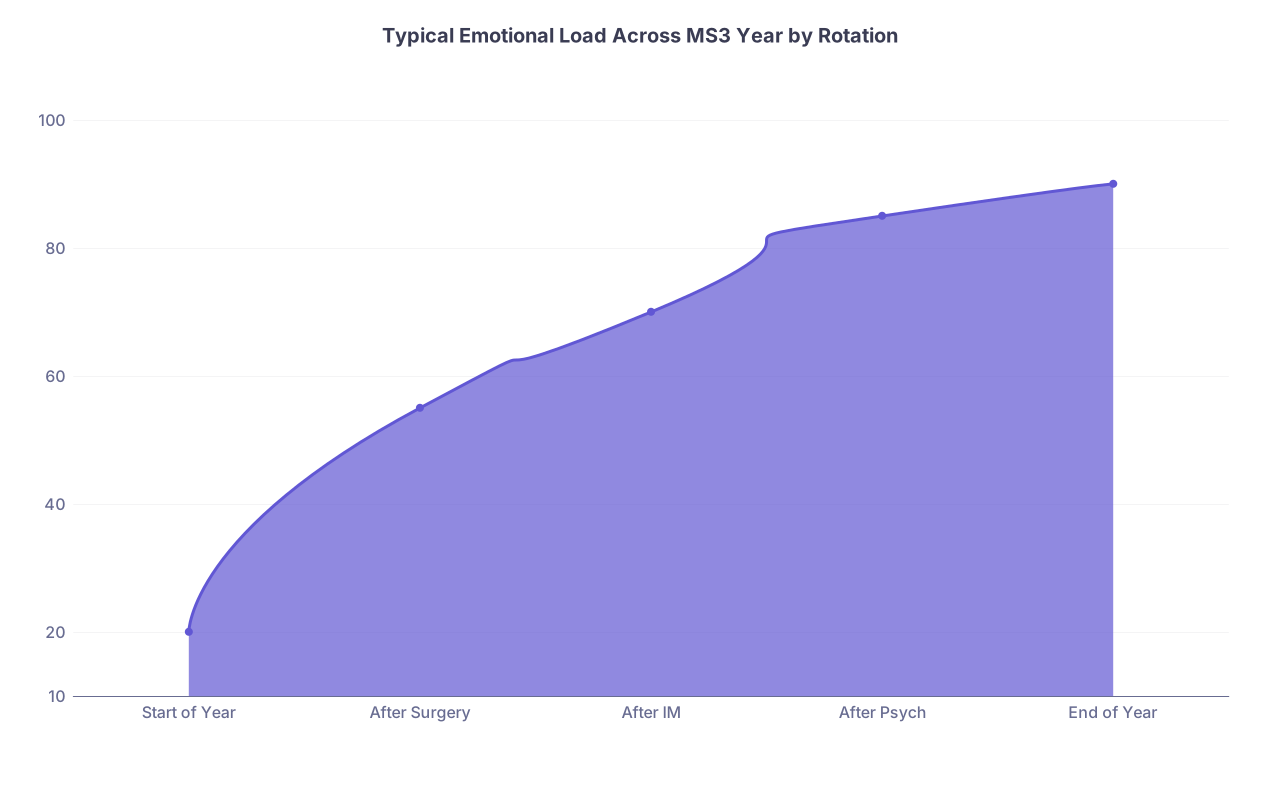
| Category | Value |
|---|---|
| Start of Year | 20 |
| After Surgery | 55 |
| After IM | 70 |
| After Psych | 85 |
| End of Year | 90 |
Consider three domains: before, during, and after shifts.
6.1. Before shift: Set your baseline
You will not like this, but it is true: your sleep, nutrition, and basic physical stability dramatically change how much emotional blow you can take. You cannot “mindset” your way out of chronic sleep deprivation.
That said, you rarely control your schedule. So you focus on what is realistically modifiable:
Micro-priming (2–3 minutes on the way in):
- Ask: “What am I likely to face today?” (e.g., angry family in ICU, chronic pain clinic).
- Set one intention: “Today my only emotional goal is to stay grounded in my body when someone is upset.”
Expectation calibration:
- Tell yourself plainly: “Someone will probably be rude to me today. That does not mean I am failing.”
- This is not pessimism. It is mental inoculation.
6.2. During shift: Live within your bandwidth
On a rough service (ED, surg nights, ICU), you have to triage your emotional bandwidth like you triage patients.
A few rules I give students:
Limit exposure to your most triggering patient
- You may need to see them multiple times, but you can shorten secondary conversations.
- You can ask a resident to be present if every solo visit ends in disaster.
Use physical anchors
- Wash your hands slowly and intentionally after leaving a tough room. Let that be the mental “boundary” ritual.
- Every time you scan your badge to re-enter the unit, take one breath where you notice what you are feeling.
Know your early warning signs
- Snapping at nurses.
- Fantasizing about walking out mid-shift.
- Feeling unusually numb during codes or family meetings.
Those are not moral failures. They are your system telling you that you are past your processing capacity. You need to pull a senior aside: “I am getting pretty overloaded with [patient]. Could you join me on the next check or take the next conversation?” Most decent residents will say yes.
6.3. After shift: Non-negotiable decompression
This is non-glamorous but crucial. You need a 15–30 minute decompression ritual when you get home. Not doom-scrolling. Decompression.
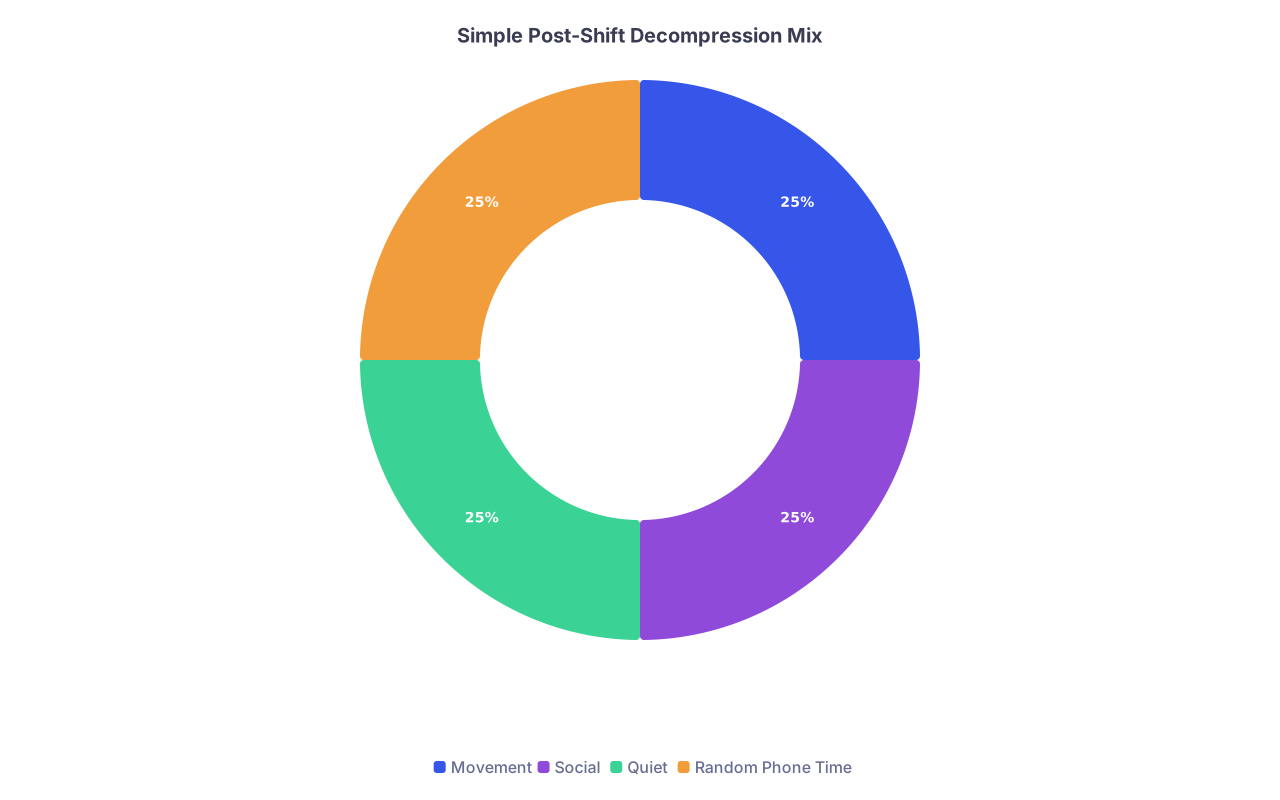
| Category | Value |
|---|---|
| Movement | 25 |
| Social | 25 |
| Quiet | 25 |
| Random Phone Time | 25 |
I am not prescribing yoga and herbal tea. I am saying: pick one thing that meets each of these categories at least a few times a week:
- Movement: 10–20 minutes of walking, stretching, anything that changes your physical state.
- Social: 1–2 honest conversations per week with someone who knows the real you.
- Quiet: No input for 10 minutes. Shower, sit, stare at a wall. Let your mind catch up.
- Junk: Yes, you can have TV, TikTok, whatever. Just be honest: this is numbing, not processing. Do not confuse the two.
If you never have Social or Quiet, your emotional load will just keep stacking.
7. Special Cases: When It Is More Than “Difficult”
Some situations cross from “challenging” to “potentially traumatizing”. Students try to minimize it because everyone else seems fine. Do not.
7.1. Explicit identity-based harassment
If a patient targets your race, religion, gender, orientation, or other core aspects of who you are, repeatedly, and the team shrugs, you are at risk for significant harm.
You have the right to:
- Ask to be reassigned from that patient.
- Ask the attending or chief resident to set clear boundaries with the patient.
- Document the incident and report it through your school’s professionalism or mistreatment system.
You will worry about being seen as “difficult” or “not a team player.” That worry is real. But there is a line where protecting your core self is more important than impressing an attending you will never see again.
7.2. Physically threatening behavior
You are not security. If a patient:
- Blocks the door.
- Makes credible threats.
- Throws objects.
You leave. Immediately. No heroic “de-escalation” is expected from a third-year learner. You then tell the nurse / resident / attending and document.
7.3. Secondary trauma from horrific stories
On psych, EM, OB/GYN, peds, you will hear things that are genuinely horrific: sexual violence, child abuse, brutal assaults.
Signs it is sticking in you:
- Recurrent images from the story popping up when you are trying to sleep.
- Avoidance of reminders (e.g., not wanting to see similar patients).
- Emotional numbing or irritability that is new.
That is not weakness. That is a normal response to abnormal content. It is exactly when you should:
- Talk with your school counselor or mental health service.
- Tell a trusted attending: “That case really got under my skin; do you have 10 minutes to talk it through?”
Good physicians model that this work leaves marks. If everyone pretends they are unaffected, they are either lying or deeply defended.
8. Turning Emotional Load into Actual Professional Growth (Without Romanticizing the Harm)
Let me be blunt: not every emotional wound becomes wisdom. Some just become scars.
But you can choose to extract professional skill from painful encounters, instead of just surviving them.

Here are three concrete competencies you can build:
8.1. Emotional granularity
Instead of “I felt bad,” try to name precisely what showed up:
- Humiliated
- Powerless
- Angry at the system
- Protective of a nurse
- Disgusted
- Conflicted
The more precise, the less overwhelming. This is not therapy-speak; it is the same principle as writing “abdominal pain, sharp, RUQ, worse with inspiration” instead of just “stomach hurts.”
8.2. Boundary-setting as a real clinical skill
Attending-level medicine demands:
- Saying no to unreasonable patient and family demands.
- Holding boundaries kindly but firmly.
- Protecting the team from burnout.
You get to practice the basic form now. Every time you say, “I am not able to do that, but I will let the team know your concern,” without over-apologizing, you are building that muscle.
8.3. Ethical clarity about your role
You are not the patient’s savior. You are not their punching bag. You are one small part of a huge system, trying to help.
Writing one short reflection per week about a difficult interaction, asking:
- What was actually my responsibility here?
- What was clearly not my responsibility?
- What would “good-enough” care look like in this context?
That keeps you from sliding into two bad extremes:
- Helpless nihilism: “Nothing I do matters; the system is broken.”
- Grandiose guilt: “If I were better, this would all be fine.”
Both will grind you down.
9. When You Need More Than Self-Management
There is a point where “coping strategies” are not enough. That point often shows up around the middle of third year.
| Sign | Why It Matters |
|---|---|
| Persistent sleep problems for >2 weeks | Classic marker of stress spillover |
| Dreading every shift with a sense of doom | Not just normal pre-round anxiety |
| Intrusive memories or images from specific patients | Possible secondary trauma |
| Emotional numbness with family/friends | Overactivation of defense mechanisms |
| Serious thoughts of quitting medicine or self-harm | Needs immediate attention |
If you are hitting any of these, it is not an indictment. It is your system waving a red flag.
Actual steps:
- Use your school’s confidential mental health service. Almost every med school has one; they are underutilized.
- Talk to your dean of students or equivalent. You can frame it pragmatically: “I am carrying a lot of emotional load from patient interactions and I want to make sure I do not burn out.”
- If symptoms are severe (especially self-harm thoughts), you treat that like any serious medical symptom: urgently and without shame.
10. What This Looks Like in Real Life: A Concrete Example
A composite case I have watched some version of at least 20 times:
You are on inpatient medicine. You are assigned to a middle-aged patient with uncontrolled diabetes and multiple admissions. She is understandably fed up. On day 3, you walk in to check vitals and see how she is doing.
She stares at you and says, “Why do they keep sending you? You never do anything. You just stand there and look stupid. Are you even a real doctor? Maybe they sent you because you are [insert racist/sexist remark]. Get out.”
Your nervous system explodes. Heat in your face. Tight in your chest. You mutter an apology and rush out. The rest of the day, you avoid her room. You feel sick when the attending asks about her on rounds.
Here is how this looks with a system in place:
In the room:
- You ground yourself with a breath.
- You say, calmly, “I am sorry you are feeling so frustrated. I am a medical student on your team, and I am here to help with your care. I can step out now and let the resident know you want to speak with them.”
- If the comments escalate or you feel unsafe, you simply say, “I am going to step out now and ask the team to come,” and you leave.
Immediately after:
- You find your resident: “Ms. X was very upset and said some pretty harsh things; I did not feel comfortable staying. Can you see her with me next time, or would you be willing to talk with her?”
- Brief narrative dump in your notes app: “Ms X called me stupid and said [X]. I felt humiliated and small. Story in my head: ‘I am useless.’”
Later that day:
- You label layers: She is scared and sick of the system (layer 2). My trigger is being seen as incompetent (layer 3).
- You decide on a small action: you will re-enter with the resident later, not alone.
- You tell a co-student: “That room was brutal; I need to vent for 5 minutes.”
That week:
- You bring it up briefly with a mentor: “I handled it, but that interaction stayed with me. I would like more tools for those situations.”
- You do not let this one moment redefine your image of yourself as a future physician.
You still feel it. But it does not own you.
With this kind of framework, you stop treating every emotionally intense patient as a personal referendum on whether you should be in medicine. Instead, you start to see them as exactly what they are: hard cases in a hard system, interacting with a human who happens to be at a very vulnerable stage of training.
You are that human now. You will not be forever.
If you can learn to manage emotional load as a third-year – with almost no power and constant evaluation pressure – you will carry a rare, durable skill into residency and beyond. The next phase is learning how to do this while also protecting the learners who come after you.
But that is a conversation for your intern year.