
It is 10:07 p.m. You just finished a 6‑hour cram session for your renal exam. You open your group chat. One classmate: “Lol I’ve done UWorld nephro twice already, just consolidating Anki now.” Another: “Anyone else getting consistent 90s on practice blocks or am I just weird?”
You were proud of your 68% block an hour ago. Now your stomach drops. You start recalculating your rank, your Step prospects, your entire career. You are not studying anymore; you are spiraling.
Let me be direct: the problem is not only them. And it is not only you. It is the system plus human insecurity plus terrible boundaries. You cannot fix the system this month. You can absolutely fix your boundaries.
I am going to walk through exactly how.
1. Understand What You Are Actually Up Against
You are not just “dealing with competitive classmates.” You are dealing with:
- A ranking‑based evaluation system
- Limited spots for high‑status specialties
- Perfectionistic personalities
- Constant comparison data (scores, hours, research)
- A culture that quietly glorifies suffering and overwork
Put that into a pressure cooker and of course people get weird.
There are roughly four “competitive classmate” archetypes I see over and over:
- The Bragger: constantly broadcasting scores, hours, publications
- The Interrogator: always asking, “How many questions did you do?” “What’d you get?”
- The Strategist: fishing for your study resources so they can “optimize” against you
- The Saboteur: subtle digs, withholding info, flexing disguised as “help”
You do not handle all of these the same way. But the underlying skill is identical: clear boundaries + stable internal reference point.
2. Diagnose: Are You Spiraling or Just Annoyed?
Annoyed is normal. Spiraling is dangerous.
You are spiraling when:
- Your heart rate spikes when someone mentions scores or percentiles
- You replay classmates’ comments on loop while trying to sleep
- You alter your entire plan because of one person’s flex (“I guess I need to start 500 Anki cards a day now…”)
- You check group chats compulsively after practice exams “just to see what others got”
- Your self‑talk shifts to global failure: “I am behind,” “I will never match X”
Spiraling is not about the classmate. It is about you outsourcing your self‑assessment to external noise.
So first step: notice the early warning signs. For most students, it is a body signal first (tight chest, stomach drop) then a thought spiral.
Once you can catch that first 10 seconds, you can intervene. Which is where boundaries come in.
3. Core Principle: Internal vs External Scoreboard
If your entire worth as a student is tied to the external scoreboard (class rank, percentile, group chat scores), you will be jerked around all year. Some days you will feel like a genius. Other days like an imposter. It will have very little to do with actual learning.
I push students to build an internal scoreboard with three main metrics:
- Process: Did I do what I planned today? (e.g., 80 questions + 200 cards)
- Learning: Am I closing my personal weak spots? (e.g., finally understanding acid–base)
- Sustainability: Can I keep this up without burning out in two weeks?
That internal scoreboard is what your boundaries are designed to protect.
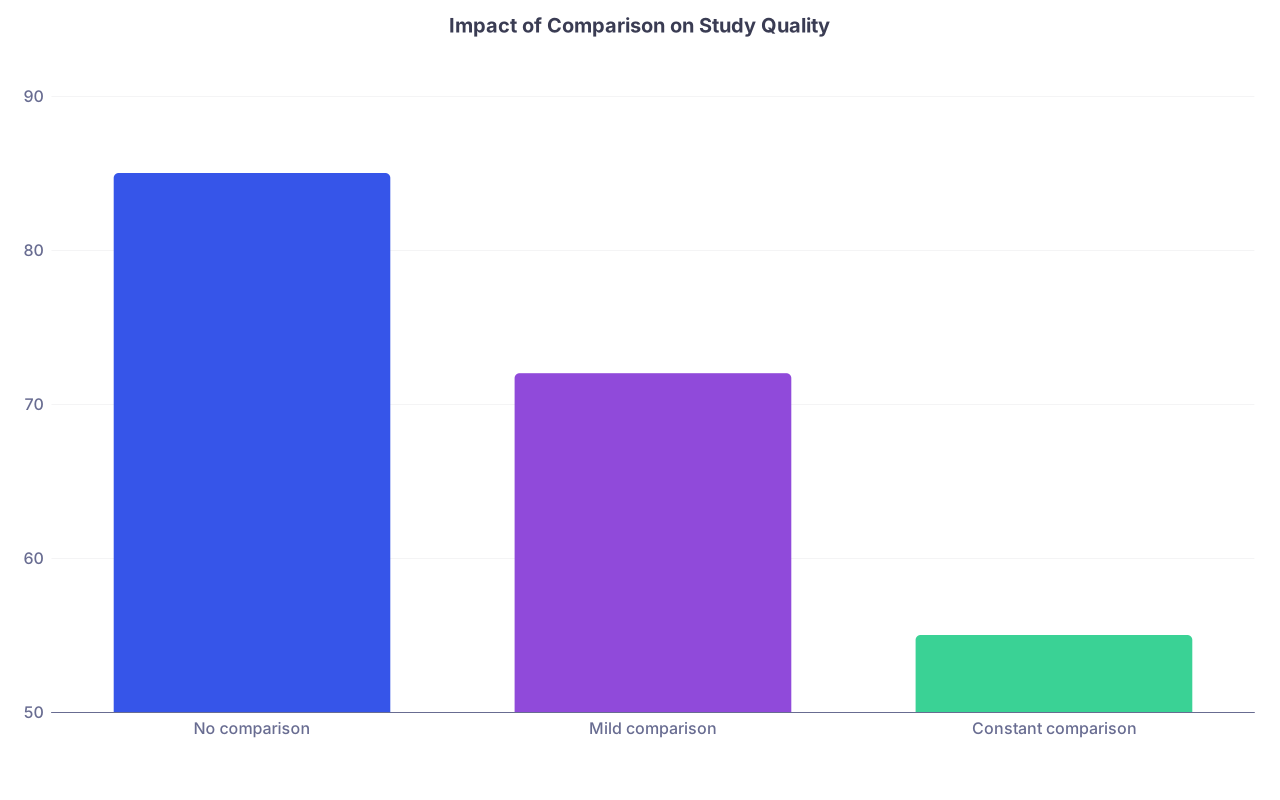
| Category | Value |
|---|---|
| No comparison | 85 |
| Mild comparison | 72 |
| Constant comparison | 55 |
Interpret that as: the more you live in everyone else’s data, the less effective your own studying becomes. I have seen it hundreds of times.
4. Concrete Boundaries: What You Say, Do, and Stop Doing
Let me break this down specifically. Boundaries are not a vibe. They are observable behaviors. I will split them into three levels: low, medium, and high assertiveness.
4.1 Low‑Assertiveness Boundaries (Stealth Mode)
Use these when you want less exposure to competition but do not want drama.
Reduce exposure to high‑trigger channels
- Mute, do not leave, the main class chat.
- Turn off pop‑up notifications for “scores” channels.
- Check once or twice a day, not continuously.
You are not obligated to consume every anxious thought your classmates broadcast.
Neutral deflection when people probe
Memorize 2–3 stock phrases. Use them on autopilot.- “I am doing fine with my system, trying not to obsess over numbers.”
- “I do some questions and Anki daily; I do not really track totals.”
- “I am focusing on keeping my plan consistent rather than comparing.”
Short. Boring. Not an invitation for deeper discussion.
Non‑competitive body language
When someone starts flexing, you do not have to lean in and ask. Simple options:- Glance at your watch, “I need to run in a sec.”
- Turn slightly away and start packing up.
- Switch to a different topic: “Hey, did you see the new schedule?”
These are mild, but they work surprisingly well. Competitive people seek reaction and audience. You remove both.
4.2 Medium‑Assertiveness Boundaries (Clear and Polite)
You use these with peers you interact with frequently: study groups, friends, lab mates.
Explicit topic boundary
You are allowed to say this. It is not rude.- “I actually do better when I do not compare scores, so I try not to talk numbers.”
- “I get really in my head about percentiles, so I am avoiding those conversations.”
Then change the subject immediately. Do not over‑explain.
Protected study slots
You create times where you are unavailable for comparison nonsense.- Block 2–3 hour sessions as “phone in bag, chat closed, do not disturb.”
- Tell close friends: “If you text me about scores during this block, I will answer later. I am trying to stay in my lane when I study.”

| Step | Description |
|---|---|
| Step 1 | Start Study Block |
| Step 2 | Silence notifications |
| Step 3 | Place phone away |
| Step 4 | Open only study apps |
| Step 5 | Write down & return to task |
| Step 6 | Continue studying |
| Step 7 | End of block |
| Step 8 | Comparison thoughts? |
Redefine what gets shared in your group
In your main study group or close circle, propose a shift:- From: “What did you get on that last block?”
- To: “What did you learn from that last block?”
Example prompt: “Instead of talking scores, can we each share the one concept that kept tripping us up?”
Some people will resist. Fine. At least you have signaled your line.
4.3 High‑Assertiveness Boundaries (Protection From Repeat Offenders)
This is for the classmate who will not drop it. The chronic bragger, the subtle saboteur, the “I am just being honest” person who leaves you wrecked every week.
Direct statement + consequence
Example script:- “I know you like talking about scores, but honestly it messes with my head. I am not going to have those conversations anymore.”
If they keep going:
- “I already said I do not want to talk scores. I am going to step away.”
Then literally walk away. In person or on the chat thread.
Leaving specific spaces
If a small group, research team, or “study squad” has turned toxic, you can exit.You do not need a manifesto. You can say:
- “My study needs are shifting; I am going to work solo for a while.”
- “The group chat is too distracting for me. I am muting / leaving, but I am around for non‑study stuff.”
People may talk. Let them. That discomfort is the price of your mental health.
Fact‑based call‑out of undermining behavior
If someone repeatedly makes cutting comments, you can name it calmly.- “Every time scores come up you mention how easy it was for you. I walk away from those conversations feeling worse, not better. I am not open to that dynamic anymore.”
Say it once, clearly. Then enforce with distance.
5. Handling Exams, Scores, and Group Debriefs
Exam days are boundary landmines. Half the class wants to autopsy every question in the hallway. The other half wants to vomit.
You need a plan beforehand.
5.1 Pre‑Exam Boundary: Preserve Your Headspace
Two simple rules I push:
No new opinions the last 12–24 hours
- Do not ask “How much did you guys get through?” the night before.
- Do not accept “You really should do X before tomorrow.”
You are done planning. Execute.
No new group resources the final evening
Last‑minute “review slides” from competitive classmates are often more about flexing than helping. Skipping them is not negligence.
5.2 Post‑Exam Boundary: The Hallway Autopsy
You can script this once and re‑use it all year.
When they start: “What did you put for the insulin question?”
You:
- “I do better when I do not dissect the test afterward. I am going to grab food.”
- “I honestly do not remember. I am trying not to think about it.”
Then walk. Do not stand there as a silent punching bag. Physical exit is often the only thing that works.
If you are stuck (e.g., waiting for OSCE stations), you can redirect:
- “I am maxed out on talking about that exam. Tell me something unrelated to school.”
If someone insists, that tells you a lot about their capacity to respect boundaries.
5.3 Score Release Days: Preventing the Spiral
Score release is where many students lose an entire 24 hours to comparison.
Here is a tight protocol that works:
Decide when you will check your score.
Not “when the email pings.” A specific time, after you have done at least one meaningful task that day.Decide what you will do in the first 30 minutes after checking.
- If satisfied: log what you think worked; then back to life.
- If disappointed: write down 3 specific learning gaps, not 30 global self‑attacks.
Delay all group chats by 2–4 hours.
You do not need to be in the first wave of “what did you get?” hysteria. Let the initial storm pass. Your score is not more valid because 15 people see it immediately.
If someone directly asks:
- “I am still processing and figuring out my plan; I am not sharing scores right now.”
That is a valid answer. Anyone who says otherwise is wrong.
6. Study Groups: When to Stay, When to Leave
Study groups can be either stabilizing or destructive. The difference is not luck; it is structure and shared norms.
6.1 What a Healthy Group Looks Like
Healthy groups:
- Spend more time on concepts and questions than on scores
- Share resources without turning it into an arms race
- Allow people to opt out of certain discussions
- Have at least one person who can say “Let’s move on” when things drift into flexing
| Feature | Healthy Group | Toxic Group |
|---|---|---|
| Primary focus | Understanding, teaching each other | Scores, rank, “who’s ahead” |
| Reaction to struggles | Normalized, problem-solved | Judged, mocked, or brushed off |
| Sharing resources | Collaborative, no strings attached | Competitive, one-upmanship |
| Flexing / humblebragging | Rare, called out or ignored | Common, rewarded with attention |
| Effect on you after | Calmer, clearer about your plan | Anxious, doubting your entire strategy |
If you leave a study session feeling stupid and behind more than 1–2 times in a row, something is wrong with that environment. Not with you.
6.2 When to Leave
You should seriously consider leaving if:
- You start altering your plan constantly to match the “top” person in the group
- You feel pressure to share every score or you will be “suspicious”
- People use your struggles as punching lines (“Wait, you still don’t get murmurs?”)
- You are doing more talking about plans than actual studying
Leaving does not mean studying alone forever. It means finding one partner who is stable, or working solo and using faculty/tutors for check‑ins.
7. Mental Habits: Fixing the Inside While You Fix the Outside
Boundaries are external. You also need internal tools, or you will just recreate the same dynamic with the next group.
7.1 Catch the Comparison Narratives
- “They are ahead, therefore I am behind.”
Reality: You are on different trajectories, with different baselines and goals. - “If I am not top X%, I am failing.”
Reality: Most specialties and careers do not require top decile performance. - “Their confidence means they are better.”
Reality: The loudest are often the least secure.
Write your specific spiral sentences down when they hit. Then force yourself to respond with something concrete, e.g.:
- “I am running my plan: 80 questions / day + review. That is aligned with my goals.”
- “My target is solid Step performance and competent clinical skills, not winning a leaderboard.”
You are not “positive affirming”; you are moving from vague doom to concrete action.
7.2 Anchor to Your Actual Goals
A lot of spiraling comes from getting hijacked by someone else’s scoreboard. Example:
You wanted a stable IM residency. Somewhere with decent teaching and humane hours. You meet someone gunning for derm, 270+ or bust. If you adopt their metrics, you will suffer for a goal you do not even want.
Do this once, on paper:
- What specialties genuinely interest me (ranked loosely)?
- What kind of life do I want (hours, city, family, etc.)?
- Therefore, what academic performance range is “enough” versus “overkill sacrifice”?
Then, when the ultra‑competitive peer flexes, you can quietly remind yourself: “We are not playing the same game.”
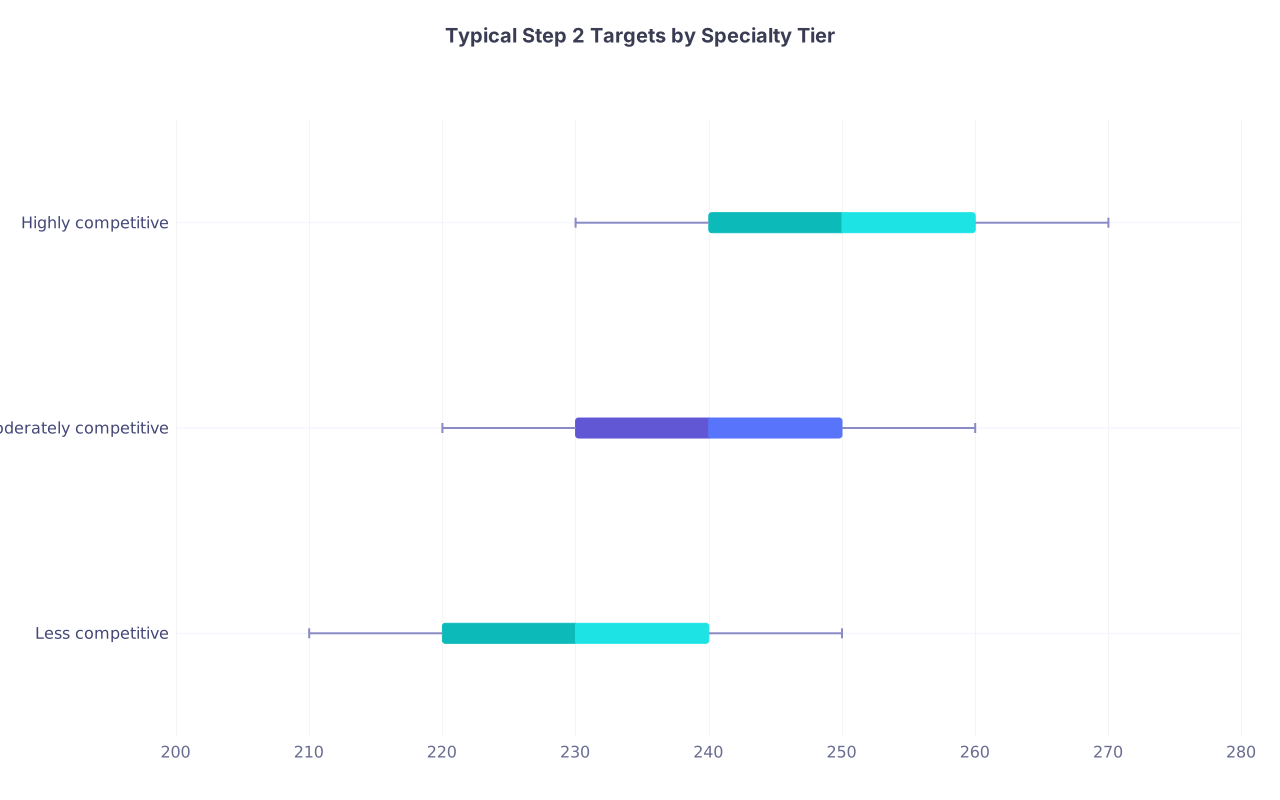
| Category | Min | Q1 | Median | Q3 | Max |
|---|---|---|---|---|---|
| Less competitive | 210 | 220 | 230 | 240 | 250 |
| Moderately competitive | 220 | 230 | 240 | 250 | 260 |
| Highly competitive | 230 | 240 | 250 | 260 | 270 |
Those are approximate distributions, not commandments. The point: “good enough” is different for different paths.
8. Special Situations: Clinical Years, Shelf Exams, and Sub‑I’s
Competition does not evaporate in clinical years. It just changes flavor.
8.1 On the Wards: Perform Without Performing for Peers
New set of competitive behaviors:
- Students interrupting each other on rounds to answer first
- People bragging about staying until midnight “to help”
- Shelf score competition and “I got honors everywhere” narratives
Your boundary moves here:
- Anchor performance assessment to attendings and residents, not peer gossip
- Decline to engage in “who is working harder” contests:
- “I am trying to be efficient and not burn out; hours alone are not my metric.”
- Protect your post‑call time from group debriefs that become one long flex session
Criteria I use: If a conversation makes you feel more focused on patient care and learning, engage. If it makes you focused on optics and image, limit.
8.2 Sub‑Internships and Letters
Here competition can feel brutal. People want the same letter from the same big‑name attending.
Here’s the thing: residents and attendings know exactly who is playing games versus who is actually dependable. The hyper‑competitive peer who subtly undermines others usually burns bridges they cannot see.
Your job:
- Solid, consistent work. Show up, follow through.
- One short check‑in with the attending about goals / feedback.
- Do not join in when others trash each other behind backs. That always gets back to staff.
Your boundary is ethical as much as psychological: you are not going to compromise professionalism to “win” a peer competition that staff are not even scoring.
9. If the Environment is Truly Toxic
Sometimes it is not just a few competitive people. The whole class culture is off. Anonymous forums, rumor mills, group chats that light up with every NBME average.
You still have levers:
- Curate a micro‑culture. Three sane people you trust can buffer an entire toxic class.
- Use institutional supports: student affairs, mental health, peer support groups. Ask explicitly, “How do students here protect themselves from the competitive culture?”
- Stop feeding the machine: do not post your scores, do not engage in anonymous ranking gossip, do not forward screenshots of others’ flexes.
If you are in real distress (sleep destroyed by anxiety, persistent hopelessness, panic around exams), this is not a “toughen up” problem. Talk to someone licensed. Preferably someone who has actually worked with medical trainees. Your brain is hardware; chronic stress will fry it if you try to white‑knuckle everything.
FAQ (Exactly 4 Questions)
1. How do I handle a friend who keeps sharing their high scores and it makes me feel awful, but I do not want to lose the friendship?
Be honest but specific. “I value our friendship, but talking detailed scores messes with my head. Can we keep our conversations away from numbers?” Say it once, calmly. If they respect it, good. If they cannot help themselves, you scale back study‑related interactions but keep social ones. If they take offense at a reasonable boundary, that is not a sturdy friendship to begin with.
2. Is it ever helpful to know where I rank in the class or what others are scoring?
Sometimes. If you are targeting a very competitive specialty, a reality check from a trusted advisor using de‑identified data can be helpful. What is not helpful: constant informal rank updates from peers, leaderboard obsessions, or trying to match the highest person in the room. Use official, infrequent benchmarks (NBMEs, faculty advising), not the daily group‑chat rumor mill.
3. What if I am the competitive one and I am worried I am part of the problem?
Good. Self‑awareness is rare. Ask two peers you trust, “Do I ever talk about scores or studying in a way that feels stressful or braggy?” Then listen without defending. You can keep ambitious goals without broadcasting them. Shift your conversations toward concepts, cases, and practical tips rather than numbers and hours. Ambition is not toxic; insecurity disguised as superiority is.
4. How do I stop mentally comparing even if I physically set boundaries?
You pair external boundaries with a simple mental routine. When you catch a comparison thought (“She is way ahead”), label it (“comparison”), redirect to your plan (“Today I am doing 60 questions + review cardio physiology”), and then take one concrete action in that plan. Over time, you train your brain: see comparison → return to task. It never disappears completely, but it drops from a full‑blown spiral to background noise.
Two things to remember if you skimmed everything else:
- Your primary job is to protect your internal scoreboard: your process, your learning, your sustainability.
- Boundaries are not attitudes; they are decisions about what you talk about, who you study with, and what data you let into your head.
Handle that, and competitive classmates become background scenery. Not the main story.