Most “wellness” programs in medical school are lipstick on a burning pig.
You’re not burned out because you skipped a mindfulness lunch. You’re burned out because you’re carrying 60–80 hours a week of cognitive load, high-stakes exams, and emotional trauma, wrapped in a culture that still glorifies self-neglect. A free yoga session on Wednesday is not going to fix that.
Let’s walk through what the data actually shows about medical student mental health, what schools are getting wrong with wellness programs, and what interventions actually move the needle.
The Problem: It’s Not You, It’s the System
Start with the uncomfortable reality: medical students are not just “a little stressed.”
Rates of depression, anxiety, and burnout in med students are consistently higher than in age-matched peers. Meta-analyses have shown depressive symptoms in around 25–30% of medical students and suicidal ideation in roughly 1 in 10 at some point during training. That’s not “everyone’s stressed in grad school” territory. That’s “something is structurally broken” territory.
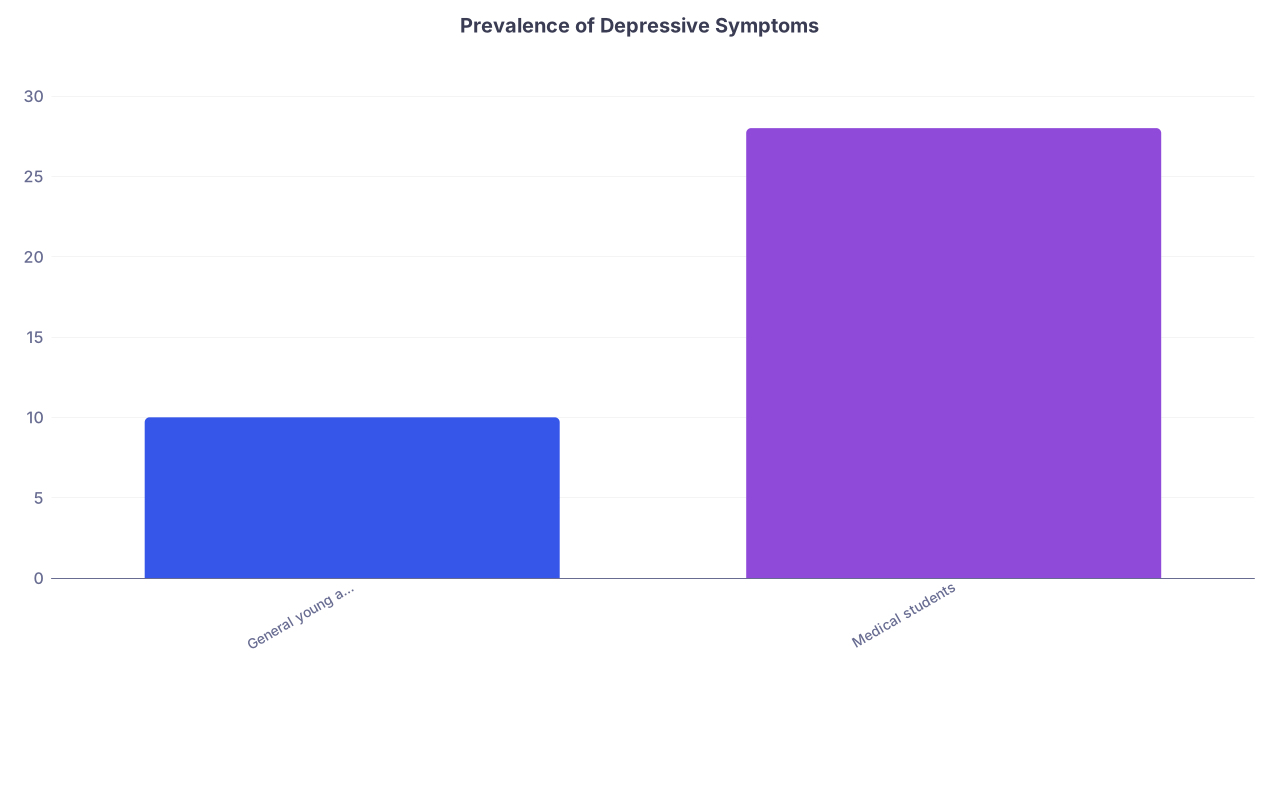
| Category | Value |
|---|---|
| General young adults | 10 |
| Medical students | 28 |
Yet when you look at many school wellness offerings, they behave as if the problem is: “Students don’t know how to breathe and stretch.”
You get:
- Mindfulness lunches scheduled in the middle of mandatory labs.
- Yoga at 7 pm after a 12-hour day on surgery.
- “Resilience workshops” that subtly imply that if you’re struggling, you’re not resilient enough.
That’s not wellness. That’s PR.
I’ve sat in “wellness committee” meetings where administrators proudly reviewed the success of a pizza-and-paint night while ignoring the student survey data screaming about exam clustering, humiliation on rounds, and lack of mental health access. That disconnect is the real story.
Myth #1: More Wellness Activities = Better Mental Health
This is the biggest illusion: that the number of wellness events is a proxy for student well-being.
It is not.
There’s actually a growing body of research that interventions focusing solely on individual-level coping (mindfulness, yoga, resilience training) have modest benefits at best when the underlying system is toxic. The WHO framework on mental health has been crystal clear for years: if you want real impact, you have to address structural and organizational factors, not just teach people to meditate under a rockslide.
When studies look at burnout and distress in trainees, the strongest predictors are things like:
- Workload and hours
- Lack of schedule control
- Mistreatment and humiliation
- Grading systems and academic pressure
- Fear of failure and punitive culture
- Financial stress and debt
Programs that ignore these and instead pump money into “wellness weeks” are treating sepsis with scented candles.
Do mindfulness and yoga help some individuals? Yes, a bit. There are randomized trials showing that mindfulness-based stress reduction can reduce anxiety and depressive symptoms in medical students by small-to-moderate effect sizes. But those same students go right back into a system that’s chewing them up.
If your “wellness strategy” is 90% coping skills and 0% structural change, you’re not doing wellness. You’re doing optics.
Myth #2: Wellness is “Extra” – Separate from Curriculum and Scheduling
Wellness programs often get bolted onto the side of the curriculum like decorative trim. Optional. After hours. Competing directly with studying, sleep, or any semblance of a life.
That’s backwards.
The strongest mental health protections we’ve seen in training environments usually have nothing to do with a formal “wellness session” and everything to do with how the core education is structured.
Things that actually matter:
- Pass/fail vs. tiered grading in the preclinical years
- How many major exams get stacked into a short time frame
- Whether students get protected time for appointments, therapy, and Step studying
- Whether a clerkship routinely ignores “off-duty” hours and keeps students for “learning opportunities” at 9 pm
- Whether students feel safe disclosing struggles without retaliation
When a school says, “We care about wellness,” and then schedules an NBME shelf, an OSCE, and a high-stakes practical in the same 10 days, the message is obvious: wellness is performative; performance is real.
The schools that are actually getting somewhere with student mental health tend to embed wellness into the structure:
- Mandatory protected time for medical and mental health appointments, with no penalty and no interrogation.
- Clear, enforced duty-hour–like limits for clerkships.
- Rational exam schedules with built-in recovery days, not just “you’ll have the weekend.”
- Integrated curricula that reduce constant high-stakes testing in favor of spaced, formative assessments.
Wellness is not what happens on Wednesday at noon. It’s what happens every single day in how your time and energy are used.
Myth #3: “Resilience” Is the Missing Ingredient
The word “resilience” has been weaponized in medical education.
Most medical students are already among the most resilient people in their age group. You don’t grind through pre-med, MCAT, applications, interviews, and a brutal selection process without stubbornness and coping skills. Then suddenly, in M2 or during surgery clerkship, the story flips: if you’re suffering, it must be a resilience problem.
No. Often it is an overload problem.
True resilience work is valuable when it acknowledges two things:
- The environment is harsh and often poorly designed.
- The institution has genuine responsibility to change that environment.
Most wellness/resilience seminars handle #1 with vague nods (“we know it’s hard”) and completely skip #2. Instead you get: “Here’s a breathing exercise before you go back to your 16-hour trauma call.”
The evidence does support teaching some individual skills: CBT-based strategies, mindfulness, time management, values clarification. But these have to be presented as tools, not as moral obligations or performance metrics.
If resilience training comes with even a whiff of blame—explicit or implied—it’s counterproductive. I’ve heard students leave a “resilience workshop” feeling worse, because now they’re burned out and “apparently also not resilient enough.”
What Actually Helps: Structural Interventions First
Let’s separate fantasy from interventions with real teeth.
1. Pass/Fail Grading (Especially Preclinical)
The move from tiered (A/B/C/Honors/High Pass) to pass/fail in preclinical years has repeatedly been linked to lower stress, reduced competitive toxicity, and similar or better performance on Step exams.
Students report better collaboration, less hoarding of resources, and more willingness to seek help early. Does pass/fail fix everything? Of course not. But there’s solid evidence it improves the climate and mental health without harming objective outcomes.
2. Exam Design and Scheduling
Clustering multiple high-stakes exams destroys mental health. This isn’t subtle. When a block stacks anatomy practicals, written exams, and clinical skills assessments into one narrow window, students’ sleep, mood, and functioning nosedive.
Programs that:
- Spread major exams more evenly
- Include protected “recovery days” post-exam
- Use more low-stakes quizzes and fewer catastrophic single-point failures
consistently see lower reported burnout and anxiety.
I’ve watched cohorts go through curricular revisions. The one change that got the most positive mental health feedback? Not a new mindfulness session. It was simply uncoupling two major exams that used to land three days apart.
3. Duty Hours and Real Limits on Clerkships
The idea that medical students “aren’t working” because they’re “just learners” is nonsense. Clerkships can look very much like unpaid junior residency, with the added fun of constant grading.
Limiting hours, protecting at least one real day off weekly, avoiding bait-and-switch (“it’s a short day” that becomes 12 hours), and having a real mechanism to report violations without retaliation—all of that has more impact than any wellness newsletter.
The study data here is clear from residency literature: duty-hour reforms are a mixed bag for patient outcomes, but they do reduce resident fatigue and probably decrease risk of depression and accidents. Students are not magically exempt from physiology.
What Helps at the Individual Level (When It’s Not Used as a Smokescreen)
Individual-level tools are not useless. They’re just over-hyped as a cure-all.
Among the evidence-backed approaches:
1. Accessible, Confidential Mental Health Care
Not “we technically have counseling somewhere.” Real access.
That means:
- Easy self-scheduling without having to email three deans.
- Wait times measured in days, not months.
- Clinicians who are not involved in grading or promotions.
- Clear statements about confidentiality and licensing (and actually sticking to them).
Whenever schools actually invest in this—multiple clinicians, some with expertise in trainee mental health—utilization goes up, and distress goes down. This is one of the few “wellness interventions” that shows meaningful benefit when done right.
2. Peer Support with Boundaries
Students consistently say the people who “get it” most are their classmates and slightly older trainees. Peer groups and near-peer mentoring work—when they’re not turned into forced, performative positivity circles.
The most effective setups I’ve seen:
- Small groups with a near-peer (MS3/MS4 or resident) who’s candid, not polished.
- Space where you can say, “I hate this rotation” without it going back to an attending.
- Option to opt out if you’re not into group sharing, without penalty or labeling.
When peer support gets formalized into graded professionalism activities, it dies. People censor themselves. The mental health benefit evaporates.
3. Practical Skills Training That Respects Reality
Generic time management advice is useless when you’re on call Q3 or in dedicated Step study. But targeted, honest tools can help:
- How to triage studying when there’s simply more content than time.
- How to negotiate with a clerkship coordinator for an appointment or therapy session.
- How to recognize early warning signs that you’re sliding into depression or unsafe exhaustion—and what to do fast.
I’ve watched students make big turnarounds not because of deep breathing, but because someone finally taught them to strategically under-prepare certain low-yield areas so they could protect sleep.
The “Wellness Guilt” Problem
There’s a quiet, nasty side effect of badly designed wellness programs: guilt.
You’re exhausted, anxious, behind on Anki, and there’s a school-wide email: “Come recharge with therapy dogs and guided meditation at noon!” You don’t go. You study or you eat alone in the library. Now you’re not only tired; you’re also “the kind of person who doesn’t prioritize wellness.”
That internal narrative is poison.
Wellness that creates guilt is failed wellness. Full stop.
Real wellness respects trade-offs. It understands that sometimes the healthiest choice at noon is to eat, call your mom, do flashcards, or just sit in silence—not to attend a structured event with a sign-in sheet.
When schools start measuring wellness “engagement” by attendance numbers, they almost always drift into pressure and subtle coercion. That’s how you turn something potentially helpful into another performance task.
What You Can Do (Without Gaslighting Yourself)
You’re one person inside a big system. You can’t fix institutional culture alone, and you shouldn’t be expected to. But you’re not powerless either.
Focus on a few levers that actually matter:
- Protect sleep with the same aggression you protect grades. Chronic sleep debt magnifies every mental health vulnerability.
- Use mental health services early, not as a last resort. Don’t wait until the wheels fully come off.
- Be deliberate about what you will let slide. You cannot master every detail in medicine; deciding what’s “good enough” on lower-yield fronts is a survival skill.
- Don’t internalize institutional failure as personal weakness. If multiple classmates are crashing on the same rotation, that’s not a character flaw epidemic. That’s a design problem.
And if you have the bandwidth, push—specifically—for structural changes, not more “wellness events.” Exam spacing. Real sick days. Confidential therapy. Pass/fail where possible. These are the fights that actually change the next class’s experience.
The Wellness Scorecard: Signal vs Noise
Here’s a quick way to judge whether your school’s wellness push is serious or cosmetic.
| Type of Intervention | Likely Impact on Mental Health |
|---|---|
| Pizza + “wellness talk” at lunch | Low / Cosmetic |
| Optional yoga/mindfulness after class | Low to Moderate (for some) |
| Pass/fail preclinical grading | Moderate, population-wide |
| Rational exam spacing + recovery days | Moderate to High |
| Protected time for therapy/appointments | High if truly enforced |
If your school is obsessed with the top row and allergic to the bottom three, you know exactly what game they’re playing.

The Bottom Line
Most medical school “wellness programs” are treating structural problems with individual band-aids. The data is clear:
- Structural changes—grading systems, exam design, duty hours, real access to confidential mental health care—do far more for medical student mental health than yoga and resilience slogans.
- Individual tools (mindfulness, CBT skills, peer support) can help, but only when they’re framed as options, not obligations, and definitely not as solutions to institutional failure.
- You’re not burned out because you lack grit. You’re operating inside a system that routinely ignores human limits. Any serious discussion of wellness has to start there—or it’s just noise dressed up as care.