
The culture of productivity in medical school is quietly toxic—and most of what you think is “grind” is just structured self-harm with good branding.
Let me be blunt: the way med students talk about efficiency, “maximizing every minute,” and “outworking everyone” is not only wrong, it’s driving anxiety, burnout, and depression. Not metaphorically. Directly. We have data on this.
You are not burned out because med school is hard. You are burned out because you’re following a broken productivity religion that punishes rest and worships inefficiency disguised as hustle.
Let’s dismantle the main myths.
Myth #1: “More Hours = More Success”
This is the flagship lie. The one everyone nods along with on day 1 of M1.
The narrative:
If you’re not studying 10–14 hours a day before an exam block, you’re “behind.” If you’re taking a night off, someone else is doing Anki and will smoke you on Step.
Reality: cognitive performance and learning hit diminishing returns fast.
Sleep research, cognitive psych, and medical education data all say roughly the same thing:
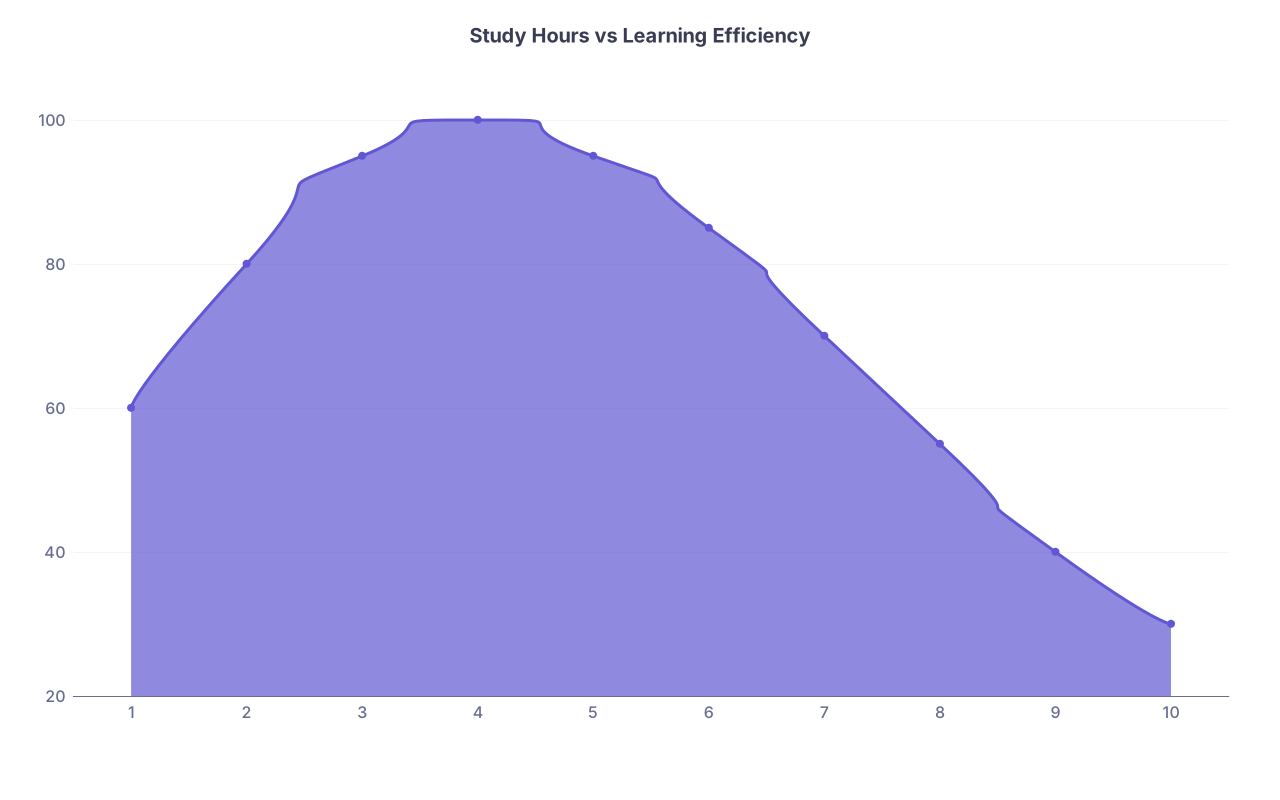
- After about 4–5 hours of truly focused work, your learning efficiency tanks.
- After 8–9 hours of continuous “study,” your error rate and time-on-task go up while retention goes down.
- Chronic sleep deprivation (and med students are pros at this) leads to worse exam scores, slower clinical reasoning, and higher rates of depression and suicidal ideation.
A 2020 meta-analysis in Academic Medicine showed that poor sleep quality in med students is consistently associated with worse academic performance. Not neutral. Worse.
Yet you still hear this:
“I pulled three 16-hour study days before the exam. I feel dead, but I passed, so it worked.”
No. You survived. That’s not the same as “it worked.” Passing despite your strategy doesn’t make the strategy good.
The more accurate equation is something like:
Productive learning hours per day: 3–6 (varies by person)
Beyond that: mostly anxiety-driven busywork.
| Category | Value |
|---|---|
| 1 | 60 |
| 2 | 80 |
| 3 | 95 |
| 4 | 100 |
| 5 | 95 |
| 6 | 85 |
| 7 | 70 |
| 8 | 55 |
| 9 | 40 |
| 10 | 30 |
What that chart says in plain language: at some point, more hours are actively hurting your learning.
You want ruthless efficiency, not martyrdom by flashcard.
If you’re consistently:
- rereading the same paragraph three times
- scrolling UWorld explanations while your brain is mush
- re-doing cards you’ll instantly forget
then you’re not “hardcore.” You’re inefficient.
And mental health-wise? Chronic overwork is directly tied to:
- Higher rates of depression, anxiety, and burnout
- Emotional exhaustion
- Reduced empathy toward patients (yes, this shows up in data)
That’s the stuff that later becomes “I hate medicine but I’ve sunk so much into this I can’t quit.”
Myth #2: “Mental Health Is a Luxury for People With Better Scores”
This one is vicious and common. I’ve heard versions of it in anatomy labs, on the wards, in group chats:
“I’ll worry about balance later. Right now I just need to survive this block.”
“I can’t afford to take care of my mental health until Step 2 is over.”
Let me be clear: mental health is not dessert. It’s basic infrastructure. Treating it like an optional add-on is exactly how you end up truly impaired.
The evidence is ugly:
- Med students have higher rates of depression and suicidal ideation than age-matched peers.
- A JAMA meta-analysis found approximately 27% of med students met criteria for depression or depressive symptoms; about 11% had suicidal ideation.
- Those numbers aren’t “students who didn’t hustle hard enough.” They’re students inside a culture that normalizes self-neglect.
Now the part nobody wants to hear: poor mental health doesn’t just make you feel bad. It wrecks productivity.
- Depressive symptoms → decreased concentration, slower processing speed.
- Anxiety → more time spent spinning and less actual work done (“studying” with 14 tabs open and zero retention).
- Burnout → emotional detachment, which wrecks your clinical performance and evaluations.
So the whole “I’ll sacrifice mental health now to succeed later” idea is mathematically wrong. You will not get to “later” in one piece if you keep taxing the same system you refuse to maintain.

A more honest framework is:
Mental health → cognitive bandwidth → sustainable productivity → performance.
Not the other way around.
You don’t earn the right to protect your brain once your scores are high enough. You protect your brain so you can get and keep those scores.
Myth #3: “If You’re Not Always Behind, You’re Not Pushing Hard Enough”
There’s a weird badge-of-honor culture around being “behind.”
- “I’m so behind on Anki.”
- “I’m three lectures behind, I’m dying.”
- “Lol I have 1,000 UWorld questions left and the exam is in 2 weeks.”
People say it half-joking, half-flexing. Like being underwater is proof you’re taking things seriously.
Here’s what’s actually happening psychologically:
- Chronic “I’m behind” mentality keeps your threat system activated (amygdala, cortisol, the whole mess).
- That threat response makes deep learning harder. You’re in survival mode, not synthesis mode.
- You get short-term bursts of panic-fueled productivity and long-term exhaustion and avoidance.
It also turns studying into a permanent emergency. No wonder your brain associates school with dread.
This state is great for outrunning a bear. Terrible for long-term memory formation, clinical reasoning, or doing a 30-question block without melting down at each wrong answer.
Clinical rotations magnify this. On wards you may see:
- Students bragging about waking up at 3:30 a.m. to pre-round
- People staying 2–3 hours after they’re dismissed “to impress”
- Folks reading 3 different UpToDate articles for every patient “because otherwise I’m lazy”
There is a difference between:
- Leaning in and learning a ton
vs. - Operating from a baseline of “if I’m not drowning, I must be slacking”
That second one is a straight line to emotional exhaustion.
Myth #4: “High Performers Are Always ‘On’”
This myth is subtle but deadly. Students look at the top of the class or the high Step scorers and assume:
“These people must be working all the time. They’re built different.”
I’ve watched the high performers closely. The reality is usually:
They’re not “always on.” They’re precise.
- They know exactly what they’re doing when they sit down.
- They shut things off when done instead of lingering in fake work.
- They protect sleep like a critical resource, not an optional hobby.
Here’s what productivity actually looks like when it doesn’t destroy your mental health:
- 3–5 hours/day of truly focused, strategic study (active recall, question-based).
- Consistent, not heroic. Think 6 days/week, not 3 days of nothing and 2 days of 14 hours.
- Predictable downtime that’s real—phone away, not doomscrolling in bed pretending it’s “rest.”
| Pattern Type | Typical Day | Mental Health Impact |
|---|---|---|
| Cram/Crash | 0–2 hrs most days, then 10–14 hrs right before exams | High anxiety, sleep disruption, burnout cycles |
| Constant Grind | 8–12 hrs daily, no days off | Chronic stress, emotional exhaustion, detachment |
| Focused Consistent | 3–6 hrs real work, scheduled breaks & rest days | Better mood, more stable performance |
The students who look suspiciously calm before exams aren’t necessarily “naturally gifted.” Many just refused to buy into the fantasy that suffering more equals scoring more.
What destroys mental health is the pressure to be “always on”:
- Checking emails from attendings at midnight “just in case”
- Feeling guilty watching a movie because “I could be doing Anki”
- Carrying a constant background narrative of “I should be studying right now”
That constant guilt is cognitive load. It soaks up energy even when you aren’t actually working.
If you protect off time, your on time gets sharper. That’s not soft. That’s strategy.
Myth #5: “You Can Time-Manage Your Way Out of Systemic Problems”
Let’s address the elephant: some of the distress you feel is not a “you” problem. It’s structural.
- Preclinical curricula that drown you in volume and pretend everything is equally important.
- High-stakes exams that compress your anxieties into one or two test days.
- Clerkships where expectations are vague, feedback is rare, and mistreatment is hand-waved as “old-school teaching.”
- A hidden curriculum that says: never complain, never need help, always say “I’m fine.”
You cannot bullet-journal your way out of that.
And when med schools respond to rising depression rates with “resilience workshops” and optional meditation sessions but keep the same abusive structures? That’s not wellness. That’s gaslighting.
Yes, individual strategies matter. But if you’re internalizing every bit of suffering as “I’m just not organized enough,” you’re shoulder-carrying institutional failure.
So let’s be exact:
- You are responsible for how you use your limited time and energy.
- You are not solely responsible for a system that demands more than is human, then calls you “unprofessional” when you crack.
The mental health damage comes from thinking every struggle means you’re weak or lazy. Often, it means you’re reacting normally to an abnormal environment.
That distinction matters.
Myth #6: “If I Slow Down, I’ll Fall Behind Forever”
Fear of falling behind is the leash that keeps people in unsustainable patterns.
You know the thoughts:
- “If I take tonight off, tomorrow will be impossible.”
- “If I don’t keep grinding, I’ll never catch up again.”
- “If I ask for help, people will know I can’t handle it.”
But look at what actually happens when students do slow down strategically:
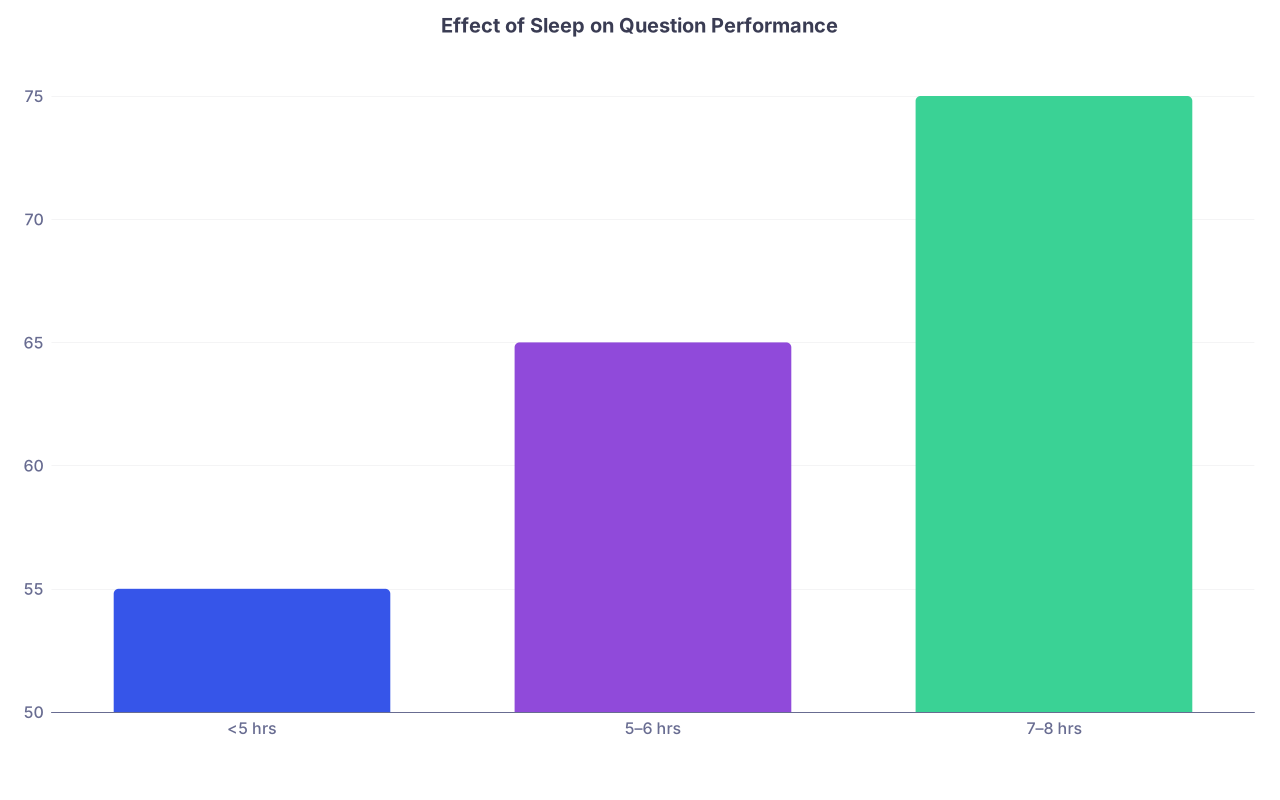
- Sleep goes up → recall improves → fewer re-review cycles → less time wasted.
- Mood stabilizes → procrastination drops → you need fewer hours to push through.
- You start choosing high-yield tasks instead of flailing across 6 resources.
| Category | Value |
|---|---|
| <5 hrs | 55 |
| 5–6 hrs | 65 |
| 7–8 hrs | 75 |
That’s a rough reflection of what many students see on NBME/UWorld performance: more sleep, higher correct percentages. Yet people keep cutting sleep like it’s extra fat.
I’ve seen students:
- Take a full day off each week during dedicated and still score >250 on Step 1 (back when it was scored).
- Protect 7–8 hours of sleep on rotations and still get honors and strong evals.
- Withdraw from a course for mental health, re-enter with support, and end up matching into competitive specialties.
Slow down intelligently, and you don’t “fall behind forever.” You regain the capacity to actually move forward.
So What Does Non-Destructive Productivity Look Like?
Here’s the non-romantic, actually-sustainable version of productivity in med school life and exams:
You cap your effective work.
Not “I study until I can’t see straight,” but “I do 4–6 hours of real, hard focus and then I am done.”You schedule rest like a requirement, not a reward.
One protected evening or half day every week where school doesn’t get to exist.You pick a few tools and ignore the rest.
Anki + class notes + one Qbank, for instance. Not six overlapping resources “just to be safe.”You treat sleep as non-negotiable during exam periods.
Seven hours minimum whenever possible. If you’re sacrificing sleep for more passive review, that’s a bad trade.You treat mood changes as data, not weakness.
Can’t get out of bed, constant dread, intrusive thoughts about quitting or dying? That’s not “I’m just stressed.” That’s a sign you need help. Early.

| Step | Description |
|---|---|
| Step 1 | Protected Sleep |
| Step 2 | Better Focus |
| Step 3 | Higher Quality Study |
| Step 4 | More Retention |
| Step 5 | More Confidence |
| Step 6 | Lower Anxiety |
That loop is the opposite of the grind culture death spiral.
The Silent Cost: Identity and Self-Worth
One last thing people underestimate: the productivity myths don’t just wreck your schedule. They quietly rewrite how you see yourself.
When your value = how many questions you did today or how many hours you logged, then:
- A slow day becomes a moral failure.
- A low score becomes proof you’re “not meant for this.”
- Rest feels like cheating.
That mindset is rocket fuel for depression.
You are not a walking UWorld report. You’re a human learning how to think, reason, and care for patients in a deeply flawed system.
If a “productivity” framework makes you forget that, it’s not productivity. It’s indoctrination.
The Bottom Line
Three things to walk away with:
- More hours and more suffering don’t reliably equal better performance. Past a point, they just equal worse mental health and less efficient learning.
- Mental health is not optional or something you postpone until you’re “caught up.” It’s the foundation of any sustainable success in medical school and beyond.
- If your productivity system makes you feel constantly behind, guilty when resting, and terrified to slow down, it’s a bad system—not a reflection of your worth.
Stop glorifying the grind. Start respecting the biology of your own brain. That is the only productivity framework that does not eventually eat you alive.