
The cult of the 14‑hour study day is toxic, unscientific, and—ironically—terrible for your scores.
Let me be blunt: the students who brag about studying “14–16 hours a day” are either exaggerating, miscounting, or burning out in slow motion. The data from cognitive psychology, sleep research, and actual performance outcomes all say the same thing: extreme study marathons are a terrible strategy for long‑term retention, exam performance, and mental health.
The top students? They’re not superhuman grinders. They’re ruthless editors of their time and surprisingly protective of their energy.
Let’s dismantle this myth properly.
The 14-Hour Day: What’s Real and What’s Instagram
You’ve heard it on rounds:
“I studied 14 hours a day for Step.”
“I was in the library from 7 a.m. to midnight.”
“If you’re not doing 12+ hours, you’re not serious.”
Here’s the truth: “time in study mode” is not the same as “time actually learning.” When someone says they studied 14 hours, what’s actually happening?
- Phone checks every few minutes
- Re-reading the same paragraph 3 times
- Drifting during videos
- “Studying” while on group chat, Discord, or Reddit
- Hour-long “breaks” that magically don’t get subtracted
Cognitive psychologists have been measuring this for years. When you track real, focused, cognitively demanding work, most people max out around 3–6 hours per day of deep learning. After that, you’re basically spending calories to feel productive.
Cal Newport calls it “deep work.” Anders Ericsson’s expertise research puts deliberate practice in a similar range. Neuroscience labs tracking mental fatigue show performance drops, error rates rise, and retention plummets after sustained heavy effort.
So yes, you can sit in a chair for 14 hours. That’s not the same as 14 hours of useful studying.
What The Data Actually Says About Learning
Let’s pull this out of opinion and into evidence.
The last several decades of cognitive science have repeatedly found that a few specific strategies drive learning:
- Retrieval practice (testing yourself, questions, flashcards)
- Spaced repetition (intervals, not cramming)
- Interleaving (mixing topics)
- Active problem solving, not passive rereading
- Adequate sleep to consolidate memory
None of these are “sit in a chair all day until you hate everything.”
High-yield, research-backed methods are shockingly time efficient. A med student doing:
- 2–3 hours of solid question-based learning
- 1–2 hours of targeted review/spaced repetition
- 1–2 hours of lighter content (videos, reading)
…consistently outperforms the student rereading notes for 10 straight hours.
Let’s visualize how effectiveness actually falls off.
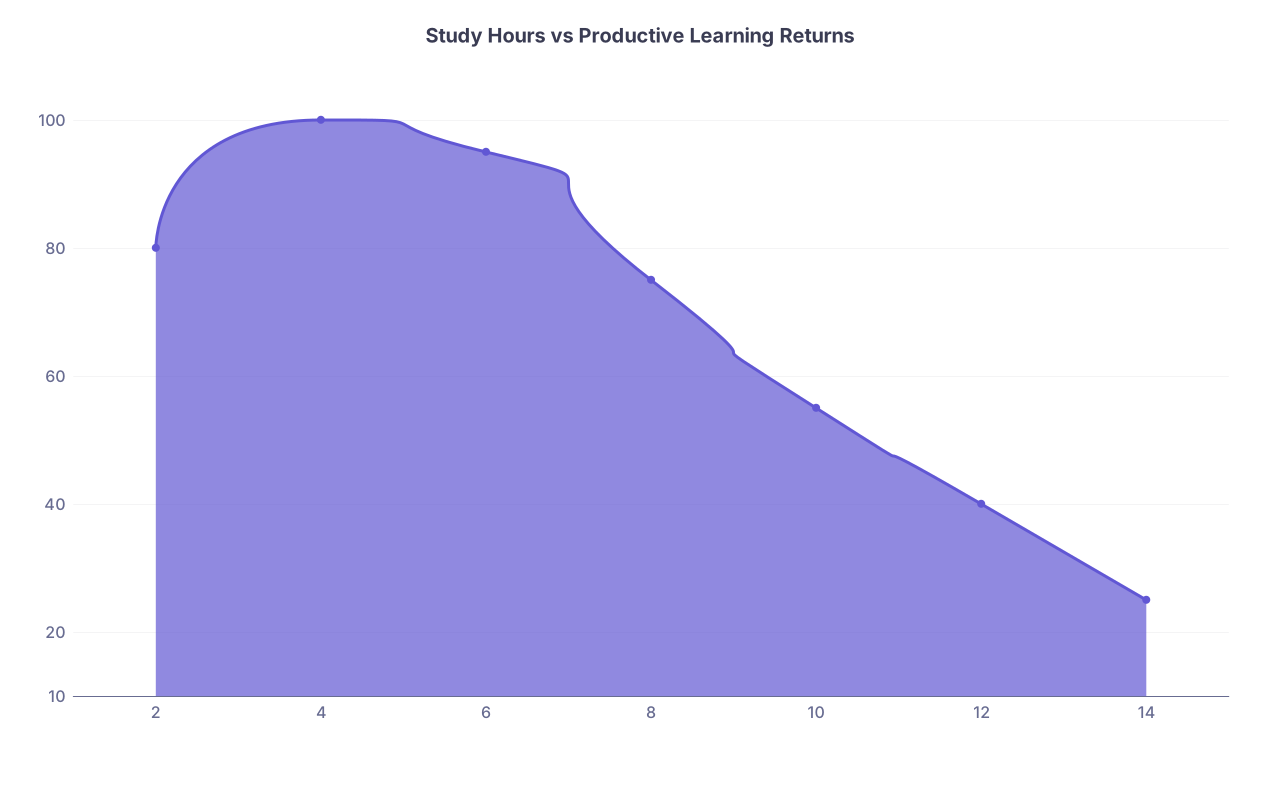
| Category | Value |
|---|---|
| 2 | 80 |
| 4 | 100 |
| 6 | 95 |
| 8 | 75 |
| 10 | 55 |
| 12 | 40 |
| 14 | 25 |
Interpretation:
- 4–6 focused hours? Near-peak returns.
- 8–10 “study” hours? Declining marginal benefit.
- 12–14 hours? You’re mostly hurting retention and accuracy.
This is exactly what top students figure out early: they chase effective hours, not big numbers.
Medical School + Mental Health: The Cost of the Grind Myth
Now let’s talk about the part people like to ignore: mental health.
Long hours are not just inefficient academically; they’re directly tied to:
- Higher burnout
- More depressive symptoms
- Worse sleep
- Higher error rates
Multiple surveys (e.g., Medscape, JAMA studies on resident and student mental health) show that burnout and depressive symptoms correlate strongly with long work hours, low control over time, and chronic sleep deprivation. You’re voluntarily recreating that as a student when you commit to 14‑hour “study days.”
And here’s the twisted part: students often blame their mental health on not working hard enough, then respond to feeling worse by trying to study even longer. That’s like responding to hyponatremia by drinking more water.
You don’t see the healthy top performers loudly proclaiming “I study 16 hours a day.” You see them:
- Leaving the library at 6–7 p.m.
- Going to the gym
- Sleeping by 11
- Saying “no” to extra low-yield commitments
The grind myth survives because people over-report intensity and under-report the recovery that actually keeps them functional.
What Top Students Actually Do (That No One Brags About)
Here’s the part nobody posts on Instagram: the best students are boringly systematic.
They’re not magical. They’re just consistent and unsentimental about what works.
1. They Cap Their Real Work
Most top students I’ve worked with or talked to in med school/Step prep land in this rough range on normal days:
| Phase | Focused Hours/Day | Comment |
|---|---|---|
| Pre-clinical exam blocks | 4–6 | Plus lectures/labs |
| Dedicated Step 1/2 prep | 6–8 | With real breaks |
| Light rotation + exam | 2–4 | Strategic and focused |
| Heavy rotation | 0.5–2 | Maintenance only |
Could they sit longer? Yes. Would scores improve? Almost always no.
They plan their day around a specific amount of work (e.g., 80–120 UWorld questions with review, Anki reviews done, 1–2 videos) rather than a macho number of hours.
2. They Use Active, Not Heroic, Strategies
They’re not:
- Rewriting notes endlessly
- Watching 10 hours of videos daily
- Highlighting everything like it’s sacred text
They’re doing:
- Question banks as the primary driver (UWorld, NBME practice)
- Spaced repetition (Anki or similar – but bounded, not 1,500 reviews a day)
- Brief, targeted content when they identify a knowledge gap
The result: fewer hours, more retention, less panic.
3. They Protect Sleep Like It’s a Drug
Study after study: less than 6 hours of sleep leads to worse working memory, attention, and test performance.
Yet medical students still treat sleep like an optional hobby.
The students consistently at the top of their class? They’re usually the ones who say things like:
- “I shut it down by 11.”
- “I don’t pull all-nighters, they wreck me.”
- “If my sleep slips, my scores slip.”
They know that sleep is memorization. No sleep → no consolidation → wasted studying.
The Psychology of Overstudying: Why You Think You Need 14 Hours
The 14‑hour myth survives not because it works, but because it comforts anxiety.
Here’s the pattern I’ve seen repeatedly:
You feel behind → You panic → You double your hours → Your fatigue rises → Your efficiency drops → You feel more behind → Repeat.
It becomes a superstition: “If I’m not miserable and maxed out, I’ll fail.”
But your brain doesn’t care how guilty or anxious you feel. It only cares if:
- You revisit material over time
- You actively retrieve it
- You’re rested enough to encode and recall
There’s also survivor bias: the one person who claims they studied 14 hours and did well becomes a legend. You don’t see the 50 who did that and crashed, scored average, or burned out of medicine entirely.
The grind myth is basically medical school’s version of “hustle culture.” It feels heroic. It’s bad science.
A Realistic High-Performance Study Day
Let’s make this concrete. What does a top-performing, mentally healthy study day actually look like for a preclinical exam block or dedicated board prep?
This is obviously variable, but the shape is pretty consistent.
Example: 7–8 Hour Effective Study Day
08:00–08:30 – Light warmup
- Quick Anki/spaced repetition
- Glance at plan for the day
08:30–10:30 – Deep work block #1
- 40 UWorld questions in timed/tutor mode
- Thorough review of correct and incorrect answers
10:30–11:00 – Break
- Snack, short walk, no studying
11:00–13:00 – Deep work block #2
- Another 40 questions and review
- Make 2–5 targeted flashcards if needed
13:00–14:00 – Lunch + real disconnect
14:00–15:30 – Lighter cognitively
- Short video segments or reading on weak topics identified from questions
- No passive marathons
15:30–16:00 – Break
16:00–17:30 – Spaced repetition & consolidation
- Finish Anki
- Brief outline or whiteboard summary of 2–3 key “big picture” connections
17:30–18:00 – Plan next day, shut down
After that: gym, hobbies, social life, or just lying on the floor questioning your existence like a normal med student.
Is this demanding? Yes. But it’s not a 14‑hour hostage situation. It’s about 7–8 hours of mostly targeted work with breaks and a finish line.
Now compare that to someone “studying” 14 hours:

| Step | Description |
|---|---|
| Step 1 | Start Day |
| Step 2 | Efficient Plan |
| Step 3 | Marathon Mindset |
| Step 4 | 4-6 hrs deep work |
| Step 5 | 2 hrs lighter review |
| Step 6 | Evening recovery |
| Step 7 | Better retention & mood |
| Step 8 | Scattered 12-14 hrs |
| Step 9 | Low focus, high fatigue |
| Step 10 | Poor retention & burnout |
The second student feels more “hardcore.” The first student scores higher and survives mentally.
Why This Matters for Mental Health (Not Just Scores)
This category is “medical school mental health,” so let’s stop pretending this is just about exam curves.
Your brain is not a disembodied algorithm. Overload it long enough and you don’t just get:
- Lower scores
- More mistakes
You get:
- Flat affect
- Loss of motivation
- Anhedonia
- Anxiety that doesn’t turn off even when you’re “not studying”
I’ve seen students who pushed 12–14 hour days for boards end up:
- Scoring worse than their practice tests
- Developing new-onset panic attacks
- Considering leaving medicine after the exam
- Needing months to emotionally recover
And yes, I’ve also seen students who studied reasonable hours, protected sleep, exercised, and walked into test day nervous but not destroyed—and performed right in line with or above their practice metrics.
The point is not that “working hard is bad.” The point is that confusing self-harm with discipline is bad.
How to Break Out of the 14-Hour Trap
If you’re currently in grind mode and feel trapped, here’s the evidence-based way out.
You don’t need a 30‑page productivity manual. You need a few decisive shifts:
Set work targets, not hour targets
Example: “80 questions + full review + all reviews in Anki + 1 hour video on weak topic.” When that’s done, you’re done.Track real focus
Use a timer (Pomodoro, Toggl, Forest – whatever) and count only honest, focused minutes. You’ll realize quickly how fantasy‑based “14 hours” really is.Cap your day before your brain gives out
Commit to a hard stop time. 9–10 p.m. latest for anything serious. After that, you’re faking it.Protect sleep as non-negotiable
7–8 hours. Not negotiable. You wouldn’t tell a patient to cut sleep to cram more work; don’t do it to yourself.Do one thing for your body daily
20–30 minutes of walking, gym, yoga, whatever. This is not luxury. It’s maintenance.
You’ll feel guilty at first. That’s just withdrawal from the grind culture, not evidence you’re failing.
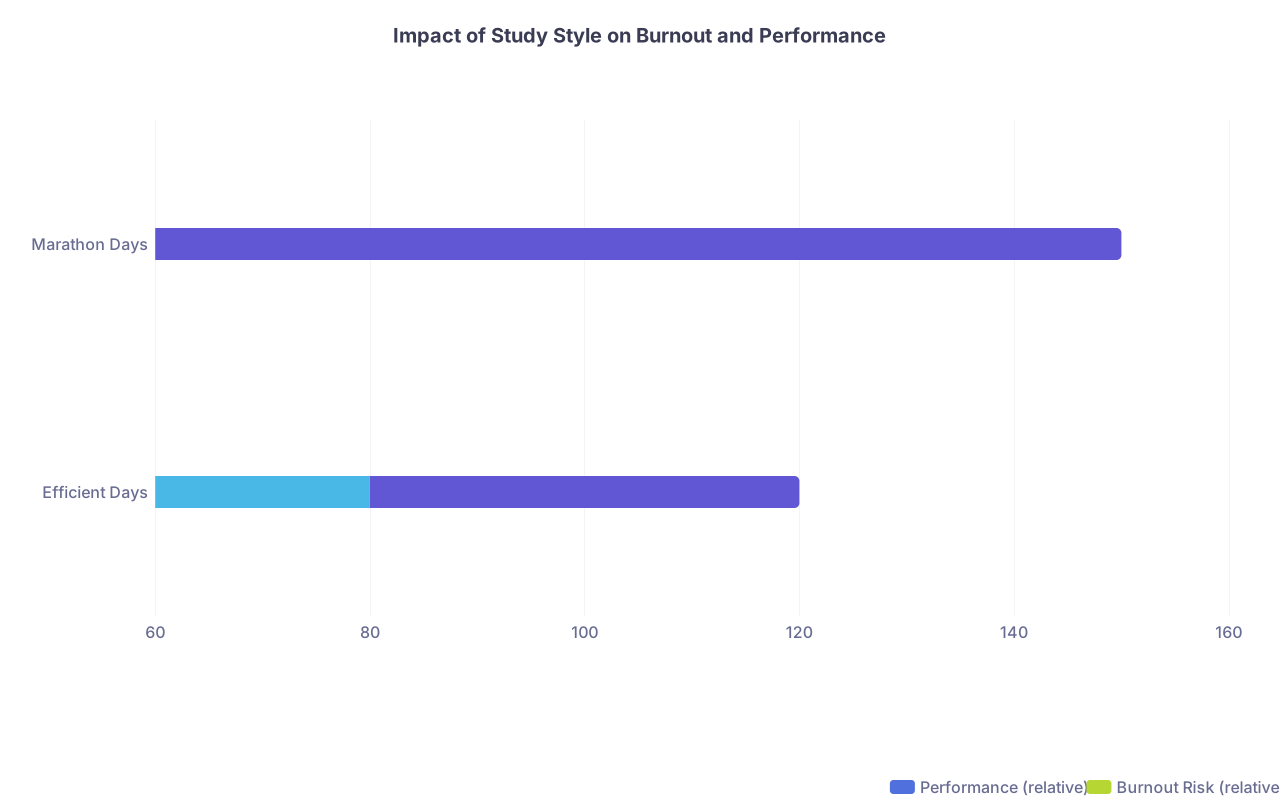
| Category | Performance (relative) | Burnout Risk (relative) |
|---|---|---|
| Efficient Days | 80 | 40 |
| Marathon Days | 60 | 90 |
The “efficient day” student does a bit less raw volume, gets better performance, and roughly half the burnout risk. That’s the trade you want.
Frequently Asked Questions
1. Is it ever necessary to study 12–14 hours in a day?
Necessary? No. Possible? Yes—during rare crunch days. A looming exam, huge content gap, or accumulated procrastination might force a brutal day or two. But as a routine strategy, it’s counterproductive. If you “need” 14 hours every day, the problem isn’t your dedication; it’s your planning and study method.
2. How many hours should I study per day in medical school?
There’s no magic number, but most high performers end up around:
- Preclinical exams: 4–6 focused hours (plus required class/lab)
- Dedicated board study: 6–8 focused hours, with breaks
If you’re consistently pushing past that and still not keeping up, you likely have a strategy problem, not a hours problem.
3. What if my classmates really are studying 14 hours and I feel behind?
Some of them are exaggerating. Some are counting everything (walking to the library, lunch with First Aid open) as “studying.” A tiny minority might actually be grinding that long—and many of them are quietly burning out or learning inefficiently. Stop benchmarking your worth by raw hours. Benchmark by: Am I retaining? Are my practice scores improving? Am I still vaguely human?
4. Can I do well on Step 1/Step 2 without insane study days?
Yes. Thousands do every year. The consistent pattern in high scorers is not “I studied 14 hours a day.” It’s:
- “I did UWorld thoroughly.”
- “I stuck with Anki/spaced repetition.”
- “I took care of my sleep.”
- “I was consistent for months, not superhuman for two weeks.”
5. How do I know if I’m overstudying to the point of harming my mental health?
Red flags:
- You feel guilty anytime you’re not studying.
- Your sleep is routinely <6 hours.
- You’re irritable, numb, or crying over minor setbacks.
- Practice performance is flat or declining despite more hours.
If that’s you, more hours won’t fix it. You need to scale back, clean up your approach, and possibly talk to student health or counseling. That’s not weakness; that’s basic maintenance of the organ you’re trying to use to pass these exams.
Key points:
- 14‑hour study days are mostly myth, ego, or panic—not an evidence-based path to top scores.
- Top performers win with focused hours, active methods, and ruthless protection of sleep and sanity.
- Your brain is your career; treating it like an expendable engine is not “hard work.” It is sabotage.