
The idea that “burnout is just part of med school” is not tough, resilient wisdom. It is learned helplessness dressed up as culture.
Let me be blunt: chronic burnout, constant anxiety, and creeping depression are not inevitable features of medical training. They are predictable outcomes of bad systems and bad beliefs that everyone keeps repeating because “that’s how it was for us.”
The data do not support the fatalistic story you’ve been sold.
What the Numbers Actually Show About Med School Mental Health
First, strip away the folklore and look at real numbers.
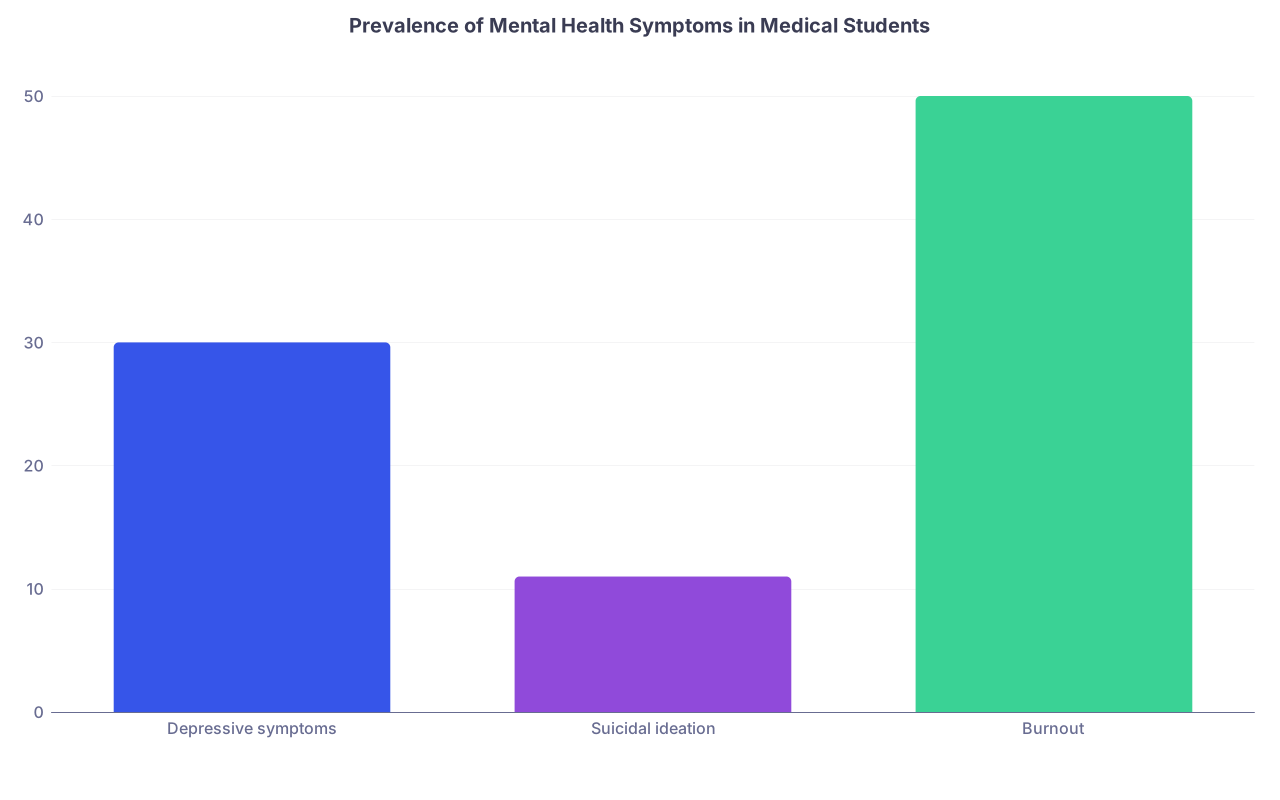
Multiple meta-analyses covering tens of thousands of medical students around the world have found:
- Depressive symptoms in med students: roughly 27–30%
- Suicidal ideation: around 11% over 12 months
- Burnout rates: typically 40–60%, depending on how it’s measured
This isn’t “everyone is a little stressed.” This is: a third of your class meeting criteria for depression and half experiencing burnout.
| Category | Value |
|---|---|
| Depressive symptoms | 30 |
| Suicidal ideation | 11 |
| Burnout | 50 |
Here’s the myth: “That’s just what med school does to you. You survive, you move on.”
No. When you follow cohorts longitudinally, mental health worsens after starting medical school compared with baseline. That matters. Because it means med school is not just revealing who “can’t handle it” — it is actively harming a subset of otherwise healthy people.
And the most important point: there is huge variability between schools and programs. Different hours. Different cultures. Different support systems. Different rates of burnout and depression.
If this suffering were “just part of becoming a doctor,” those differences would not exist.
Harmful Belief #1: “Burnout Is Normal in Med School”
This is the big one. You’ve heard it from upperclassmen, faculty, maybe even your dean.
“Everyone’s burned out.”
“It’s just a phase.”
“Third year is supposed to suck.”
They say it like a weather report. Inevitable. Untouchable.
Here’s what’s wrong with that.
First, the word “burnout” itself gets abused. Being tired after a 14-hour study day before exams? Not burnout. Being frustrated after a bad eval? Not burnout.
Clinically, burnout is a triad:
- Emotional exhaustion
- Depersonalization (you stop seeing patients — and yourself — as people)
- Reduced sense of personal accomplishment
Chronic, not just a bad week.
When people normalize this, they do three damaging things at once:
- They discourage early help-seeking. If you believe “everyone is like this,” you wait until you are completely nonfunctional before reaching out.
- They shift blame away from systems. If burnout is “normal,” then the 80-hour study weeks, humiliation-based teaching, and exam-loaded schedules get a free pass.
- They lower your standards for your own life. You start telling yourself that being empty is the cost of being “serious.”
The evidence absolutely does not say burnout is some badge of honor. Higher burnout in training is associated with:
- Poorer academic performance
- More self-reported medical errors and lower professionalism
- Higher rates of substance misuse
- Later career dissatisfaction and early exit from medicine
I’ve watched students who normalize burnout walk straight into residency on fumes. Then intern year hits, and they don’t have any buffer left. The system calls it “lack of resilience.” That’s nonsense. It’s cumulative injury.
Burnout is common. But common is not the same as normal. Tooth decay is common. We still treat it.
Harmful Belief #2: “If You’re Struggling, You Just Can’t Handle Medicine”
This one is more insidious because people rarely say it out loud. They imply it.
The student who takes an extra year for a leave? “Maybe this isn’t for them.”
Someone discloses they’re on an SSRI? There’s a pause. A subtle tilt in the room.
Here’s what the data actually shows: struggling in med school is strongly linked to the environment and prior vulnerability, not some mythical personality flaw.
Risk factors for depression, anxiety, and burnout in med students include:
- Pre-existing mental health history (obvious)
- Perceived mistreatment, humiliation, or discrimination
- High debt and financial insecurity
- Lack of social support and belonging
- Rigid, high-stakes evaluation systems with little feedback
None of those are “you just can’t cut it.” They are structural and contextual.
We also know that many of the students who suffer the most are the ones who care the most. The perfectionists. The conscientious ones. The students who ruminate about missed questions for hours and overprepare for every patient they see. Medicine lives off them — and then gaslights them when the system eats them alive.
If emotional distress were a marker that you “don’t belong,” then residency programs wouldn’t be scrambling to figure out why so many residents — the ones who “made it” — are depressed or quitting.
The people who concern me most are not the ones who cry in a dean’s office and say, “I need help.” It’s the ones who’ve fully internalized that if they hurt, it’s because they’re weak. Those are the students who white-knuckle everything and show up in crisis when they finally crack.
You’re not broken for reacting to a broken setup.
Harmful Belief #3: “You Can Either Be Healthy or You Can Excel”
This is the false binary that keeps achievers stuck.
You hear versions of it constantly:
“If you want to honor this clerkship, expect to have no life.”
“Just grind for four years, then you’ll have time to be well.”
“Nobody who matches derm sleeps.”
It’s nonsense. And it’s empirically wrong.
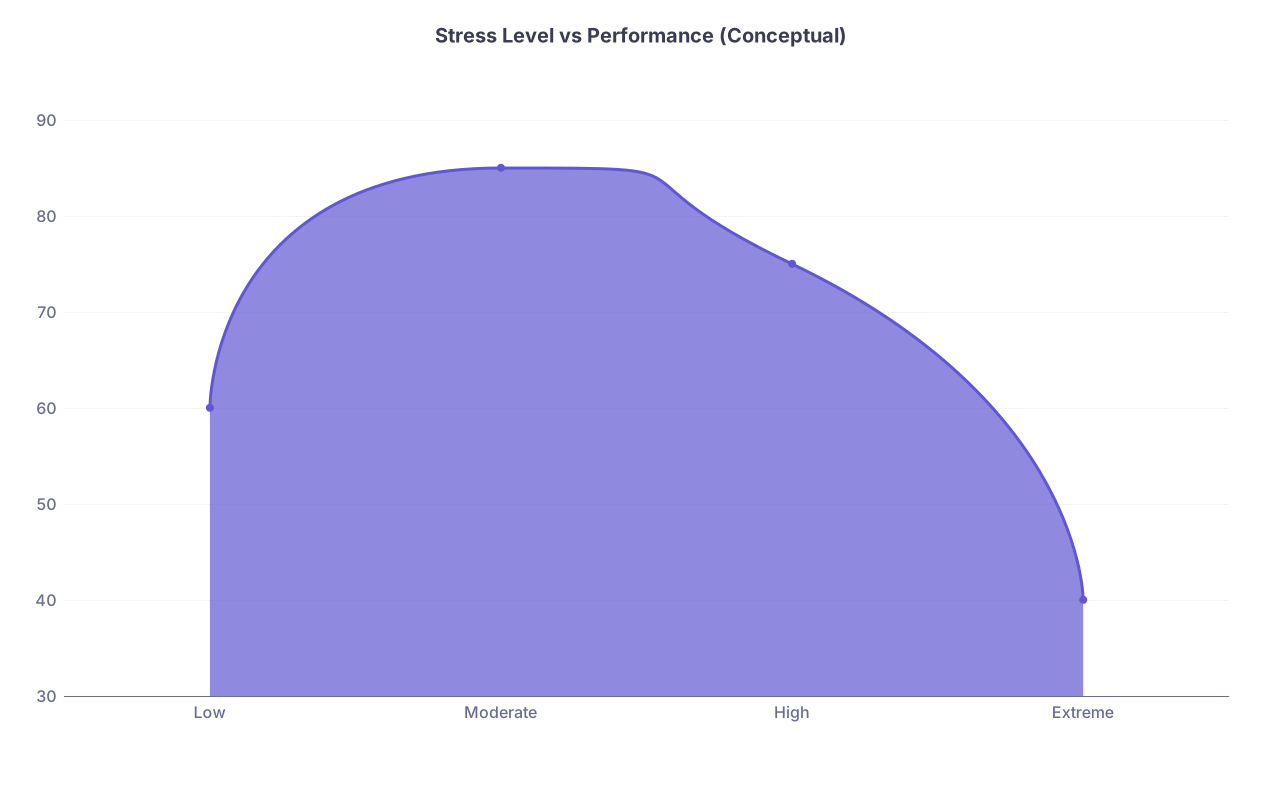
When you actually study performance and well-being, you see a U-shaped curve. A little stress? Fine. Motivating even. Chronic high stress, sleep deprivation, and mental illness? Cognitive performance tanks.
There are studies linking higher depressive symptoms and burnout with:
- Worse exam performance
- Slower clinical reasoning
- More frequent errors in simulated and real clinical tasks
The catch is this: the people who pull slightly back from the edge — who sleep 7 hours instead of 4, who exercise 3 times a week, who protect a few relationships — often believe they’re doing worse than their all-nighter classmates, even when their scores are similar or better.
Why? Because the culture worships visible suffering. We fetishize the person in the library at 1 a.m., not the person who quietly studied well, shut their laptop at 10, and went home.
I’ve watched students:
- Drop 10–15 study hours a week to reclaim sleep and basic exercise
- See Step scores improve because their brain finally had consolidation time
- Feel less like impostors because their memory and reasoning actually functioned when it mattered
The belief that “being healthy means accepting mediocrity” is exactly backwards. Long-term excellence is incompatible with chronic self-neglect.
| Category | Value |
|---|---|
| Low | 60 |
| Moderate | 85 |
| High | 75 |
| Extreme | 40 |
Harmful Belief #4: “You Should Wait Until Things Are Really Bad to Get Help”
Translated: “Don’t be dramatic.”
Students internalize this quickly. Counseling is seen as a last resort. Leaves of absence are whispered about like a shameful secret. Meanwhile, everyone proudly compares hours studied and cups of coffee like combat scars.
Look at how this plays out.
Med students consistently report:
- High rates of depressive symptoms
- Low rates of formal treatment seeking compared to non-med peers
- Fear of stigma and licensing consequences as a major barrier
Two problems with this “wait until it’s bad” mindset.
First, you’re a worse judge of your own deterioration than you think. I’ve sat through versions of the same conversation:
“I mean, I’ve been crying a lot, but I’m still passing, so I’m fine.”
“I can’t remember the last day I wasn’t anxious, but that’s normal, right?”
By the time you think “OK, this is really bad,” the people around you have likely been worried for weeks.
Second, early intervention works. Basic CBT skills, medication when indicated, modest schedule adjustments, time-limited leaves — these are not career-enders. They’re damage control.
But because the culture whispers “you’re weak if you need that,” students delay until their only options are dramatic: major leaves, failing courses, hospitalizations. Then everyone wrings their hands and asks how it got so bad.
It got that bad because the unofficial rule was: “Don’t make a fuss.” That rule is killing people, literally.
Harmful Belief #5: “Only External Fixes Matter, So There’s Nothing You Can Do”
Now let me flip to the other side, because there’s a subtle trap here.
Some students swing all the way from “it’s all my fault” to “it’s all the system’s fault, and until they fix it, I’m helpless.” That’s also wrong.
Yes, we need systemic change. Duty hours, assessment structure, culture of teaching, financial pressures — all of that. But large systems move at glacial speed. You don’t have 10 years to wait for the perfect wellness committee redesign while you disintegrate in real time.
The frustrating reality: both things are true.
The system is harmful and there are levers you can pull that move your personal needle more than you think.
No, I don’t mean lavender oil and gratitude journals while on 28-hour call.
I mean:
- Tight, protected sleep windows that you treat like an exam obligation
- Saying “no” to extra research or leadership roles you’re adding purely out of fear
- Scheduling mental health visits the same way you schedule OSCEs — non-optional
- Quietly choosing study methods that work for you, even if everyone else is watching 4x speed videos till 2 a.m.
I’ve watched students stop going to a popular but dysfunctional study group and gain back 8 hours a week and 20 points on practice exams. No “self-care” quotes on Instagram, just less nonsense.
The myth that “you’re powerless until the system changes” keeps you stuck in passive resentment. You’re not powerless. You’re constrained — those are different things.
What Actually Helps (Based on Data, Not Vibes)
Let’s talk about what actually moves outcomes in this mess, because some things do.
| Intervention Type | Evidence of Benefit |
|---|---|
| Confidential counseling | ↓ depression, ↓ distress |
| Mindfulness / CBT programs | ↓ stress, ↓ burnout scores |
| Pass/Fail preclinical | ↓ anxiety, similar exam scores |
| Duty hour / workload tweaks | ↓ burnout, ↑ satisfaction |
| Strong mentoring culture | ↑ well-being, ↑ belonging |
Schools that shifted to true pass/fail preclinical grading saw lower anxiety and comparable board outcomes. Programs that built real, protected mental health services — not token wellness pizza lunches — saw more students engage earlier and less severe crises later.
On the individual side, students who:
- Protected 7–8 hours of sleep on most nights
- Maintained even 2–3 short exercise bouts a week
- Had at least one non-med identity they kept alive (music, family role, religious community, whatever)
…had lower burnout and depression scores, even at similarly demanding schools.
None of this is magic. It’s not even particularly “wellness brand” friendly. It’s boring, structural, and annoyingly practical. But it works better than pretending you’re a heroic machine until you crash.
How to Start Believing Something Different
If you want to stop absorbing these harmful beliefs, you need to do something that goes against the hidden curriculum: you have to mentally separate medicine from this version of training.
Medicine is not inherently incompatible with mental health. Certain ways of structuring training are.
So, here’s the mindset shift I’d argue for:
- Treat your mental health like a core competency, not a side quest. If you wouldn’t blow off learning how to read an EKG, don’t blow off learning how your own brain destabilizes under chronic stress.
- Refuse to use “normal” as your standard. Ask: “Is this acceptable?” Not “Is this common?” Very different question.
- Stop glorifying dysfunction in others. When a classmate brags about not sleeping, don’t be impressed. Be cautious. The more you reward that narrative, the more trapped you’ll feel by it.
You will still have hard rotations. You will still have bad days and rough weeks. This is not a manifesto for painless training — that doesn’t exist.
But there’s a canyon of difference between “this is hard” and “my suffering means it’s working.”
Only one of those deserves to survive.
The Bottom Line
Three core points you should not let go of:
- Burnout, depression, and anxiety in med school are common, but they are not “normal” or inevitable — they are heavily shaped by fixable systems and beliefs.
- Struggling does not mean you “can’t handle medicine”; it usually means you are reacting reasonably to unreasonable conditions. Early help-seeking is a strength, not a red flag.
- Protecting your mental health is not in conflict with high performance; over the long run, it is the only way to sustain it without breaking.
If anyone tells you that being miserable is just “part of the process,” understand what they’re really saying: “We were harmed, and we didn’t know how to fight it.” You can learn from their experience without repeating their mistakes.