
Seventy percent of medical students report moderate to severe psychological distress at some point during their training—yet a substantial fraction of them were doing just fine, even thriving, before school started.
So no, medical school stress is not some fixed, universal law of nature. It is a pattern. And patterns have causes.
The convenient story is, “Med school is just inherently brutal; everyone will be miserable; suck it up.” That story lets institutions off the hook and puts all the blame on individual “resilience.” It also does not hold up well when you actually look at longitudinal data that follow the same students over time.
Let’s walk through what the data actually show and puncture a few sacred myths.
What Longitudinal Studies Actually Show About Med Student Stress
Longitudinal studies track the same people across time. That’s exactly what you need if you want to answer the question “Is stress inevitable?” rather than “How stressed are students at a single time point?”
Across countries and school systems, the pattern repeats: students come in mentally healthier than age-matched peers, then deteriorate after the training environment hits them.
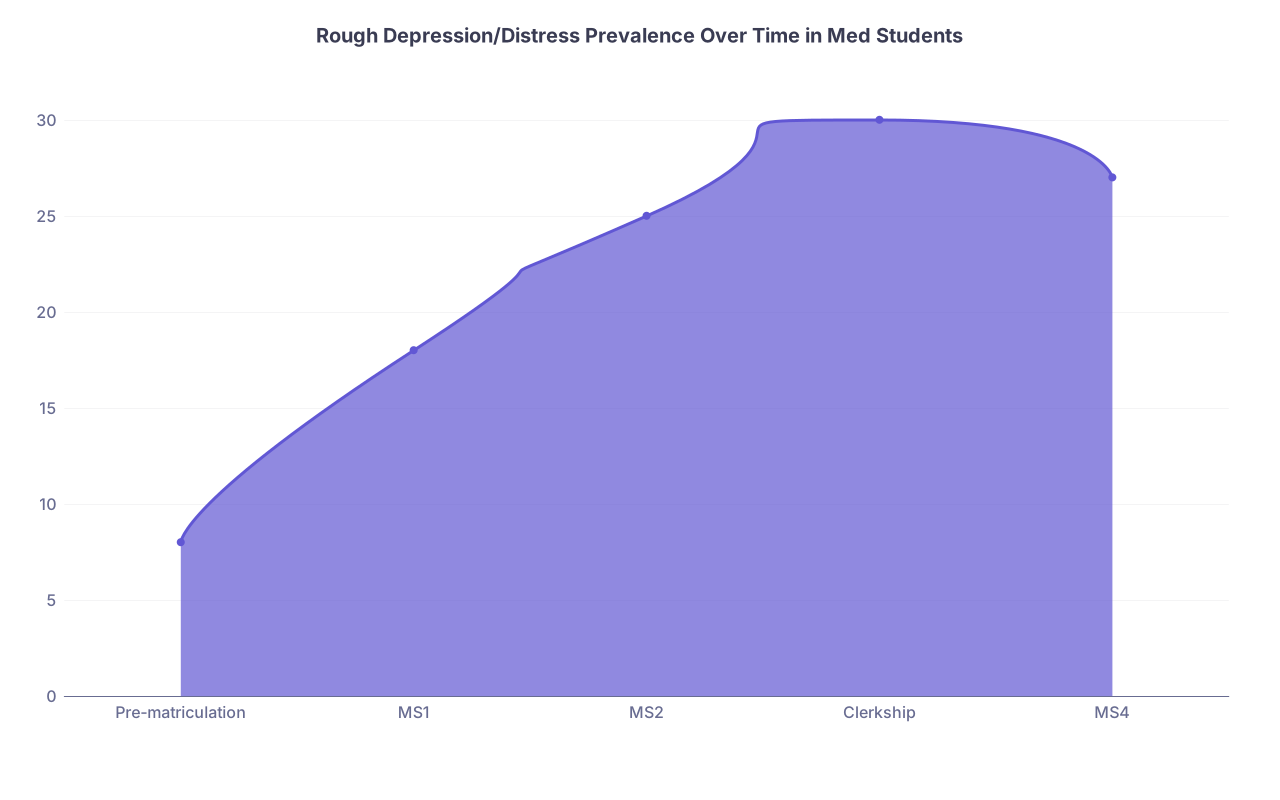
Classic example: A multi-year study in the U.S. and Canada following medical students from pre-matriculation into training showed that:
- Before starting, med students had lower depression and better quality of life than the general population.
- By the end of their first or second year, their depression and anxiety rates exceeded non-medical peers.
- Burnout and emotional exhaustion rose sharply and stayed elevated through clinical years.
| Category | Value |
|---|---|
| Pre-matriculation | 8 |
| MS1 | 18 |
| MS2 | 25 |
| Clerkship | 30 |
| MS4 | 27 |
Those percentages vary by study, but the direction doesn’t. They start relatively well. The environment drags them down.
There are two uncomfortable implications:
- The problem is not that med students are inherently fragile. They’re actually a pretty robust group at baseline.
- Stress and distress are emergent properties of how we structure training—assessments, workload, culture, support—rather than some intrinsic “med school = suffering” equation.
And here’s the kicker: those same longitudinal studies also show substantial variation. Not everyone crashes. Some students remain stable. A minority even improve in some mental health domains with the right supports.
So “inevitable”? No. “Statistically likely if we keep doing things the same way”? Absolutely.
Myth 1: “Everyone Is Miserable—It’s Just Part of the Process”
I hear this exact sentence from residents when they talk to MS2s about Step 1 prep: “Look, everyone’s miserable. That’s just med school.”
The data say otherwise. Everyone is stressed at times. Not everyone is clinically distressed or burned out.
Longitudinal work breaks students into trajectories instead of looking at the average. You see patterns like:
- A large group with low but fluctuating distress across four years
- A moderate group that starts low, spikes in the pre-clinical/Step era, then partially recovers
- A smaller group that starts getting worse early and stays bad
In many cohorts, that last high-distress trajectory is somewhere around 15–25%. Serious, but not “everyone.” And even in the “spike then recover” group, the recovery is not random. It correlates with changes in environment:
- Curriculum moving to pass/fail
- Step 1 going pass/fail (where implemented)
- Better academic and mental health support
- Reduced humiliation culture in clinical teaching

A rough comparison from schools that have shifted assessment philosophies is striking. When schools moved from high-stakes numerical ranking to genuine pass/fail with fewer mandatory lectures and more formative feedback, their internal longitudinal surveys showed:
- Lower rates of reported anxiety about exams
- Lower burnout scores
- Improved sleep and less use of maladaptive coping (cramming, stimulants, avoidance)
- Equal or better board performance
Which blows up the argument that “you have to suffer to maintain standards.” No, you have to prepare well to maintain standards. Suffering is a design choice.
So the idea that “everyone is miserable” is false in two ways: empirically (the data do not show universal misery) and conceptually (where misery is high, structural choices play a huge role).
Myth 2: “If You’re Struggling, It’s Because You’re Not Resilient Enough”
The resilience myth is convenient. It shifts responsibility from systems to individuals and introduces shame—perfect way to stop people from speaking up.
Here’s what longitudinal data consistently show:
Students who end up struggling more do often have some identifiable risk factors before med school:
- Prior history of mental illness
- Perfectionism and maladaptive coping styles
- Lower perceived social support
But those risk factors are neither necessary nor sufficient. Many students with clean psychiatric histories and “good coping” still deteriorate badly under certain conditions:
- Chronic sleep deprivation (clerkships with 28-hour calls, anyone?)
- Unpredictable schedules that destroy any sense of control
- Non-stop high-stakes exams with ambiguous expectations
- Toxic clinical cultures (public shaming, belittling, racism, sexism)
Longitudinal models that adjust for baseline resilience still find that changes in the learning environment predict a huge fraction of the variance in mental health over time.
In other words, you can be very “resilient” and still be crushed by a bad system. Conversely, you can be quite vulnerable and do surprisingly well in a healthy one.
A good example is transitions. Almost every longitudinal mental health curve shows spikes at predictable points:
- Starting med school
- First major set of exams
- Start of clerkships
- Step 1/Step 2 period
- Residency application season
The students who go through those transitions in programs with:
- Clear expectations
- Protected time
- Humane call schedules
- Transparent remediation pathways
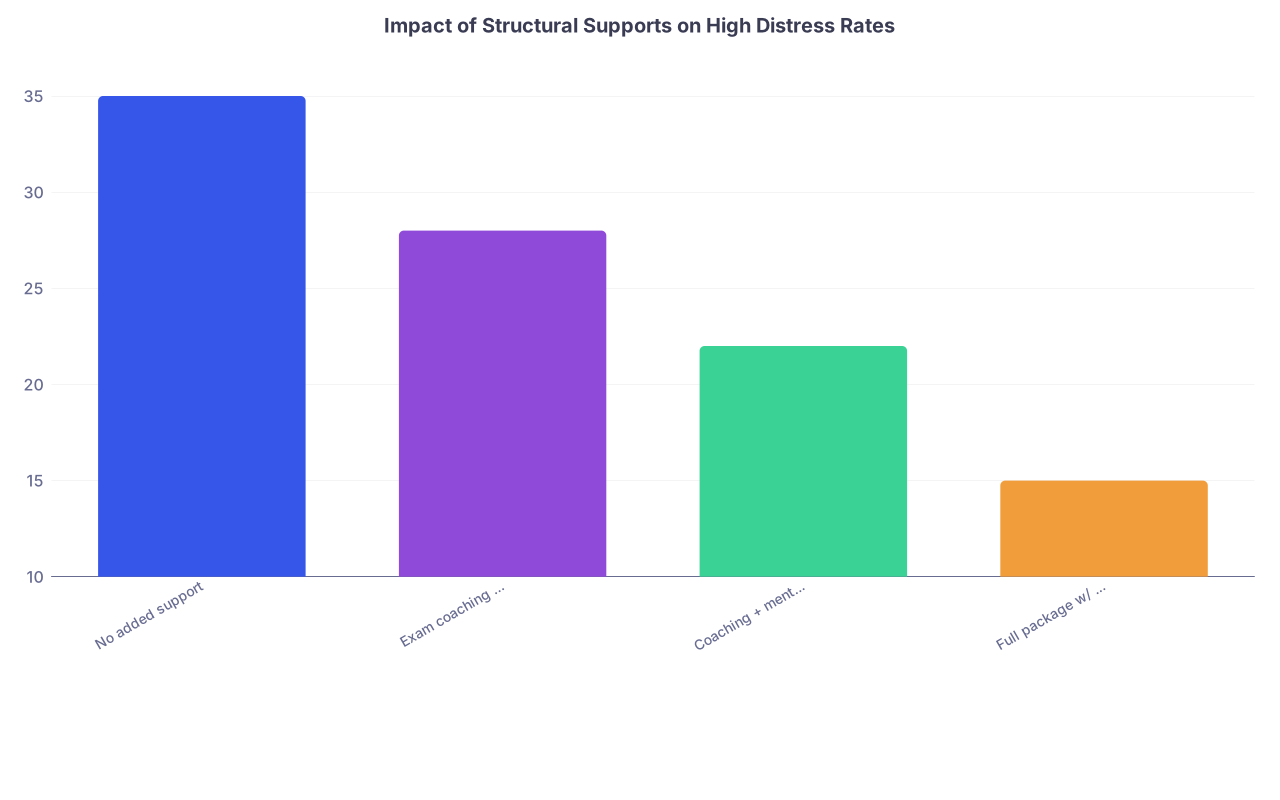
have far smaller spikes—and quicker returns to baseline—than those dropped into chaotic, punitive environments. Same humans. Different system.
| Category | Value |
|---|---|
| No added support | 35 |
| Exam coaching only | 28 |
| Coaching + mental health access | 22 |
| Full package w/ pass-fail | 15 |
You can see the pattern: “Resilience” is as much about what you’re being asked to endure as it is about your inner grit.
So if you’re struggling, it does not automatically mean you’re weak. It might mean you’re reacting normally to an abnormal set of demands.
Myth 3: “The Exams Are What Break People”
Let me be very clear: exams are stressful. I’ve seen students shake during pre-OSCE huddles. I’ve watched people come out of NBME practice tests pale and convinced their career is over because they pulled a 61%.
But when you look at repeated measures over years, the story is more subtle.
Exam periods do correlate with short-term spikes in anxiety and depressive symptoms. That’s expected. But multiple longitudinal datasets show something else:
- Stress returns close to baseline after exams when the overall environment is supportive and fair.
- Stress remains chronically elevated when exams are embedded in a culture of constant comparison, ranking, and fear.
The exam itself is rarely the only problem. It’s the ecosystem:
- Class rank disclosures and “honors” inflation that make every minor test feel like a referendum on your worth
- Faculty making offhanded comments like “With a score like that, neurosurgery is probably off the table” to a first-year student
- Whisper networks about “what score you need” for each specialty, often wildly distorted
Compare two hypothetical schools in a simplified model of high-anxiety rates:
| School Model | Individual High Anxiety During Exams | Chronic High Anxiety Across Year |
|---|---|---|
| High-stakes rank, limited support | 60% | 35% |
| Pass/fail, robust support | 45% | 15% |
Same material. Similar baseline student quality. Very different mental health trajectories.
What truly breaks people is not a seven-hour test. It’s 18 months of living inside a sorting hat that never turns off, convinced every question you miss is closing a door forever.
So no, “the exams” are not inherently soul-crushing. The way we weaponize them is.
Myth 4: “Clinical Years Are Supposed to Be Trauma; That’s How You Learn”
I’ve heard attendings say this almost proudly: “Third year broke me, but it made me a better doctor.”
Did it? Or did it just make you more tolerant of abuse and less attuned to your own distress?
Longitudinal work that includes the clinical years shows a consistent bump in burnout and emotional exhaustion when students hit clerkships. No surprise. New environment, higher responsibility, worse sleep.
But again, the range is telling.
Schools that cleaned up their clinical teaching culture—explicit policies against public shaming, mechanisms to report mistreatment that actually lead to consequences, evaluation systems that do not let a single malignant resident tank a student—see smaller and shorter distress spikes.
A common pattern in better environments:
- Stress increases early in clerkships.
- Students gradually adapt as they gain skill and confidence.
- Burnout moderates by late MS3 or early MS4.
In worse environments:
- Stress increases early.
- Negative experiences (humiliation, discrimination, unsafe workload) are frequent.
- Students’ distress stays high or climbs further, and cynicism skyrockets.

And let’s debunk the “trauma makes you tough” idea. Chronic stress and moral injury (seeing bad care, being forced into ethically uncomfortable situations, being yelled at for speaking up) are associated with:
- Higher risk of depression and substance use
- Leaving clinical practice earlier
- Reduced empathy and more negative attitudes toward patients
That’s not “toughness.” That’s damage.
Students can and do learn to function under pressure without being routinely humiliated or sleep-deprived into numbness. Trauma is not a teaching tool. It’s a cost.
So What Actually Helps? Patterns from Longitudinal Improvements
If stress isn’t inevitable, what moves the needle?
The most convincing evidence comes from schools that changed things midstream and then followed the same cohorts.
Common interventions that show real, measurable improvement in repeated mental health surveys:
- Genuine pass/fail grading—no hidden rankings, no “unofficial” tier lists sent to residency programs.
- Reduced exam frequency with better feedback, shifting away from constant high-stakes testing.
- Structured longitudinal mentorship, where students have a known person following them through multiple years.
- Readily accessible, confidential mental health services not tied to academic evaluation.
- Clear policies and enforcement around mistreatment in clinical environments.
- Some actual autonomy: flexible attendance policies, fewer pointless mandatory sessions.
Students in those revised systems still report being stressed at key points. Of course they do. But the proportion hitting persistent high distress drops. People bounce back more quickly after rough blocks.
One school that switched to an integrated pass/fail pre-clinical curriculum and bolstered wellness and advising saw their proportion of students meeting criteria for “high burnout” decrease from roughly one-third to closer to one-fifth over several cohorts, without any drop in licensing exam pass rates or residency placement.
That is not a miracle. It is just evidence that design matters.

| Step | Description |
|---|---|
| Step 1 | Start Med School Healthy |
| Step 2 | Preclinical: Heavy Content |
| Step 3 | Temporary Stress Spikes, Recovery |
| Step 4 | Chronic Elevated Stress |
| Step 5 | Clinical Years with Buffer |
| Step 6 | Clinical Years with Burnout |
| Step 7 | Graduate with Manageable Stress |
| Step 8 | Graduate Burned Out or Exit Early |
| Step 9 | Environment Type |
What This Means For You (And What It Does Not)
If you’re in medical school or about to start, here’s the uncomfortable but honest bottom line.
You will experience stress. You will have weeks where you’re tired, anxious, irritated, maybe questioning why you signed up for this. That is normal.
What is not inevitable is:
- Long-term deterioration of your mental health.
- Constant anxiety and dread.
- The belief that being a doctor requires sacrificing your well-being.
If your program, culture, or mentors try to sell you that as “just how it is,” they’re not describing a law of nature. They’re describing a system that has chosen to run on the cheapest fuel: students’ unprotected time and mental health.
You do not control the system. But you’re also not powerless. The longitudinal data point to a few pragmatic moves that help individuals inside imperfect environments:
- Seek predictable structure where you can: set non-negotiable sleep windows, recurring study blocks, and protected non-medical time. Consistency buffers distress curves.
- Build a small, honest support network. Not 40 classmates in a GroupMe. Two or three people you can tell the truth when you’re not okay.
- Treat mental health services like any other tool—not a last resort when you’re already underwater. Students who engage earlier tend to have less severe and shorter episodes.
- Be very skeptical of the “we all did it this way and survived” crowd. Survived is a low bar. Look at how they’re actually doing, not just what they say.
And one more thing: if your baseline mental health before med school isn’t perfect, that does not mean you’re doomed. But it does mean you should be proactive instead of waiting for the predictable pressure points (first big exams, clerkships, boards) to expose every crack.
The Short Version
Medical school stress is common, expected, and in many settings excessive—but not some immutable law of the universe. Longitudinal data are very clear:
- Students start out healthier than peers and then worsen after entering training, with trajectories that vary based on environment, not just individual “resilience.”
- Structural choices—grading, exam culture, clinical teaching climate, support access—have measurable effects on who becomes burned out and who stays relatively well.
- Stressful periods are inevitable; chronic, escalating distress is not. Where it’s widespread, it reflects system design, not a character flaw in students.