
What if the nights you’re most proud of—the 2 a.m. grind, the extra UWorld block when you were half-asleep—are the exact nights that are making your exam scores worse, not better?
Let’s kill a sacred cow: the idea that “pushing through” exhaustion is what separates serious med students from everyone else.
It is not.
The Myth: “If I’m Tired and Still Studying, I’m Winning”
You know the culture. Someone flexes in the group chat: “Been in the library since 7 am, leaving now at midnight. Step 2 grind.” Everyone responds with fire emojis. Nobody asks the only question that matters:
What did your brain actually retain?
The unspoken myth in medical school is simple:
Effort = outcome.
More effort = more outcome.
So if you’re exhausted and still pushing, you must be gaining an edge.
Here’s the uncomfortable truth: once you’re past a certain level of fatigue, your “studying” is often just performance. It feels like work. It looks like dedication. But cognitively? You’re paying full price for a fraction of the benefit—and sometimes you’re actively hurting future performance.
Let me walk through what the data actually shows, not what the culture glorifies.
What Sleep Deprivation Really Does to Learning (Not Just “Feeling Tired”)
I’m not talking about “I yawned twice, better go to bed.” I’m talking about the levels of fatigue med students brag about.
We have decades of cognitive science on this. It’s not ambiguous.
1. Sleep loss wrecks memory consolidation
You don’t store memories while you stare at First Aid. You store them when you sleep, especially during slow-wave and REM sleep.
There are controlled studies where:
- People learn word pairs or motor tasks.
- One group sleeps normally.
- The other group is sleep deprived, or sleep restricted.
Next day? The sleep-deprived group isn’t just a “little off.” They’re dramatically worse at recalling what they studied, even though they spent the same or more time “learning” it.
For med students: that means your heroic 3 extra hours of Anki at midnight might be traded for worse memory of all the material you touched that day—including what you learned earlier, when you were fresh.
2. Reaction time and accuracy tank before you “feel” exhausted
People think, “If I’m too tired to think, I’ll know.” No, you won’t. That’s the problem.
Sleep studies use tasks like the Psychomotor Vigilance Test (PVT) to check reaction time and lapses. With even moderate sleep restriction (say 4–6 hours/night), performance drops sharply by day 3–5. People swear they’re “adjusting.” Their performance data says otherwise.
Apply that to question banks. You’re doing UWorld at midnight on 5 hours of sleep and telling yourself, “I’m fine, just a bit tired.” But your:
- Processing speed slows
- Working memory shrinks
- Error rate increases
So now you’re practicing doing questions in a dumber version of your brain. Reinforcing wrong reasoning. Feeling falsely confident when you “would have gotten that if I wasn’t tired.”
That’s not grind. That’s self-sabotage.
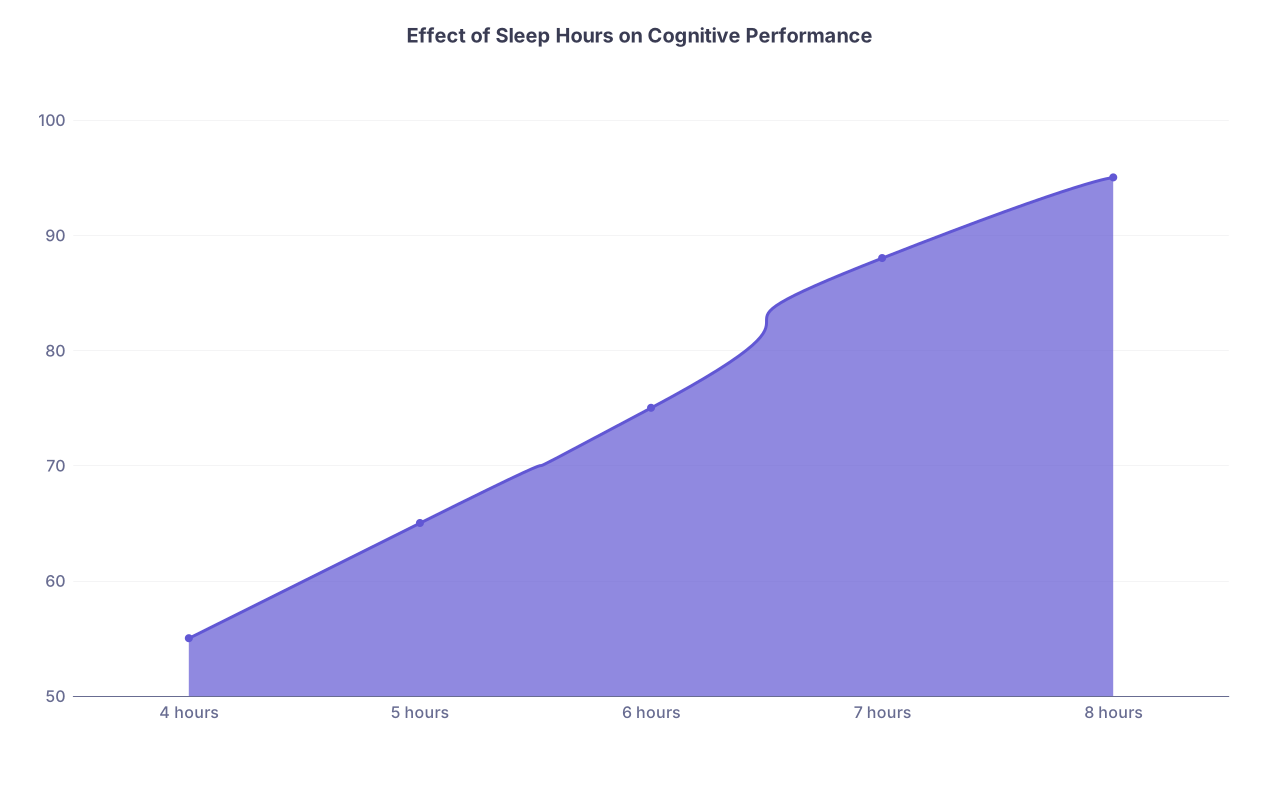
| Category | Value |
|---|---|
| 4 hours | 55 |
| 5 hours | 65 |
| 6 hours | 75 |
| 7 hours | 88 |
| 8 hours | 95 |
(Values are approximate relative performance percentages based on multiple sleep research findings: the trend is the point.)
3. Chronic partial sleep loss mimics full-blown sleep deprivation
Med students rarely pull one all-nighter. They live in a state of chronic sleep debt: 5–6 hours a night for weeks.
Research shows:
Five nights of 4–6 hours of sleep can impair you as much as one full night without sleep. The catch? Subjective sleepiness plateaus. People think they’re “used to it.” Their performance continues to deteriorate.
So when you say, “I’ve been on 5 hours all week but I’m pushing through,” what you actually mean is, “I’ve been quietly dragging my brain through wet cement while convincing myself this is what high achievers do.”
“But I Don’t Have a Choice. I Have to Push.”
No, here’s the real thing: you have to trade. And most students trade badly.
Let’s differentiate between three situations:
- You’re a few weeks out, generally okay on sleep, and feel tired at 11 p.m.
- You’re a week out, behind on content, sleeping 5–6 hours.
- It’s the night before the exam.
Different rules. Same underlying principle: the brain is not an infinite machine. It’s a fickle, metabolically expensive, sleep-dependent organ. Ignore that and you pay.
Situation 1: The everyday “I’m tired but should I squeeze more in?”
This is where most of the damage happens, because it seems harmless.
You leave lecture at 5 p.m., study until 11 p.m., feel your focus slide, yawn, reread the same sentence… and then you decide to power through until 1 a.m. because “future me will be grateful.”
Here’s what the data and my experience say: past about 45–60 minutes of low-quality, glassy-eyed “studying,” productivity collapses. Your perceived productivity might stay high—because time is still passing and pages are still turning—but your effective encoding is trash.
Rested 8 hours + 5 hours of sharp effort will beat 5 hours of sleep + 9 hours of foggy effort. Every time.
Situation 2: You’re behind and the exam is close
This is where the myth hits hardest. Students tell me:
“I have to stay up, there’s no way I can get through all this otherwise.”
No, you have two real options:
- Try to brute-force everything with sleep debt and end up remembering 60% of it half-baked.
- Ruthlessly triage, sleep more, and remember 90% of what you actually study.
Med school exams aren’t graded on how many pages you looked at. They’re graded on how many questions you answer correctly. That depends on depth and retrieval, not superficial exposure.
So yes, you might “see” fewer pages if you sleep. But you’ll be more likely to remember what you did see. That usually translates to better scores, not worse.

Situation 3: Night before the exam
I’ve seen this up close more times than I can count.
Two internal med residents before their in-training exam:
- Resident A: Leaves by 9 p.m., light review, screens off by 10, asleep by 10:30.
- Resident B: In the work room until 1:30 a.m. running through “high-yield facts,” chugging coffee.
Next day? Resident B is glassy-eyed by 11 a.m., misreads stems, mis-clicks answers, and bombs sections they actually knew. Resident A is tired but functional and performs closer to their baseline.
The literature backs this up: the night before an exam, extra studying at the expense of sleep tends to correlate with worse performance, especially on tests involving reasoning, problem solving, and attention. You know—exactly what your exams require.
So, Does Pushing Through Exhaustion Ever Help?
Let’s be fair. There are rare edge cases where pushing through truly makes sense:
- You catastrophically wasted weeks and your shelves/Step are within days.
- There’s discrete, memorization-heavy content you really can cram and accept some performance penalty for.
- You’re trying to pass, not maximize score, and need a last-minute bump from 50% to 60% recall of specific lists.
But that’s triage in a disaster, not a strategy.
Here’s how I’d frame it:
Once you’re clearly cognitively fatigued, every “extra hour” of study isn’t free. It comes with a hit to:
- Next-day performance
- Memory consolidation
- Mood and motivation
- Long-term burnout risk
Sometimes that trade is still worth it. Almost always, students pretend there is no trade at all.
The Culture Problem: We Confuse Suffering with Mastery
Med school rewards visible suffering.
People post photos of 14-hour library days, not of going to bed at 10 p.m. so their hippocampus can do its job. Nobody flexes: “Slept 8 hours, focused for 5, and closed my laptop at 8 p.m. because my recall was tanking.”
But think about specialties that actually care about performance when lives are on the line—aviation, for example. Pilots have hard duty-hour and rest rules. Nobody is impressed when a pilot says, “I only slept 4 hours but I powered through.” They get grounded.
Medicine? We call that “dedication.”
Let me be blunt: a lot of what passes for “grind” in med school is just poor cognitive hygiene.
If a pharm professor told you to ignore all receptor kinetics research and just go with vibes, you’d laugh. But you’re willing to ignore decades of sleep and learning science because the upperclassman who got a 260 “barely slept the last month.”
You don’t know what they could have scored if they’d slept. Neither do they.
What Actually Predicts Better Exam Scores?
Not vibes. Not martyrdom. Not screenshots of your Anki stats with 900 reviews remaining.
Patterns across multiple studies and countless real students point to a few boring, unsexy truths:
- Consistent, protected sleep windows
- Focused, time-limited study blocks when alert
- Regular testing (qbanks, retrieval practice) when your brain isn’t fried
- Strategic rest days that prevent full-blown burnout
- Reasonable exercise and nutrition so your brain isn’t running on fumes
Notice what’s not on that list:
“I routinely study past the point when my vision blurs and my thoughts slow down.”
To make this concrete, look at a simple comparison.
| Pattern | Sleep | Daily Study Quality | Typical Outcome |
|---|---|---|---|
| A: Chronic grind | 4–5 hrs | Long, low-quality, distracted | High burnout, inconsistent scores |
| B: Balanced high-yield | 7–8 hrs | Short, high-focus blocks | More stable, higher scores |
| C: Last-minute crammer | 3–4 hrs last week | Panicked, shallow review | Occasional pass, poor retention |
| D: Moderate with triage | 6–7 hrs | Prioritized topics, frequent practice | Solid scores, better long-term recall |
Pattern B and D win in the long run. Every. Single. Time.
The Mental Health Angle Everyone Pretends Is Optional
Let’s talk about the part people shove aside with a joke and more caffeine: your brain is not just a study device. It’s you. Your emotions, judgment, impulse control, stress resilience—they’re all running on the same hardware you’re burning out for a few extra cards.
Chronic sleep loss and non-stop grind aren’t just performance issues. They’re risk factors for:
- Depression
- Anxiety
- Emotional dysregulation
- Increased risk of serious mistakes (on the wards and on exams)
I’ve watched students go from high-functioning to completely unraveling in 3–6 months because they bought the “always push, never rest” narrative. Their scores didn’t go up. Their mental health went down first, and their academics followed.
The irony is brutal: the very people most terrified of failure adopt the exact habits that make failure more likely.

| Step | Description |
|---|---|
| Step 1 | Lack of Sleep |
| Step 2 | Reduced Focus |
| Step 3 | Lower Study Quality |
| Step 4 | Weaker Memory Encoding |
| Step 5 | Worse Exam Performance |
| Step 6 | Increased Anxiety |
| Step 7 | More Late-Night Studying |
That loop is real. And most people don’t break it by “trying harder.” They break it by violating the culture and doing something radical like… going to bed.
How to Actually Decide When to Stop for the Night
Let me make this practical. Not perfect, but better than blind grind.
Ask yourself three questions:
- Am I re-reading the same sentence or explanation multiple times?
- Are my question errors increasingly due to misreading stems or dumb mistakes, not content gaps?
- If I stopped now and slept, would I realistically study better tomorrow?
If the answer to all three is yes, you’re not “winning” by pushing. You’re generating motion without progress.
A simple rule I’ve seen help a lot of med students:
- Set a hard stop time range (e.g., between 10–11 p.m. latest)
- If your brain crashes early, you stop earlier—not later
- No “but I only did X cards” bargaining unless you’re truly days away from test day and critically behind
On nights you feel that compulsion to push through just because you’re anxious, remind yourself: anxiety doesn’t magically increase synaptic plasticity. If anything, it decreases it.
You cannot brute-force learning into a tired, overloaded brain.
Years from now, you won’t remember the specific UWorld block you did half-asleep at 1:30 a.m. You will remember whether medical school turned you into someone who treats their brain like a tool to be honed—or like a resource to be used up and discarded.
Pushing through exhaustion doesn’t make you serious. Learning when to stop, sleep, and come back sharp does.