
The fear that “one mental health day will tank my residency chances” is nonsense. Persistent, harmful nonsense—but still nonsense.
You are not going unmatched because you called out of a clerkship once, rescheduled a test, or told your attending you needed a day before you snapped. If anything, the people who never stop, never rest, and never admit they are crumbling are the ones I worry about long-term. Those are the folks who show up in the burnout and impairment data later.
Let me walk through what actually matters for residency—and where mental health fits in—based on data, not hallway mythology and panicked GroupMe messages.
The Myth: “If I Take Time for Mental Health, Programs Will Blacklist Me”
The hidden curriculum in medical school is loud and clear: suffer quietly. Students trade horror stories of someone who “took time off and never matched,” as if a single sick day triggered some secret NRMP kill switch.
Reality is much more boring and much more forgiving.
Residency programs see:
- Your transcript and clinical grades
- Your exam scores (Step/Level)
- Your narrative evaluations
- Your MSPE (Dean’s Letter)
- Your personal statement
- Your letters of recommendation
- Your CV (including any leaves of absence or major disruptions, if applicable)
What they do not see:
- “Took 1 mental health day during surgery”
- “Rescheduled exam once due to feeling overwhelmed”
- “Visited counseling center 7 times in M2 year”
Those things aren’t documented that way. They are not coded into some “risk” label. There’s no line in the MSPE that says: “Student occasionally took care of themselves—recommend against.”
When wellness becomes an issue in residency selection is when:
- There is a formal, extended leave of absence without a clear story or explanation
- There are patterns of unprofessional behavior: no-shows, missed responsibilities, chronic lateness, poor reliability
- There is clear patient safety risk related to impairment
One or two health days handled responsibly? That is not it.
What the Data Actually Shows About Burnout and Performance
Let’s look at risk the way a program director does: who is more likely to crash and burn?
Multiple large studies (Mata et al., 2015; Dyrbye & Shanafelt, a dozen times over) have shown:
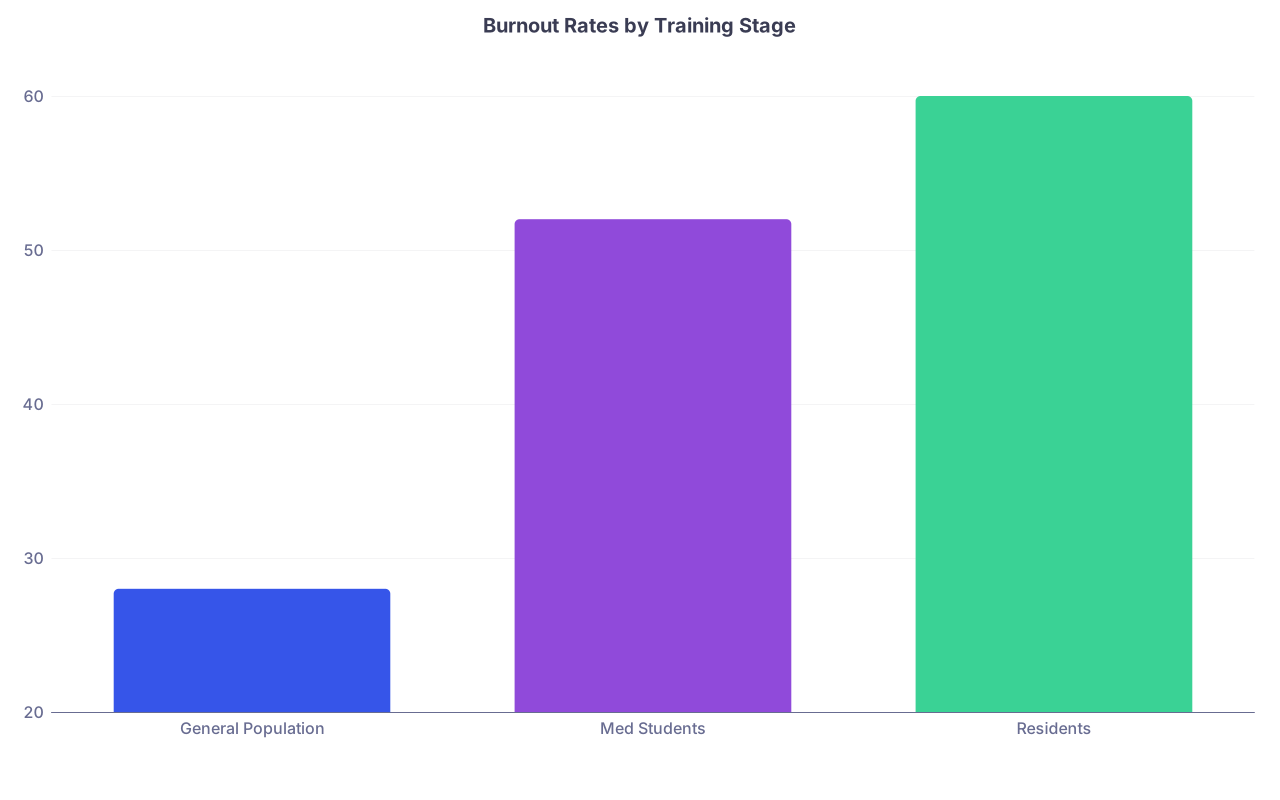
- Burnout among medical students is high—often >50% meet criteria
- Suicidal ideation in medical trainees is higher than age-matched peers
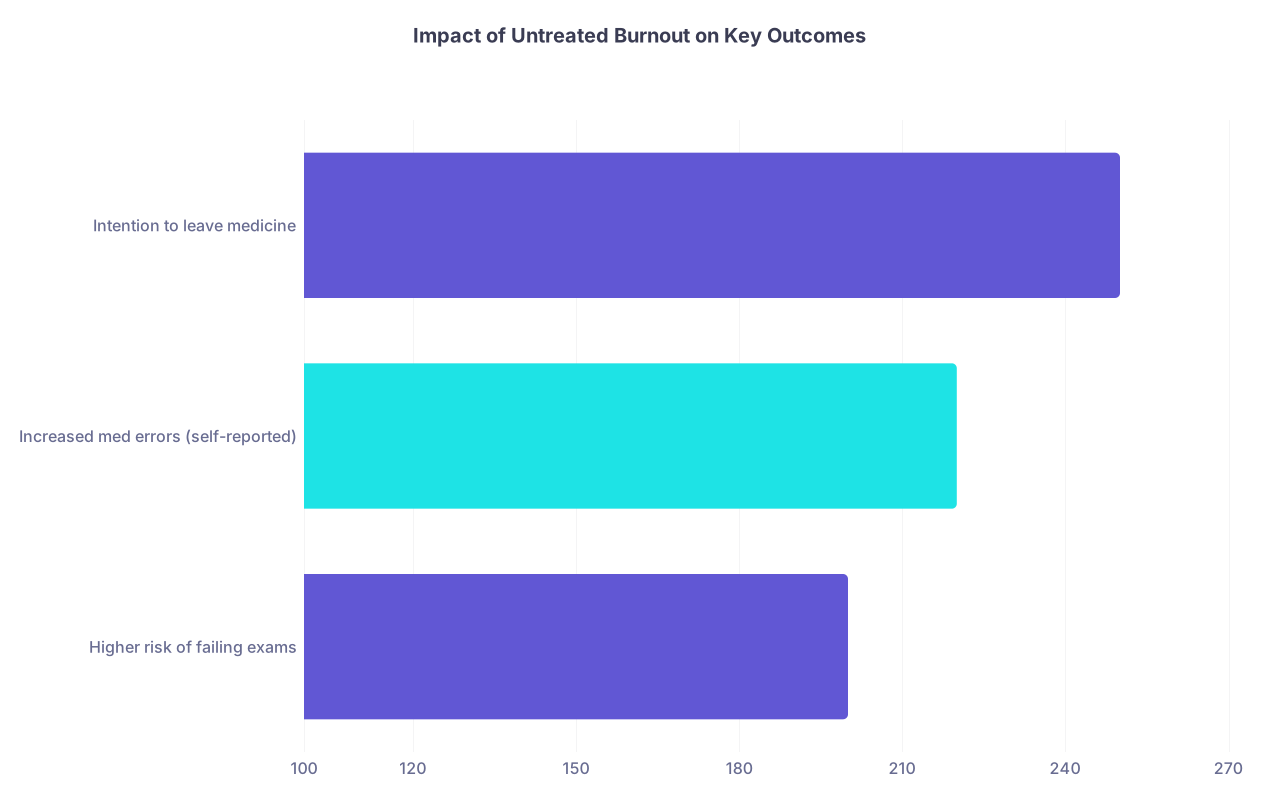
- Burnout is associated with worse professionalism, more self-reported errors, and intention to leave medicine
Here’s the uncomfortable truth: the student who never takes a day off, studies through panic attacks, and treats sleep like a negotiable luxury is not “strong.” They’re a future statistic.
And residency programs know this.
A lot of program directors are now asking—in their own way:
“Is this applicant going to fall apart PGY-1? Are they able to recognize their limits and seek help before things get dangerous?”
Taking a mental health day is not a red flag. Failing to recognize you’re sliding into dangerous territory and pretending you’re fine? That’s more concerning.
To make this concrete:
| Category | Value |
|---|---|
| General Population | 28 |
| Med Students | 52 |
| Residents | 60 |
If more than half of trainees are burned out, the applicant who has never needed a break and reports being “totally fine, never struggled” reads as either not self-aware or not honest.
What Happens Academically If You Never Stop?
Here’s the other myth:
“If I just grind through, my scores and evaluations will be better. Breaks are a luxury I can’t afford.”
Let’s talk performance, not vibes.
Sleep deprivation and chronic stress impair:
- Working memory
- Executive function
- Focus and concentration
- Emotional regulation (which matters a lot on the wards)
There’s cognitive psychology and neurobiology behind this, but you know it from real life. You’ve had that day where you read the same paragraph four times and could not tell me what it said. That is not “dedication.” That’s brain failure.
On exams:
- Multiple studies on cognitive performance show diminishing returns beyond a certain number of continuous hours of study
- Anxiety and high arousal impair complex reasoning and test-taking judgment
The student who says, “I can’t afford to lose a day before Shelf” while scoring borderline on UWorld and sleeping 4 hours a night is often thinking emotionally, not rationally. One well-timed reset can move you from scattered and inefficient to focused and effective.
And on the wards, it’s even more obvious. I’ve watched students who pushed through severe anxiety or exhaustion:
- Miss subtle but important details on presentations
- Snap at nurses and look “difficult” to work with
- Show up with that thousand-yard stare that screams “I’m not okay”
Guess what shows up in narrative comments?
“Occasionally disorganized.”
“Sometimes appeared overwhelmed.”
“Interpersonal interactions could be improved under stress.”
These vague phrases hurt you far more than “student appropriately communicated need to take time for personal health and returned performing at a high level” ever will.
What Actually Gets Documented (And What Doesn’t)
You need to understand how the sausage is made: how schools translate your messy, human life into a clean PDF for ERAS.
A single mental health day, handled normally, usually looks like any other sick day.
Typically it goes like this:
- You wake up and you’re done. Panic spiraling, can’t stop crying, chest tight, or completely depleted.
- You email or call your clerkship coordinator/attending: “I’m not able to come in today for health reasons.” You don’t need to recite DSM criteria.
- They mark you absent. Often you make up the day with an extra shift or it just disappears into the noise depending on the rotation.
End of story.
This doesn’t magically convert into “unreliable” or “concerning for psychiatry.” What matters is your pattern and your professionalism. One day, clearly communicated, is ordinary.
Where documentation becomes real:
- Extended medical or mental health leave: this can appear on your transcript or MSPE as a leave of absence, delayed graduation, or modified schedule
- Repeated absences without clear communication
- Behavior that triggers professionalism remediation or disciplinary action
Even then, context matters a lot. I’ve seen MSPE language like:
“Student took a medical leave of absence between M2 and M3. They returned to the curriculum and subsequently performed at or above the level of their peers on clerkships.”
That does not destroy an application. Programs read that and think:
Resilient. Dealt with something hard. Came back and did well.
Again: one mental health day? It doesn’t even rise to this level.
The Bigger Risk: Waiting Until You Completely Break
The real danger is not that one day off will ruin your residency chances. It’s that you don’t take that day until the cost is much higher.
I’ve watched the progression more than once:
- Student is exhausted and anxious but keeps pushing “because I can’t fall behind.”
- Sleep drops. Eating habits fall apart. They stop exercising, stop seeing friends.
- Studying gets more inefficient. They start to panic about being behind, so they double down.
- Eventually performance tanks: failed Shelf, bad clinical evals, or a Step score significantly below their practice tests.
Now we’re in territory that does affect residency.
Here’s how that looks at the level of outcomes:
| Category | Value |
|---|---|
| Higher risk of failing exams | 200 |
| Increased med errors (self-reported) | 220 |
| Intention to leave medicine | 250 |
(Read these as relative odds ratios or percentage increases across studies—directionally, the point is clear: untreated burnout isn’t neutral. It hurts performance.)
Compare two realities:
- Scenario A: You take one day mid-rotation, regroup, read a few key topics, sleep, maybe talk to someone. You come back functioning.
- Scenario B: You stubbornly grind until you fail the exam, tank an eval, or need weeks off.
Residency programs see Scenario B in your file. Scenario A? They never even know it happened.
The “Weakness” Fear: What If I Disclose Anything?
Different but related myth: “If I ever admit I struggled with mental health, programs will see me as weak and not resilient.”
Here’s the nuance.
You do not owe anyone the most vulnerable pages of your diary. You are allowed to keep things private.
But the idea that programs categorically punish any mental health disclosure is outdated and frankly not accurate in 2026. The culture has shifted—slowly and inconsistently, yes—but it has shifted.
Program directors are juggling:
- Duty hour limits
- ACGME requirements around wellness
- Rising resident depression and suicide data
- The very real cost of losing a trainee mid-program
They are not looking for “never-struggled robots.” They are looking for people who function under stress and do not explode or disappear without warning.
A resident who says (in an appropriate context):
“I’ve learned I do better when I don’t ignore my mental health. I’ve built a system—sleep, boundaries, asking for help early—that keeps me steady.”
…is safer, not riskier.
What you do not want is a personal statement that is 90% trauma dump with no arc of insight, support, or stability. That’s bad for you regardless of the topic.
Handled well, something like, “I learned to take a mental health day before I burned out, and my performance improved” is not the scandal you think it is. It’s evidence of basic self-regulation.
Concrete, Low-Drama Ways to Take a Mental Health Day
“Okay, but what does doing this ‘responsibly’ actually look like?”
Fine. Here’s the grown-up version that doesn’t trigger unnecessary drama.
You:
- Communicate early: As soon as you know you are not safe or functional for the day, email or call the appropriate person.
- Use simple, factual language:
“I’m not able to come in today due to a personal health issue. I will follow up with you and the coordinator about any needed make-up work.”
You do not need ICD codes. - Don’t vanish off the grid: That’s how you get labeled unprofessional.
- Actually use the day: Sleep, decompress, meet with a therapist if you have one, or at least step back and reset. It’s not a “scroll Instagram and feel guilty” day.
If you stack up multiple days, yes, now we’re in the realm where you probably should involve student health, your dean, maybe formal accommodations. That’s not failure. That’s how grown professionals manage real illness, mental or physical.
If you’re worried about how often is too often, this is a decent sanity check, not a rule:
| Pattern | How It’s Usually Perceived |
|---|---|
| 1 day off in a tough rotation | Normal human behavior |
| 2–3 scattered days across a year | Still normal if well-communicated |
| Several days in one block, with plan | Needs structure, but still manageable |
| Repeated no-shows, poor communication | Professional concern, not “mental health” |
Programs respond to patterns and professionalism, not one-off human days.
How This Fits With Exams and “Falling Behind”
Let’s connect this to the part you actually obsess over: exams.
Most students’ Step/Shelf study time looks like an anxiety-driven race. More hours, more resources, more questions. Less rest, less exercise, less anything that isn’t Amboss or Anki.
Then they’re shocked when their scores plateau or drop.
There’s a reason serious test-prep companies, sports psychologists, and high-level performers in every field build recovery into their plans. Brains are not linear-output machines. They need cycles.
Taking one day off in a 6-week rotation because you’re about to lose it doesn’t ruin your Shelf. It often saves it. You’re trading one low-quality, semi-useless day of half-studying and full-panicking for later days where you’re actually able to encode and recall information.
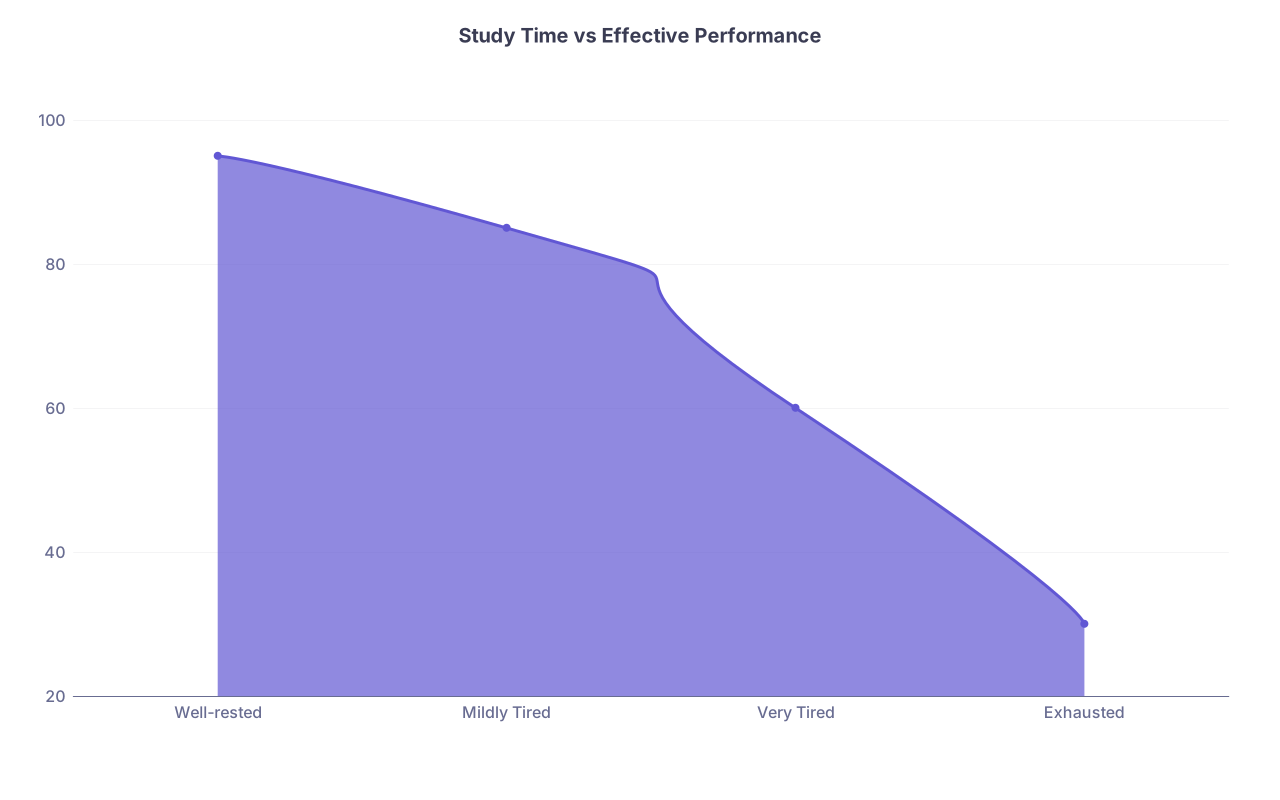
Think of this like a basic performance curve:
| Category | Value |
|---|---|
| Well-rested | 95 |
| Mildly Tired | 85 |
| Very Tired | 60 |
| Exhausted | 30 |
You’re terrified of giving up calendar days, but you ignore that the last 2–3 days before you crash are often 30–60% effective at best. That is a bad trade.
A properly used mental health day pushes you back toward the left of that curve.
The Hard Part: Letting Go of the Martyr Identity
Underneath all of this is identity. Medicine trains you to be a martyr. The subtext is constant:
If you really cared, you wouldn’t need sleep.
If you were truly strong, you’d just push through.
If you were cut out for this, you wouldn’t struggle like this.
That’s not professionalism. That’s pathology.
Real professionals:
- Know when they are impaired
- Protect patients by stepping back when they are not safe
- Use systems—colleagues, supervisors, health services—to stay functional over years, not just days
A mental health day used wisely is not indulgent. It’s a basic act of professional maintenance.
The unprofessional move is pretending you’re fine when you’re not, showing up half-present, missing things, snapping at staff, and then calling it “sacrifice.”
Pulling It Together
So no, taking a mental health day will not destroy your residency chances. What actually matters:
- Residency programs care about patterns and professionalism, not a single well-communicated day off. One or two mental health days do not appear as giant red flags in your file. Chronic unreliability and untreated meltdown do.
- Untreated burnout is far more dangerous to your scores, evaluations, and long-term career than a strategic day of rest. The data is clear: burnout correlates with worse performance, more errors, and serious mental health outcomes.
- Learning to step back before you break is part of being a safe physician, not a sign you “can’t hack it.” Used responsibly, a mental health day is a tool, not a confession of weakness.
If you’re at the point where you’re asking, “Would taking a day ruin everything?” you probably already know the answer: you need the day.
Take it. Then use it well.