
The scary truth is this: by the time a dean “notices” you’re burning out, you’ve usually been burning for months.
I’m going to walk you through what deans, student affairs offices, and course directors actually see—and what they say behind closed doors—when med students start to come apart. Not the polished wellness-talk version. The real version.
You want to know what’s visible. What gets flagged. What gets quietly written in emails you never see. And what actually prompts intervention versus what just gets shrugged off as “normal med school stress.”
Let’s get into it.
The Myth vs. The Reality of “We’re Watching Out for You”
Most schools sell you the same story: “We care deeply about your well-being. We’re monitoring for burnout. Please reach out if you’re struggling.”
They’re not lying. But the operational reality is different.
Here’s how it actually works at most U.S. med schools:

| Step | Description |
|---|---|
| Step 1 | Subtle behavior changes |
| Step 2 | Faculty or admin notices |
| Step 3 | Informal note or hallway comment |
| Step 4 | Email to Student Affairs |
| Step 5 | Immediate escalation to Dean/Counseling |
| Step 6 | Monitor quietly |
| Step 7 | Outreach to student |
| Step 8 | Urgent meeting / leave discussion |
| Step 9 | Severity / Risk? |
There is no big “burnout dashboard” with your name on it. Nobody is graphing your mental health in real time.
What deans actually notice most are three things:
- Changes in professional behavior
- Changes in academic performance
- Behavior that creates liability for the school
Everything else—your insomnia, your crying in the shower, the 3 a.m. doom-scrolling—stays invisible unless it bleeds into those three categories.
That’s the ugly truth.
The First Red Flags: What Course Directors Whisper About
Burnout doesn’t show up first as “student in tears in the dean’s office.” It starts much earlier and looks smaller.
1. The Engagement Drop-Off
I’ve sat in course director meetings where someone points to a name on the roster and says, “He was sharp first block, he’s a ghost now.”
They notice when:
- You stop turning your camera on (for hybrid/recorded content) after being reliably engaged before.
- Your small-group comments go from thoughtful to monosyllabic.
- You stop emailing questions, miss office hours, or stop seeking clarification.
One course director at a top-20 school literally said, “If a previously A-level student disappears from my inbox and small group, I assume they’re not okay.” They do not assume you suddenly stopped caring about learning. They assume something is cracking.
But here’s the key: at this stage, they rarely escalate. They just start watching you.
They may email Student Affairs with something like: “Not urgent, but keep an eye on [Name]. Noticeable change in engagement this block.”
You are already on a mental list.
2. The Attendance Pattern That Makes People Nervous
Deans aren’t counting every missed lecture. They don’t care if you watched at 1.75x at home. They care about patterns.
The pattern that gets flagged is: erratic, unexplained inconsistency. Not just “I don’t go to non-mandatory things.” That’s half your class.
What raises eyebrows:
- You start missing mandatory small groups or clinical skills sessions with last-minute “not feeling well” emails. Again and again.
- You leave early from standardized patient sessions with vague reasons.
- You repeatedly show up late to anything with a patient or assessor in the room.
Faculty interpret that—not entirely unfairly—as “something is off.” They may not say “burnout” out loud. But they say “concern.”
I’ve seen emails like: “Third late arrival to CPC small group. Usually prepared, today seemed scattered and flat. Not sure what’s going on.”
That’s the burnout smoke before the fire.
Academic Changes: When Numbers Start Telling a Story
No one fails an exam out of the blue. Administrators compare you to yourself much more than you realize.
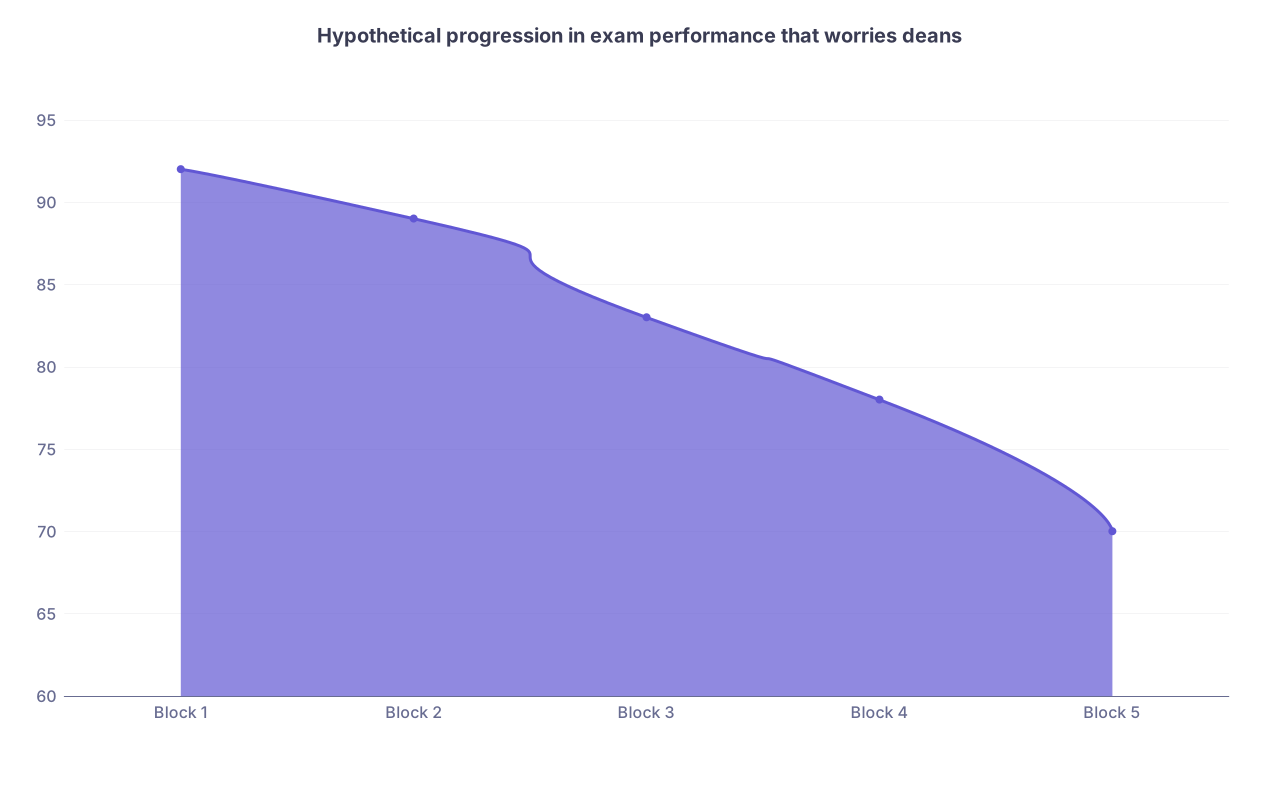
| Category | Value |
|---|---|
| Block 1 | 92 |
| Block 2 | 89 |
| Block 3 | 83 |
| Block 4 | 78 |
| Block 5 | 70 |
Here’s what deans and promotions committees really notice.
1. The Slow Slide, Not the Single Bad Grade
One bad test? Nobody panics. They might not even register it.
What gets discussed in those closed-door meetings is the trajectory.
Comments sound like:
- “Started strong, top quartile. Now sitting just above the fail line for three consecutive blocks.”
- “USMLE practice scores dropping despite increased study time.”
- “Repeated NBME retakes trending the wrong direction.”
Every school has students who get punched in the face by one exam and recover. Those aren’t the people they worry about.
They worry about the ones clearly grinding themselves down. The exam scores are just the visible symptom.
2. “Overstudying Into the Ground”
A phrase I’ve heard more than once: “She’s studying herself into worse performance.”
Faculty can tell when:
- You’re logging insane study hours based on what classmates or advisors report.
- You keep asking for more resources, more question banks, more practice tests—while your scores inch downward.
- You talk more about fear of failure than about learning the material.
Deans know that’s burnout plus anxiety, not laziness. But here’s the harsh part—they still have to treat the academic performance as real. Your internal suffering doesn’t protect you from external consequences, unless you let them intervene early.
Clinical Years: The Burnout Signs Nobody Puts in Writing
This is where things get more dangerous. For you, and for the school.
Once you’re in the hospital, your burnout is no longer just your problem. It becomes a patient care and professionalism issue. That’s when deans really start to pay attention.
1. The “Personality Shift” Comment
You want to know the single most ominous phrase that shows up in an evaluation?
“This is a change from how I’ve seen them before.”
Attendings and residents will forgive a lot if they think, “This is just who this student is—quiet, anxious, tentative.” What they don’t like is sudden shifts.
I’ve watched this happen:
- M2 year: cheerful, engaged, enthusiastic.
- Early M3: still pushing, still trying.
- Mid-M3: flat affect, minimal conversation, avoids eye contact, seems “checked out.”
Faculty notice. And they talk.
They’ll say things like, “She looks empty. I don’t think this is laziness. I think she’s cooked.”
Sometimes they send a quiet note to the clerkship director. Sometimes it just colors your eval phrases: “seemed tired,” “less engaged than peers,” “reserved to the point of seeming disinterested.”
That language is code. Deans know how to read it.
2. The Subtle Patient Care Slips
Serious burnout doesn’t just make you sad. It makes you sloppy.
Here’s what gets noticed and escalated fast:
- You keep forgetting simple tasks: following up labs, returning calls, writing notes on time.
- You start avoiding patients, volunteering out of interactions, lingering by the computer instead of in the room.
- Your notes become generic, copy-paste disasters with obvious omissions.
A resident might shrug once or twice. By the third time, they say something to the attending. The attending might send something like: “Student appears overwhelmed and exhausted. Performance slipping. Concern for burnout.”
That goes into a file. You don’t always know which file.
What Actually Triggers a Dean to Step In
Let’s be blunt. Deans are busy. Many are juggling accreditation, curriculum changes, LCME reports, angry faculty, and a never-ending stream of small fires.
So what actually pushes them from “aware” to “we need to act”?
1. Safety and Liability
Nothing moves faster through a medical school than a safety concern.
This is the unspoken hierarchy:
| Trigger Category | Typical Response Speed |
|---|---|
| Threat to self/others | Immediate (same day) |
| Clinical safety concerns | 24–48 hours |
| Repeated professionalism issues | Days to a week |
| Academic decline only | Weeks to months |
If someone so much as suggests you might be suicidal, severely depressed, or impaired (substance, sleep deprivation to the point of risk), things escalate rapidly.
Behind the scenes, emails look like:
- “Urgent: Student expressing hopelessness, concerning comments about not wanting to continue.”
- “Resident reports student crying repeatedly in call room, unable to complete tasks.”
- “Multiple absences with vague illness, flat affect when present, concern for major depression.”
That’s when you get mandatory meetings. Strong suggestions for leave. Sometimes direct referrals to counseling with “you must attend” phrasing.
It’s not just about caring. It’s about risk—legal, accreditation, reputational.
2. Colliding Problems: When Multiple Systems Flag You
A single course director isn’t going to drag you to the dean’s office. But three different people, in three different settings, all saying “I’m worried about this student”? That’s a different game.
The patterns that flip the switch:
- Academic decline + unprofessional behavior + a resident email saying “something is really wrong.”
- A remediation plan not followed + persistent absences + rumors of you “not doing well.”
- A professionalism committee case + hints of mental health crisis.
Every school has some variant of this conversation in a promotions or Student Affairs huddle:
“We’re seeing the same name from three directions. This isn’t just a bad block. This is bigger.”
That’s when the dean stops being a distant name and becomes someone sitting across from you, saying, “Tell me what’s actually going on.”
The Things You Think Are Hidden (They’re Not)
Let me be very clear about this: your peers tell on you. Sometimes to protect you. Sometimes to protect themselves. But either way, your burnout leaks.
1. Classmates as the First Alarm System
I’ve lost count of how many times I’ve seen:
- A classmate quietly talking to the course director: “I’m worried about [Name]. They haven’t left their apartment in days.”
- A student sending an email to Student Affairs: “I don’t want to betray trust, but I’m concerned about safety.”
- Group members telling the faculty: “We keep covering for him; he’s not showing up.”
You never see those emails. But they absolutely happen.
Deans pay attention to that. Peer concern is considered one of the most reliable early signals, because you see each other when faculty don’t.
2. Social Media and the “Public Meltdown”
No, they’re not routinely stalking your Instagram. They do not have a secret wellness team refreshing your Twitter feed.
But:
- If you post something clearly alarming—self-harm references, substance jokes that land too real, “I’m done, nothing matters” type content—and a classmate screenshots it and sends it in? It hits their desk.
- If your professional accounts (yes, even those “anonymous” med Twitter/Reddit accounts that aren’t as anonymous as you think) start attracting attention, someone eventually forwards it.
I’ve sat in on meetings where someone brings up, “There’s a Reddit post that sure sounds like one of ours. The story matches exactly.” They aren’t always wrong.
If they can tie it to you, they treat it as real. Not hypothetical.
How Deans Prefer You to Show Burnout
This part you rarely hear: schools actually have a version of burnout that’s easier—for everyone—to manage.
It looks like this:
- You show up early, before the academic collapse.
- You’re honest: “I’m not okay. My sleep is wrecked. I’m crying all the time. I’m terrified I’m going to fail.”
- You let them document it, redirect you, maybe slow you down.
The scenario deans dread is the opposite:
- You keep your head down and push until you fail multiple things at once.
- You say nothing, minimize everything, ghost faculty.
- Problems surface only when you’re unsafe to yourself or patients.
You know what deans say, off record, about the second group?
“If he had just come to us six months ago, we could have saved a year of his life.”
They are not exaggerating. Burnout ignored for a year in med school doesn’t set you back a week. It can derail an entire phase of training.
What You Can Do Before They “Notice” in the Worst Way
I’m not interested in giving you fluffy wellness posters. You know the generic advice already. Hydrate, breathe, yoga, whatever.
Here’s the more uncomfortable, practical truth:
1. Use Their Own Triggers Before They Use Them on You
Remember what they watch:
- Attendance
- Trajectory of performance
- Professional behavior
- Safety signals
You can weaponize that knowledge for yourself.
You can show up to Student Affairs and say:
- “My scores are trending down across three blocks and I know it’s not a knowledge issue—it’s that I’m burning out.”
- “I’ve started missing mandatory things. That’s not like me. I’m worried where this is headed.”
- “Residents have commented that I look exhausted and ‘different.’ They’re right.”
You are handing them exactly the red flags they would otherwise piece together over six months. That shortcut matters. It buys you options—schedule adjustments, leaves of absence, exam timing changes—before your record is so messy that everything has to be formal remediation.
2. Stop Trying to Fail Quietly
There’s a certain med student personality that terrifies deans: the stoic imploder.
Looks like this:
- Never complains.
- Keeps saying “I’m fine, I just need to work harder.”
- Is visibly deteriorating but refuses help until everything is on fire.
You think you’re being strong. On the institutional side, it looks like a disaster they can’t predict or manage.
I’ve heard a dean say, about a student like this: “He white-knuckled until he snapped. I’m not letting that happen again if I can help it.”
You don’t earn extra respect by suffering silently. You just decrease the number of ways they can help you without blowing up your progression.
What Deans Will Not Tell You Directly
Let me spell out some things they usually only say behind closed doors.
Burnout is common. Like, shockingly common. They’re not surprised by it. They’re only surprised when you pretend you’re immune.
Your record matters less than your trajectory. Two rough semesters followed by clear recovery with documented support? That’s survivable. A quiet, chaotic slow-motion crash with no transparency? That’s what lands on promotions committee agendas with the phrase “pattern of concern.”
They are balancing you vs. the system. They want you to be okay. They also have to protect patients, the school’s reputation, and accreditation. When you’re burned out, you’re not just tired—you’re a potential systems problem. That’s when they step in hard.
You’re not a liability because you’re human. You become a liability when you’re in obvious trouble and nobody knows until it spills into performance and safety.
So don’t let it get that far.
FAQ: Burning Out in Med School – What Deans Really See
1. If I tell a dean or Student Affairs I’m burning out, will it go in my MSPE or residency applications?
Usually, no—but with qualifiers. They’re not eager to brand you as “the burnout student” in a permanent document. What does go in your record are concrete things: leaves of absence, course failures, professionalism issues, remediation plans. If you come early, get support, and stabilize, there’s often little or no formal footprint. If you say nothing, crash hard, and require major interventions, that is much more likely to have visible consequences that programs notice. Quiet, early honesty almost always ages better than a late, dramatic implosion.
2. Can I be pulled from rotations or delayed from exams just for “burnout”?
Yes, indirectly. They don’t usually write “burnout” on forms. They talk in terms of fitness for duty, mental health, or need for medical leave. If your burnout is clearly affecting attendance, reliability, or clinical performance, they’re obligated to act. That can mean delaying major exams (Step 1/2), pulling you from a rotation, or recommending/mandating a leave. It feels punitive in the moment, but from their side, it’s simple: better a structured pause than an unsafe student failing forward into bigger damage.
3. What’s the smartest way to approach a dean if I’m burning out but haven’t failed anything yet?
Go in with specifics, not drama. Say something like: “My scores are trending down, I’m sleeping 3–4 hours a night, I’m starting to miss mandatory things. I’m not in crisis yet, but I know where this road leads if I keep pushing.” That language does three things: shows insight, shows you’re still functional, and signals you’re asking for preventive help, not a rescue from disaster. Deans and Student Affairs respond much more generously when you come to them early with a clear narrative than when they have to track you down after something explodes.
Key takeaways:
- Deans don’t detect burnout from your feelings; they detect it from patterns—attendance, performance, professionalism, and safety.
- By the time they “notice” on their own, you’ve usually been suffering for months. If you want options, you have to surface it earlier yourself.
- The system responds most constructively when you give them a clear, early warning—before your burnout starts leaving permanent marks on your record.