
Last spring, a third‑year I’ll call “R” got pulled into the student affairs office after morning rounds. She thought she was in trouble for something that happened on surgery. She wasn’t. The dean quietly slid a printout across the table with three years of little red flags on it—attendance patterns, quiz scores, wellness checkboxes, pre‑clinical professionalism comments. “We’ve been watching this build,” he said. “You’re not in trouble. You’re burning out.”
Let me be blunt: your school is tracking your burnout risk in ways no one explained at orientation. Not because they’re evil. Because accreditation, liability, and reputation force their hand. And because they’ve learned the hard way what happens when they ignore the quiet signals.
You see one quiz. One missed session. One curt comment from an attending.
They see a trend line.
Let me walk you through how that actually works over four years.
The Four‑Year Surveillance Pattern
Most students imagine “support” as optional wellness workshops and free counseling. Meanwhile, behind the scenes, the school has built what is basically an early‑warning system for academic, professional, and mental health collapse.
They almost never call it “burnout tracking.” Official label is something softer: “learner performance monitoring,” “student success dashboard,” “longitudinal learner portfolio.”
But functionally? It’s a burnout risk monitor.
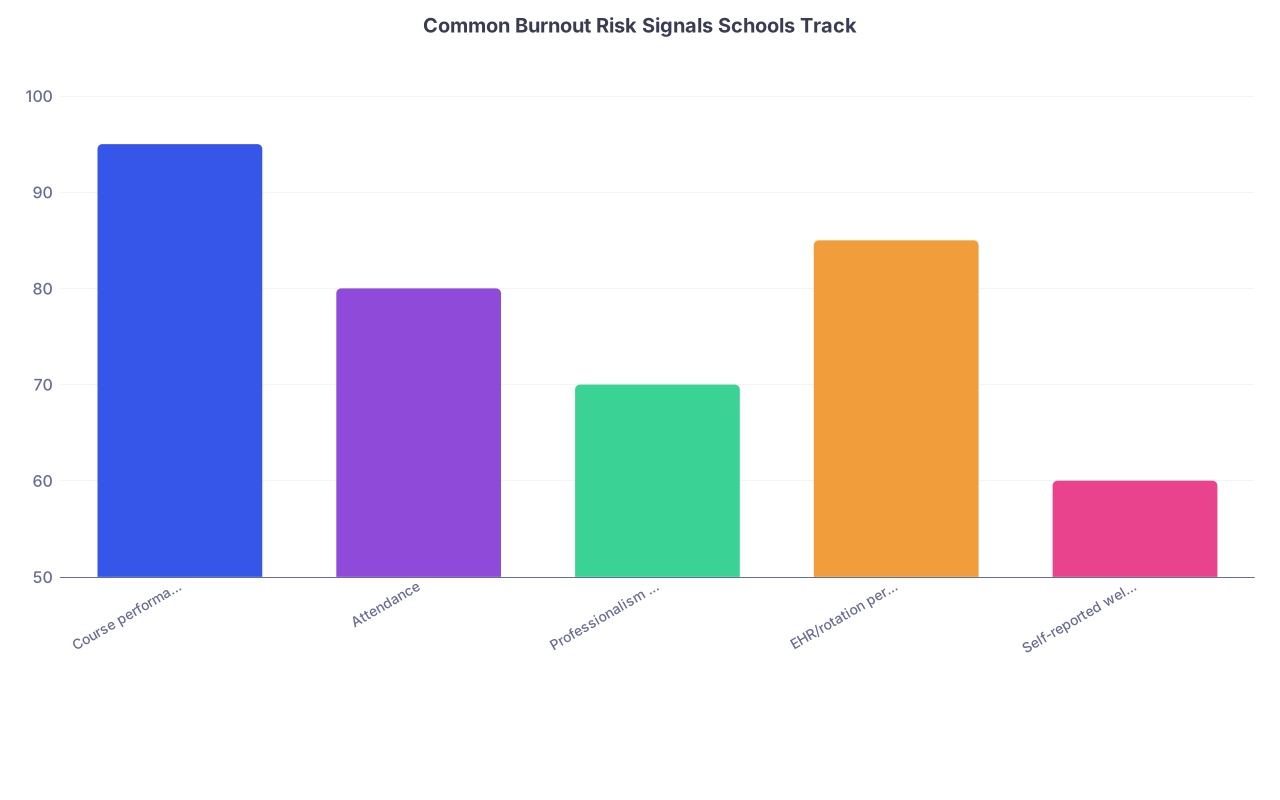
| Category | Value |
|---|---|
| Course performance | 95 |
| Attendance | 80 |
| Professionalism notes | 70 |
| EHR/rotation performance | 85 |
| Self-reported wellness | 60 |
Those percentages are roughly how many mid‑large schools (based on conversations in faculty meetings and LCME/COCA prep committees I’ve sat in) have at least some systematic way to track each category.
None of this is in the glossy brochure they gave you on interview day. But it’s running under the hood from M1 orientation to Match Day.
Let’s break it down by phase, because the signals and the stakes change as you move through.
M1–M2: The “Soft” Data That Isn’t Actually Soft
Pre‑clinical years are when most schools quietly build your baseline. This is when they figure out what “normal” looks like for you.
The “burnout watchlist” at this stage usually isn’t explicit. But there’s always somebody—an assistant dean, director of academic support, or “longitudinal coach lead”—who has a spreadsheet or dashboard of concern levels.
1. Assessment Drift, Not Just Scores
They don’t just look at your absolute scores. They look for drift.
A single bad anatomy exam? Nobody cares.
A pattern like this? They care.
| Exam Block | Class Mean | Student Score | Concern Level |
|---|---|---|---|
| Block 1 | 82 | 84 | None |
| Block 2 | 81 | 79 | None |
| Block 3 | 83 | 75 | Mild |
| Block 4 | 80 | 68 | Moderate |
| Block 5 | 84 | 65 | High |
I sat in one “Academic Progress Committee” where the chair literally said, “I’m less worried about the guy who failed two blocks and then rebounded than I am about the one who’s bleeding points every exam.”
They track:
- Progressive declines across multiple blocks
- Worsening performance in applied/clinical reasoning vs memorization
- Big drop after a stressful life event they know about (family death, breakup, illness)
To them, that slow slide screams burnout. Or depression. Or crisis brewing.
2. Attendance: Zoom Logs Don’t Lie
You think you’re “just” skipping a few 8 a.m. sessions. Your school sees a heat map.
Every modern LMS and attendance tool can spit out:
- Which required sessions you missed
- How often you arrive late (badge swipes time‑stamped)
- Whether you watched required recordings, and when
I’ve seen deans scroll through attendance by week and literally say, “This is where M1 broke up with his girlfriend—look at that cliff.”
It’s not the occasional absence that lands you on their radar. It’s patterns:
- A sharp change from your baseline
- Clusters of missed sessions around exams (especially if performance drops at the same time)
- Chronic “bare minimum” attendance paired with other issues
They rarely come at you first with “your attendance is bad.” Officially they open with, “We’ve noticed some changes, how are you doing?” because the goal—on paper—is support, not discipline.
But the same data that feeds those wellness talks also feeds professionalism decisions if things escalate.
3. Wellness Surveys: The “Anonymous” Ones Usually Aren’t
Your school sends you those check‑ins:
- “Rate your stress this week from 1–10”
- “How often have you felt down, depressed, or hopeless?”
- “Have you had thoughts of self‑harm?”
Here’s the part students don’t fully get: a lot of those are linkable.
Maybe not line‑by‑line to your name. But tied to a cohort, campus location, sometimes even academic group or house. And at some schools, they are absolutely tied to your individual record—especially if they’re inside the LMS or coach platform.
I’ve watched a dean pull a report for “students who have screened positive for moderate–severe distress three times this semester” and then cross‑reference with failing scores and attendance. That’s their “quiet list” for outreach.
They are not calling everyone on that list. That would be chaos. But if your name is there and you start slipping in other domains? Your phone will ring.
Or you’ll get this email: “The Office of Student Support is reaching out to offer a check‑in. This is not punitive.”
Translation: “You tripped our tripwire.”
M2–Step 1/Level 1: The Pressure Cooker Phase
Second year exposes which simmering problems are becoming actual fires.
Programs know this is where burnout and depression spike. They’re under enormous scrutiny from accreditors to show they aren’t ignoring it.
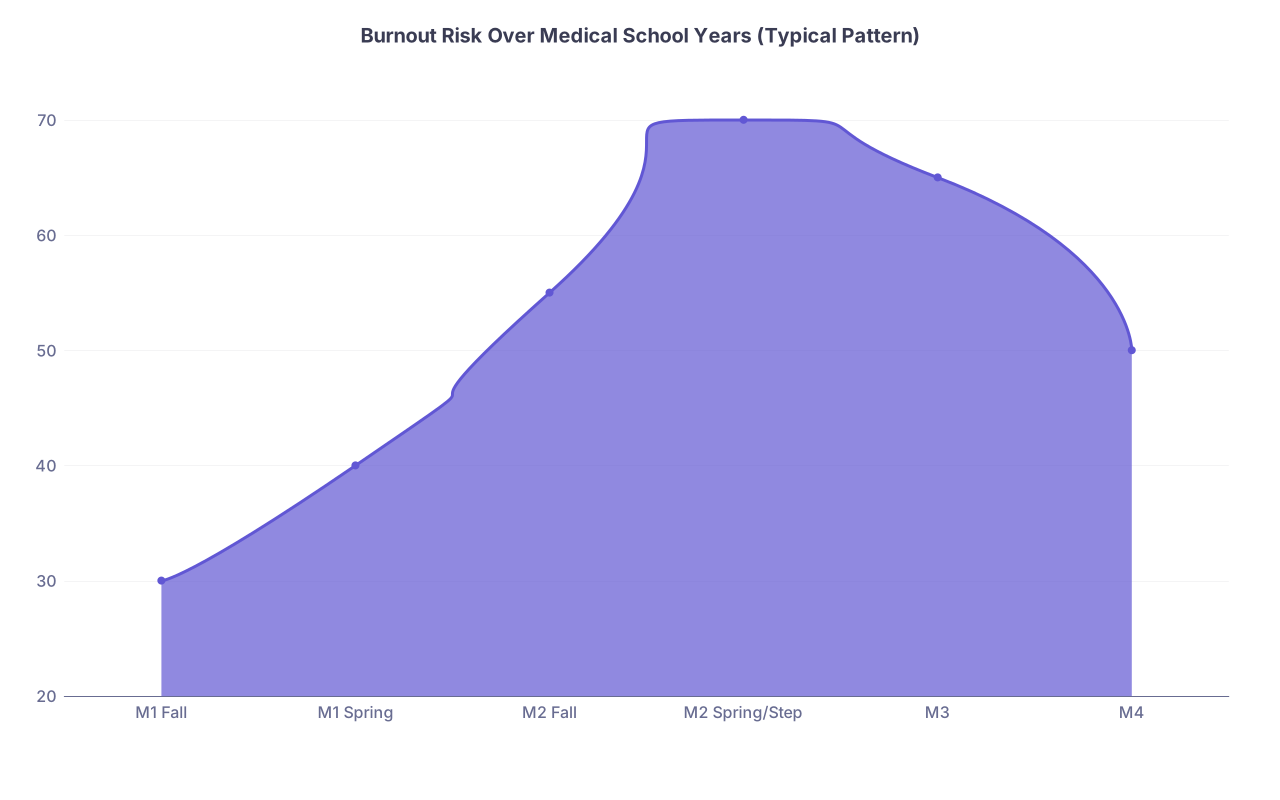
| Category | Value |
|---|---|
| M1 Fall | 30 |
| M1 Spring | 40 |
| M2 Fall | 55 |
| M2 Spring/Step | 70 |
| M3 | 65 |
| M4 | 50 |
Those rough percentages mirror what faculty cite from AAMC and internal surveys behind closed doors. By M2 spring—right around licensing exam season—burnout risk peaks.
4. Dedicated Study Behavior: Who’s Disappearing
During Step/Level dedicated, your school tracks more than you think:
- NBME/UWorld self‑assessments if you take them through institutional accounts
- Whether you show up to optional review sessions after struggling earlier
- Communication with advisors and coaches
At one school, the dean gets a weekly export: “Students whose practice scores are not improving or are declining.” He calls them personally. Not to shame them. To prevent the classic spiral: poor practice test → longer hours → worse sleep → worsening performance → total collapse.
The quiet rule I’ve heard multiple deans say:
“If someone’s practice scores drop twice and they go dark on email, we intervene whether they want us to or not.”
Going “off the grid” in dedicated is a huge red flag. You see it as “I just need to grind.” They see it as “high‑risk for mental health crisis, possible exam no‑show, or catastrophic fail.”
M3: Clinical Rotations as a Burnout Lab
Here’s where the tracking shifts flavor. In the hospital, your wellness gets filtered through evaluation forms and hallway gossip.
There are three main channels.
5. Narrative Comments: The Stuff That Never Makes Your Eyes
You see your rotation grade and maybe a few scrubbed comments.
Faculty and residents submit way more than you ever read.
I’ve sat in promotions meetings reading raw evals. The ones that make everyone go quiet are rarely about knowledge. They’re about affect.
Patterns like:
- “Seems increasingly withdrawn over the course of the rotation.”
- “Lost weight and looked exhausted by the end of the month.”
- “Tearful on rounds on multiple occasions.”
- “Great start but appeared checked out the last two weeks.”
Any one of those might get blamed on a tough month. But if comments like that show up in medicine, then surgery, then psych? That’s a burnout trajectory.
Most schools now have some version of a “concern flag” button in the eval system. Residents and faculty can mark:
- Academic concern
- Professionalism concern
- Personal/wellness concern
Clicking that quietly routes your name to a dean or student affairs person who reviews it. You’re not always told that you’ve been “flagged for wellness concerns,” but your name has just gone into a smaller watchlist.
6. Work‑Hour and Duty‑Log Patterns
Yes, students log hours too, especially on core rotations. These logs aren’t just for LCME compliance. They’re a crude stress monitor.
What they watch for:
- Chronic >80‑hour reported weeks (either your team is abusive, or you’re not coping, or both)
- Large mismatches between your logs and your peers’ on the same service
- Students never taking the days off they’re entitled to
There’s a running joke in some clerkship offices: “The ones who never log a day off are the ones we need to call.”
People who don’t feel entitled to rest, who internalize all the pressure, burn out hard. Programs know this. They may not confront you directly, but they’ll nudge:
“Remember you’re allowed a day off per week. Please talk to your team if you haven’t been taking them.”
At some schools, repeated “over‑logging” gets you on the radar the same way under‑performance does.
7. Mid‑Rotation Feedback Sessions
Those “routine” midpoint check‑ins? They’re also wellness probes.
A clerkship director once told me, “If a student cries in a midpoint meeting, I email student affairs that afternoon. Not as a punishment. As a signal.”
They don’t write “burnout” in the note. They write:
- “Student overwhelmed, reports excessive fatigue.”
- “Significant self‑criticism, difficulty accepting positive feedback.”
- “Expressed dread about continuing in medicine.”
That goes in your file. Again, not necessarily in a punitive way, but it becomes part of the longitudinal pattern.
One isolated breakdown? People move on. Same tone shows up in three different clerkship director notes? You’re on the quiet “we may need to step in” list.
M4: The Polished Surface vs The Back‑Channel Concerns
By fourth year, you’ve learned to perform being “fine.” That doesn’t mean they’ve stopped watching.
At this point, burnout risk isn’t just about you suffering. It’s about downstream risk:
- Will you crater on sub‑I and get a professionalism incident?
- Will you underperform on Step 2/Level 2 late and threaten your graduation timeline?
- Will you melt down on away rotations and embarrass the school?
So the tracking pivots again.
8. Letters, Advising Notes, and “Fit” Concerns
You’ll never see the back‑channel conversations that happen before a dean signs your MSPE (Dean’s letter).
I’ve watched these meetings. They go like this:
“Is there anything we should know before we send this student to a high‑volume surgery program?”
“Well, she’s excellent clinically, but she needed a leave in M3 for burnout. She’s back and doing well, but we should be sure she has support if she ends up at a malignant place.”
Are they supposed to disclose everything? No. Most are careful. But your internal “story” as a burnout risk absolutely shapes the strength and tone of their advocacy.
On the flip side, if they’ve seen you wobble in M2–M3 and recover with support, that often reassures them.
Burnout risk isn’t just a red mark. It can also become:
“This student knows their limits and uses resources appropriately. They won’t suffer in silence.”
9. Leaves of Absence and Remediation as Long‑Term Data
If you’ve taken a leave—mental health, personal, whatever—here’s the unspoken reality: someone is assigned to track you more closely when you return.
They watch for:
- Slower timing on major milestones (Step 2, core rotations)
- Re‑emergence of the same patterns that led to leave
- Isolated professionalism slips that look like “old” behavior
No one will say, “Because you left, we don’t trust you.” Out loud, the phrase is, “We want to make sure you’re supported.”
Underneath that is a calculation:
“Can this person safely and reliably function as a resident next year?”
So your data in M4—elective attendance, sub‑I evals, Step 2 performance—gets read through the lens of your M1–M3 history.
Burnout risk is a four‑year story, not a moment.
What They Don’t Tell You About “Wellness Resources”
There’s an uncomfortable tension here that students sense but can’t quite name.
Schools are under real pressure to prove they care about wellness. LCME and COCA literally look for evidence: policies, resources, tracking, interventions.
At the same time, you’re not wrong to worry about privacy or career impact if you open up. Faculty debate this behind closed doors all the time.
Here’s how it usually breaks down—in reality, not in policy documents.
| Signal Type | Who Sees It First | Typical Response |
|---|---|---|
| Bad exam streak | Academic support/dean | Meeting, study plan, follow-up |
| Attendance drops | Course director/dean | Email, check-in, warning |
| Wellness survey risk | Student affairs/wellness | Outreach offer, optional |
| Concerning eval comment | Clerkship director/dean | Private meeting, monitoring |
| Self-harm ideation | Counseling/dean on call | Immediate safety protocol |
You need to understand two things:
- They’re not neutral. They are incentivized to intervene, document, and “manage” you because of accreditation and liability.
- Most of the people doing this actually care. Truly. They’re trying to catch you before you break.
The system is clumsy, sometimes intrusive, occasionally harmful. But ignoring it, pretending your data isn’t being connected, is naive.
How To Use This System Without Letting It Use You
Let me flip this from voyeurism to strategy.
Knowing that your school tracks burnout risk quietly, you can either operate in fear or learn to work with it.
Three unvarnished pieces of advice:
1. Don’t let the first “flag” be a catastrophe.
If you’re sliding academically, disappearing from class, and melting down on the wards, that combination forces their hand. Early, smaller signals—one bad block, one shaky rotation—are the time to proactively approach someone. That turns a potential “problem student” story into a “self‑aware and responsible” story.
2. Control the narrative when you can.
If you know your evals will mention you seemed withdrawn during a horrible month? Tell your advisor or clerkship director before they see it: “I was dealing with X. I’m getting help. Here’s what I’m changing.” Your behavior + your explanation shape how they interpret every data point after that.
3. Use the “quiet watchers” on your side.
Every school has 1–2 people in student affairs who are blunt, trustworthy, and actually helpful. Find them. If your name is ever on a watchlist—and for many of you, it will be—it’s better if the person reading it already knows you as a human, not a problem.