
The way most students approach clerkship year almost guarantees emotional exhaustion.
Not because you are weak. Because the system has predictable traps, and nobody bothers to warn you properly. You are walking into a meat grinder acting like it is a picnic rotation. That mismatch is what burns people out.
Let me walk you through the specific mistakes that quietly accelerate emotional exhaustion during clerkships—and how to not be the next cautionary tale.
1. Treating Clerkship Year Like an Endless Audition
Everyone tells you, “Third year is one long job interview.” That sentence ruins people.
The mistake is simple: you start believing your entire worth rests on:
- This attending’s impression
- This one shelf score
- This single rotation grade
So you start performing. Constantly. As if every second is being filmed.
That mindset has three nasty consequences:
- You never feel “off duty.”
- You take every minor criticism as a character indictment.
- You suppress your actual emotional reactions to trauma, death, and chaos.
I watch students do this in July. By December they are husks. Pleasant, efficient husks.
The red flags you are falling into the “endless audition” trap
- You replay every attending interaction on your commute home, grading yourself.
- You feel irrational panic when you are not visibly busy—so you invent tasks.
- You say “yes” to every opportunity out of fear: “What if this matters for my eval?”
This looks ambitious from the outside. Inside, it is corrosive.
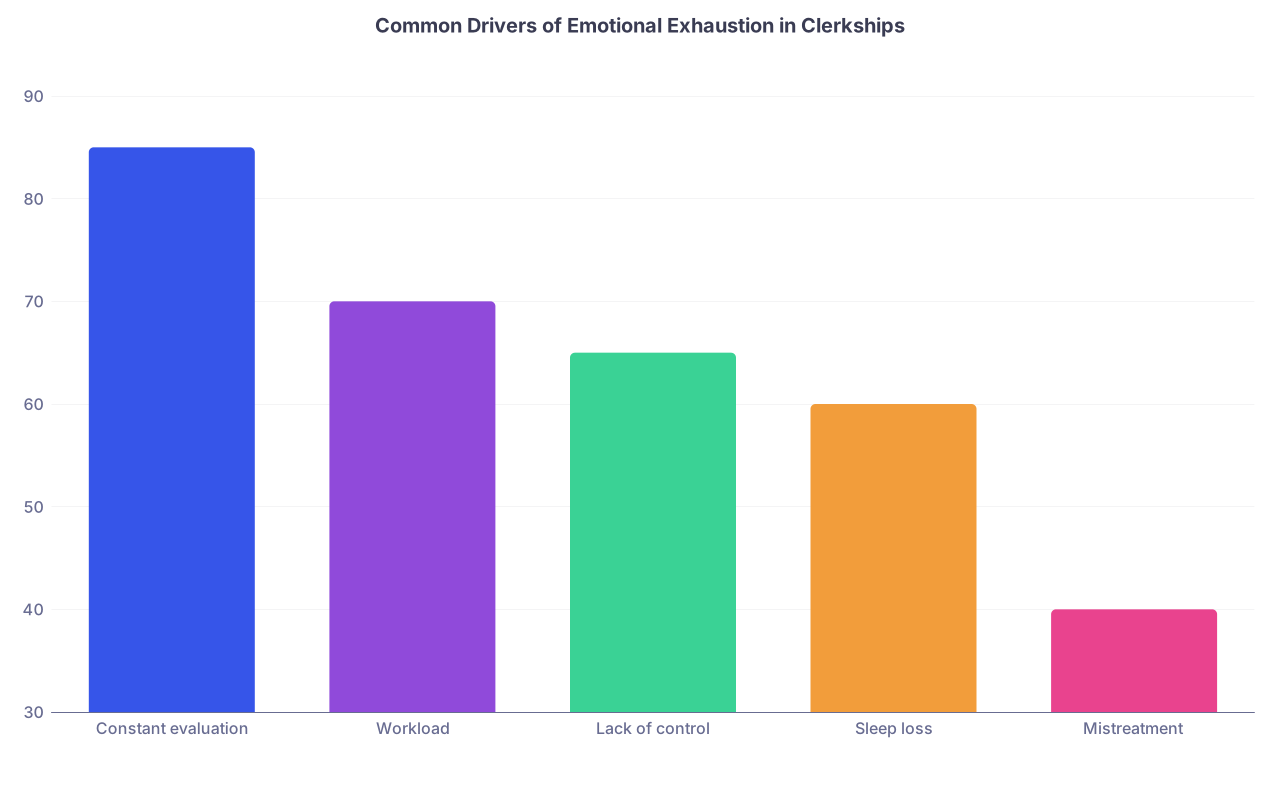
| Category | Value |
|---|---|
| Constant evaluation | 85 |
| Workload | 70 |
| Lack of control | 65 |
| Sleep loss | 60 |
| Mistreatment | 40 |
How to not make this mistake
Set hard rules about what clerkship grades are and are not allowed to mean.
They are: a noisy signal of your performance in a deeply flawed system.
They are not: a judgment of whether you belong in medicine, are smart enough, or are a “good person.”
Concrete protections:
- Decide in advance how many total hours per week you are willing to dedicate to “performance extras” (extra notes, pre-rounding earlier, bonus reading). Cap it.
- Block 10–15 minutes after each shift purely to decompress, not to self-criticize. Phone away. No “I should have said…” loops.
- Pick one or two people (resident, faculty, dean) whose feedback you take seriously. Everyone else becomes “data,” not verdicts.
The students who last are the ones who treat clerkships as training, not judgment day.
2. Letting Your Schedule Become a Free‑for‑All
Clerkship year punishes people who do not aggressively protect structure.
Here is the pattern I keep seeing:
New rotation. New hours. New team. You tell yourself, “I will just adjust once I see what the schedule is like.” You never adjust. You just react. Day after day.
The consequence is chaos:
- Eating at random times or not at all
- Inconsistent sleep windows
- Zero predictable time for exercise, calls with family, or rest
Your brain interprets this as: “I am not safe. Anything can happen at any time.” That chronic threat response is a straight path to emotional exhaustion.

| Step | Description |
|---|---|
| Step 1 | Start Rotation |
| Step 2 | React to chaos daily |
| Step 3 | Skip meals & sleep |
| Step 4 | Emotional exhaustion |
| Step 5 | Set protected routines |
| Step 6 | Greater stability |
| Step 7 | Lower exhaustion risk |
| Step 8 | Plan schedule? |
Where students go wrong
Three common scheduling mistakes:
No fixed wind‑down routine
You come home whenever, scroll, snack, maybe read for shelf, collapse. Your brain never gets the “we’re done” signal. Sleep quality tanks.Using “when I have time” as a plan
That phrase is code for: “This will not happen.” Exercise, therapy, journaling, even laundry—if they are not on some kind of schedule, clerkships will eat them alive.Treating weekends as cleanup time only
Students stack weekends with notes, shelf prep, emails, and errands. Zero actual rest. By mid‑year, they start Monday already depleted.
How to not make this mistake
You need anchor points. Non‑negotiables.
Pick:
- A minimum sleep window (for example, 11 p.m.–5 a.m. on early days; midnight–7 a.m. on later days). You will break it sometimes, but it should exist.
- Two concrete recharge blocks per week (for example, Wednesday evening 8–10 p.m., Sunday morning 9–11 a.m.). Treat them like mandatory call.
- A default quick‑meal plan. Not “I’ll cook when I can.” I mean: 3–4 cheap, repeatable meals you can assemble half‑asleep.
If your schedule changes weekly, your anchors flex—but they never disappear. The mistake is letting the rotation dictate everything and your needs dictate nothing.
3. Over‑Identifying With Every Patient and Family
Clerkship year is the first time many students see repeated trauma: codes, fetal demises, unexpected bad scans, neglected kids, cruel family dynamics.
The mistake is thinking empathy means feeling everything fully for every single patient.
That does not make you a better doctor. It makes you a very short‑lived one.
I have watched students crumble after a run of tragedies because they believed:
“If I am not devastated by this, I am becoming cold and uncaring.”
So they force themselves to sit in devastation. Again and again. No boundaries.
Signs you are over‑identifying
- You are still replaying one patient’s story days later with intense emotion.
- You feel guilty when you laugh or enjoy anything after a bad outcome.
- You feel responsible for things completely outside your control (for example, “If I had pushed harder, the attending might have changed the plan”).
Here is the brutal truth: you will see more suffering in one year of clerkships than many people see in a decade. Your nervous system cannot handle “maximum empathy” every time.

How to not make this mistake
You need emotional triage.
Ask yourself:
- Is this situation actually my responsibility?
- Is my emotional reaction helping this patient or my learning right now?
- Have I given this enough attention for today?
Then you set a boundary. That might mean:
- Limiting how long you talk about a distressing case before shifting topics.
- Allowing yourself to be “professionally present” rather than emotionally flooded at the bedside.
- Scheduling intentional processing time (15–20 minutes journaling or talking to someone) instead of rehashing the entire event in your head at 2 a.m.
Compassion is sustainable. Over‑identification is not. Confuse the two, and clerkship year will drain you fast.
4. Accepting Subtle Mistreatment as “Just How It Is”
There is a quiet, harmful message that floats around teaching hospitals: “Everyone got yelled at. Everyone got humiliated. You just have to toughen up.”
That sentence has kept countless students in damaging environments far too long.
I am not talking about firm feedback. I am talking about:
- Being consistently mocked in front of patients or staff
- Being frozen out of learning opportunities as punishment
- Being told your concerns about workload, safety, or mistreatment mean you are “not cut out” for this
Here is the trap: you start telling yourself, “If this bothers me, the problem is me.” So you absorb it. You rationalize it. And your self‑respect erodes.
| Behavior Type | Example | Healthy Response |
|---|---|---|
| Constructive feedback | “You missed X on exam; review it.” | Reflect and adjust |
| Harsh but fair | “This note is sloppy. Fix it.” | Improve, set mental guard |
| Humiliation | “Are you stupid? A child knows this.” | Document, seek support |
| Exclusion | Repeatedly sent away from cases | Escalate pattern |
| Retaliation | Worse eval after raising concern | Report formally |
Why accepting this accelerates emotional exhaustion
- You waste huge emotional energy trying to “perform your way” into basic respect.
- You start believing that dignity and psychological safety are optional in medicine.
- You stop reaching out for help because you anticipate dismissal or retaliation.
By the time students get to me and say, “I think I am burnt out,” half the story is some version of, “I kept telling myself it was fine when it wasn’t.”
How to not make this mistake
You need a clear internal line between “tough environment” and “unacceptable behavior.”
Ask:
- Would I be okay with a loved one being treated this way?
- Does this style make me safer and better, or just smaller and more anxious?
- Is there a pattern across days or people?
Then: use the channels that exist, even if they are imperfect.
- Document specific incidents with dates, times, witnesses.
- Use confidential reporting systems or student affairs when a pattern emerges.
- Talk to residents you trust—often they know which attendings are toxic and how to work around them.
You will not fix the system in one rotation. But you do not have to silently normalize mistreatment as “training.”
5. Sacrificing Recovery for Shelf Exam Panic
Another huge driver of emotional exhaustion: the “I’ll rest after the shelf” lie.
On day one of the rotation, you are already thinking about the exam. You buy the Qbank, print the guides, download the Anki deck. Reasonable.
Then the tension starts:
- Long days on the wards
- Little control over your time
- Rising guilt about how many questions you are not doing
So you do the predictable self‑destructive thing: steal from sleep and recovery to pay the Qbank.
I see students proudly say, “I’ve been waking up at 4 a.m. to get my questions in.” They look wrecked. Their brain function is held together with caffeine and fear.
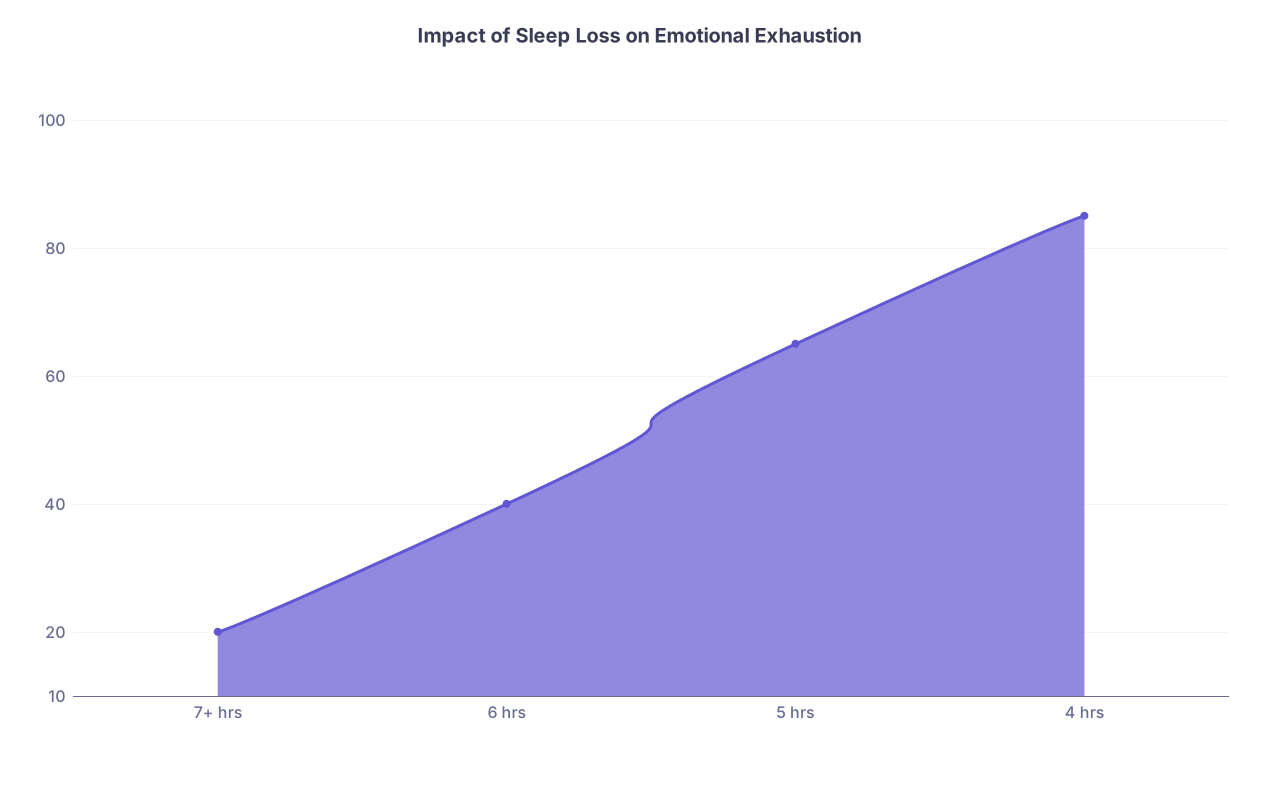
| Category | Value |
|---|---|
| 7+ hrs | 20 |
| 6 hrs | 40 |
| 5 hrs | 65 |
| 4 hrs | 85 |
Where this goes wrong
- Below about 6 hours of consistent sleep, your learning efficiency plummets. So your extra study time buys you fewer points than you think.
- Chronic sleep debt amplifies emotional reactivity. Small frustrations feel catastrophic.
- You enter the exam already depleted—and then still have to go back to the wards.
This is how clerkship year becomes a slow grind into apathy. Not one disaster. Just relentless micro‑depletion in the name of one more block of UWorld.
How to not make this mistake
Decide before the rotation what you will and will not sacrifice for the shelf.
Non‑negotiables I have seen work:
- Floor for sleep: absolutely no pattern of <6 hours more than 2 nights in a row. If work demands it, fine. Studying does not.
- Max daily questions: choose a realistic number (e.g., 20–40 on weekdays, more on weekends) and stick with it rather than chasing perfection.
- At least one day per week where you stop all study by a set time (for example, 6 p.m.) no matter how “behind” you feel.
Paradoxically, students who protect rest often outperform their exhausted peers. Not because they care less, but because their brains can still function.
6. Isolating Yourself to “Not Burden Anyone”
Clerkship year can be socially brutal. Different teams each month. Residents and attendings rotating weekly. You never fully belong anywhere.
Many students make this fatal move: they withdraw.
The story they tell themselves:
- “Everyone is busy. I do not want to bother them.”
- “Other people are handling this fine; I do not want to look weak.”
- “Once this rotation ends, I will reconnect with people.” (You will not.)
So they eat lunch alone. They study alone. They cry alone in the call room bathroom and then wash their face and go back out, acting.

Isolation is like fertilizer for emotional exhaustion. It turns manageable stress into overwhelming stress because there is nowhere for the pressure to go.
The subtle isolation traps
- Only talking to classmates about logistics (shelf dates, resources) and never about how you are actually doing.
- Ignoring family and non‑medical friends because “they would not get it.”
- Avoiding student support services or counseling because “I am not that bad yet.”
By the time you admit you are “that bad,” your reserves are gone.
How to not make this mistake
You do not need a giant support network. You need 2–3 reliable humans and a habit of actually telling them the truth.
Concrete moves:
- Choose one clerkship buddy per rotation you check in with weekly, explicitly about how you are coping, not just how you are scoring.
- Keep one non‑medical relationship intentionally alive (short weekly call, shared show, whatever) to remind yourself you are more than a student.
- If your school offers counseling: schedule an appointment before you feel like you are breaking. Use it as maintenance, not emergency repair.
You are not a burden for being human in an inhuman system. The real danger is pretending you are fine when you are clearly not.
7. Ignoring Early Warning Signs of Emotional Exhaustion
Most students do not go from “fine” to “burnt out” overnight. There is a long gray zone where things are sliding, and if you catch it there, you can still course‑correct.
The mistake is dismissing that gray zone as “just a tough week.”
Let me be very specific about what I watch for in clerkship students:
- You feel dread most mornings, not just before a known tough day.
- You stop caring about things you used to be proud of (doing a good H&P, reading around cases).
- Your empathy blunts—not just protected, but truly gone. Patients become “tasks.”
- You find yourself fantasizing about quitting medicine or “getting hit by a bus” so you can rest, but you quickly brush the thought away.
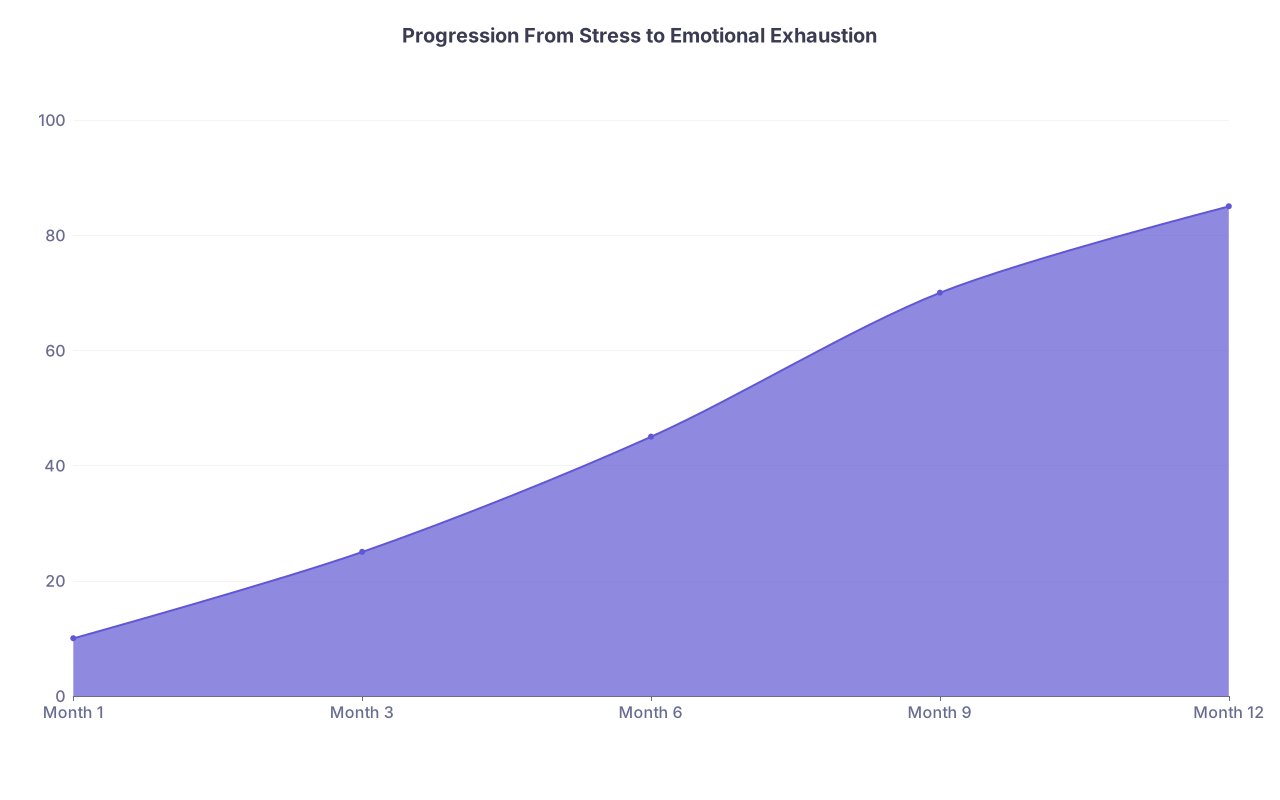
| Category | Value |
|---|---|
| Month 1 | 10 |
| Month 3 | 25 |
| Month 6 | 45 |
| Month 9 | 70 |
| Month 12 | 85 |
These are not character flaws. They are warning lights on the dashboard.
How to not make this mistake
You need a simple, brutally honest self‑check.
Once a week, answer (privately, in writing):
- How much do I dread going in tomorrow (0–10)?
- How much do I care about my patients’ well‑being right now (0–10)?
- How much do I feel like I am a person outside of medicine (0–10)?
If dread is climbing, care is dropping, and “person outside medicine” is falling toward zero, that is not a phase. That is emotional exhaustion in progress.
That is when you:
- Loosen your perfectionism around grades and studying just enough to sleep more.
- Proactively talk to a dean, mentor, or mental health professional.
- Reevaluate any toxic environments you can avoid in fourth‑year scheduling.
Waiting for a full collapse before you take action is the worst mistake you can make.
FAQ: Clerkship Year & Emotional Exhaustion
1. How do I know if what I am feeling is normal stress or actual burnout?
Normal stress waxes and wanes with the rotation and specific events. You might have a brutal call shift, feel awful, then enjoy a day off and feel reset. Burnout—especially emotional exhaustion—feels more like a baseline you cannot shake. If you notice persistent dread, blunted empathy, and a sense of “I have nothing left to give” lasting weeks, not days, you are past normal stress.
2. Won’t setting boundaries and protecting my time hurt my evaluations?
In practice, no—unless your “boundaries” are actually avoidance. Attendings care far more about engagement, reliability, and growth than about whether you pre‑rounded at 4:30 a.m. instead of 4:00. The students who implode from exhaustion and start making mistakes or disconnecting emotionally usually take a bigger hit in evaluations than the ones who pace themselves intelligently.
3. What if I am on a malignant service and feel trapped?
First, drop the fantasy that “sucking it up” on a toxic service builds resilience. It builds cynicism and self‑doubt. Document specific incidents, talk to trusted residents and faculty, and involve your clerkship director or student affairs if patterns of mistreatment or unreasonable workload emerge. You may not be able to escape the rotation entirely, but schedules, expectations, and team assignments can sometimes be adjusted quietly when there is enough data.
4. Is it “too much” to see a therapist or counselor during clerkships?
No. It is often the smartest move you can make. Students who use counseling proactively tend to handle clerkship stress better, not worse. You are not “taking resources away from someone worse off.” Clerkship year is precisely when structured support can prevent a slide into severe burnout or depression. A 50‑minute session every couple of weeks is a minor time investment compared with the cost of crashing.
5. How do I talk to classmates about emotional exhaustion without sounding dramatic?
Be concrete and specific. Instead of “I’m falling apart,” try: “I’ve noticed I’m starting to dread every day and I feel less and less like myself. Are you feeling any of that?” Most of the time, you will see relief on their face because they have been feeling it too. Keep the door open: “If you ever want to be honest about how this is hitting you, I’m here.” You do not need dramatic confessions—just real conversations that break the illusion that everyone else is thriving.
Open your calendar for the next two weeks right now. Block off two specific, protected recharge periods and one honest check‑in with a person you trust. Those three small decisions will do more to protect you from clerkship‑driven emotional exhaustion than any new Qbank or study hack.