
It is 1:47 a.m. Two nights before your first shelf exam. Your roommate went to bed at 11. Your group chat has gone mostly quiet. But you are still at the desk, blue light in your face, telling yourself the same lie every medical student repeats before they burn out:
“I will catch up on sleep after the exam.”
You scroll through Anki, reread the same paragraph about nephritic vs nephrotic for the fifth time, feeling your focus evaporate. You are not really learning anything. You are just too anxious to stop. And you are building the exact pattern that will wreck you by the time Step 2 rolls around.
Let me be blunt: the way most med students treat sleep before big exams is stupid and self‑sabotaging. Not because you are weak. Because the culture quietly rewards short-term grind and completely ignores long-term cognitive damage.
You are here because you feel the pressure of “one more UWorld block” and “just a few more Anki reviews.” I am here to show you the specific sleep mistakes that come back to bite almost everyone. The ones that tank scores, fry nerves, and make some students hate medicine who did not need to.
You want to avoid being that person standing outside the exam room, hands shaking, thinking, “I knew better, and I still did this to myself.”
Let us make sure you do not.
The Biggest Lie: “I Can Trade Sleep for Points”
Before we get tactical, understand this: your brain is the organ you are testing. Not your flashcard streak. Not your ability to stay awake.
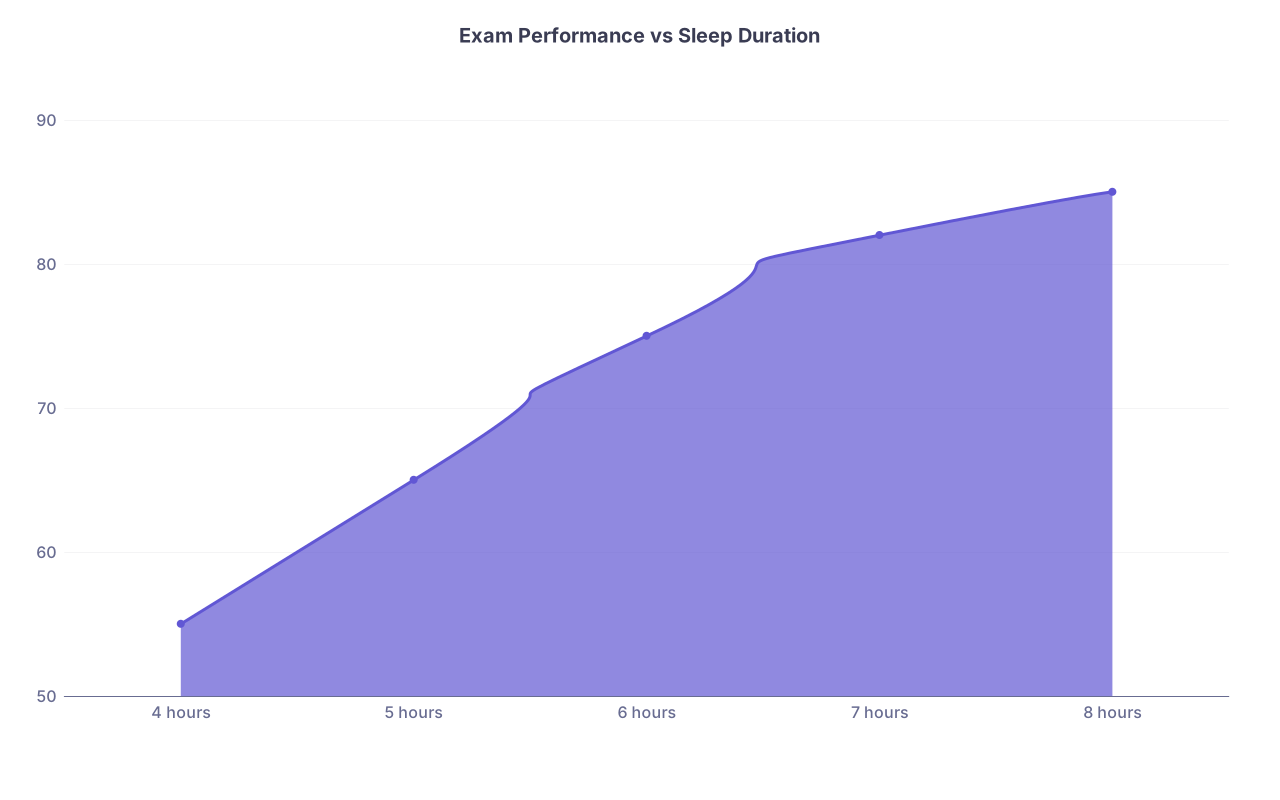
| Category | Value |
|---|---|
| 4 hours | 55 |
| 5 hours | 65 |
| 6 hours | 75 |
| 7 hours | 82 |
| 8 hours | 85 |
Here is what I have seen repeatedly:
- Student A studies 12–14 hours a day for a week, sleeps 4–5 hours a night, drinks a small lake of caffeine, and walks into the exam brittle and foggy.
- Student B studies 8–10 hours a day, guards 7–8 hours of sleep like a prescription, does fewer total questions, and walks in calm, with clear recall.
Student B usually scores higher. Dramatically higher.
Why? Because sleep is not “rest time.” Sleep is when you:
- Consolidate memories from short-term to long-term
- Integrate patterns (the “oh that makes sense now” connections)
- Prune useless noise so important details are accessible under stress
You think you are doing extra “learning” at 2 a.m. What you are actually doing is sabotaging consolidation of what you already studied.
The core error: assuming hours awake = hours productive. It does not. Post‑midnight “studying” is often just anxious scrolling disguised as work.
Do not make the mistake of believing you are the exception. You are not. I have watched people with 260-level potential drag themselves into the low 230s because they insisted on being heroes instead of humans.
Mistake #1: The Week‑Before “Sleep Debt Explosion”
You coast along most of the block: sleeping decently, studying moderately. Then two weeks before the exam, you look at the calendar, panic, and decide to “turn it on.” Translation: you stop sleeping like a person.
The pattern is almost always the same:
- 10–14 days out: You extend bedtime by “just an hour.”
- 5–7 days out: You are cutting sleep to 5–6 hours, telling yourself you will “pay it back.”
- 2–3 days out: You are in full sleep‑debt mode, wired and exhausted, trying to cram high‑yield lists into a brain that cannot hold them.

Your brain does not care that this is “crunch time.” Chronic partial sleep loss (even just 1–2 hours less per night for a week) adds up. And it does things to you that you cannot override with willpower:
- Slows reaction time
- Impairs working memory (the thing you need to hold all the answer stems in your head)
- Wrecks emotional regulation, so every hard question feels like catastrophe
The worst part? You will misjudge your own performance. Sleep‑deprived people systematically think they are doing “okay” long after their function has tanked. Med students are no different.
The avoidable mistake: treating the final 7–10 days as a reason to cut sleep instead of tighten focus. The last week is not for expanding content. It is for solidifying.
Better pattern (yes, this is non‑negotiable if you want your peak score):
- From 7 days out to exam day:
- Maintain the same sleep and wake time every day.
- Block your study hours. Stop at a fixed time.
- Protect your final 2 hours before bed as no‑screens, low‑stimulation.
You gain far more by walking in rested with 90% of your planned content than exhausted with 100% “covered” and 60% actually accessible.
Mistake #2: All‑Nighters and “Half‑Nighters” (They Are Both Bad)
Most med students will tell you they “never pull all‑nighters.” Then you find out they stayed up until 3:30 a.m. the night before a 7:30 a.m. exam.
That is a half‑nighter. It is just as destructive.
All‑nighters are obviously bad. But the more subtle trap is going to bed so late that you might as well not have slept. Four hours of broken sleep, preceded by caffeine and blue light, is not restorative. It is body‑on, brain‑off.
| Sleep (Night Before) | Cognitive Level Next Day |
|---|---|
| 0–2 hours | Severely impaired |
| 3–4 hours | Markedly impaired |
| 5–6 hours | Mild–moderate deficits |
| 7–8 hours | Optimal |
| 9+ hours (unusual) | Often groggy/sluggish |
The thought pattern that kills people here:
“I just have to push through tonight. It is one night. I will survive.”
Yes, you will survive. But your hippocampus will not be functioning at full capacity. Your prefrontal cortex will not be either. Which matters when you are parsing subtle Step‑style multi‑order questions.
I have seen students lose 10‑15 percentile points because of one terrible night of sleep right before a major exam. They knew the content. They could not access it when it counted.
If you are tempted to trade that last chunk of sleep for another Anki deck, ask yourself: Am I willing to throw away 10 points of performance to maybe learn one more obscure side effect?
You know the answer.
Mistake #3: Massive Caffeine Overcompensation
You are tired, behind, and anxious. So you do what every med student does: coffee, energy drinks, yerba mate, pre‑workout “just to study.”
Caffeine is not the enemy. Mis-timing it is.
What students get wrong before big exams:
They increase their baseline dose in the week before the test.
Suddenly you are at 400–600 mg a day when your norm is 150–200 mg. Your sleep gets lighter and more fragmented without you fully noticing, so the “extra” study hours you carved out are powered by a brain that is already degraded.They keep drinking caffeine late.
Even a “small” coffee at 4–5 p.m. can still be hitting at midnight in a sensitive person. I have watched students who “cannot fall asleep before exams” casually tell me they had an iced coffee at 5 p.m. That is not anxiety. That is pharmacology.They change their caffeine routine on exam day.
You never drink energy drinks, but suddenly at 7 a.m. the morning of Step 1 you crush a 300 mg can “just to be safe.” By block 3 you are jittery, nauseated, and making impulsive answer choices.
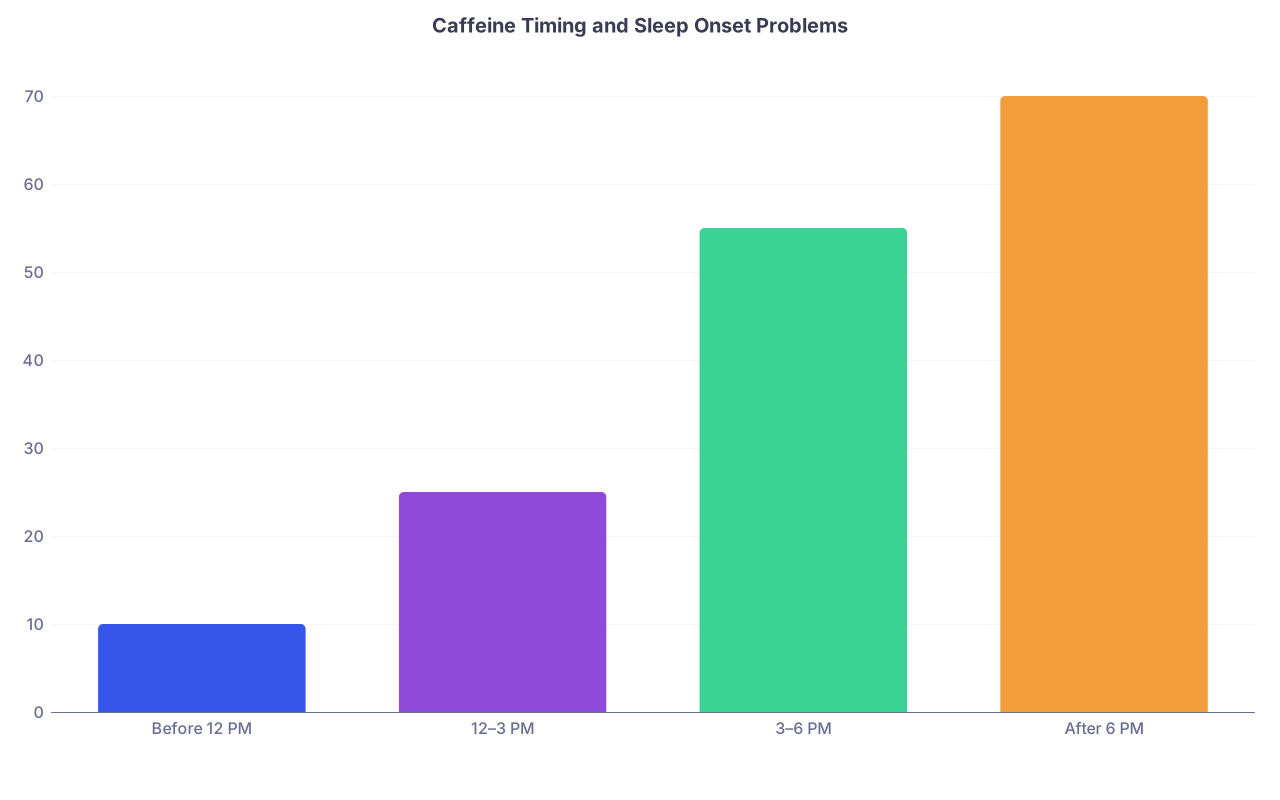
| Category | Value |
|---|---|
| Before 12 PM | 10 |
| 12–3 PM | 25 |
| 3–6 PM | 55 |
| After 6 PM | 70 |
Do not screw this up:
- Keep your caffeine amount stable in the 1–2 weeks before the exam.
- Stop caffeine at least 8 hours before bedtime. Earlier if you know you are sensitive.
- On exam day, mirror your usual pattern. Same amount, same timing. No “new” beverages.
If you need 600 mg to stay awake to study, that is not a caffeine problem. That is a sleep and schedule problem.
Mistake #4: “Revenge Study Procrastination” at Night
There is a nasty cousin to revenge bedtime procrastination in med school: revenge study procrastination.
You lose chunks of the day to lectures, busywork, clinical duties, and administrative nonsense. You feel like the day was stolen from you. So at 10–11 p.m., when you should be downshifting, you tell yourself:
“Now I finally have time to really study.”
So you open question banks, social media, resources, and settle in for a 3–4 hour “deep work” session. Except you are not fresh. You are tired, resentful, and distracted. Your yield is terrible. But you keep going because stopping would mean facing your frustration and fatigue.
I see this all the time during clerkships. Especially on surgery.
What this does:
- Trashes your circadian rhythm
- Links your bed with stress and hyperarousal
- Teaches your brain that late night = fight / flight / memorize
The mental health cost is not trivial. This pattern:
- worsens anxiety
- worsens depressive symptoms
- makes burnout hit harder and sooner
And yes, it will bleed into your performance on big tests, because you are walking into exam season already chronically distressed and underslept.
If you notice your best “study time” is after 10 p.m., that is not a strength. That is a warning sign that your daytime structure is broken or unrealistic.
You are better off ruthlessly optimizing 8–10 high‑quality daytime hours and sleeping at night than patching your life together with midnight heroics.
Mistake #5: Ignoring Sleep Hygiene Until the Night Before
Some students attempt to brute‑force “good sleep” only on the night before a major exam. The rest of the year, their sleep hygiene is chaos:
- Studying in bed
- Falling asleep to YouTube or TikTok
- Blue light in the face up until the exact second they close their eyes
- Naps at random times, including 7–8 p.m.
Then, one night before Step 1, they decide: “I will go to bed at 10 p.m., no screens, perfect sleep.” The brain does not magically cooperate.
Your sleep system is trained. By your habits. By your environment. By your timing.

| Step | Description |
|---|---|
| Step 1 | Late-night studying |
| Step 2 | Increased caffeine use |
| Step 3 | Difficulty falling asleep |
| Step 4 | Shortened sleep time |
| Step 5 | Daytime fatigue |
| Step 6 | More evening studying needed |
When you ignore sleep hygiene and then try to “fix” it for one critical night, what usually happens:
- You go to bed early
- You stare at the ceiling watching your heart rate pick up
- You catastrophize: “If I do not fall asleep now, I am screwed”
- You get less sleep than usual, not more
Do not wait until the last second.
Basic, boring rules that work if you start at least 2–4 weeks before big exams:
- Bed is for sleep (and sex), not study. Desk for studying.
- Screens off or filtered and away 45–60 minutes before bed.
- Same sleep and wake time 6–7 days a week, including weekends.
- Cut long naps (over 30 minutes) and avoid napping after mid‑afternoon.
No, this is not glamorous. But neither is crashing your exam performance because you insisted on scrolling in bed every night “to relax.”
Mistake #6: Overtraining the Day Before, Under‑Sleeping the Night Before
The day before the exam is where many otherwise smart students completely lose the plot.
Typical bad pattern:
- Wake up early “to get a head start”
- Grind 8–12 hours of last‑minute questions and high‑yield lists
- Keep caffeine flowing
- Study anxiously into the late evening “because tomorrow is huge”
- Try to shut brain off at midnight, fail, ruminate, sleep badly
By exam morning, they are mentally cooked.
The big flaw: treating the day before the exam like another full study day. It is not. It is a taper day. Like the day before a marathon.
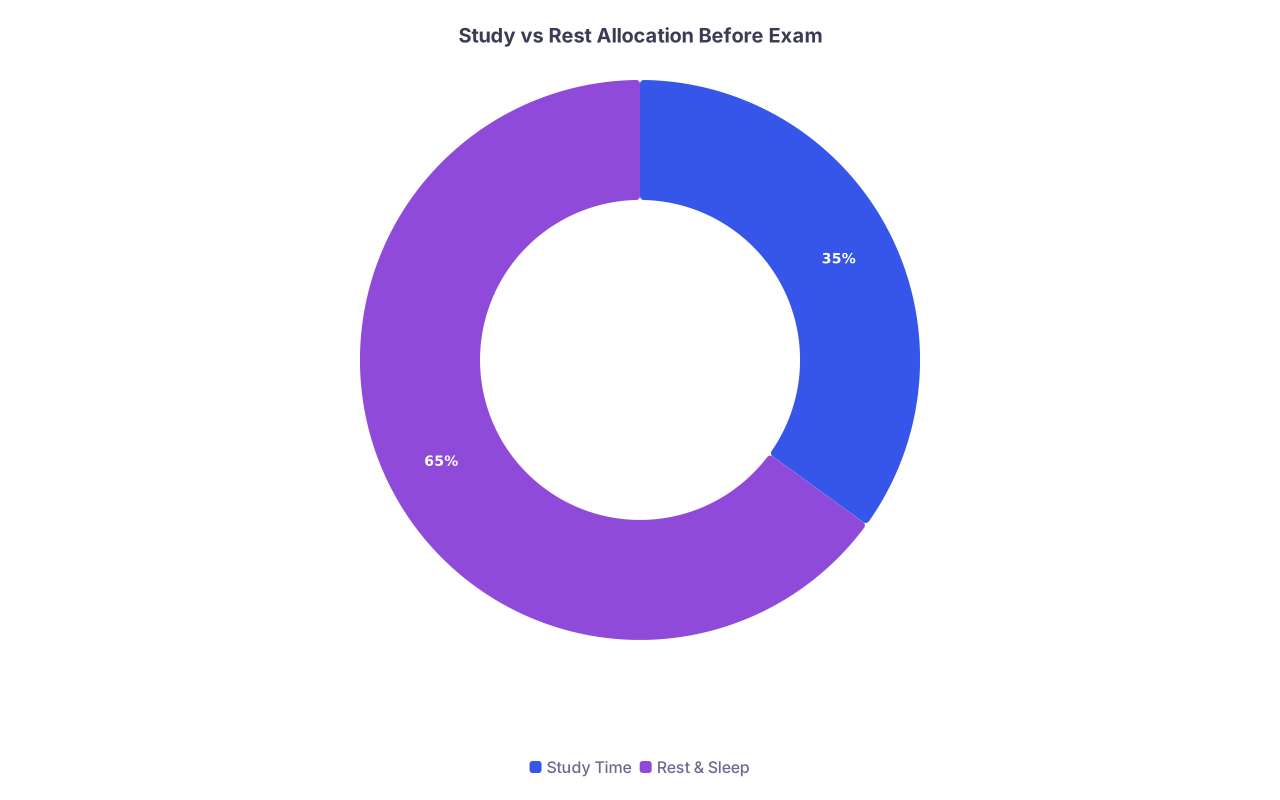
| Category | Value |
|---|---|
| Study Time | 35 |
| Rest & Sleep | 65 |
Think of it this way: every new fact you try to jam in 12–18 hours before your exam has almost zero chance of consolidating meaningfully. But every hour of deep, high‑quality sleep the night before massively improves your ability to retrieve what is already there.
What to avoid:
- Starting any new resource or section
- Timed full blocks in the late afternoon / evening
- Large doses of caffeine after lunch
- Emotional post‑mortems of missed questions (“How could I forget that?”) at 10 p.m.
Your job the day before:
- Light review only: flashcards, quick formulas, rapid pass of your own notes
- Moderate physical movement: walk, jog, stretch
- Normal meals, no heavy new foods
- Wind down early and respect your usual bedtime
You do not win the exam the day before. You only have the power to lose it by tanking your sleep.
Mistake #7: Treating Sleep as Optional Because “It’s Just a Shelf”
Another trap: students will respect sleep for Step 1, maybe Step 2, but trash it for “less important” exams: anatomy practicals, path exams, clerkship shelves.
That is how you build bad habits you cannot turn off later.
Big picture problem: you are not only preparing for one exam. You are training how your brain and body respond to high‑stakes testing. You are building a template.

If your template is:
- Panic → sacrifice sleep → overstudy at night → walk in exhausted → survive
That will be your default for Step 2, for in‑service exams, for boards in residency. And yes, for overnight calls and patient care. You will link anxiety with self‑neglect.
A better template to engrain:
- Notice anxiety → tighten schedule → keep sleep constant → protect routines → trust preparation
You need that pattern to survive this career in any sustainable way.
So no, you do not “save good sleep hygiene” only for national boards. You practice it on the “smaller” exams so that when the big ones come, the pattern is automatic.
Mistake #8: Assuming Mental Health Can Survive Chronic Sleep Loss
We need to talk about the mental health side. Because the category you chose is not “test‑taking strategy.” It is medical school mental health. Good. Because this is where many people crack.
Chronic sleep restriction changes you. Not just your scores.
You become:
- More reactive and irritable
- Less able to regulate worry
- More prone to hopelessness and catastrophic thinking
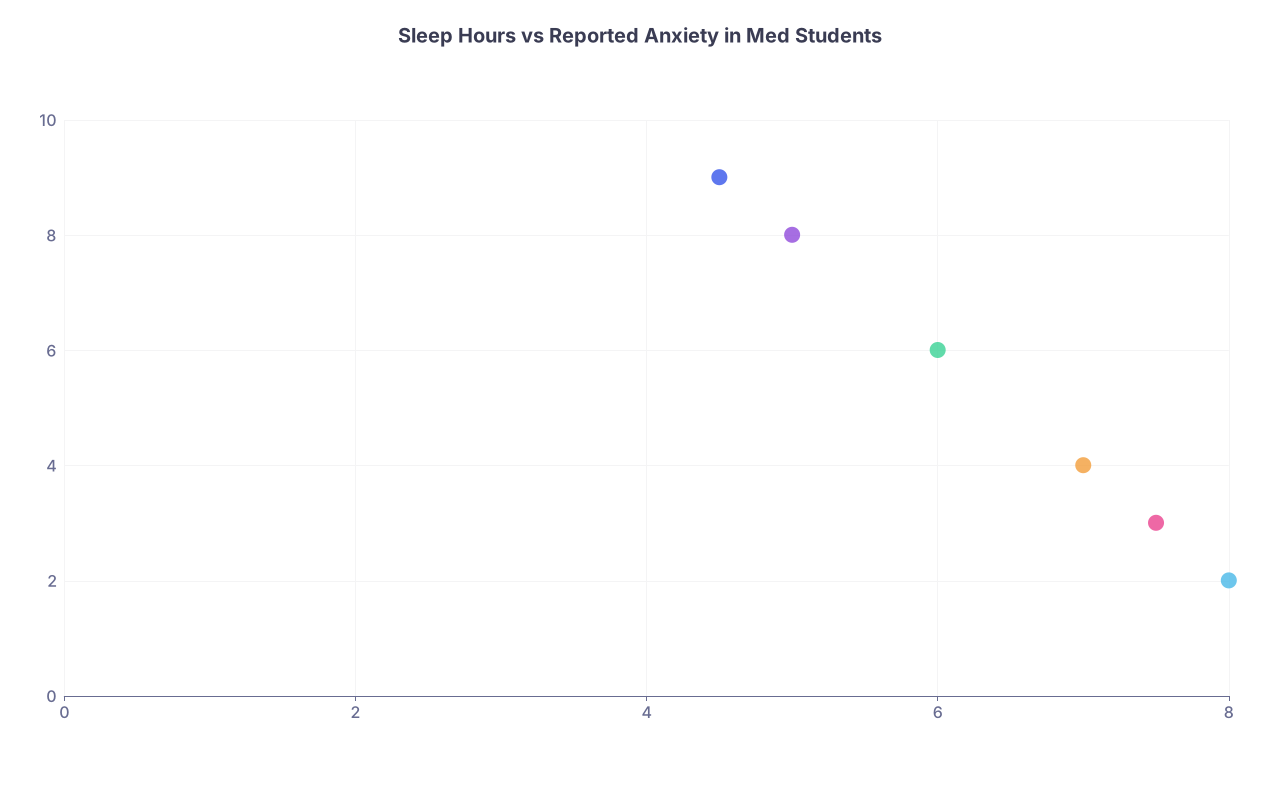
| Category | Value |
|---|---|
| Student 1 | 4.5,9 |
| Student 2 | 5,8 |
| Student 3 | 6,6 |
| Student 4 | 7,4 |
| Student 5 | 7.5,3 |
| Student 6 | 8,2 |
That student crying in their car after a shelf? Often not “too sensitive.” Often just profoundly sleep deprived on top of normal stress.
I have watched students develop full‑blown generalized anxiety or major depressive episodes because they spent months oscillating between high stress and too little sleep. Their brain never got a chance to reset.
You will hear peers brag: “I was on call until midnight then up studying until three.” Ignore the flex. What you are hearing is untreated anxiety, poor boundaries, and a crash coming.
If you already have any mental health vulnerabilities (history of anxiety, depression, trauma, ADHD), chronic sleep loss before high‑stakes exams will hit you harder. The emotional fallout will not be a minor inconvenience. It will feel like your entire identity is unraveling.
Sleep is not a luxury for “weak” students. It is the treatment that prevents you from breaking under a system that constantly tests your limits.
If you are noticing:
- Daily crying spells
- Anhedonia (nothing feels good)
- Persistent thoughts of failure or worthlessness
- Intrusive thoughts of self‑harm, even passive
That is not a “grind harder” problem. That is a “stop sacrificing sleep and get actual professional help” problem.
How to Avoid These Sleep Sacrifices (Without Being Unrealistic)
You do not need a perfect schedule. You do need to stop repeating the same preventable mistakes.
Here is a simple reality‑based framework you can actually use:
Decide your minimum sleep quota per night before a major exam season.
For most med students, that is 7 hours. Not ideal, maybe, but realistic.Lock your sleep and wake times first, then build a study schedule around them.
Not the other way around. You would not move an OR start time for your convenience. Treat your sleep the same way.Cap your daily study hours.
If you are “studying” more than 10 hours a day for weeks, you are not studying. You are either panicking or avoiding. Quality beats quantity every time, especially long‑term.Schedule a taper: last 48 hours are for review, not expansion.
Do not start new resources, new decks, or aggressive new question blocks.Protect your exam‑eve evening like a procedure.
Light review → dinner → walk / shower → screens off → sleep. No last‑minute heroics.
If you cannot stick to this because you are always behind, the problem is not that the rules are too strict. The problem is your plan was never realistic for a human body in the first place.
The Short Version: What You Will Actually Regret
There are some regrets I hear over and over from students after big exams. They almost never say, “I wish I had done another 200 questions that last night.”
They say things like:
- “I knew the material, but my brain was slow. I felt like I was thinking underwater.”
- “I saw questions I had studied, but I just could not pull the details out.”
- “I was so wired from caffeine and lack of sleep that I panicked on blocks 3 and 4.”
- “I crashed emotionally afterward and realized I had been on the edge for weeks.”
You will not remember the extra late‑night flashcards a month from now. You will remember how it felt to walk into that exam room: either calm and clear, or broken and buzzing.
If you made it this far, keep these points tight in your head:
- You do not trade sleep for points. You trade sleep for slower thinking, weaker recall, and poorer emotional control.
- The week before the exam is not the time to cut sleep. It is the time to stabilize it and taper your studying.
- You are training lifelong patterns. Protecting sleep before exams is not laziness. It is the only way you get through medicine without destroying your mind.
Do not wait until the day you stand outside a major exam wishing you had treated your brain like something you plan to use for the rest of your career.