The way most medical students use social media is quietly destroying their confidence and killing their focus.
Not because they are weak. Because the platforms are engineered to hijack exactly the parts of your brain you need most for exams, clinical performance, and mental health.
You are not just “scrolling.” You are training your brain. You are rewiring your attention. You are handing your self-worth to an algorithm that does not care if you pass Step 2 or burn out.
Let me walk you through the traps I keep seeing medical students fall into—and how to avoid becoming another “I was fine M1, then everything crumbled” story.
1. The Comparison Trap: Everyone Else Looks Smarter, Happier, and Farther Ahead
The worst mistake: believing what you see in your feed is reality.
You know this intellectually. But it still gets under your skin emotionally.
What you see:
- Classmate posting their 260+ Step score screenshot
- Resident with a perfectly curated “day in my life as a derm resident” vlog
- Peer sharing their latest publication, “H-index = 7 😅”
- Study influencers casually flipping through First Aid with captions like “9 hours of Anki done, now gym + meal prep!”
What you do not see:
- The student who failed a block and quietly disappeared from Instagram
- The “high scorer” who cried in their car after every NBME
- The derm resident who feels trapped in a specialty they picked for prestige
- The influencer who filmed that “study with me” video three times to get the perfect aesthetic
I watched one M2 spiral after a friend posted: “Scored 267 on Step 1 after 5 weeks of dedicated, ask me anything.”
He already had a strong NBME trajectory. But that single post convinced him he was behind. His thought process:
- “I am at 235 on practice tests, that is so far from 267”
- “Maybe I am not as smart as I thought”
- “If I don’t hit 250+, doors will close forever”
His studying did not improve. His anxiety did.
How this trap wrecks you
- It makes your ceiling your new baseline
- It turns other people’s rare wins into your daily expectations
- It erases your actual progress because it is not “post-worthy”
- It trains your brain to constantly self-audit: “Am I enough? Am I behind?”
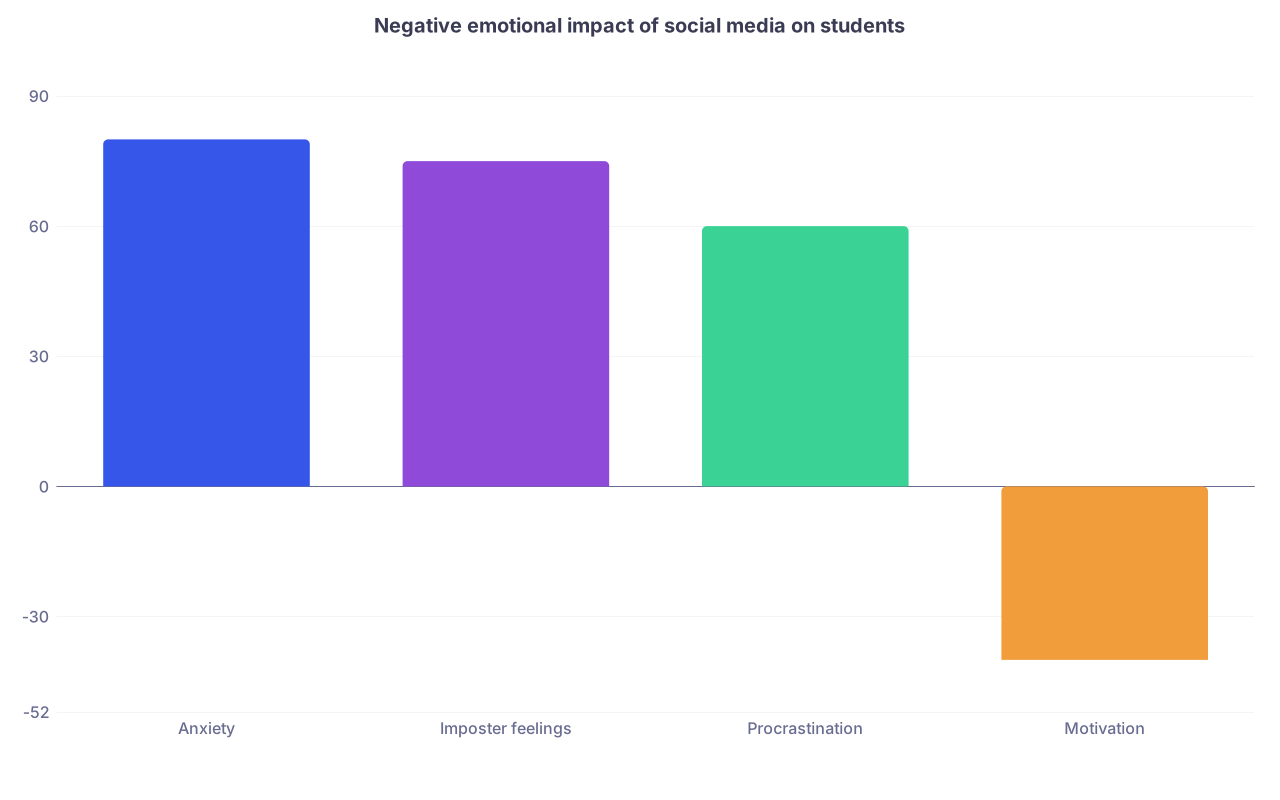
| Category | Value |
|---|---|
| Anxiety | 80 |
| Imposter feelings | 75 |
| Procrastination | 60 |
| Motivation | -40 |
The numbers are illustrative, but the pattern is real: anxiety and imposter feelings go up; genuine internal motivation drops.
How to avoid this mistake
Set a personal rule: You do not compare your:
- Beginning to someone’s middle
- Average day to someone’s highlight reel
- Reality to someone’s branding
Mute aggressively
You do not need to unfollow. Just mute:- Score posts
- “Grind culture” accounts
- Classmates who only post achievements (and nothing human)
Create a “reality check” folder
In your notes app, keep:- Your practice test score progression
- Specific feedback from attendings or preceptors
- Concrete things you improved over last month / last exam
When comparison thoughts hit, you look at data, not vibes.
If your feed makes you feel smaller, it is not “inspiration.” It is poison.
2. The Micro-Dopamine Trap: Training Your Brain Not to Tolerate Boredom
Exams reward sustained, deep focus. Social media punishes it.
Two weeks before a major exam, I watched a student sit in the library with UWorld open. For 10 minutes straight, he did this cycle:
- Read half a question
- Feel a flicker of discomfort (“I don’t know this cold”)
- Grab phone
- Scroll Instagram for 45 seconds
- Back to question
- Repeat, endlessly
He studied for “8 hours.” He probably did 3 hours of actual work.
What this trap does to your brain
Every time you:
- Hit a hard question
- Feel confused
- Start to feel mental fatigue
…and then you reach for your phone, you are practicing this loop:
Discomfort → Escape → Tiny dopamine hit → Relief
You are literally conditioning yourself:
- To associate studying with pain
- To break focus every time the work matters most
- To need micro-rewards every 2–5 minutes
That system will fail you:
- On 7-hour exams with no phone
- On wards when you must stay mentally engaged despite being tired
- When you need to read dense papers, guidelines, or long consult notes
The silent lie: “It’s just a quick break”
It is rarely just a quick break.
By the time you:
- Unlock phone
- Check notifications
- Respond to a message
- Scroll 2–3 posts “just to see”
Your attention is gone. And it does not bounce straight back.
How to avoid this mistake
You will not win a willpower battle with your phone. You need structure, not vibes.
Try this simple setup (I have seen it save scores):
Use app blockers during focus blocks
- Apps like Freedom, Forest, Opal, StayFocusd
- Block Instagram, TikTok, Snapchat, Twitter/X, YouTube shorts
- Set 45–60 minute blocks, then a 5–10 minute offline break
Physical separation
- Phone in bag, across room, or in locker
- If you need it for 2FA, use airplane mode + Wi-Fi only on laptop
Hard rule:
No vertical-scroll apps:- In lecture
- During practice blocks
- In bed right before sleep
If you train your brain to expect stimulation every 30 seconds, you cannot expect it to sit calmly through a 7-hour exam. That is not an attitude problem. It is conditioning.
3. The “Study Influencer” Trap: Mistaking Aesthetics for Effectiveness
Pretty notes do not pass UWorld questions. Viral study routines are not built for your brain, your school, or your exam calendar.
Yet students keep copying:
- 6-hour “deep work” schedules from people not actually in med school
- Ridiculous morning routines (5 a.m. wake, 30 min journaling, 45 min yoga, 1-hour walk, 2 hours of breakfast and planning)
- 10-color highlighting systems that turn into an arts-and-crafts project
I watched a solid student tank their first big exam after switching from:
- Ugly but consistent Anki + question bank
To: - “Aesthetic summary pages,” rewritten notes, color-coded everything, and copying a YouTuber’s exact daily timetable
Their performance dropped. Their anxiety went up. And they blamed their discipline, not the trash system they adopted.
The hidden problems with influencer routines
They are optimized for content, not outcomes
- Long overhead shots of pretty notes = clickable
- Time-lapse of you doing 40 practice questions with detailed review = boring
They have survivor bias
- You see the one influencer who “studied 3 hours a day and scored 260”
- You do not see the 500 who tried that, failed, and stopped posting
They ignore differences that matter
- Different school pacing
- Different baseline knowledge
- Different mental health, sleep, work obligations
How to avoid this mistake
Use influencers for ideas, not templates
You can borrow:- A time-blocking concept
- A specific review trick
- A way to organize your calendar
But you must test it at small scale before committing your whole prep.
Follow actual score and burnout outcomes, not vibes
Ask yourself:- “Did my last 2–3 weeks feel more focused or more scattered?”
- “Are my practice scores moving up, flat, or down?”
- “Do I end the day understanding more, or just having produced ‘study-looking’ work?”
Keep a brutally simple rule:
If a method:- Does not directly improve recall
- Does not improve question performance
- Does not shorten your study time for same or better results
…it is aesthetic clutter. Drop it.
Be very careful whose systems you trust with your mental health and board scores. Many “study influencers” will be fine if you fail. You will not.
4. The Professional Persona Trap: Always “On,” Never Honest
Here is a subtle trap that wears people down.
Med students start accounts to:
- “Build a professional brand”
- “Share my journey to help others”
- “Network for competitive specialties”
Fine. But then this happens:
- You feel pressure to post only wins and growth
- You hide the bad exams, the ugly feedback, the burnout
- You become a character: “resilient, high-achieving, positive future physician”
I have seen students say, almost word for word:
“I can’t post that I am struggling. What if programs see it?”
“I feel fake but I also feel stuck. People expect me to be inspiring now.”
The result:
- You are exhausted by pretending
- You cannot be fully honest online
- You start to extend that pretending into real life
How this crushes confidence
You create a split:
- Online: Competent, always improving, on top of it
- Inside: Uncertain, overwhelmed, tired, occasionally lost
That gap becomes:
- Shame: “If they knew the real me, they would be disappointed”
- Isolation: “I cannot tell anyone I am actually not okay”
- Anxiety: “What if I cannot keep this up during rotations or residency?”
How to avoid this mistake
Decide your line in advance
Ask yourself:- What will I talk about publicly? (general struggles, normal stress)
- What stays private or only with trusted friends / therapist? (burnout, suicidal thoughts, serious missteps)
You do not owe the internet your vulnerability
Being honest does not mean live-blogging your breakdowns.
Nor does it mean crafting fake “I struggled but look at me now” arcs every week.Build at least one offline space where you can be unfiltered
- Group chat with 1–3 classmates who get it
- Therapist or counselor
- Mentor who remembers what med school actually feels like
If your “professional brand” costs you your authenticity and psychological safety, it is a bad trade.
5. The Doom-Scroll Trap: Specialty Panic and Future Catastrophizing
This one hits especially hard around:
- Step/Level scores
- Applying to competitive specialties
- Clinical clerkship grading
You search:
- “Derm match rate 2024”
- “Average Step 2 score for ortho”
- “Internal medicine fellowship match stats”
Then you end up on:
- Reddit threads packed with anonymous catastrophizing
- X/Twitter posts from bitter near-misses and outliers
- Comment sections that read like horror stories
You walk away convinced:
- “If I do not have 10 publications, I am done”
- “I got one pass on surgery, so no hope for ortho”
- “Step 1 pass/fail ruined everything for me”
Why this trap is so effective
Online, angry or extreme stories travel faster:
- The student with average stats who matched fine does not write a 3,000-word Reddit post
- The student who missed their dream specialty by a hair sometimes does
So your sample is skewed.
You also see:
- Perfect CV screenshots
- Hyper-detailed breakdowns of “what it takes”
…and you forget:
- Many of those people are flexing, not educating
- Context matters (home program, connections, school reputation, personal circumstances)
How this destroys your focus
Instead of:
- Doing questions
- Reviewing weaknesses
- Building real relationships at your home institution
You spend hours:
- Refreshing forums
- Re-analyzing your CV every week
- Mentally quitting before you even apply
How to avoid this mistake
Set strict rules for “career research” time
- 1–2 hours, once a month, not daily
- Objective: gather data, then step away
Prefer official/structured sources over anonymous forums
- NRMP data reports
- Specialty organization websites
- Advisors and program directors at your school
Anchor decisions in your numbers, not random online benchmarks
- Your class rank, evaluations, Step/Level scores, research interests
- Real feedback from people who have seen your work
If reading about a specialty makes you less likely to study today, you are not “researching.” You are self-sabotaging.
6. The Sleep and Recovery Trap: Phone in Bed, Brain on Fire
You are exhausted. You tell yourself: “I just need 10 minutes to switch off and scroll.”
Forty-five minutes later:
- You are watching unrelated videos
- You have seen 3 score flexes, 2 horror stories, and 5 unrealistic routines
- Your heart rate is up, not down
Med students massively underestimate this:
You cannot be mentally healthy if your sleep is trash. You cannot perform on exams with chronically shortened, fragmented sleep. Social media in bed is a sleep-destroying machine.
Typical pattern I see
- Bedtime at 11:30
- Phone in hand “to check something quickly”
- Scroll until 12:15–12:45
- Brain stimulated, now “too awake to sleep”
- Next day: more coffee, more anxiety, less focus
Over weeks:
- Mood worsens
- Concentration drops
- You blame your grit, not your phone
How to avoid this mistake
Adopt one of these rules. Just one. Then build from there.
No phone in bed. Period.
Charge it across the room, in another room if possible.Digital sunset
- No social media apps 60 minutes before intended sleep
- If you must, only allow low-stimulation content (e.g., reading on Kindle, not short-form video)
Use tech against itself
- App timers that auto-lock at a certain hour
- Focus modes / Do Not Disturb with custom schedules
Sleep is not negotiable in med school. It is infrastructure. Wreck your sleep and everything else eventually collapses.
7. Building a Healthier Relationship with Social Media (Without Going Off-Grid)
You do not need to disappear from the internet. You do need to stop pretending your current usage is neutral.
Here is a simple, honest framework that actually works for most students I have seen use it.
Step 1: Audit your current reality
For 3 days:
- Track total screen time on social apps
- Notice when you reach for your phone (boredom? anxiety? procrastination?)
- Rate your mood before and after longer scroll sessions (1–10)
| Metric | Day 1 | Day 2 | Day 3 |
|---|---|---|---|
| Total social minutes | 140 | 120 | 155 |
| Study interruptions | 9 | 7 | 10 |
| Mood change (avg) | -2 | -1 | -3 |
If your “relaxing scroll” consistently leaves your mood lower, believe the data, not the story you tell yourself.
Step 2: Decide your non-negotiables
Some examples that actually hold up under pressure:
- Max 30–45 minutes total social media per day
- Zero social media:
- 1 hour after waking
- During any timed practice
- In bed
Step 3: Curate, do not just consume
You control your feed more than you admit.
Follow:
- A few evidence-based educators
- Accounts that normalize struggle without glamorizing dysfunction
- Non-med things that genuinely relax you (art, nature, long-form content)
Ruthlessly mute or unfollow:
- Score flexes
- Accounts that spike anxiety or envy
- People you only follow out of guilt or FOMO
Step 4: Protect your deep work like your life depends on it
Because your future life does.
Create:
- 2–4 focus blocks per day (45–75 minutes)
- Phone physically away + app blocking during those blocks
- Short, intentional breaks (walk, snack, stretch, call a friend) instead of doom scrolls

| Step | Description |
|---|---|
| Step 1 | Start Study Block |
| Step 2 | Phone on DND/App Blocker |
| Step 3 | 45-60 min Focused Study |
| Step 4 | 5-10 min Offline Break |
| Step 5 | End Session, Limited Social Media |
| Step 6 | Break Time? |
| Step 7 | More Studying? |
When your relationship with social media stops being mindless and becomes intentional, two things tend to happen:
- Your confidence stabilizes because it is built on your own data, not the feed
- Your focus returns because you are no longer constantly yanking your brain out of gear
FAQ (4 Questions)
1. Do I have to delete all my social media to succeed in medical school?
No. I have seen plenty of students succeed while still using social media. The ones who do well treat it like caffeine: controlled, timed, and limited. If you cannot stick to basic boundaries—no scrolling in bed, no interruptions during study blocks—that is when I push people to consider full deletion, at least during high-stakes periods like dedicated board prep.
2. Is following “medfluencers” actually harmful, or am I just being sensitive?
It is harmful when their content consistently leaves you feeling behind, inadequate, or panicked, even if the advice is technically “good.” Sensitivity is not the issue. Your nervous system is giving you data: “This is destabilizing me.” Believe it. You can find role models and guidance without tying your self-worth to strangers’ curated lives.
3. How do I know if social media is really affecting my scores, not just my mood?
Look at objective patterns. If your hours “studying” are high but your completed questions, reviewed flashcards, or practice test scores are stagnant, and you are interrupting work to check your phone, it is affecting performance. When students cut social media interruptions for even 1–2 weeks, they often see concrete improvements in question volume, retention, and test accuracy.
4. What if all my med school friends are on social media and I am afraid of missing out?
You will miss some jokes, memes, and minor updates. You will not miss the things that actually matter if you have even a couple of real-life or group chat connections. I would rather see you “miss” a meme than miss a pass on a major exam. If people only include you via social media, that is a separate problem—and it says more about the relationship than your decision to protect your mental health.
Key takeaway 1: Social media is not neutral. It is actively training your brain away from the exact skills you need in med school: sustained focus, tolerance of discomfort, and internally grounded confidence.
Key takeaway 2: You do not need to disappear from the internet. You do need to set hard boundaries, curate your feed ruthlessly, and treat your attention like a limited, high-value resource—because in medical school, it is.