
The way most med students handle stress is quietly destroying their residency years before Match Day.
I’m not being dramatic. I’m telling you what residents say when the door is closed, the pager is quiet for five minutes, and they’re talking to someone who’s not grading them. When I ask, “What do you wish you’d done differently about stress in med school?” the answers are remarkably consistent. And brutally honest.
Let me walk you through what they tell me. Not the polished “wellness talk” version. The real version.
The First Big Regret: Treating Stress Like a Temporary Phase
Residents will say it in different ways, but it boils down to this:
“I thought I just had to survive med school. Then residency would be better.”
It is not. It is harder. More responsibility, less control, more hours, more real deaths, more moral injury. Whatever stress patterns you build in med school do not magically disappear. They calcify.
I’ve heard a PGY-2 in IM say this almost word for word on night float at 3 a.m.:
“If I’d learned how to sleep and say no in M2 instead of grinding myself into the ground, I wouldn’t be this wreck right now. I practiced being miserable for four years. Now I’m just…better at it.”
The myth in med school is: “This is just a sprint. I’ll fix my life later.”
The truth from residents: you’re building your baseline. Your default stress response. Your relationship with work and with yourself.
They wish they had treated their stress habits the way they treated their Step prep: deliberate, planned, and non-negotiable.
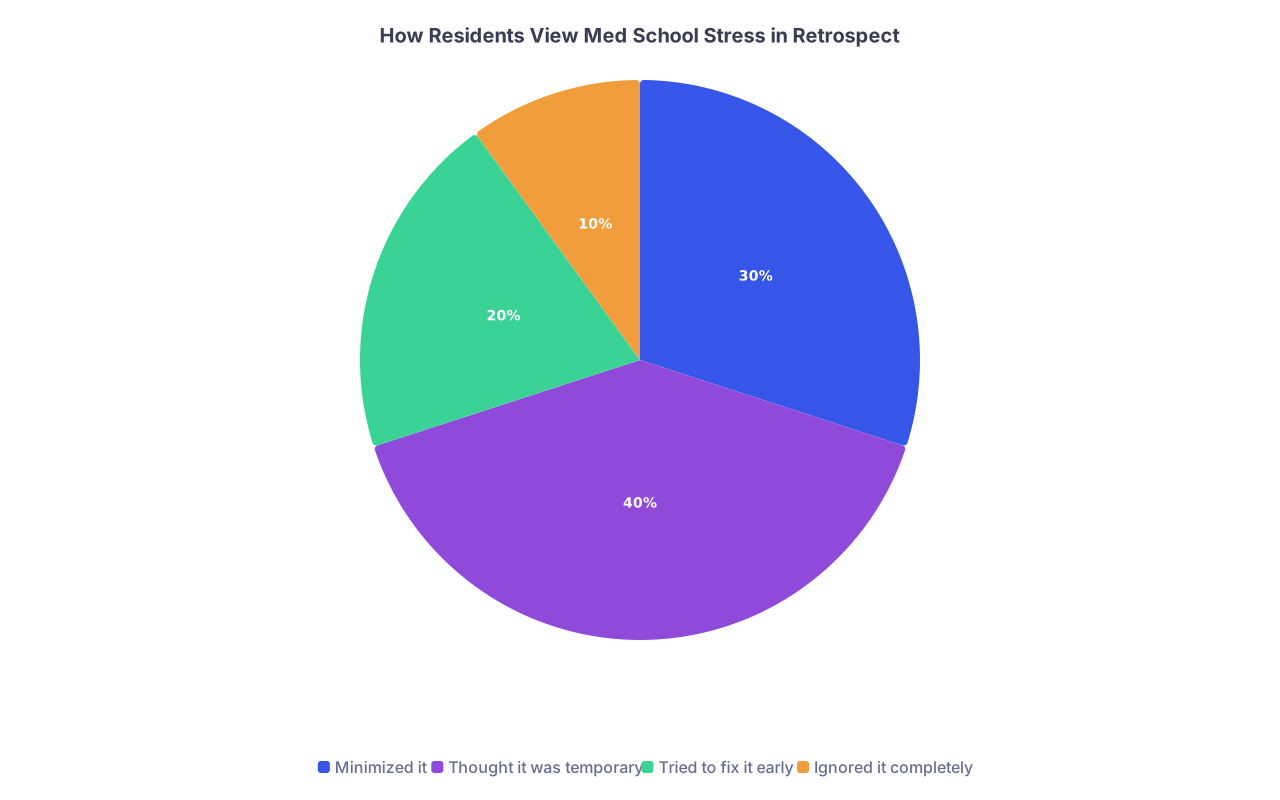
| Category | Value |
|---|---|
| Minimized it | 30 |
| Thought it was temporary | 40 |
| Tried to fix it early | 20 |
| Ignored it completely | 10 |
The Second Regret: Confusing Masochism With Work Ethic
I’ve heard more attendings than you’d think say this quietly about med students:
“They don’t know how to work. They only know how to suffer.”
That stings, but it’s not wrong.
Med students often equate suffering with virtue. The later you stay. The more you say yes. The fewer breaks you take. The more you brag about how little you slept. It becomes a culture contest of who can degrade their own health the most.
Residents look back and say, “I wish I had learned efficient, sustainable work, not heroic self-destruction.”
What they mean by that:
They wish they had:
- Stopped bragging about being “so busy” and started measuring how effectively they were learning per hour.
- Stopped tying their worth to how exhausted they were.
- Stopped saying yes to every project, shadowing, and committee just to feel “competitive.”
Here’s what program directors actually notice. Not what you think they notice.
| What Students Obsess Over | What PDs & Attendings Actually Respect |
|---|---|
| Working until 2 a.m. in the library | Solid clinical reasoning when rested |
| Saying yes to every research idea | Finishing 1–2 meaningful projects well |
| Being on every student leadership group | Showing up prepared and reliable |
| Never asking for help or a break | Knowing limits and escalating early |
| Looking perpetually stressed and busy | Being calm, teachable, and consistent |
Residents remember the turning point very clearly. That first night on call when they realized:
No one cares that you can do Anki for 8 hours straight.
They care that at 3 a.m., when a patient is crashing, you can think clearly.
“I wish I had practiced working like a professional, not like a martyr,” is a direct quote from a surgery resident who used to pride himself on 16-hour study days in M2.
When you train yourself to equate pain with productivity, you don’t magically turn that off when you’re at risk for burnout and depression. You double down. That’s how people break.
The Third Regret: Ignoring the Early Warning Signs
In med school, the bar for what counts as a “problem” gets warped. Everyone’s tired. Everyone’s anxious. Everyone’s stressed. So you normalize things that, in any other setting, would be massive red flags.
Residents will say things like:
- “I thought crying in my car twice a week was…normal.”
- “I assumed having chest tightness every time I checked my email was just ‘being in med school.’”
- “I never called it depression. I said I was ‘burned out.’ Translation: I was depressed and didn’t want that label.”
The pattern is predictable.
First year or early second year: You stop doing hobbies “temporarily.” Sleep gets shorter. Anxiety starts to feel like your baseline. But you’re still functioning, still scoring fine, so you ignore it.
Late second year: You’re grinding for Step. You define your self-worth with a three-digit number or a pass/fail line. Your anxiety spikes. You push harder.
Clinical years: You suddenly live on evaluations. You internalize every critical comment and dismiss every positive one. You feel replaceable and invisible at the same time. Stress stops being something you “have” and becomes who you are.
By the time residency hits: The mindset is set. “I’m the person who just keeps going no matter what.” Translation: “I’m the person who doesn’t recognize when I’m not okay.”
Residents wish they’d taken these “normal med school” signs seriously:
- Losing enjoyment in everything, not just school.
- Dreading every day, not just exams.
- Eating garbage or barely eating at all without noticing.
- Needing alcohol or substances to “come down” regularly.
- Waking up with a racing heart for no clear reason.
- Constant guilt when not studying, even for 20 minutes.
Those are not character traits. They’re symptoms.
And here’s the part you’re not told honestly: program directors are far less scared of someone who sought help in med school than of someone who’s never had any insight into their own limits.
The quiet truth? The resident who can say, “I hit a wall in M2, got therapy, adjusted how I work, and here’s what I learned” is far safer to them than the one who boasts, “I’ve never needed help.” The second one is a meltdown waiting to happen.
The Fourth Regret: Outsourcing Their Self-Worth to Scores and Evaluations
Almost every resident I’ve asked says some version of:
“I wish I’d learned earlier that there’s always another metric, another hoop, another way to feel ‘not enough.’”
Med school trains you to live evaluation-to-evaluation. Preclinical exams. Shelf exams. Step. OSCEs. Clinical evals. Honor society. Then applications. Then interviews. Then rank lists.
So you adapt. You put your self-worth into numbers and comments. It works…right up until it doesn’t.
Ask any PGY-1 who was a “top” student in med school. The story is the same. They show up to residency used to being praised. Then they get their first attending who’s blunt, the first rotation where they’re average, the first bad evaluation.
They crumble.
I watched a stellar former AOA student on her first ICU month sitting in the hallway after a rough feedback session, saying, “I don’t think I belong in medicine.” Why? Because one attending told her she “struggled with prioritization” on a busy night.
Residents wish they’d learned earlier:
- The system always has another hoop. If you keep waiting for the “last one,” you’ll be 45 and still chasing it.
- You are not your last test score.
- Attending mood, unit chaos, and random bad days account for more evaluation noise than you think.
- Your internal narrative matters more than any comment box.
Here’s the mental shift they wish they’d made in med school instead of residency:
From: “I study to prove I’m enough.”
To: “I study to become competent enough to help patients and not hurt them.”
That’s a very different stress profile.
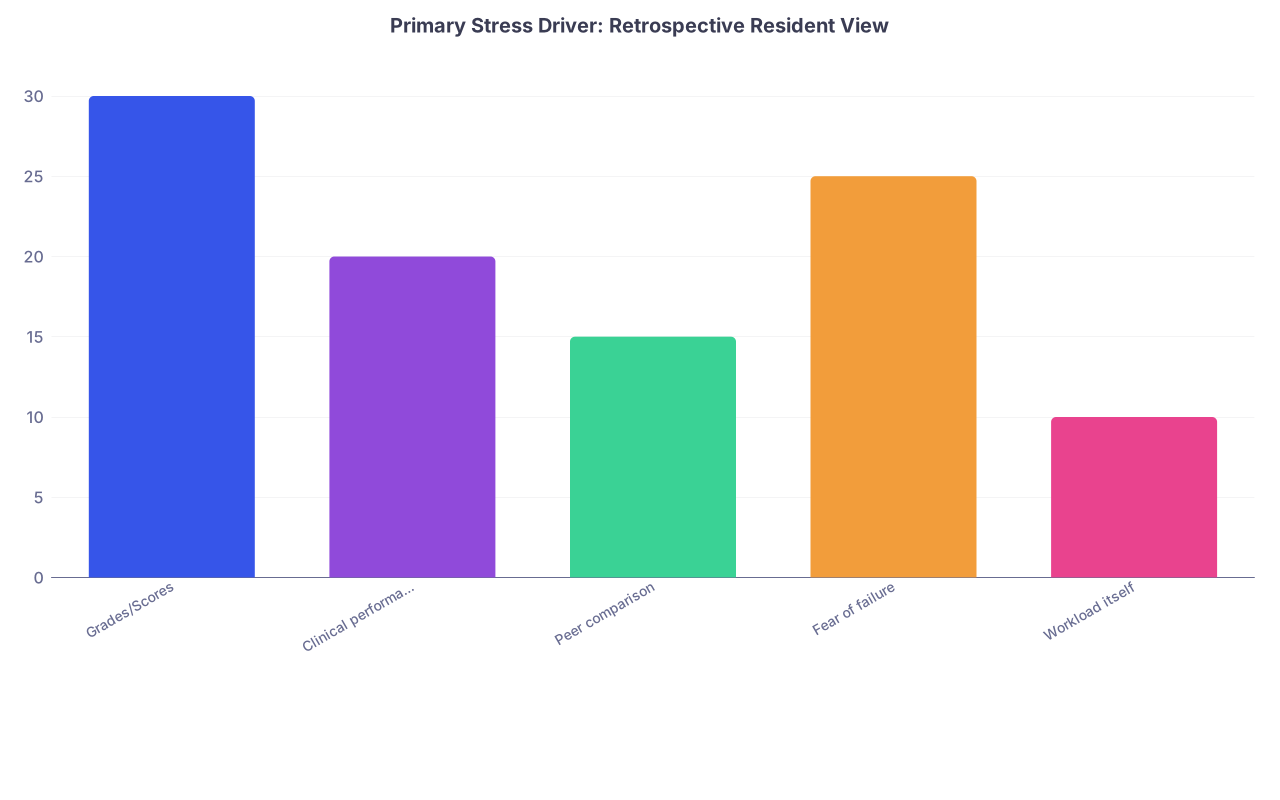
| Category | Value |
|---|---|
| Grades/Scores | 30 |
| Clinical performance | 20 |
| Peer comparison | 15 |
| Fear of failure | 25 |
| Workload itself | 10 |
The Fifth Regret: Never Developing Real Coping Skills
Med school culture sells three fake coping strategies as if they’re legitimate:
- Complaining constantly with equally stressed friends.
- Bingeing Netflix / social media as a numbing escape.
- Drinking “socially” but in quantities that would alarm any internist on call.
Residents, when they’re honest, are blunt about it:
“I didn’t cope. I escaped.”
They realize too late that what works when your biggest stressor is a path exam does not work when your biggest stressor is telling a family their 27-year-old son is brain dead.
They wish they had learned skills that actually scale with responsibility:
- How to emotionally decompress after a bad patient encounter instead of just shoving it down and scrolling.
- How to ground themselves quickly when anxiety spikes on rounds.
- How to talk to a therapist before it becomes a five-alarm fire.
- How to step away without feeling like a failure.
And no, mindfulness apps on your phone that you open twice a month are not a coping strategy. That’s a band-aid on an arterial bleed.
Let me be specific about what effective coping looked like in the few med students who transitioned into residency with less damage:
They had at least one completely non-medical identity that they protected aggressively. Musician. Runner. Painter. Parent. Whatever. They treated it as mandatory, not optional.
They knew 2–3 concrete techniques that actually worked for them:
Breathing exercises they’d practiced, not just “know about.”
Going for a 10-minute walk outside instead of doom-scrolling.
Journaling for five minutes to dump intrusive thoughts.
Yes, it sounds basic. That’s the point. Under stress, you don’t rise to your aspirations; you fall to your training. If your only training is “white-knuckle harder,” that’s what you’ll do.
The Sixth Regret: Trying to Be Invisible Instead of Honest
This one’s uncomfortable, but you need to hear it.
A lot of med students go into “stealth mode” with stress and mental health. Their internal monologue is: “If anyone knows I’m struggling, I’ll be labeled. Unsafe. Weak. Unprofessional. I’ll never match.”
Residents look back and realize how upside-down that thinking was.
Here’s what faculty actually say behind closed doors about learners who are clearly stressed but insist they’re “fine”:
- “I don’t know what’s going on with them, but something’s off.”
- “I’d rather have someone who asks for help than someone who pretends.”
- “If they can’t tell me they’re drowning now as a student, what happens when they’re an intern with a full list?”
I’ve seen a PD explicitly rank someone lower because, in their words, “There’s a mismatch between how they present and how they’re actually doing. That makes me nervous.”
Compare that with the student who quietly pulled the clerkship director aside and said, “I’ve been dealing with anxiety. I’m working with student health, I’ve adjusted my workload, I’m committed to being safe and reliable. If you see anything that concerns you, please tell me early.”
That student? Got described as “mature” and “insightful” in the committee meeting.
Residents wish they’d understood this truth earlier:
Owning your limits is professional. Hiding them is what scares people.

| Step | Description |
|---|---|
| Step 1 | Stress spikes |
| Step 2 | Overwork more |
| Step 3 | Short-term survival |
| Step 4 | Burnout/Depression |
| Step 5 | Notice early signs |
| Step 6 | Adjust workload & seek help |
| Step 7 | Learn sustainable habits |
| Step 8 | Enter residency with better baseline |
| Step 9 | Old pattern |
The Seventh Regret: Treating Their Body Like a Disposable Tool
If you want the most universal, almost boring regret residents voice, it’s this:
“I trashed my body in med school for no good reason.”
And they’re right. They weren’t on q4 call. They weren’t responsible for codes every night. They weren’t dealing with the sheer physical load of residency yet. But they were already living like overworked second-year residents—for exams.
The specifics are familiar:
- Sleeping 4–5 hours consistently for weeks “because Step.”
- Eating whatever’s quickest and cheapest, not what keeps you functioning.
- Stopping exercise entirely for “a month” that turned into years.
- Treating caffeine like an IV drip and then wondering why anxiety is worse.
Let me be blunt. I’ve watched PDs read an H&P written by an intern at 4 a.m. You can tell which ones haven’t slept well in weeks. It shows in the thinking. In the missed differentials. In the “copy-paste” level of attention.
Residents figure out very quickly that your body is your primary tool. If it’s broken, your judgment is broken.
They look back at their med school selves and think, “If I’d used those four years to actually learn how to sleep well, eat decently, and move my body, residency would still be hard—but I wouldn’t be starting already depleted.”
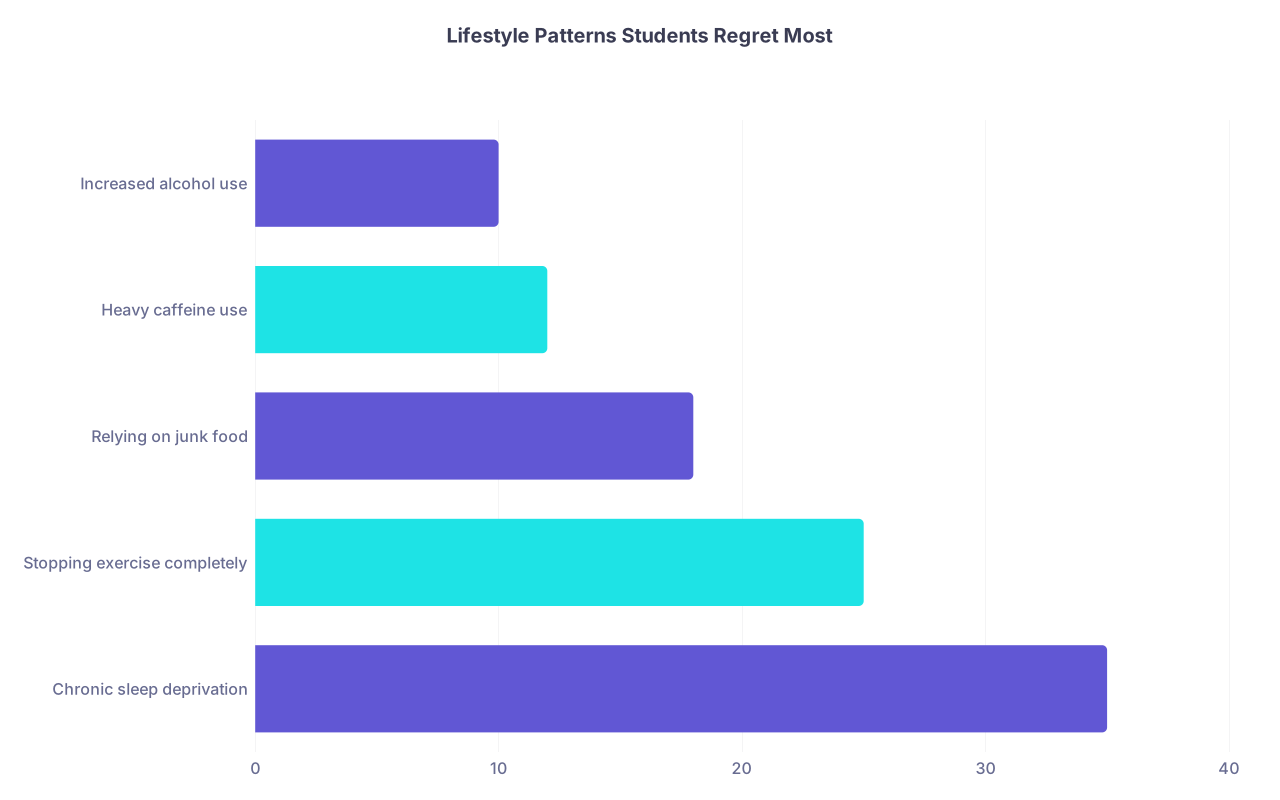
| Category | Value |
|---|---|
| Chronic sleep deprivation | 35 |
| Stopping exercise completely | 25 |
| Relying on junk food | 18 |
| Heavy caffeine use | 12 |
| Increased alcohol use | 10 |
And no, this isn’t about becoming some wellness influencer. It’s about not sabotaging your nervous system while you demand it do the hardest cognitive work of your life.
The Eighth Regret: Never Learning to Say “No” Strategically
You will never have more people trying to put things on your plate for “your benefit” than in med school. Research projects. Student groups. Tutoring. Committees. Shadowing. Conferences.
Residents, when they look back, are almost bitter about this one:
“I wasted so much mental energy on things that didn’t move the needle at all.”
What they wish they had done was exactly what they do now as residents: ruthless triage.
- Does this activity help my long-term goals in a clear, specific way?
- Do I have the bandwidth to do it without trashing my sleep or sanity?
- Am I saying yes because I want to, or because I’m scared to say no?
The irony is that the same students who can triage a chest pain workup can’t triage their own lives.
The smartest moves I’ve seen from med students—moves those same people thanked themselves for in residency:
They picked 1–2 lanes to invest in deeply (research in a relevant field, teaching, or community work) and let other shiny opportunities go. They accepted that not every CV line is worth the stress.
They learned phrases like:
- “I’d love to, but I’m at my limit right now and I don’t want to commit and then underdeliver.”
- “I’m focusing my extra time on current projects to make sure I do them well.”
That’s the language of someone who understands stress is not an accident; it’s the result of choices.
Residents wish they’d realized sooner: “No” is not a character flaw. It’s a skill.
How This All Plays Out on Day 1 of Residency
Let me pull all this together with what attendings whisper after July 1.
Every year, they see two rough categories of new interns:
Group 1: The “survive-at-all-costs” med school mindset.
They:
- Can’t sleep when they’re off because they’ve trained themselves to always be “on.”
- Take every criticism as a referendum on their worth.
- Hide struggles until someone else catches a mistake.
- Break down around November and start saying things like, “Maybe I shouldn’t be a doctor.”
Group 2: The “I learned my limits in med school” minority.
They:
- Crash hard post-call and don’t apologize for it.
- Ask early when they’re unsure, not as a last resort.
- Treat feedback as data, not as a verdict.
- Still struggle—everyone does—but don’t completely unravel.
The dirty little secret? Often Group 2 didn’t have easier med school paths. They just stopped pretending stress didn’t exist and started training for residency like an actual marathon, not a series of panicked sprints.

What Residents Would Tell You Directly, If They Could
When I ask residents, “If you could pull aside your M1 or M2 self, what would you say about stress?” the answers converge.
Stripped of fluff, here’s the core of what they wish they’d done differently:
They wish they’d treated med school as training for a sustainable career, not a four-year hazing ritual.
They wish they’d stopped fetishizing suffering and started respecting sleep, health, and boundaries the way they now respect sterile technique.
They wish they’d learned to ask for help when things first felt off, instead of waiting until they were staring at a leave of absence or a disciplinary meeting.
They wish they’d loosened the chokehold scores and evals had on their identity, long before they had real lives and patients in the balance.
And they wish they’d understood one thing above all:
Stress in medicine is non-negotiable. Suffering is not. The habits you build right now decide which of those you live in.
You do not impress anyone by surviving med school in the most painful way possible. You just make residency—and your life after it—much harder than it has to be.

The Short Version, If You Skipped Here
Three things residents wish you’d actually take from all of this:
- Your stress patterns in med school are not temporary. You’re building your default wiring for residency and beyond.
- Efficiency, boundaries, sleep, and honest help-seeking are not luxuries. They are professional competencies in medicine, just like reading an EKG.
- You will never study or achieve your way out of stress. You can only train your way into handling it without losing yourself.
Start acting like that now, and your future self—the one wearing a pager at 2 a.m.—will be a lot less angry with you.