The students who really thrive in med school are not the ones you think they are.
Faculty do not sit in meetings raving about the gunner answering every question on rounds or the person with the prettiest Anki graph. Behind closed doors, when program directors and clerkship directors talk about “the ones we keep an eye on,” they’re usually talking about a very specific kind of student: calm, consistent, slightly under the radar, and mentally tougher than they look.
You’ve seen them. They’re not the loudest, not always top of the class, but somehow they always seem okay. Not burned out, not spiraling, not living in the library at 2 a.m. They do well on exams, attendings remember them, residents like working with them, and they don’t seem to be crumbling inside.
Let me tell you what’s really going on.
They’re not “naturally chill.” They’ve built habits that protect their brain while everyone else is busy flexing their suffering.
And yes—program directors notice. They may not write “has healthy boundaries” in the eval, but I’ve heard more than one PD say, “This is someone who can actually survive residency without imploding.”
What PDs Actually Say About These Students
I’ve sat in those meetings. Here’s the kind of language you hear about the students who quietly thrive:
“She’s unflappable. Got a rough attending on surgery, still showed up the same every day.”
“He bounces back fast. Had a bad shelf but handled it like an adult.”
“She asks for help early. Doesn’t wait until she’s drowning.”
“Reliable, no drama. The residents loved working with him.”
Notice what’s missing:
“Crushed 270,” “honors in everything,” “published 12 papers.” That stuff is background noise. Competitive, yes. But not what makes people say, “I want that person in my program.”
The students who thrive long-term all share a pattern: they manage their mind like it’s part of the job, not an optional self-care hobby.
Let’s break down what they actually do differently.
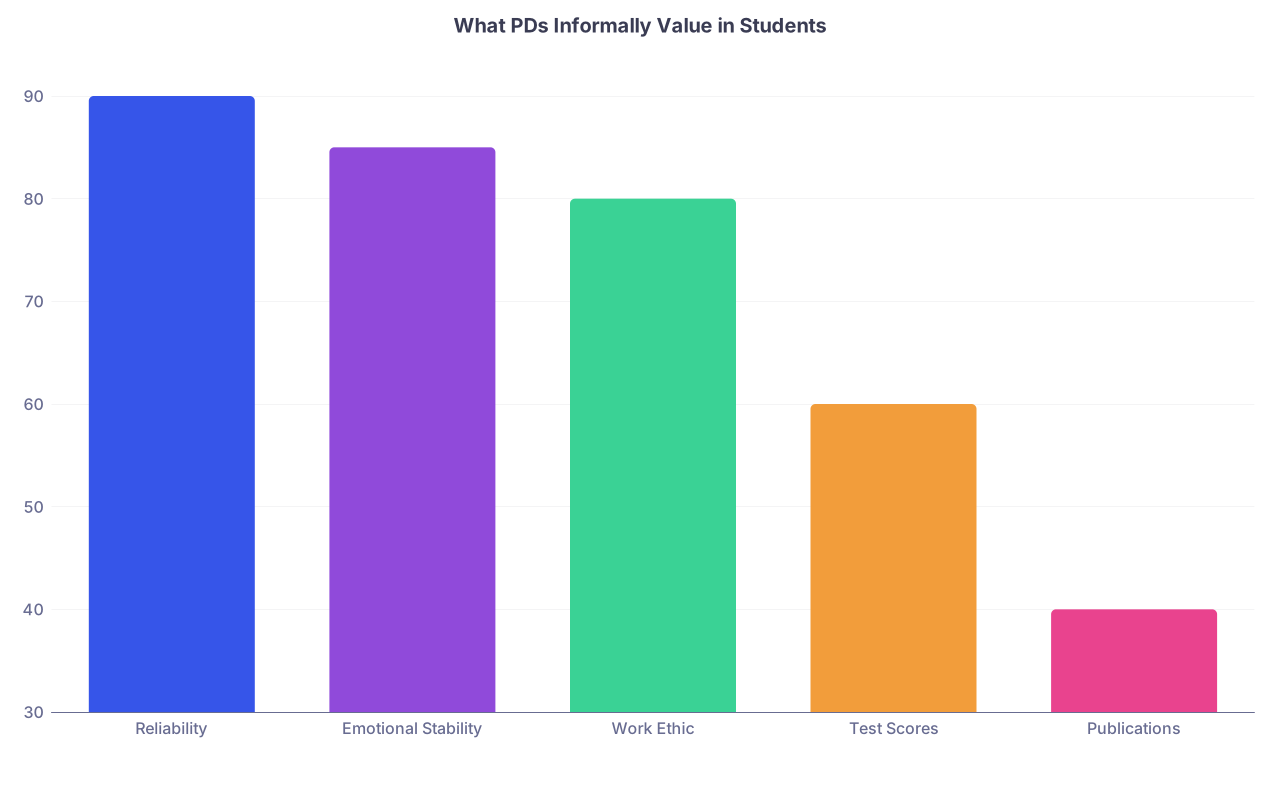
| Category | Value |
|---|---|
| Reliability | 90 |
| Emotional Stability | 85 |
| Work Ethic | 80 |
| Test Scores | 60 |
| Publications | 40 |
Habit #1: They Refuse to Let Exams Own Their Identity
Most students say exams are important. The ones who quietly thrive act like exams are data, not verdicts.
Here’s the difference I’ve heard faculty talk about:
Two M3s both bomb their first shelf.
Student A spirals. Stops sleeping properly, starts skipping meals, tells everyone, “If I don’t honor, I’m done for IM.” Every subsequent test becomes a referendum on their worth. They start chasing heroic study plans that last four days before crashing.
Student B looks pissed for 24 hours. Then shows up in my office and says:
“Ok, I clearly misjudged this. Here’s what I actually did. What would you change?”
They adjust the plan. They treat the score like a lab value that needs intervention, not a personality trait.
Program directors love that second student. They adapt. They don’t catastrophize. They don’t make extra work for everyone with constant emotional fires.
The habit underneath this? A very simple mental rule:
“I am responsible for my effort and my process. The score is feedback—not my identity.”
That’s not motivational-poster fluff. It’s how they talk to themselves on a bad day. And that internal script is the difference between a temporary setback and a semester-long meltdown.
They also do one more thing others don’t: they schedule their freak-out.
I’ve seen this multiple times:
“I give myself one evening to be upset. No studying, no pretending I’m okay. Just let it suck. The next morning it turns into a plan.”
That’s not denial. That’s disciplined emotional processing.
Habit #2: They Think in Systems, Not Heroics
The students who burn out think like firefighters. Every week is an emergency. They pull “just this once” 2 a.m. study sessions, skip meals, cancel every non-academic part of their life and call it “short-term sacrifice.”
The students who thrive think like engineers. They ask: “If I had to live this exact week for six months straight, what would break first?”
Then they fix that.
They don’t wait for crisis to change their system. They adjust early, in small, unsexy ways:
– They build a default weekly schedule they repeat. Not perfect, just consistent.
– They cap their daily question load before cognitive mush sets in.
– They reserve protected non-study time and guard it like a shift assignment.
And here’s the uncomfortable truth faculty know but rarely say out loud:
The student who studies 4–6 focused hours a day, five or six days a week for the whole year will outperform the one who “grinds” 10–12 hours a day for three weeks, crashes, then ghosts for five days.
Everyone talks about “working hard.” Few talk about wattage vs. burnout.
The quiet thrivers know their usable output, not their aspirational number. I’ve heard students say very calmly:
“If I go past 6 hours of real focus, my retention drops. So I don’t.”
And they’re right. They treat their brain like a finite resource, not an infinite punishment target.

Habit #3: They Protect Their Sleep Like It’s a Rotation Requirement
Here’s one of the worst-kept secrets among attendings: we can see which students are sleep-deprived. They’re slower, more irritable, and their decision-making gets… questionable.
And yes—PDs talk about it. “He always looked tired” is code for “I don’t trust his stamina.”
The students who thrive don’t just “try to sleep more.” They build their entire workflow around preserving a baseline of sleep, even during exams and rotations.
Concrete patterns I’ve seen:
– Hard cutoffs. “I stop at 11 p.m. even if I’m not done. I’d rather lose 10 questions tonight than 30 tomorrow.”
– Pre-call buffer. Students who don’t schedule intense studying the night before call. They shift heavier work earlier in the week.
– Non-negotiable wake time. They anchor the morning and adjust the evening—not the other way around.
Yes, there are exceptions. Nights. ICU. Weird call patterns. But the thriving students treat those as exceptions, not their personality. They don’t romanticize running on 4 hours. They see sleep deprivation for what it is: cognitive self-sabotage disguised as “grind.”
Ask around quietly and you’ll find this pattern: the students who got 250+ and still seemed mentally okay were not usually the ones posting dark 3 a.m. “still grinding” stories.
The all-nighter culture is loud. The well-rested are busy doing well.
Habit #4: They Choose Their People Very Carefully
I watch first- and second-years make this mistake constantly: they join whatever friend group or study group forms first. Then they inherit everyone else’s anxiety, panic, and dysfunction.
The students who thrive are ruthless about this. They pick their people with intention.
Here’s what they avoid:
– The perpetual catastrophizer: “We’re all failing, right?”
– The comparison addict: constantly asking, “How many cards did you do?”
– The martyr: “I studied 14 hours yesterday, what about you?”
– The rumor-spreader: always talking about who honored what, who’s “set” for derm, who’s “done for” after one bad grade.
And here’s who they seek out:
– The quietly consistent person. Not flashy, just always prepared.
– The emotionally stable classmate who can have a conversation that isn’t about school.
– Upperclassmen who are honest about their path, not just flexing outcomes.
I’ve literally heard PDs say, “Who you surround yourself with in med school will either stabilize you or pull you into the ground.” They’re not being dramatic. They’ve watched cohorts for decades.
The “thrivers” do something simple most students skip: they re-evaluate their social circle every few months.
“I like you as a person” does not always equal “I should study with you.” The thriving students are willing to separate those.

Habit #5: They Have a Script for Failure Before It Happens
Most students only figure out how to deal with failure after it crushes them. That’s exactly when your brain is least capable of rational planning.
The ones who quietly thrive decide ahead of time how they’ll respond.
I’ve asked students this directly: “What’s your plan if you fail an exam or a shelf?” The ones who crumble usually say some version of, “That can’t happen. It just can’t.”
That’s magical thinking. PDs see right through it.
The ones who handle med school well say something like:
“If I fail:
- I email the course director within 24 hours and ask for a meeting.
- I ask exactly what went wrong—question types, topics, test-taking.
- I book 1–2 sessions with learning resources or a tutor.
- I tell two people I trust so I don’t isolate.
- I adjust my schedule for the next block based on data, not shame.”
Is that overkill? No. That’s a pre-planned crisis protocol.
They don’t always need it. But when something hits—shelf, Step, OSCE, remediation—they’re already holding a script. That script protects their mental health more than any inspirational quote ever will.
Faculty notice the difference. When a director says, “She handled adversity with maturity,” this is the kind of thing they’re talking about.

| Step | Description |
|---|---|
| Step 1 | Exam Failed |
| Step 2 | 24 hr emotion window |
| Step 3 | Email/course director meeting |
| Step 4 | Analyze what went wrong |
| Step 5 | Adjust study system |
| Step 6 | Meet with learning/tutor |
| Step 7 | Loop in support person |
| Step 8 | Return to baseline plan |
Habit #6: They Build Tiny, Boring Non-Medical Anchors
The students who quietly thrive are almost always anchored to something outside medicine that they refuse to sacrifice completely.
Not a side hustle. Not a massive time suck. Just a small, durable identity piece that reminds them they’re human, not a test-taking machine.
Faculty have mentioned things like:
“She runs three times a week no matter what.”
“He plays pickup basketball Sunday mornings.”
“She draws for 20 minutes at night.”
“He cooks dinner with his partner most evenings, even on tough weeks.”
Here’s what those anchors do:
– They give your brain a predictable “off” signal.
– They keep your identity from collapsing into “student” only.
– They create micro-wins unrelated to grades or scores.
You don’t need a grand wellness practice. You need 15–30 minutes of something small and real that you keep doing even in exam weeks. That consistency is what PDs read as emotional stability.
The mistake most students make is all-or-nothing: either full hobby mode or nothing for three months. Thrivers pick something tiny and refuse to let go of it.
Habit #7: They Learn How to Say “No” Without Apology
Med school is full of fake emergencies and optional obligations dressed up as requirements. The thrivers are good at sorting signal from noise.
I’ve watched this play out in real time:
Student gets an email: “We’d love for you to join this project, it’ll only take an hour or two a week.”
The anxious student says yes to everything. Six weeks later they’re drowning, resentful, and behind.
The quietly thriving student has a default response:
“Thanks for thinking of me. Right now my main priorities are [USMLE prep/this rotation/mental health]. I don’t think I can commit fully and I don’t want to do a half-hearted job, so I’ll have to pass.”
Is that uncomfortable? Sure. But guess what PDs hate seeing on applications and in residents? Overcommitted people who deliver mediocre work and then burn out early.
Inside conversation I’ve heard from faculty:
“I’d rather have the student who said no to three things and did one thing extremely well than the one who said yes to seven and barely showed up.”
You don’t get extra points for being perpetually overwhelmed.
The habit here is simple: they know their top 1–2 priorities for that phase (M2 preclinical, dedicated, core rotations, application year) and they filter decisions through that lens. Everything else is a maybe or a no.
| Situation | Thriving Student Response |
|---|---|
| New research offer in dedicated | Likely no or delayed |
| Extra shifts on busy rotation | Selective, based on rest and exams |
| Leadership role late M3 | Only if aligns with career goals |
| Social event before big exam | Maybe, with time limit |
| Peer asking for constant tutoring | Bounded help, not endless commitment |
Habit #8: They Treat Help-Seeking as Strategy, Not Weakness
PDs pay attention to who uses resources early and who waits until they’re broken.
The students who quietly thrive are not shy about this. They’ll talk to the learning specialist after a single bad exam. They’ll schedule counseling before the second month of feeling off. They’ll ask a senior resident, “How would you study for this shelf?” during week one, not the night before.
Faculty discussions sound like this:
“He came to me in week two when he started to struggle instead of ghosting and then panicking right before the final.”
“She was proactive about getting accommodations adjusted before Step, not after failing.”
Here’s the mental move they make that others don’t:
They see help as a professional skill.
You will not survive residency—or attending life—if you can’t say, “I’m at my limit, I need backup.” The students who practice that in med school are the ones the PDs trust to call for help with a crashing patient, not fake it until disaster.
If your instinct is “I should be able to handle this alone,” understand this: that’s not strength. That’s inexperience, and programs know it.
Where Mental Health Really Shows Up on Your Application
Nobody’s asking you for your PHQ-9 on ERAS. But mental health habits show up in ways PDs recognize:
– Consistent performance with no dramatic nosedives
– Narrative comments about “a pleasure to work with,” “calm under pressure,” “responsive to feedback”
– Lack of chaos: no pattern of repeating courses, unexplained leaves, or erratic evals
– Letters that mention resilience, maturity, or professionalism during stress
The students who quietly thrive aren’t luckier. They’ve just been running a different playbook while everyone else is competing on suffering.
And here’s the thing I wish more people told you early:
The way you treat your mind in med school is how you’ll treat it as a resident, and later as an attending. You’re not just trying to “get through.” You’re building defaults that will either protect you—or cost you—over the next 30 years.