
It is mid-October of your first year. Anatomy lab smells like preservative and burned-out ambition. Your group chat is buzzing with “just finished another Anki deck” at 1:37 a.m. You are behind on lectures, pretending you are not. You checked your school’s counseling page twice, then closed the tab. You tell yourself, “Everyone else is handling this. I just need to push harder.”
This is exactly where people start making predictable, fixable mental health mistakes.
Let me walk you through the ten biggest ones I see MS1s repeat every year, so you do not become another “we were really worried about you” story after the fact.
1. Treating MS1 Like Undergrad on Steroids
The first and most damaging mistake: assuming medical school is just college with more content.
It is not. It is a different game.
In undergrad, you could cram before exams, pull a couple of all‑nighters, and still walk away with an A. In MS1, that same behavior turns into chronic anxiety and low‑level panic because the material does not just go away after the test. It compounds. Week after week.
The mental health trap looks like this:
- You start by studying 3–4 hours a day, “easing in”
- First quiz goes fine, so you assume you are safe
- Two modules later, your buffer is gone and you are 20 lectures behind
- Now you are “studying” 10–12 hours a day, but half of that is pure stress scrolling and staring
The result: constant guilt. Chronic sense of failure. It is not the workload alone that breaks people; it is feeling permanently behind and ashamed.
Do not make the mistake of copying your undergrad settings into a med school environment:
- Stop thinking in “test cycles” and start thinking in “systems” and “cumulative knowledge”
- Build weekly routines as if every block matters long‑term (because it does)
- Accept that sustainable, daily, boring consistency beats last‑minute heroics now
If you keep treating MS1 like a harder version of undergrad, you end up with a burned‑out brain by Thanksgiving and an identity crisis by finals.
2. Ignoring Sleep Until Your Brain Turns Against You
Every year I watch at least one MS1 basically sacrifice sleep as their first “study strategy.”
You know the script: “I am just cutting back a couple of hours to get through this exam.” “I can function on 5 hours; I did it during finals in college.”
For about 10 days, you might. Then it stops being a choice, because your brain starts betraying you:
- You re‑read the same paragraph three times and absorb nothing
- You start having stress dreams about missing exams or mixing up drugs
- Your baseline anxiety jumps; small problems feel like disasters
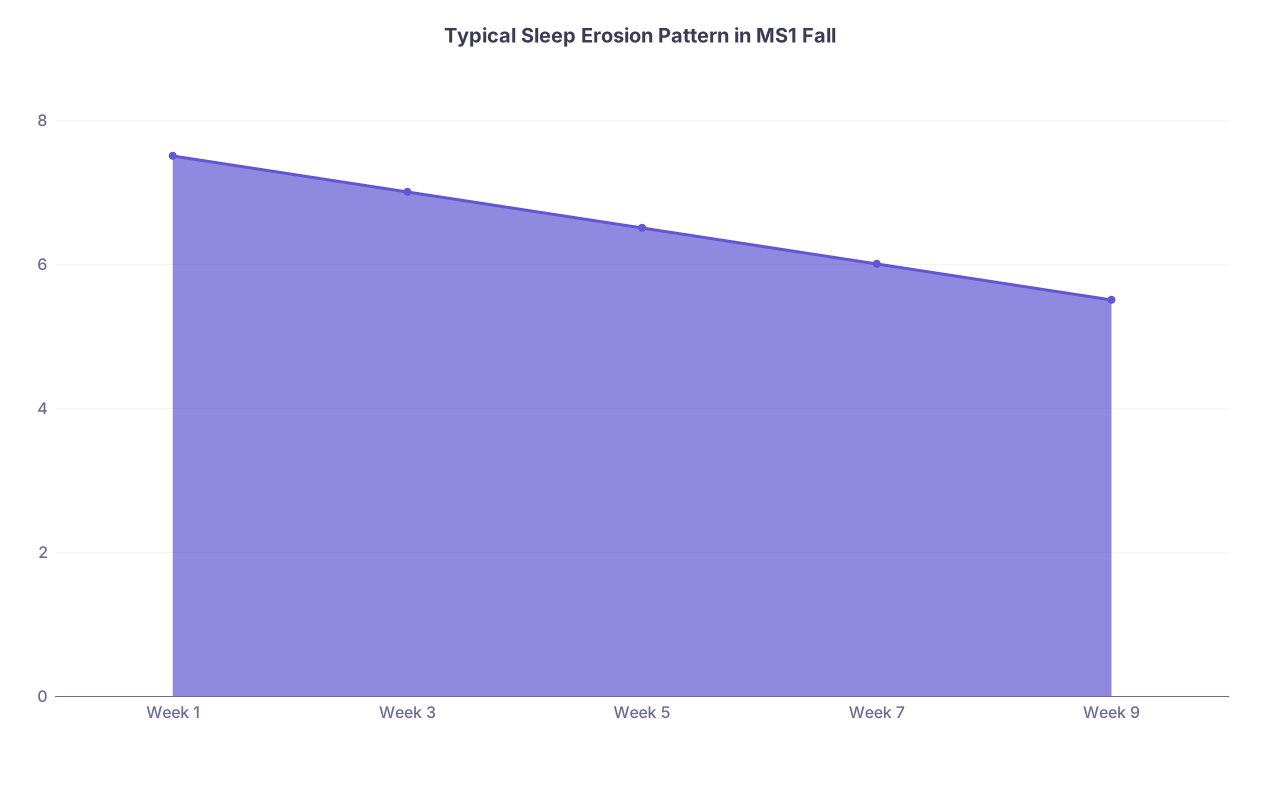
| Category | Value |
|---|---|
| Week 1 | 7.5 |
| Week 3 | 7 |
| Week 5 | 6.5 |
| Week 7 | 6 |
| Week 9 | 5.5 |
Less sleep does not buy you more studying. It buys you:
- Worse memory consolidation (you literally forget more of what you “learned”)
- Higher risk of depression and anxiety
- Shorter fuse with classmates, partners, and patients
The sneaky mental health mistake is pretending that sleep is flexible but your study schedule is fixed. It should be the opposite. You protect 7–8 hours like it is part of the curriculum, because functionally, it is.
Practical protections:
- Set a hard cutoff time at night and actually shut your laptop
- If you are consistently studying past midnight, the problem is your plan, not your willpower
- Two nights of poor sleep in a row? Treat that as an emergency, not a “new normal”
If your internal monologue is “I will fix my sleep after this block,” you are already in dangerous territory.
3. Studying in Isolation and Calling It “Focus”
“I just study better alone.”
That line fills my inbox every September. And I get it. You might be introverted. You might have killed the MCAT in a solo routine.
But here is the mistake: using “I am focused” as a cover for slow, quiet isolation.
You skip optional events. Stop going to class. Avoid group study. Turn down coffee invites because “I need to catch up.” One week of this is fine. A semester of it is not “discipline.” It is social malnutrition.
I have watched this turn into:
- Feeling like everyone else has friends and support except you
- Paranoia that your classmates are secretly judging you or ahead of you
- No one noticing when your mental health actually starts to slide

Under stress, humans do worse in isolation. You do not need to be the social chair. But you do need:
- At least one classmate who knows your actual life, not just your Anki habits
- Some in‑person contact each week that is not “talking about the test”
- A person who would notice if you stopped showing up for a while
The red flag: you realize the only people you have spoken to in person this week are standardized patients, a cashier, and a lecturer.
Do not brag about “grinding alone” while your mental health quietly erodes. That is not focus. That is risk.
4. Waiting Until You Are in Crisis to Get Help
This one frustrates me the most, because the pattern is so obvious and so avoidable.
The MS1 thought process:
- “I am more stressed than usual, but everyone is. This is normal.”
- “I am crying three times a week, but the block is just tough.”
- “I cannot sleep, my appetite is gone, and I have intrusive thoughts, but the exam is next week; I will deal with this later.”
Then suddenly it is not a wellness check‑in anymore. It is an urgent conversation about safety, withdrawal, or remediation.
The mistake is treating counseling, therapy, or student support as an emergency‑only resource. That is like only using an inhaler midway through respiratory arrest.
Most schools actually have these supports:
- Free or low‑cost student counseling, often with short waitlists early in the year
- Confidential mental health services separate from evals
- Wellness deans or advisors who have literally seen hundreds of students in your exact spot
| Scenario | Early Support Outcome | Crisis-Only Outcome |
|---|---|---|
| Mild anxiety | Coping skills, stable | Escalates to panic |
| Sleep problems | Resolved in weeks | Months of dysfunction |
| Academic struggles | Plan + pass | Remediation or delay |
| Burnout risk | Adjusted schedule | Leave of absence needed |
Stop grading your “deservingness” for help. You are not wasting anyone’s time by saying: “My mood has been off for a month and I am worried.” That is textbook preventive care.
If you are wondering, “Is this bad enough to get help?”—that is your sign that yes, it is time.
5. Turning Every Conversation into a Competition
Nothing torpedoes mental well‑being faster than living inside a comparison bubble.
Common first‑semester traps:
- Constantly asking classmates how many cards they did, what resources they use, how many practice questions they finished
- Letting someone else’s schedule dictate your panic level: “She is on her third pass already; I am dead”
- Obsessively checking class averages and raw score distributions
Here is the truth very few people say out loud: a lot of your classmates are exaggerating or straight‑up lying. Or at least selectively reporting their “best days” as if they are normal.
You will never hear: “I scrolled TikTok for 2 hours and then realized I remembered 0 of the lecture.” But that happens. A lot.
The mistake is assuming your internal chaos is unique and everyone else’s public persona is accurate. That mental narrative breeds:
- Impostor syndrome
- Shame about completely normal struggles
- Reluctance to ask for help because you think you are the only one drowning
If you must compare, compare realistically:
- Your sleep this week vs last week
- Your focus time vs distracted time
- Your exam performance vs your own previous exams
The moment a conversation leaves you more anxious than supported, you are allowed to say, “I am going to stop talking about scores; this is not helping me.” Protect your brain like you protect your GPA.
6. Treating Exercise and Food as Optional Extras
I see MS1s sacrifice the basics first: movement and nutrition.
The mindset:
- “I will get back to the gym after this block.”
- “I do not have time to cook; I will just DoorDash something at 11 p.m.”
- “I skipped breakfast; I will be fine.”
For a week, fine. For a semester, this is how you quietly sabotage your own resilience.
Physically, you get:
- Energy crashes during long lectures
- Brain fog disguised as “I am just bad at this material”
- Worsening mood that you misattribute entirely to “stress”
Mentally, you start believing your body is just a vehicle to carry your brain between exams. That disconnect is dangerous for someone training to care about whole human beings.
You do not need a perfect wellness routine. You need the non‑negotiable floor:
- Movement 3–4 days a week, even if it is 20 minutes of walking or bodyweight exercises
- Halfway decent meals at consistent times—protein, something that grew in the ground, something that is not pure sugar
- Hydration at basic human levels, not just coffee and energy drinks
Red flag: you realize you have not broken a sweat or eaten anything green in 10–14 days. That is not “hustle.” That is a warning.
7. Pathologizing Normal Stress and Minimizing Serious Symptoms
Two opposite mistakes under the same umbrella.
First version: every discomfort gets labeled as a major disorder.
- “I am anxious” after one rough day
- “I have burnout” two weeks into the semester
- “I am depressed” when you are actually exhausted and overwhelmed
Over‑pathologizing normal, expected stress can backfire. It makes you feel defective for having a human reaction to a huge life change. It can also make you tune out when you actually need to take new symptoms seriously.
Second version, and frankly more dangerous: dismissing real mental health red flags as “just med school.”
- Persistent low mood for most of the day, nearly every day, for weeks
- Losing interest in things you actually used to like
- Thoughts like “If I got in a car accident and did not have to deal with this, it would be a relief”
Those are not “normal” parts of training. Those are textbook criteria that should trigger professional support.

| Step | Description |
|---|---|
| Step 1 | Feeling stressed? |
| Step 2 | Adjust schedule, self-care |
| Step 3 | Seek professional help |
| Step 4 | Monitor closely |
| Step 5 | Counseling / MD |
| Step 6 | Short-term & situational? |
| Step 7 | Lasting >2 weeks? |
The skill you need is discrimination:
- Stress before an exam that resolves after? Normal.
- Stress that never lets up, even during breaks? Not normal.
- One bad week of low mood? Watchful waiting.
- A month of low mood and withdrawal from people? Time for help.
Do not let the culture of “everyone is drowning” convince you that serious symptoms are just part of the deal.
8. Over‑identifying with Being “The Strong One”
A lot of you walked into MS1 with a story: “I am the reliable one. The tough one. The one who does not break.”
That identity is seductive. It got you through the MCAT, personal statements, leadership roles. The mistake is refusing to update it when you hit an environment designed to test your limits.
You might:
- Always be the listener, never the sharer
- Brush off concern with “I am fine, just busy”
- Feel almost offended at the idea that you might struggle like “everyone else”
I have seen students in this category crumble silently. They are the last to ask for an extension, last to admit they are behind, last to consider counseling. They see it as failure, not adaptation.
Let me be blunt: if your entire sense of worth is built on not needing help, medical training will eventually smash it.
You do not have to become a “feelings person.” But you need to:
- Allow yourself to be a human first, role second
- Take seriously the feedback of people close to you when they say, “You seem off”
- Practice saying something as simple as: “Actually, things have been harder lately”
If your pride is blocking your access to support, that pride is not strength. It is a liability.
9. Living in “I’ll Be Happy When…” Mode
“I will feel better once this block is over.” “I will relax once anatomy is done.” “I will fix my life after first semester.”
This is a mental trap I see constantly: postponing all well‑being to some mythical future moment when things are “less busy.”
Here is the reality no one wants to accept in September: there is always another block. Another exam. Another reason to postpone your life. If you keep deferring happiness, you reach M4 and realize you never had a year that was allowed to be good.
Psychologically, “I will be happy when…” thinking:
- Trains your brain to stay in survival mode
- Makes you resent the present constantly
- Sucks joy out of even small wins, because you are already worried about the next hurdle
You need to build tiny, non‑negotiable pieces of a real life now:
- One small thing each week that has nothing to do with medicine
- Moments where you actually let yourself enjoy competence instead of immediately moving the goalposts
- Space to acknowledge that you are allowed to want a life, not just a CV
If you catch yourself saying “after this exam” every week for a month, stop. That is how people wake up five years later not recognizing themselves.
10. Believing Struggle Means You Do Not Belong Here
The most destructive mental health mistake: interpreting difficulty as proof you are an admissions error.
The story goes like this:
- First bad quiz or failed exam → shock
- You look around and assume no one else failed (they did, they just are not announcing it)
- Your brain quietly concludes: “They let me in by mistake. I am the weak link.”
Then you layer shame on top of stress. Now you are not just managing content; you are carrying a constant narrative of “I am not good enough to be here.” That is exhausting.
I have watched objectively brilliant students spiral from a B‑minus. The grade was not the problem. The story they wrote about the grade was.
Let me be direct: the people who glide through MS1 with zero friction are the exception, not the norm. And even many of them crack later, when clinical work or personal life hits.
Struggle in MS1 means:
- You are encountering a volume and pace you have never seen before
- You are being forced to grow new skills under pressure
- You are human
It does not mean:
- You are dumb
- You are a fraud
- You are destined to be a bad doctor
If one rough exam or one rough semester has you Googling “should I drop out of med school,” talk to a real human before you let that thought sit alone in your head. Advisor, counselor, trusted attending, someone. You are a terrible judge of your own worth in the middle of a crisis.
FAQ (4 Questions)
1. How do I know if what I am feeling is “normal med school stress” or something more serious?
Look at duration, intensity, and function. If symptoms (low mood, anxiety, insomnia, loss of interest, intrusive thoughts) last most days for more than two weeks, and they are interfering with core tasks (studying, basic self‑care, relationships), treat that as more than “normal stress” and seek professional help through your school or externally.
2. Is it a mistake to start therapy in MS1 even if I am not in crisis?
No. That is actually smart. Early therapy can give you tools before things get bad, and it normalizes asking for help. Many high‑functioning students use therapy as preventive maintenance, not emergency repair. The mistake is waiting until you are barely functioning.
3. I failed my first exam. Does this mean I am not cut out for medicine?
No. It means your current strategies are misaligned with the demands. Almost every class has people who fail early exams and go on to do very well after adjusting study methods, schedules, and sleep. Use it as data, not a verdict. Talk to faculty, upperclass mentors, and, if needed, student support to build a new plan.
4. How can I protect my mental health without falling behind academically?
You do not protect mental health instead of performing; you protect it to enable performance. Anchor sleep, minimal exercise, and decent food as non‑negotiables. Use structured study blocks and realistic schedules. Say no to constant comparison. Catch small problems early by checking in with yourself weekly. These habits make you more efficient, not less.
Key points to walk away with:
- Do not sacrifice sleep, basic health, or relationships on the altar of “grind”; those are the foundations that keep you in the game.
- Ask for help early—counseling, mentoring, academic support—before stress turns into crisis.
- Difficulty in MS1 is not evidence you do not belong; it is evidence you are doing something hard that almost no one gets through unscathed.