
The way most med students do group study is broken—and it’s quietly wrecking their mental health.
You think you’re reducing stress by “not doing this alone.” In reality, the way many of you run study groups is multiplying anxiety, burning time, and shredding focus. I’ve watched it happen exam block after exam block: good students, smart students, walking into group study relatively okay and walking out drained, demoralized, and behind.
Let me walk you through the specific mistakes that make group study a mental health liability instead of a safety net—and how to avoid turning your study group into a stress factory.
1. The Biggest Lie: “At Least I’m Studying If I’m With the Group”
The most dangerous group study error is this: treating any time with other people and open books as “studying.”
That’s how you end up doing 3–4 hour “sessions” that produce about 30 minutes of actual learning and 3+ hours of attention fatigue and subtle self-comparison.
Here’s what I’ve seen over and over:
- Four students “studying cardio” together
- Two are leading discussion
- One is quietly lost and ashamed to ask
- One is half on Anki, half on Instagram
- Everyone leaves tired
- Nobody can clearly say what they actually mastered
Your brain isn’t stupid. It knows the difference between real work and performance work. When you sit through fake productivity, you walk away more anxious, because your body feels the time depletion but your mind knows: “I still don’t understand this.”
That mismatch is a recipe for:
- Persistent background dread
- Sleep problems (mind keeps cycling: “I’m behind. I’m behind.”)
- Avoidance behaviors (“I’ll just join more group sessions; maybe that will fix it”)
If you take nothing else from this:
Group study only counts if you can state specifically what you can do now that you could not do before the session.
If you can’t answer that in one sentence, you did socializing near textbooks, not studying.
2. The Emotional Trap of the Wrong People
The second big error: choosing your group based on friendship, not function.
You’re not assembling a brunch crew. You’re assembling a stress-management tool.
The wrong mix of people will drain your mental energy faster than any pathophys lecture.
Red flag group types that wreck mental health
The Flex Group
- One person “just skimmed this once and got it”
- Constant Step score talk
- Casual: “Oh, you don’t know that? We had it last semester.”
- You leave feeling small, behind, and afraid to speak up
The Venter Group
- 30–60 minutes of every session = venting about:
- Attendings
- Administration
- NBME questions
- How “unfair” everything is
- Do not misunderstand me: venting is human. But this is not therapy. Your exam clock is still running.
- 30–60 minutes of every session = venting about:
The Overfunctioner + Passengers Group
- One person makes the Anki decks, practice questions, schedules
- Everyone else shows up unprepared and “just wants to follow along”
- The leader burns out
- The others feel guilty and increasingly dependent
The Catastrophizer Group
- Constant predictions of doom:
- “I’m definitely going to fail.”
- “This exam will destroy us.”
- Test anxiety spreads. It’s viral.
- Constant predictions of doom:
If your mental health is even a little fragile (and in med school, whose isn’t at times?), these dynamics will wreck you.
You want:
- People who prepare something before meeting
- People who can say “I don’t know” without shame
- People who do not constantly measure their worth out loud with test scores
If your group dynamic leaves you consistently more anxious after meeting, that’s not a group—it’s a hazard.
3. No Structure = Maximum Stress
Unstructured group study is one of the fastest ways to feel like you’re “always studying” and “never getting anywhere.”
Here’s how the burnout loop usually looks:

| Step | Description |
|---|---|
| Step 1 | Join casual group session |
| Step 2 | Talk vaguely about topics |
| Step 3 | Feel behind and confused |
| Step 4 | Stay longer to catch up |
| Step 5 | Leave exhausted, still unclear |
| Step 6 | Increased anxiety about exams |
| Step 7 | Join more group sessions |
The missing piece? Basic structure.
If your “plan” is just “Let’s meet and do renal,” you’ve already lost.
You need answers to 4 questions before you sit down together:
What exactly are we trying to accomplish?
- Example: “We’ll do 30 UWorld cardio questions together focusing only on arrhythmias.”
How will we know we’re done?
- Clear endpoint: “When we’ve done 30 questions OR hit 90 minutes, whichever first.”
What is each person’s role?
- Who’s timing?
- Who’s scribing key points on a whiteboard?
- Who’s keeping the room from wandering off-topic?
What happens after the session?
- Does everyone review their marked questions alone?
- Are you making a tiny summary sheet?
Unstructured group work often leads to one of two energy-draining extremes:
- Hyper-detail spirals on niche topics that won’t move your score or confidence
- Superficial skimming that feels like coverage but leaves no memory trace
You need guardrails, or your brain will burn itself out trying to track fifty parallel threads of half-finished ideas.
4. Turning Group Study into a Comparison Olympics
This one hits mental health the hardest, especially around exams and Step/COMLEX prep.
Too many group sessions turn into:
- Subtle score checking: “What are you getting on NBMEs?”
- Deck counting: “How many Anki cards do you have left?”
- Shame-based benchmarking: “Wait, you don’t know the coag cascade by heart?”
The mistake is assuming that knowing other people’s metrics will motivate you. More often, it just:
- Raises your baseline anxiety
- Shifts your attention to their pace instead of your own
- Encourages impulsive changes in study plan (usually harmful)
Look at what actually happens when people make scores the center of group interactions:
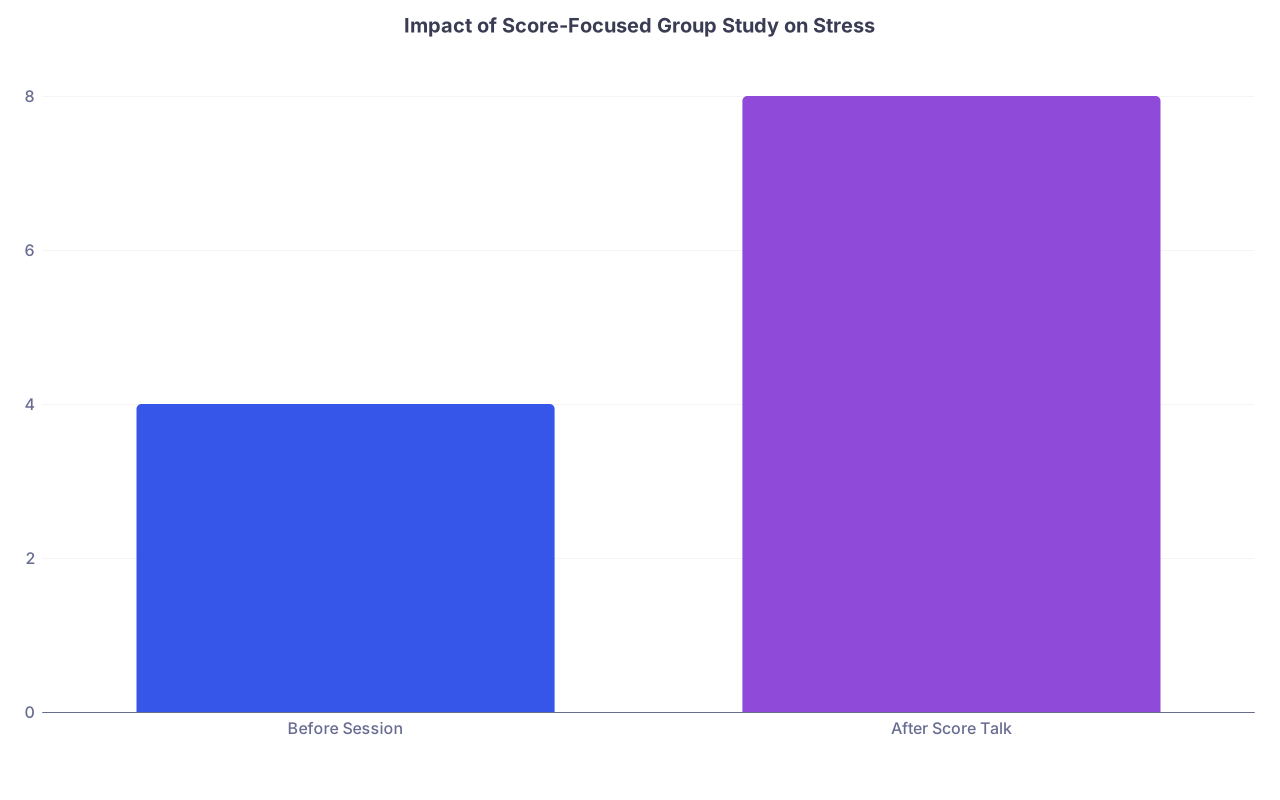
| Category | Value |
|---|---|
| Before Session | 4 |
| After Score Talk | 8 |
(Imagine stress on a 0–10 scale. I’ve literally seen people jump from “mildly worried” to “borderline panic” in a single session of “So what did you get on NBME 11?”)
If every group meetup includes:
- “What did you get on this block?”
- “How many hours did you study yesterday?”
- “How many questions are you up to?”
You’re feeding the part of your brain that believes:
“My worth = my score, and I’m constantly being evaluated.”
Bad formula for long-term mental health.
Set boundaries around metrics
You don’t have to be weird about it. Just set norms:
- “We’re not going to do score comparison in this group.”
- “If we talk about exams, let’s keep it to strategy, not numbers.”
If someone keeps pushing: “C’mon, just share, it’s motivating,” recognize that for what it is: their anxiety management strategy, not yours.
You’re allowed to say no.
5. Using Group Study for Tasks That Should Be Solo
Not everything belongs in a group. In fact, most deep learning doesn’t.
The mistake: dragging inherently solo tasks into group space and then wondering why you feel behind all the time.
Bad uses of group time that kill energy:
- Watching lecture videos “together”
Usually becomes: one person pausing constantly, others silently frustrated. - Doing basic content review in a group
You’re trying to build your initial understanding while someone else is sprinting ahead. - Making Anki cards live in the group
That’s admin work. It will expand to fill all available time.

You want to protect your limited, high-quality attention for:
- Initial content digestion
- Confused-topic untangling
- Writing or active recall
Those are best done:
- Alone
- In a quiet place
- On your own timeline
Group time is expensive—cognitively and emotionally. Use it only for tasks that truly benefit from multiple brains:
- High-yield question discussion
- Teaching each other tricky pathways or frameworks
- Explaining topics you already learned to solidify them
- Talking through exam strategy and pattern recognition
If you’re doing something in a group that you could do just as effectively alone—probably you’re wasting both cognitive energy and emotional stability.
6. Letting the Group Destroy Your Schedule and Sleep
Here’s a mistake I see a lot in second year and dedicated exam prep:
Letting the group schedule steamroll your own biological needs.
Example patterns:
- You’re a morning person, but the group always meets 8 pm–11 pm “because that’s when everyone is free.” You drag yourself there, half-alert, then can’t fall asleep until 1–2 am because you’re wired and stressed.
- You needed a lighter day after a rough call / long lab, but you go to the session anyway because “they’ll think I’m slacking” or “I can’t miss cardio day.”
- The group decides to “push through” and extend the session “just one more hour,” and now you’re home late, hungry, and anxious.
Over time, here’s what that does to mental health:
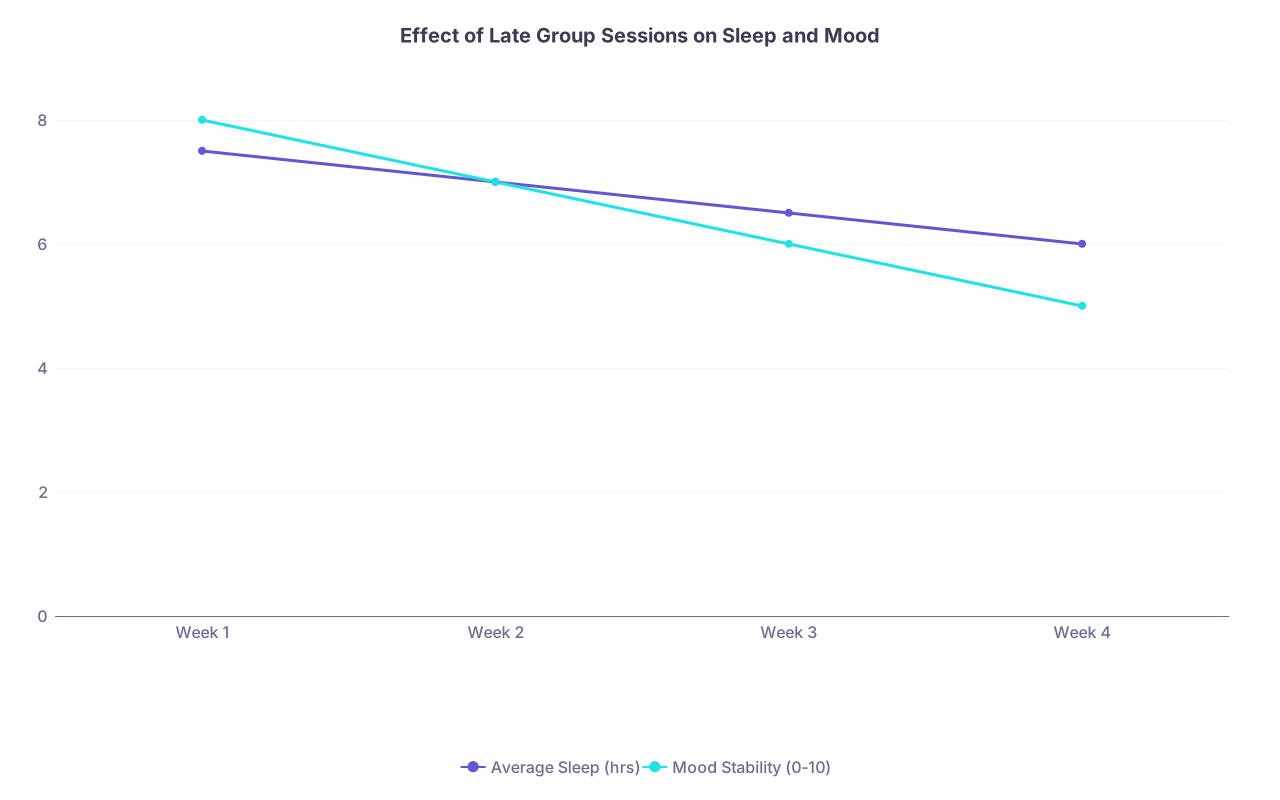
| Category | Average Sleep (hrs) | Mood Stability (0-10) |
|---|---|---|
| Week 1 | 7.5 | 8 |
| Week 2 | 7 | 7 |
| Week 3 | 6.5 | 6 |
| Week 4 | 6 | 5 |
You cannot separate “study strategy” from “mental health” when your strategy is:
- Undermining your sleep
- Blocking your exercise time
- Cutting into any non-academic life
If a “supportive” study group leaves you chronically underslept, irritable, and unable to focus alone, it’s not supportive. It’s another stressor.
You’re allowed to say:
- “I don’t do late-night sessions.”
- “I’m skipping today; I need an off-ramp for my brain.”
- “I’ll come for the first hour only.”
If your membership in a study group depends on sacrificing your basic health needs, that’s not a group—it’s a bad deal.
7. Misusing Group Study for Anxiety Soothing Instead of Learning
Now to the most subtle error: using group study primarily as an emotional sedative.
This happens a lot during:
- Dedicated Step/COMLEX prep
- Finals week
- Shelf-heavy rotations
You’re scared to be alone with your thoughts and the massive content pile. So you cling to the group.
Not to learn. To not feel alone.
What it looks like:
- You join every group session, even when the topic doesn’t match your weak spots.
- You stay the entire time, even once your brain is fried.
- You leave more tired, but slightly calmer because “at least we’re all in this together.”
The problem: you’re teaching your brain that the only way to manage exam anxiety is to be constantly around others.
That’s dangerous. Because:
- Exams are solo.
- Clinical performance is often solo.
- Real mastery requires solo struggle.
Healthy mental health strategy isn’t “never feel anxious.”
It’s “I can feel anxious and still focus and move forward, alone if needed.”
If you’re using group study as a security blanket, ask yourself:
- “Would I be able to study effectively alone for 2–3 hours right now?”
- If the answer is no, your problem is not lack of group time. It’s untrained distress tolerance.
You can absolutely use group time to feel less alone. You just cannot outsource all of your emotional regulation to it. That bill will come due during exam week.
8. A Healthier, Saner Way to Use Group Study
Let’s flip this. Here’s how to set up group study that actually protects your mental health instead of eroding it.
A. Be brutally clear about the purpose
Each session must answer, in one sentence:
“We are meeting to ____________.”
Acceptable examples:
- “We are meeting to do 20 renal pathology questions slowly and deeply.”
- “We are meeting to teach each other the 3 topics we each marked as ‘red’ this week.”
- “We are meeting to create a one-page cheat sheet of must-know cardio murmurs.”
If you can’t fill that blank? Cancel the session or tighten the plan. Otherwise, you’re signing up for chaos.
B. Design the session for energy conservation
You want to end with reasonable fatigue, not full depletion. For mental health, shorter, focused sessions beat marathons.
Here’s a sane framework:
| Segment | Duration | Focus |
|---|---|---|
| Warm-up check-in | 5–10 min | Quick mood/energy + plan review |
| Active work block | 35–40 min | Questions/teaching only |
| Micro-break | 5 min | Stand, stretch, no exam talk |
| Active work block | 35–40 min | Continue or switch topic |
| Wrap-up | 5–10 min | Each person: 1 thing learned |
Two blocks. That’s it. Not four. Not “until we’re done.”
Your brain’s capacity is finite, especially under stress.
C. Protect emotional boundaries
Set ground rules explicitly:
- No score comparisons in this group
- No trash-talking classmates or attendings (it spirals fast)
- If someone looks overwhelmed, check in, not call them out
- You can step out or leave early without justification
Sounds formal. It’s not. It’s self-respect.
9. Know When to Quit the Group (or Never Join)
Some of you need to hear this directly:
If your study group consistently leaves you more tired, more anxious, and more confused—you’re allowed to walk away.
Here’s a quick mental health–oriented checklist:
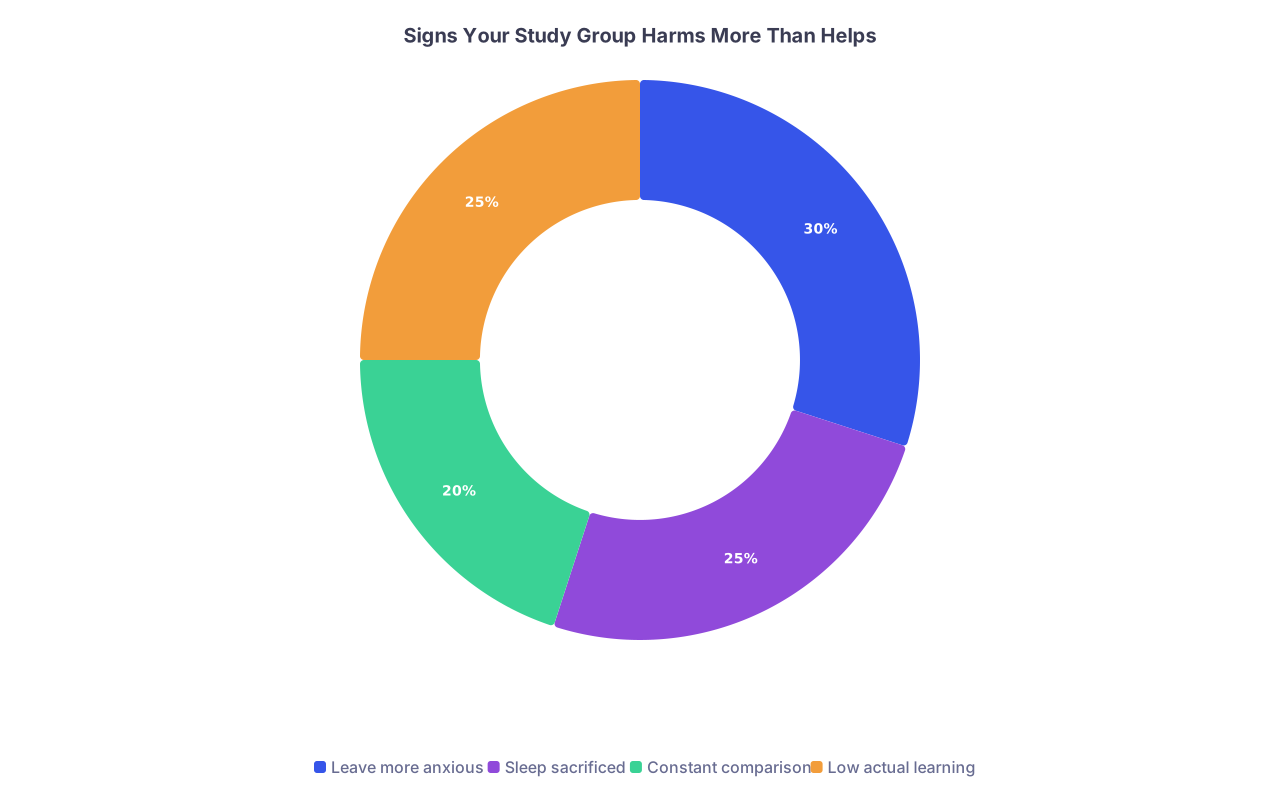
| Category | Value |
|---|---|
| Leave more anxious | 30 |
| Sleep sacrificed | 25 |
| Constant comparison | 20 |
| Low actual learning | 25 |
If you recognize two or more of these most weeks:
- You leave sessions more anxious than when you arrived
- You’re regularly sacrificing sleep/food/exercise to attend
- You measure your worth by the group’s pace
- You can’t describe what you actually learned that day
That’s not “you being weak.” That’s the environment being misaligned with what your brain and body need to function.
You can:
- Take a “2-week break” as a test
- Switch to 1–2 people who match your pace and vibe
- Use asynchronous tools (shared docs, question lists) instead of live meetings
And if you’re the one keeping a dysfunctional group alive because you don’t want to disappoint people—recognize that you’re paying with your mental health for other people’s comfort. That trade is almost never worth it.
10. A Simple, Low-Drama Reset Plan
If your current group situation feels off, here’s a reset you can do this week:

| Step | Description |
|---|---|
| Step 1 | Audit Current Group |
| Step 2 | Tighten Structure |
| Step 3 | Pause or Leave Group |
| Step 4 | Set Clear Session Goals |
| Step 5 | Limit Length to 60-90 min |
| Step 6 | Switch to Solo Study + 1 Buddy |
| Step 7 | Re-evaluate in 2 Weeks |
| Step 8 | Helpful or Draining? |
Combine that with one question after each session:
“Do I feel calmer and more capable than before we started?”
If the answer is routinely no, you change the structure, change the people, or change the frequency. Anything else is slow-motion burnout.

FAQs
1. How do I leave a study group without creating drama?
Be direct and low-explanation. You don’t need a TED Talk.
You can say:
- “I’m changing my study approach for this block and need to work mostly solo.”
- “I’ve realized I focus better in smaller groups, so I’m going to step back from this one.”
- “My schedule and energy haven’t been matching with evening sessions, so I’m going to sit this group out for a while.”
No one is entitled to your presence at the expense of your mental health. If they get offended by you taking care of yourself, that’s more data that leaving was the right call.
2. Is it possible that I just don’t do well with group study at all?
Yes. And that’s not a flaw.
Some people simply:
- Learn faster alone
- Get easily overstimulated by multiple voices and opinions
- Are prone to comparison thoughts they cannot easily shut off
If you notice that most group settings raise your anxiety and drop your comprehension, trust that data. Use groups surgically:
- Occasional question-review sessions before big exams
- One trusted peer you teach or explain things to
- Short, targeted “teach me this one concept” meetings
You don’t earn extra virtue points for suffering through methods that do not work for your brain.
3. What if my only friends in med school are my study group?
Then you especially need boundaries.
You can separate:
- “People I like and care about”
- From “People I routinely study with”
Try this:
- Keep them as social friends: coffee, walks, watching something, non-medical talk.
- Gently pull back on intensive group study: go less often, stay shorter, or opt for solo prep and then join them after exams.
Your mental health will generally do better if you:
- Study in the way that best fits your brain
- Socialize in the way that best feeds your soul
Those don’t always have to be the exact same people or the exact same settings.
Today, do one concrete thing:
Look at your calendar and your last 2–3 group sessions. For each one, write down in one line: “What did I actually gain, and how did I feel after?”
If those answers scare you, don’t ignore that. Adjust one thing—length, people, or purpose—before your next session.