
How Over-Planning Your USMLE Prep Can Become a Mental Health Disaster
What if the thing you think will “save” your Step prep—the perfect, color-coded master schedule—is actually the fastest way to burn yourself out and wreck your mental health before you even hit your first NBME?
Let me be blunt: I have watched more students crush themselves with planning than with content. They are not failing UWorld. They are failing their own impossible schedules.
You are not lazy. You are not unmotivated. But you might be building a system that makes you feel that way. Every. Single. Day.
Let’s walk through how that happens—and how to stop doing it before you turn your USMLE prep into a 3‑month mental health crisis.
The Seduction of the “Perfect” USMLE Plan
There is a very specific pattern I keep seeing.
A student, usually anxious and conscientious (read: you care a lot), sits down and decides this time will be different. No more winging it. No more scattered days. This time, you are going to “treat Step like a job.”
So you build a monster:
- Hour-by-hour study schedule
- Fixed number of UWorld questions per day
- Exact pages of First Aid / Pathoma / Anki cards
- Rigid end-dates for each subject block
- No defined space for bad days, illness, or just… being a human
For a week, maybe two, you white-knuckle it. Then reality shows up. A family issue. Call week. Two days of migraines. Suddenly, your schedule is “behind.”
And this is where the real damage starts—not academic, but psychological.
You tell yourself:
- “I’m already off. This is ruined.”
- “Everyone else is sticking to their schedules. What is wrong with me?”
- “I cannot afford any more slip-ups. I have to make this up somehow.”
So you patch the plan. Push more questions into fewer days. Sleep a little less. Cut meals shorter. Drop exercise “until after the test.” You sacrifice mental health in the name of “productivity.”
That is the trap.
Over-planning is not about being organized. It is about trying to control your anxiety by controlling every minute. And that never ends well.
The Psychological Cost: When Your Schedule Becomes Your Judge
The biggest mistake? Treating the schedule as law, not a tool.
A rigid USMLE schedule does more than structure your day. It becomes a scorecard on your worth. That sounds dramatic, but I have heard these exact sentences, usually at 11:30 p.m. over text:
- “I’m a failure. I was supposed to do 80 questions and only did 40.”
- “If I cannot even follow my plan, how am I going to be a doctor?”
- “I wasted today.”
No, you did not “waste” the day. You had a human day. But the schedule does not have that category. It only has “completed” or “failed.”
That creates three nasty mental health problems:
Constant self-criticism.
Each deviation from the plan becomes “proof” that you are not good enough, not disciplined enough, not like the mythical other students who are “crushing it.”All-or-nothing thinking.
If you are 3 hours behind, the day is “ruined,” so you might as well give up, scroll, feel guilty about scrolling, then panic at 1 a.m. and do low-quality exhausted studying.Loss of internal control.
Your sense of agency shifts from “I choose how to study” to “The schedule dictates my day.” You feel trapped by the thing you built.
That is how a tool becomes a psychological weapon. Against you.
Why Over-Planning Feeds Anxiety Instead of Reducing It
You probably built the massive schedule to feel more in control. Ironically, the exact structure you hoped would calm your anxiety is throwing gasoline on it.
Here is the key mistake: confusing certainty with safety.
Your brain, under stress, loves certainty. “If I do exactly 80 questions a day, watch 4 videos, then I will be fine.” It is a neat, satisfying story.
Reality is not neat. You will:
- Get sick
- Have low-energy days
- Need extra time on topics that make no sense
- Hit an NBME that goes worse than expected and mentally collapse for a day
Over-planning pretends those days will not exist. Or that you can “push through.” You cannot. Not sustainably.
So when reality pushes back, your anxiety spikes:
- “I am behind.”
- “I will never catch up.”
- “This means I will fail.”
Your plan, built for a fictional robot version of you, becomes daily evidence that the real you is not enough. That is brutal on mental health.
This is not a willpower problem. It is a planning problem.
Early Warning Signs That Your Plan Is Hurting You
If you want a sanity check, look for these red flags. If you see several, your schedule is not “ambitious.” It is toxic.
You feel guilt, not relief, when you look at your planner.
Your calendar should feel like guidance, not a list of failures.You use phrases like “make up 120 questions this weekend.”
That is not a plan. That is a punishment. And it rarely happens.You are constantly trading sleep for finishing the schedule.
Chronic 4–5 hour nights are not “the grind.” They are cognitive sabotage.You panic if your study start time shifts by an hour.
Flexibility is gone. You feel like the whole day is off if you start at 10 instead of 9.You never build in recovery days or lighter days.
Every square on your calendar is full. There is no planned slack.You track “tasks completed” but not “questions understood.”
Obsessing over quantity while ignoring actual learning.
If these hit uncomfortably close, you are not uniquely broken. You are doing what anxious high-achievers do: trying to out-plan fear. It just happens to backfire.
The Perfectionism Trap: Planning as Procrastination
Here is another mistake people rarely admit: sometimes “planning” is just socially acceptable avoidance.
You know you need to sit and do questions. But that is scary. You might discover that you are not scoring where you want. So instead, you tweak the spreadsheet.
You:
- Reorder your subject blocks
- Adjust how many questions you will do per day
- Build three alternative plans “just in case”
- Recalculate your entire timeline after every NBME
You feel busy. You feel “serious.” But you are not actually studying. You are rehearsing studying.
I have seen students lose entire weeks like this. The worst part: they feel even more panic afterward, because they used “study time” on meta-work.
Your brain gets a little dopamine hit from “fixing” the plan. It feels productive. It is not. It is just cleaner procrastination.
And here is the mental health impact: each revision quietly sends the message, “The last you was stupid and unrealistic. This new you will finally do it right.” That is a constant drip of self-contempt.
The Energy Budget You Keep Pretending Does Not Exist
You are not a machine. You have an energy budget.
The problem with hyper-detailed plans is simple: they pretend all hours are equal. They are not.
Studying UWorld at 9 a.m. after a decent night of sleep is not the same as forcing UWorld at 11:45 p.m. when your brain is sludge. But your spreadsheet does not care. It only says: 80 questions.
Here is what over-planners often ignore:
- Cognitive fatigue is real. Question 65–80 at midnight are not equal to 1–20 in the morning.
- Decision fatigue piles up. Just having to decide whether to “push through” or reschedule all the time drains you.
- Emotional exhaustion counts. A bad NBME drains you more than two hours of content videos.
Eventually, your internal monologue degrades into:
- “I am always tired.”
- “I am always behind.”
- “There is no break until the test.”
That is the perfect recipe for burnout and depressive symptoms.
When Over-Planning Starts to Mimic Burnout and Depression
Let me be specific, because this is where things get dangerous.
I have sat with students in this phase—honors students, gunners, the “they are so put together” people—and they say things like:
- “I wake up already tired and dreading the day.”
- “I cry randomly when I open UWorld.”
- “I feel numb. I check blocks off, but nothing sticks.”
- “I feel like my entire self-worth is riding on this one score.”
These are not just “exam jitters.” They are mental health red flags.
What over-planning does is compress your identity into “future USMLE score.” Then it ties your daily self-worth to your adherence to the plan.
So if you are:
- Losing interest in things you normally enjoy
- Sleeping much more or much less
- Feeling constant dread even on “good” days
- Fantasizing about just walking away from medicine entirely
You are not being “dramatic.” You might actually be sliding into burnout or depression, and your rigid plan is making it worse.
This is where people start doing unsafe things—stimulants misuse, doubling caffeine, dropping therapy, hiding distress from friends, avoiding help because “I do not have time.”
Do not make that mistake. No exam is worth a psychiatric crisis.
A Healthier Way to Plan: Structure Without Self-Destruction
You do still need a plan. The solution is not “wing it.” The solution is to stop building plans that assume you are a robot.
Here is how to keep rigor without wrecking yourself.
1. Plan in blocks, not minutes
Overly granular schedules are fragile. They shatter the first time life intervenes.
Instead of “9:00–9:45 renal path, 9:45–10:30 cards phys…”, think:
- AM: 40–50 questions + review
- PM: 2–3 hours targeted content on weak areas
You give yourself guardrails without handcuffs. You can start at 8 or 10 and still have a “successful” day.
2. Build in slack on purpose
Rigid plans assume 100% of days will go well. That is delusional.
You need:
- At least one lighter day per week
- Buffer days every 2–3 weeks with no fixed goals except “catch up or rest”
- A pre-scheduled “worst-case week” strategy: what happens if you lose 3–5 days unexpectedly?
If you do not build in slack, reality will. Brutally.
3. Focus on weekly goals, not just daily quotas
Daily goals are brittle. Miss one and the entire week looks doomed.
Instead, set:
- Weekly UWorld targets (e.g., 200–280 questions total)
- 2–3 concrete learning outcomes (e.g., “UL and LL neuroanatomy clear,” “renal phys solid”)
Then distribute the work flexibly day-to-day depending on energy and other responsibilities.
4. Track learning and mental state, not just numbers
If your only metrics are:
- “Questions done”
- “Anki cards cleared”
- “Hours studied”
You will miss the real warning signs.
You need subjective check-ins:
- “How anxious was I studying today? (1–10)”
- “Did I understand why I got questions wrong, or just read the explanation and move on?”
- “Did I have at least one genuine break, not just scrolling with guilt?”
If your anxiety scores are climbing while your question counts also climb, that is not a “good grind.” That is a red flag.
A Simple Flow for Adjusting Your Plan Without Shame
You will fall behind. Everyone does. The mistake is equating “adjusting the plan” with “personal failure.”
Use a simple mental flow like this:

| Step | Description |
|---|---|
| Step 1 | Plan not met today |
| Step 2 | Shift tasks to buffer/light day |
| Step 3 | Reduce daily load |
| Step 4 | Prioritize high-yield tasks |
| Step 5 | Short check-in: mood, sleep, anxiety |
| Step 6 | Talk to advisor/mental health |
| Step 7 | Continue with adjusted plan |
| Step 8 | Pattern or one-off? |
| Step 9 | Severe distress? |
The key piece: if you have been “falling behind” for more than 3–4 days in a row, the plan is the problem. Not you.
Comparing a Rigid vs. Flexible USMLE Plan
To make this concrete:
| Feature | Rigid Plan | Flexible Plan |
|---|---|---|
| Daily question target | Fixed (e.g., exactly 80) | Range (e.g., 40–60) |
| Time blocks | Hour-by-hour | AM/PM blocks |
| Handling bad days | “Make it up later” | Built-in buffer / lighter days |
| Response to falling behind | Self-blame, add more tasks | Adjust goals, re-prioritize |
| Mental health impact | Guilt, anxiety, all-or-nothing | Adaptable, less self-criticism |
Stop pretending you are the person on the left. You are human. You need the right side.
The Social Media and Group-Chat Trap
A quick side note that is not really a side note: other people’s “perfect” plans will mess with your head.
You will see:
- Screenshots of insane schedules: “300 questions/day + 6 hours of videos”
- Group chat flexes: “Just finished 10-hour UWorld marathon”
- People posting NBME jumps with no mention of the crash that came afterward
If you are already prone to over-planning, these posts do one thing: they push you to over-correct. You rewrite your schedule more aggressively, trying to match an image that is probably fake, cherry-picked, or completely unsustainable.
Two rules:
Do not crowdsource your mental health to group chats.
Most of them are 70% anxiety, 30% facts.Treat any shared schedule as data, not a standard.
You can borrow structures, but if your sleep, mood, or physical health crash, that plan is wrong for you.
Recognizing When You Need More Than a Better Plan
There is a point where this stops being a study-strategy problem and becomes a mental health problem that needs real support.
You should not try to “fix it yourself” if:
- You are having frequent thoughts like “I wish I would just get hit by a car so I wouldn’t have to take this exam.”
- You are using or escalating substances (prescribed or not) just to keep up with the schedule.
- You are cutting off friends, hiding distress from everyone, and telling yourself you will “deal with it after Step.”
- You have physical symptoms of extreme stress: chest pain, panic attacks, uncontrollable crying, total insomnia.
This is where you pause the schedule and talk to someone: campus counseling, a therapist, a physician, a trusted faculty member. Yes, really. I have seen students avoid this until they fully break down two weeks before the test.
That is the mistake you are trying to avoid.
A More Honest Way to Think About USMLE Planning
Let me give you the frame I wish more students would adopt.
You are not planning for a fictional ideal study robot with infinite energy and no bad days. You are planning for you:
- With your baseline anxiety
- With your sleep patterns
- With your family situation
- With your physical and mental vulnerabilities
Over-planning is usually just you refusing to account for your actual humanity. You keep building schedules for the version of you that does not exist. Then punishing the real you for not matching it.
Stop doing that.
Build a plan that assumes:
- You will have off days.
- Your energy will fluctuate.
- You will need breaks.
- Your value as a person does not rise and fall with daily “tasks completed.”
Because here is the quiet truth: students who succeed long-term—on exams and as physicians—are not the ones who maximize every minute. They are the ones who protect their mental health enough to stay in the game.
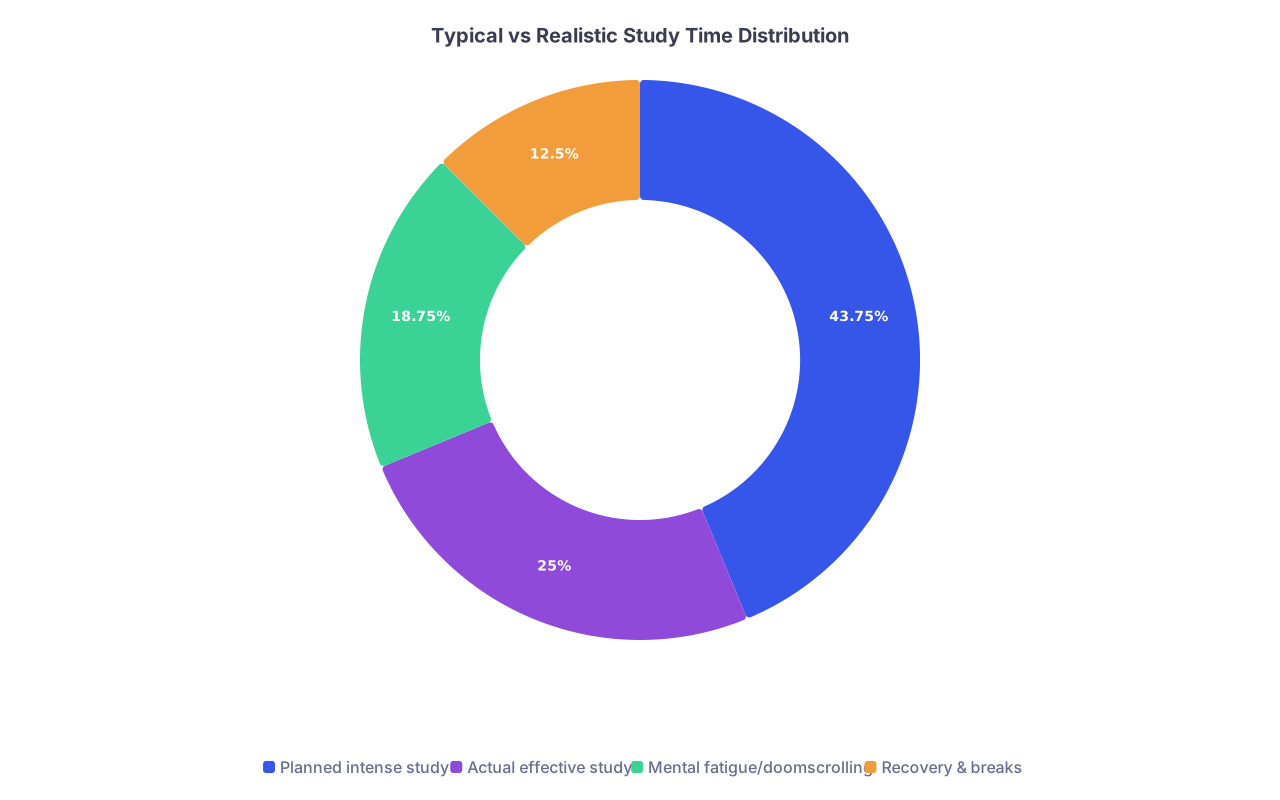
| Category | Value |
|---|---|
| Planned intense study | 70 |
| Actual effective study | 40 |
| Mental fatigue/doomscrolling | 30 |
| Recovery & breaks | 20 |
If your reality looks more like the right half of that chart than the left fantasy, you are not failing. You are just human. Adjust the plan accordingly.
The Bottom Line: Do Not Let the Plan Become the Problem
Keep this tight and clear:
- If your USMLE schedule makes you feel like a failure most days, the schedule is broken, not you.
- Over-planning is not discipline; it is often anxiety in disguise, and it can push you toward burnout and depression.
- The goal is not a perfect plan. The goal is a sustainable one that respects your brain, your body, and your mental health—so you can actually make it to test day intact.