Is More Practice Always Better? Evidence on Overstudying and Burnout
What if those extra 1,500 practice questions you’re planning to do before your exam actually make your score worse?
That’s not hypothetical. I’ve watched students grind UWorld blocks until midnight, seven days a week, proudly touting “I hit 8,000 questions,” then walk out with scores below their NBMEs and absolutely cooked mentally. Not because they were lazy. Because they believed the most dangerous myth in medical education:
More is always better.
More practice questions. More hours. More Anki reviews. More everything.
Let’s break that.
The Myth: “You Can’t Overstudy if You Care Enough”
Medicine worships overkill. If 40 Anki cards help, then 400 must be better. If 4,000 questions raise your score, then surely 8,000 guarantees success. And if you’re not doing as much as the loudest person in your group chat, you’re “behind.”
Reality: the relationship between practice and performance is not linear. It looks a lot more like this: rapid benefit at the beginning, plateau in the middle, then decline when fatigue and burnout overwhelm attention and memory.
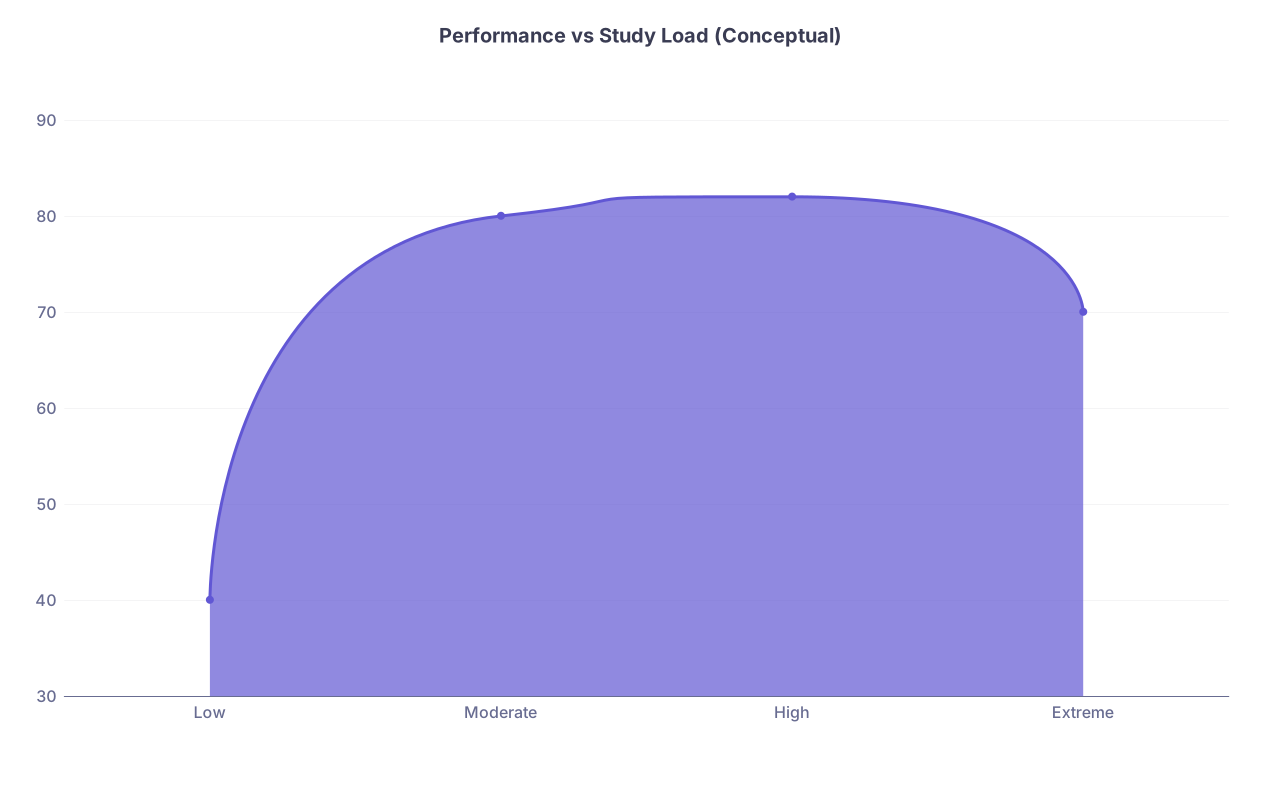
| Category | Value |
|---|---|
| Low | 40 |
| Moderate | 80 |
| High | 82 |
| Extreme | 70 |
That last drop? That’s the “I did everything and still didn’t get the score I wanted” zone.
No, you’re not broken. The strategy is.
Let’s pull in some actual evidence instead of vibes and Reddit flex posts.
What the Data Actually Shows About Overstudying
1. Burnout and performance are not independent
Medical students love to pretend burnout is just an emotional side-effect. You feel bad, but you can still grind.
That’s wrong. Burnout is cognitive.
Multiple studies across med schools show roughly 45–60% of medical students meet criteria for burnout at any given time. Not “a bit stressed.” Burned out: emotional exhaustion, depersonalization, and reduced sense of efficacy. And here’s the part people hand-wave:
Burnout is associated with:
- Lower exam performance
- More test anxiety
- Worse concentration and memory
- Increased errors and near-misses in clinical settings
You can’t say “I’ll burn out later, I just need to pass this exam now.” The burnout you’re cultivating now is already sabotaging the learning you think you’re doing.
2. More study time past a point doesn’t predict better scores
There is data on this from Step 1, Step 2, and in-course exams:
- For most exams, there’s a range of “effective” daily study hours (usually around 6–8 focused hours for intense exams like Step; often less for in-house tests).
- Beyond that, additional hours don’t correlate with higher scores. In several studies, once students hit a moderate threshold, scores cluster tightly regardless of whether they studied 6 or 12 hours a day.
- Very long study days correlate more with distress and fatigue than with higher performance.
I’ve seen this play out dozens of times in real students:
- Student A: 6–7 high-quality hours, protects sleep, reviews mistakes carefully → predictable NBME growth
- Student B: 10–12 anxious hours, rushing through blocks, skimming explanations, cutting sleep → wildly inconsistent NBME scores, often dropping late in the study period
The difference isn’t “motivation.” It’s that one respects cognitive limits and the other tries to brute force biology.
Overpractice: When “More Questions” Starts Backfiring
Let’s talk practice questions specifically, because this is where the arms race gets ridiculous.
You’ve probably heard things like:
- “You must do 2 full passes of UWorld”
- “If you haven’t hit X thousand questions, you’re not ready”
- “Just keep doing more blocks, it’ll click eventually”
That advice sounds hardcore. It’s also wrong for a large chunk of students.
The benefit curve for practice questions looks something like this:
| Question Volume | Typical Effect on Performance |
|---|---|
| 0–1,000 | Steep improvement |
| 1,000–3,000 | Still improving, slower |
| 3,000–5,000 | Plateau territory |
| >5,000 | Diminishing or neutral; can harm if sleep/stress suffer |
Is this exact? Of course not. But it reflects what I’ve seen across dozens of real schedules:
- Below ~1,000–1,500 questions: you simply haven’t seen enough patterns
- Around 2,000–3,000: you’re consolidating and refining
- Past that: you’re at serious risk of swapping depth for volume and building fatigue instead of insight
The key issue isn’t just number of questions. It’s what gets sacrificed to hit those numbers:
- Sleep
- Careful review
- Spaced repetition
- Exercise and basic sanity
When people brag about doing 6–8 blocks a day, they usually aren’t telling you how shallow their review is, or how their last two blocks of the day are done half-conscious.
Cognitive Limits: Your Brain Is Not a Bottomless Bucket
There’s a hard ceiling here, and it’s not fixed by “wanting it more.”
Short version from cognitive psychology and learning science:
Working memory is limited.
You can only process a few novel items at once. Beyond that, errors jump.Attention is fatigable.
After about 45–90 minutes of deeply focused work, performance drops unless you take real breaks. Not scrolling-breaks. Actual reset.Sleep is required for consolidation.
Deep and REM sleep literally stabilize and reorganize memories. Chronic sleep restriction (say, 5–6 hours repeatedly) tanks working memory, attention, and complex reasoning. Exactly what exams test.
So when a student says, “I’m doing 12 hours of studying a day, sleeping 5 hours, and I’m still stuck,” the answer is not, “Do 14.”
You’re past the point where more input equals more output. You’re in the zone where:
- You misread questions
- You forget stuff you literally reviewed 24 hours ago
- You confuse similar concepts because your brain never had the off-duty time to separate and store them
You’re not failing because you’re doing too little. You’re failing because you’re refusing to stop.
Overstudying vs Working Hard: How to Tell the Difference
Let me draw a clear line here, because people love to misinterpret this as “you’re saying don’t work hard.”
No. I’m saying stop confusing self-damage with dedication.
Here’s a useful contrast.
| Feature | Healthy Intensity | Overstudying / Overpractice |
|---|---|---|
| Daily study time | ~4–8 focused hours (exam-dependent) | 9–14+ hours, day after day |
| Sleep | 7–8 hours most nights | 4–6 hours, “I’ll catch up later” |
| Review quality | Deep review, fewer questions | Shallow review, maximal question volume |
| Emotional state | Tired but grounded | Constant anxiety, dread, or numbness |
| Score trend | Gradual upward or stable | Fluctuating, often down with more effort |
If you recognize yourself in the right-hand column, you are not “being hardcore.” You’re in the zone where more practice is either:
- Doing nothing
- Or actively hurting your performance
The Burnout Trap: Why You Don’t Feel the Decline Until It’s Late
One of the nastier things about burnout is timing. It doesn’t announce itself with a clear “stop” sign. It creeps.
The progression usually looks something like this:

| Step | Description |
|---|---|
| Step 1 | Increased study load |
| Step 2 | Short-term score bump |
| Step 3 | More hours to lock it in |
| Step 4 | Sleep & breaks cut |
| Step 5 | Fatigue & irritability |
| Step 6 | Scores plateau or dip |
| Step 7 | Anxiety → even more hours |
| Step 8 | Burnout & further decline |
The evil part? The early phase works. You add hours, your scores go up. That positive reinforcement keeps you from realizing you’ve already slid into an unsustainable model.
By the time your scores plateau or drop, you’re so invested in the “just do more” story that you double down. Exactly the wrong move.
Signs you’re in the burnout zone even if you’re still functioning:
- You read a paragraph and realize you absorbed none of it
- You feel detached and weirdly numb about things you used to care about
- You alternate between panicked productivity and complete shutdown
- You can’t remember basic facts you “know” you’ve reviewed repeatedly
That’s not laziness. That’s a brain waving a white flag.
Evidence-Based Ways to Get More Out of Less
If “just do more” is bad advice, what actually works? There’s decent learning science here, and it’s very different from what the loudest grinders preach.
The methods that consistently correlate with better performance and less burnout are:
1. Spaced repetition, not marathon cramming
Distributed practice (short, repeated exposures over time) beats massed practice (one huge chunk) for durable learning. That’s the whole point of Anki and similar systems, but students sabotage it by turning it into 1,500-card-death-marches.
Active retrieval over passive rereading
Testing yourself (questions, recall, teaching) solidifies memory far more than re-reading or re-watching. But again, quality matters more than raw quantity.Interleaving
Mixing topics and question types trains discrimination and flexibility. Doing all cardiology, then all nephrology, then all endocrine sounds sensible but actually leads to brittle knowledge.
4. Sleep and exercise as non-negotiable
Not “nice to have.” Directly performance-related. Multiple studies show better exam performance and lower burnout in students who protect even minimal physical activity and adequate sleep.
Let’s be concrete about tradeoffs.
| Swap This | For This |
|---|---|
| 3 extra hours of late-night qbanks | 1 hour earlier sleep + 2 hours deep review |
| Passive video binge | Mixed recall + selective videos |
| 6 blocks/day at 50% review | 3–4 blocks/day with 100% careful review |
| Seven-day grind weeks | 5.5–6 days with a real half/full day off |
The students who win long-term aren’t the ones who can suffer the most. They’re the ones who are ruthless about return on effort.
When Less Practice Actually Raises Your Score
I’ve seen multiple versions of this same story:
- Student is doing 5–6 question blocks daily, sleeping 5 hours, reviewing shallowly, and watching NBME scores bounce or fall.
- We cut them to 3–4 blocks/day max, mandatory 7–8 hours of sleep, hard cap on total daily study time, and deeper review of missed questions.
- Next NBME: score jumps 5–15 points within 1–3 weeks.
Same brain. Less “work.” Higher performance.
Why? Because they finally shifted from quantity signaling (“Look how much I’m doing”) to quality learning (“Here’s what I’m actually fixing”).
This is where the myth really needs to die: suffering more is not a reliable signal of learning more.
How to Know When to Stop for the Day
Practical question: where’s the stopping point?
You’re not going to find a randomized trial that says, “Thou shalt not exceed 7.3 hours.” But there are good personal markers:
Stop once:
- Your accuracy and focus drop sharply across blocks
- You find yourself re-reading the same question stem multiple times
- You’re making dumb mistakes you don’t make earlier in the day
- You’re pushing tonight’s sleep below 7 hours “just to squeeze in one more block”
That “one more” block done at 30% brain capacity is usually worse than no block at all. You mislearn, reinforce confusion, and spike stress.
If your scores are stable or improving on practice exams, and you’re within striking distance of your goal, often the most high-yield move in the last 3–5 days:
- Keep question volume modest
- Shift heavily to targeted review
- Protect sleep like it’s part of the exam
Because it is.
The Clinical Parallel: Would You Practice Medicine This Way?
Let’s zoom out.
If a resident told you:
“I’m going to do 14-hour shifts every day for months with no real days off, sleep 4–5 hours, and handle twice the normal patient load because that’ll obviously make me a better doctor faster.”
You’d call that unsafe. Stupid, even. You’d point out:
- More hours doesn’t mean more learning
- Fatigue causes errors
- Burnout wrecks empathy, judgment, and retention
Yet med students routinely apply the exact same reckless logic to studying. Then act surprised when their performance, mood, and memory implode.
You cannot build a sustainable medical career on chronic self-abuse dressed up as “dedication.”

Bottom Line: When “More” Turns Into “Too Much”
Let me cut through the noise.
More practice is not always better. There’s a clear point where extra questions and hours add almost nothing and start actively hurting through fatigue, shallow learning, and burnout.
Burnout is a performance problem, not just a feelings problem. It degrades attention, memory, and judgment. Grinding through it doesn’t build resilience. It just trains you to ignore your own cognitive limits.
You’ll usually score higher with focused, capped, sustainable effort than with desperate, maximal effort. Protect sleep. Cut dead-weight volume. Review deeply. If something has to give, it should not be your brain’s basic operating conditions.
If your plan to “do better” is always “do more,” you do not have a strategy. You have a superstition.