
The culture of medical school worships suffering far more than it worships science. That’s the problem.
We pretend medicine is evidence-based, then run our training system on superstition: “Real doctors don’t sleep.” “If you’re not miserable, you’re not working hard enough.” “Burnout is just weakness.” None of that survives contact with actual data.
You do not have to destroy your mental health to succeed in medical school or on exams. In fact, the odds get worse when you do.
Let’s dismantle the grind myths one by one and replace them with what the research — and the outcomes — actually show.
Myth #1: “If You’re Not Suffering, You’re Not Serious”
This is the favorite line of the martyr crowd. The ones bragging in the library at 1:30 a.m., loudly complaining about how little they sleep, half-flexing, half-whining.
Here’s what the data actually shows: beyond a modest level, more suffering does not equal more success. It just equals more suffering.
A few hard numbers:
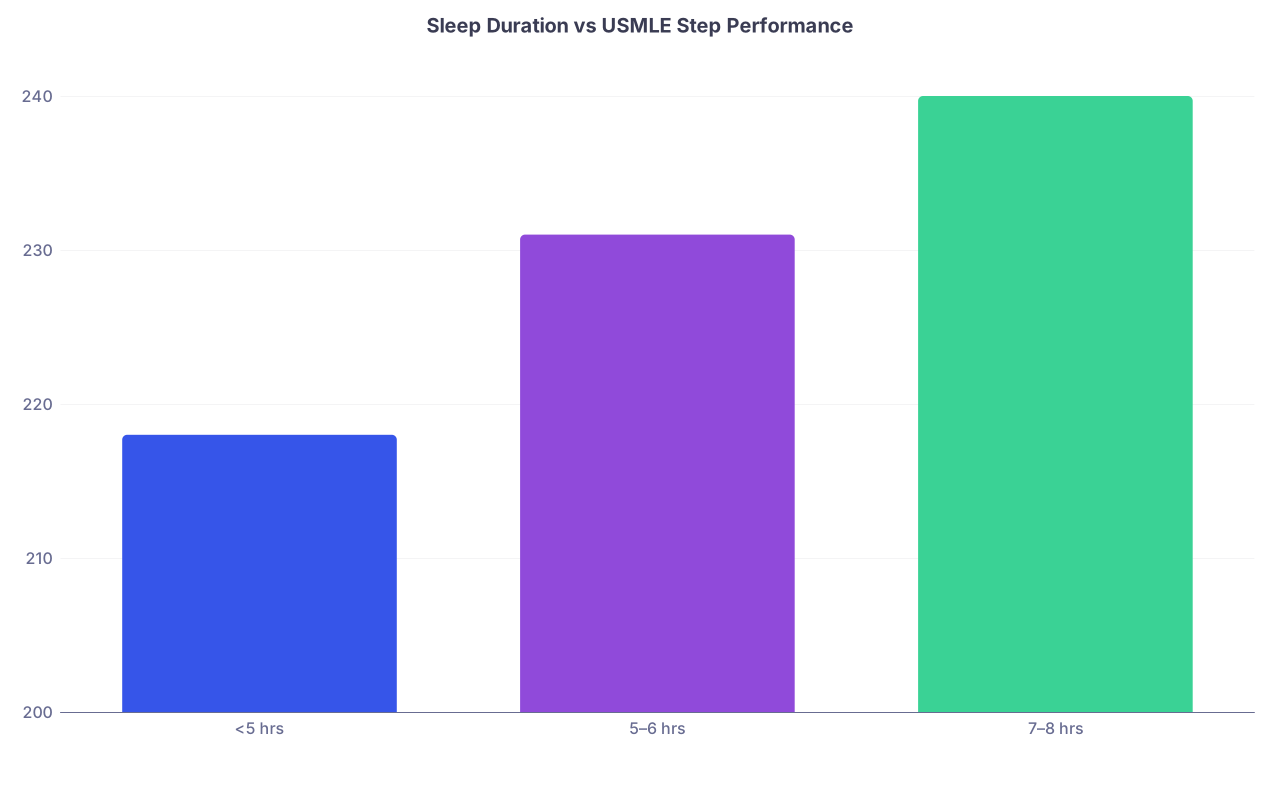
| Category | Value |
|---|---|
| <5 hrs | 218 |
| 5–6 hrs | 231 |
| 7–8 hrs | 240 |
Multiple studies on medical students and residents converge on the same theme:
- Students sleeping around 7–8 hours consistently perform better on standardized exams than their sleep-deprived classmates.
- Chronic sleep deprivation impairs attention, working memory, and decision-making — exactly what you need for clinical reasoning and exam performance.
- Burnout and depression correlate with worse academic performance, higher error rates, and more professionalism issues.
This isn’t a moral argument. It’s statistical.
The formula most students run is:
More hours → more output → better results.
What actually happens after a certain point:
More hours → worse cognition + slower recall + more re-reading → same or worse results for more time spent.
I’ve watched this play out in real groups:
- Student A: Studies 10 “heroic” hours a day, sleeps 5 hours, re-watches the same videos, keeps re-reading First Aid because “I don’t feel ready.” Anxious, exhausted, plateaued.
- Student B: Studies 6–7 focused hours, protects sleep, uses active recall and spaced repetition. Leaves by 8 p.m. Looks suspiciously… fine. That’s the one who quietly posts a strong Step score.
The grind myth survives because misery is visible. Sleep, boundaries, and attention hygiene are not.
You don’t get extra points on test day for being the most exhausted person in the room.
Myth #2: “More Hours = Better Scores”
Let’s be blunt: if time alone were the secret, every student sleeping in the library would ace Step.
They don’t. Because how you study vastly outweighs how long you stare at material.

Students who perform well on exams consistently do a few specific things:
They space their learning instead of cramming.
They use active recall (questions, flashcards, practice problems) rather than passive review.
They mix topics (interleaving) instead of blocking all of cardiology in one marathon day.
There’s decades of cognitive psychology research on this. You don’t need to memorize the names (Bjork, Roediger, Cepeda) to benefit from their work. The core is simple:
- Retrieval practice (forcing yourself to recall information) builds durable memory.
- Spaced repetition (revisiting content over days/weeks) keeps it accessible.
- Passive review (re-reading, re-watching) feels comfortable and productive but is mostly an illusion.
Let me put it harshly:
If you’re “studying” 12 hours a day and 8 of those hours are re-reading notes and watching lectures on 1.25x, you’re not working hard. You’re just working long.
A focused 5–7 hours of active practice beats a scattered 12–14 hour slog. Almost every time.
Programs know this. Look at how top commercial test-prep resources are built: question banks, flashcards, short explanations. Not 20-hour video courses of someone reading slides you already have.
The grind myth persists because “I studied for 14 hours” sounds impressive in a group chat. “I did 120 questions and spent 4 hours reviewing my mistakes deeply” doesn’t sound heroic. It just works.
Myth #3: “Mental Health Is a Luxury You Can’t Afford in Med School”
This one is particularly destructive — and common.
The whispered script goes like this:
“Yeah, I’m anxious, barely sleeping, feel detached, but this is just how med school is. I’ll fix it in residency. Or after boards. Or after fellowship. Or…”
Here’s what actually shows up in the literature:
- Medical students have significantly higher rates of depression, anxiety, and suicidal ideation compared with age-matched peers.
- Burnout in medical school predicts burnout in residency. It does not magically reset at graduation.
- Untreated mental health conditions are associated with academic difficulty, professionalism issues, leaves of absence, and in worst cases, dropping out or self-harm.
There’s this fantasy that you can just outrun your brain until “after boards.” That period… never comes. There is always another high-stakes hurdle. Step 1. Shelf exams. Step 2. Sub-Is. Residency interviews. In-service exams. Boards. On and on.

Programs that actually care about outcomes (not just appearances) are starting to admit what older physicians quietly know: stable mental health is a performance enhancer, not a distraction.
Students who seek treatment for depression/anxiety and engage in therapy or medication when indicated:
- Often see better academic performance afterward.
- Have better long-term functioning and lower risk of serious crises.
- Are more likely to actually stay in medicine.
The “mental health is weakness” mantra is just stigma with a white coat on. And it’s factually wrong.
You’re not tougher for white-knuckling panic attacks through an exam. You’re just untreated.
Myth #4: “Self-Care Is Soft; Real Medicine Is Hardcore”
The word “self-care” is overused, I know. It now conjures images of scented candles and bubble baths, which understandably makes med students roll their eyes.
So let’s drop that phrase and talk about something else: performance maintenance.
Every high-performance field outside medicine takes this seriously. Elite athletes treat recovery as part of training. Concert pianists protect their hands, sleep, and practice structure like it’s religion. Pilots have mandatory rest rules because fatigue kills people.
Yet in medicine, one of the most cognitively demanding professions on earth, we act like the smartest approach is to abuse ourselves and hope for the best.
Here’s reality: your brain is a biological organ. It runs on sleep, glucose, oxygen, and a halfway decent level of psychological stability. Ignore those, and you will pay — usually when you most need your brain to work.
I’ve seen “soft” habits save students’ academic lives:
- A student failing early exams, chronically behind, staying up until 3 a.m. every night. When forced to go to bed by midnight, start exercising 20 minutes three days a week, and see counseling, suddenly they’re passing comfortably. Content knowledge didn’t double. Brain function did.
- Another who started doing 10-minute mindfulness sessions before study blocks, cut phone usage, and surprised themselves with how much more they could absorb in less time.
We can quibble about the buzzwords, but we cannot deny the physiology. Chronic stress and sleep restriction reduce hippocampal function and memory consolidation. That’s not a vibe. That’s brain structure.
So no, going for a walk, eating a real meal, or saying no to yet another late-night study session is not weakness. It’s baseline maintenance for someone whose job is to keep other people alive using their brain.
Myth #5: “Everyone Else Is Grinding Harder Than You”
One of the most toxic aspects of med school life is the constant, distorted comparison game.
You hear classmates brag:
“I did 200 Anki cards, 80 UWorld questions, scrubbed a case, and stayed until 2 a.m.”
Or, “I studied all weekend. Didn’t even leave my apartment.”
You know what you rarely hear? The truth.
“I opened Anki, did 40 cards in 2 hours because I kept checking my phone, scrolled Reddit for 45 minutes, panicked, and then did 20 questions while half-dissociating. Then I went home and told my roommate I studied all day.”
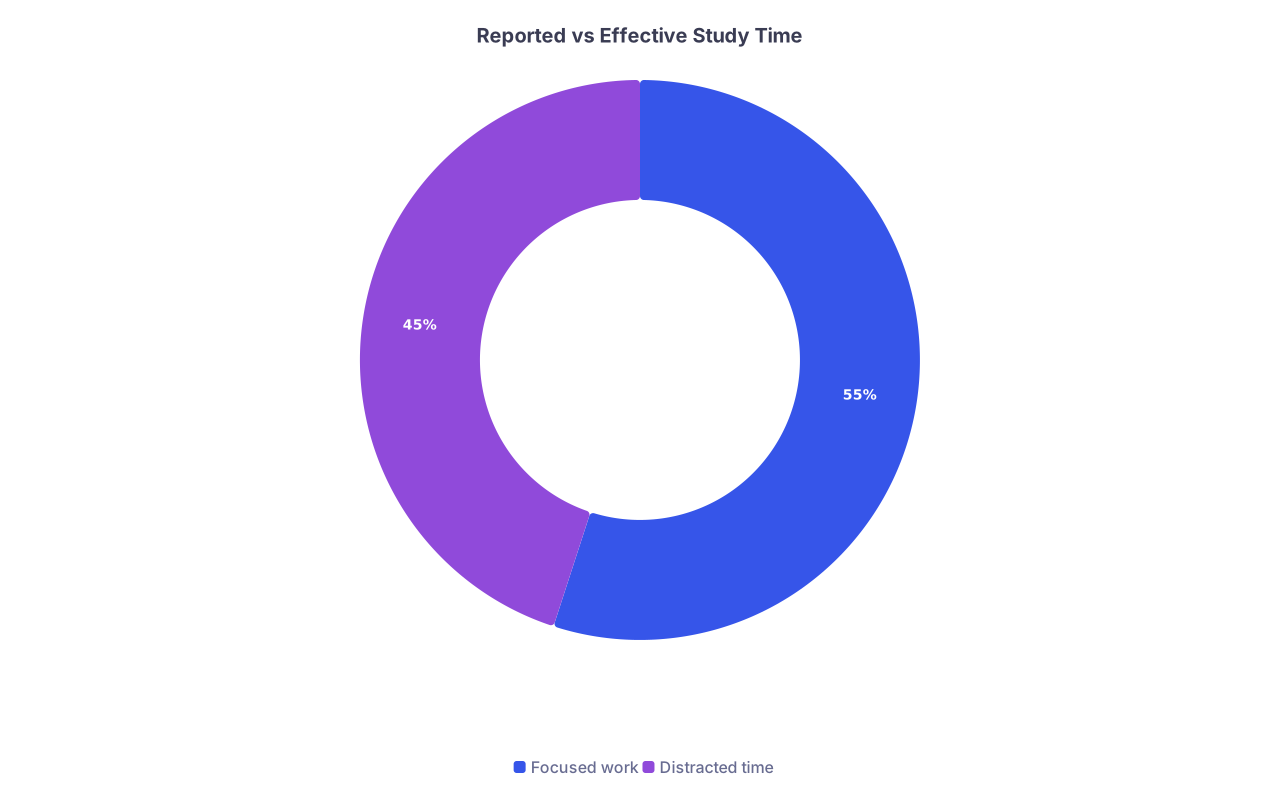
| Category | Value |
|---|---|
| Focused work | 55 |
| Distracted time | 45 |
Most students overestimate how much focused work they do and underestimate how much meaningless time they burn — while still calling the entire block “studying.”
So you’re not actually comparing yourself to their reality; you’re comparing yourself to their highlight reel and ego projections.
When I’ve had students time-block their day and honestly track focused minutes (phone away, not multitasking), they’re shocked. Eight “study hours” turn out to be three or four legitimate ones.
Meanwhile, the quieter student who leaves at 7 p.m. may have gotten the same three or four focused hours… without the shame spiral and sleep deprivation.
The grind myth thrives on this illusion that “everyone else” is more disciplined, more hardcore, more prepared. In real data, what separates students is far more mundane:
- Who started consistent, reasonable studying earlier instead of panicking late.
- Who protected basic health behaviors.
- Who used effective methods and actually learned from their mistakes.
Not who posted the most dramatic study selfie.
Myth #6: “You Have to Choose: Top Scores or Mental Health”
This might be the biggest myth of all: that you’re standing at a fork in the road.
Path A: Crush exams, match competitively, sacrifice your sanity.
Path B: Protect your mental health, accept mediocre scores and limited options.
That framing is convenient drama. It’s also a false dichotomy.
| Factor | Grind-Only Approach | Sustainable Approach |
|---|---|---|
| Daily Hours | 10–14 unfocused | 6–8 focused |
| Sleep | 4–6 hours | 7–8 hours |
| Methods | Re-reading, passive | QBank, spaced recall |
| Burnout Risk | High | Lower |
| Long-Term Retention | Poor | Strong |
I’m not going to lie to you: doing well in med school still requires work. Real work. Some sacrifice. You don’t get neurology by osmosis while watching Netflix.
But the trade-off is not between “no effort” and “self-destruction.” It’s between:
- Smart, structured effort you can sustain for years.
- Chaotic, extreme effort that spikes before every exam and leaves you wrecked.
Look at people who score 250+ on Step 2 or honor multiple clerkships without imploding. They are not always the ones who are visibly grinding the hardest at 2 a.m.
They are the ones who:
- Started using question banks earlier, in smaller daily chunks.
- Integrated practice questions into their rotations instead of trying to “catch up” with a 4-week death sprint.
- Took one real day off weekly and actually protected it.
- Took mental health seriously enough to adjust when they slid into burnout.
There are students who push extremely hard and stay mentally okay. Usually because their foundation (sleep, support system, coping skills) is strong. The grind itself isn’t what made them successful. The grind was something they happened to survive.
Saying you “must” suffer to achieve top results is like saying you must smoke to be a good cardiologist because a few old attendings did and survived. Wrong direction entirely.
So What Does a Non-Grind, High-Performance Approach Actually Look Like?
Not perfection. Not Instagram-aesthetic productivity. Something like this:
- You aim for 6–8 hours of mostly focused study on heavy days, less on lighter days.
- You prioritize sleep like it’s a core assignment, not a reward.
- You use active recall (questions, flashcards, teaching others) as your default, not re-reading.
- You start Step/shelf prep earlier with small, consistent doses, instead of binge-studying.
- You treat escalating anxiety, depression, or burnout as a medical problem to address — not as a personal failing to hide.

| Step | Description |
|---|---|
| Step 1 | Plan Weekly Study |
| Step 2 | Daily Focused Blocks |
| Step 3 | Active Recall & Questions |
| Step 4 | Review Mistakes |
| Step 5 | Adjust Plan |
| Step 6 | Protect Sleep & Breaks |
Then you adjust. When you hit stretches that require more (boards, big exams), you increase temporarily, not permanently. You don’t normalize permanent crisis mode.
The Bottom Line
You don’t earn your MD by suffering more than everyone else. You earn it by learning more, retaining more, and functioning well enough to use that knowledge on real patients.
Three key points to walk away with:
- Pain is not a performance metric. There’s zero evidence that chronic sleep loss, nonstop studying, and ignoring your mental health improve outcomes. Much of the time, they do the opposite.
- Smart, sustainable methods win long-term. Active recall, spaced repetition, and realistic hours beat chaotic 14-hour “hustle” days stuffed with passive review.
- Protecting your mental health is not optional if you want a real career in medicine. It’s part of the job. The work is hard enough; you do not need to make it harder by glorifying self-destruction.
You don’t have to suffer to succeed. You just have to stop confusing suffering with progress — and start practicing evidence-based training on yourself, not just your future patients.