
The belief that “real” medical students power through without help is not just wrong. It is statistically, clinically, and professionally dangerous.
I’ve heard versions of the same line in every school and hospital corridor:
“If I go to therapy, programs will think I can't handle it.”
“If I need help, maybe I shouldn’t be a doctor.”
“If I just work harder, this will go away.”
That’s the culture speaking. Not science. Not outcomes data. Not actual competency.
Let’s tear this apart.
Myth #1: “If I need therapy, it means I’m not cut out for medicine.”
This is the most common and the most toxic myth. It sounds logical on the surface: medicine is hard; only “the tough” survive; if you crack, you shouldn't be here.
The actual data say something very different.
Across multiple countries and schools, 30–50% of medical students screen positive for depression symptoms, and about 1 in 10 report suicidal ideation in the past year. Those numbers are from meta-analyses in JAMA and other high-impact journals, not random blogs.
Let me be blunt: if struggling meant you’re “not cut out for medicine,” half your class should drop out tomorrow.
Does that match what you see? No. Because needing support under extreme, sustained stress is not evidence of being unfit. It’s evidence of being human in an inhumane training system.
Here’s what the stronger correlation actually is:
Students who recognize they’re struggling and do something effective about it (therapy, medication when appropriate, real boundaries) are less likely to crash hard later. They have fewer full-blown crises, fewer leaves of absence, and less burnout long term.
The “I muscled through it alone” crowd? They’re the ones you see three years later cynical, checked out, or drinking their way through residency. I’ve seen that pattern repeat in multiple cohorts.
There is zero evidence that seeing a therapist disqualifies you from being a good physician. There is plenty of evidence that untreated depression, anxiety, and burnout impair performance, judgment, empathy, and patient care.
So you tell me which one is incompatible with medicine.
Myth #2: “Therapy will go on my record and ruin my career.”
Here’s where rumor, fear, and half-truths have blended into a persistent ghost story.
Let’s separate the parts:
Your school’s counseling/therapy service
Usually: confidential health record. Not part of your academic file. Not visible on your transcript. Not automatically reported to anyone.Your academic record
Contains things like course failures, professionalism issues, leaves of absence (sometimes), not “Johnny saw a therapist for anxiety.”Residency programs and licensing boards
They do not receive a list of who has gone to therapy. They do not get your psychotherapy notes. They do not get your diagnostic codes.
What they might see:
- A leave of absence or extended time to graduation.
- Documented major impairment if it required formal committee action.
Even then, the cause is often summarized vaguely (e.g., “medical leave”) and does not specify “this person saw a therapist” or “had an anxiety disorder.” And no, the vast majority of people in therapy never take a formal leave.
Let’s be even more concrete. Many licensing boards are under legal and cultural pressure to stop asking “Have you ever had a mental health diagnosis?” and instead ask the only question that actually matters:
“Do you currently have any condition (mental or physical) that impairs your ability to practice safely?”
That’s a huge legal shift driven by data showing that overbroad mental health questions reduce help-seeking and do not improve safety.
Here’s what the evidence actually shows: students avoid needed care because they believe treatment will be held against them, not because there’s clear proof that it is.
| Barrier Type | What Surveys Show |
|---|---|
| Fear of career harm | Very common, especially pre-clinical |
| Actual reporting of therapy | Rare, usually not required |
| Actual impact on matching | Minimal to none in most scenarios |
| Untreated impairment risk | High, documented in multiple studies |
The irony: your untreated mental health problem is far more likely to hurt your performance, get noticed, and affect your record than your decision to get therapy.
If you keep white-knuckling it, blow your Step/Level exam, fail a key rotation, or have a meltdown in front of staff, that will be reflected in your evaluations. That’s visible. That’s what PDs actually see.
No one is reading: “This person had the audacity to get help at age 24.”
Myth #3: “Therapy will make me soft and lower my performance.”
This is the macho version: “Stress sharpens me. If I unpack things, I’ll lose my edge.”
Let’s be honest. There is a difference between acute, short-term stress (which can sometimes enhance focus) and chronic, grinding anxiety, depression, and sleep deprivation. You know which one you’re living in.
Performance is not about how wrecked you can be and still function. It is about sustained, reliable, high-level functioning over years.
What do we actually see in students who get decent mental health support?
- Better sleep after cutting down the 2 am doom-scrolling and panic cycles.
- More efficient studying because they can focus for 60–90 minutes instead of re-reading the same paragraph five times.
- Fewer sick days and breakdowns right before exams and OSCEs.
- Less self-sabotage from perfectionism (“If I can’t get 260, why bother starting?”).
When anxiety or depression is moderately severe, treatment often improves test scores and clinical performance simply by restoring executive function, working memory, and attention. You cannot out-grit a brain that’s misfiring.
I’ve seen students go from failing NBME practice tests to passing comfortably after 2–3 months of consistent therapy plus sleep and medication. The content didn’t magically become easier. Their cognitive bandwidth returned.
Therapy is not some endless emotional excavation where you cry for years and stop being productive. Good therapy with a clinician who understands high-performing students is targeted:
- Identify self-defeating patterns: procrastination, all-or-nothing thinking, catastrophic fear of failure.
- Build concrete coping skills: time-blocking, exam-day routines, cognitive restructuring.
- Address identity issues that are tanking motivation: “If I’m not top 10%, I’m nothing.”
This is performance enhancement disguised as mental healthcare.
Myth #4: “Everyone else is coping fine; I’m the only one this weak.”
No, you are just the only one hearing the unfiltered version of your own brain.
On campus, what you see is curated. People flexing Anki streaks, Step scores, research posters. In the library at 11 pm, people whispering about questions, not panic attacks. On rounds, everyone acting sharper and calmer than they feel.
What you don’t see is:
- The person who went home and cried in the car after being humiliated on rounds.
- The one who’s on SSRIs and sees a therapist weekly but has told exactly two close friends.
- The classmate who thinks about crashing their car “just enough to get out for a while.”
More than once I’ve had two students from the same small cohort, both convinced they were the “weakest,” both privately in therapy, both comparing themselves to each other’s public mask.
The data keep saying the same thing: help-seeking is the exception, not the need for help. The fact that you’re miserable doesn’t mean you’re the outlier. It means you’re honest.
You’re not the weak one. You’re just the one who has stopped lying to yourself as effectively as everyone else.
Myth #5: “If I just push through this exam block, it’ll get better.”
Temporary stress is part of medicine. But many students confuse a chronic meltdown with a situational crunch.
Here’s a simple mental check:
If you tell yourself, “After this exam/rotation it’ll calm down,” but you have been saying some version of that for 6+ months, you are not just in a rough week. You’re in a sustained pattern.
What happens if you keep ignoring sustained distress?
- Sleep debt accumulates. Cognitive performance drops.
- Cynicism and depersonalization rise. You start hating patients, classmates, yourself.
- Physical symptoms show up: GI issues, headaches, chest pain.
- You hit a breaking point somewhere high stakes: Step, clerkships, sub-I, intern year.
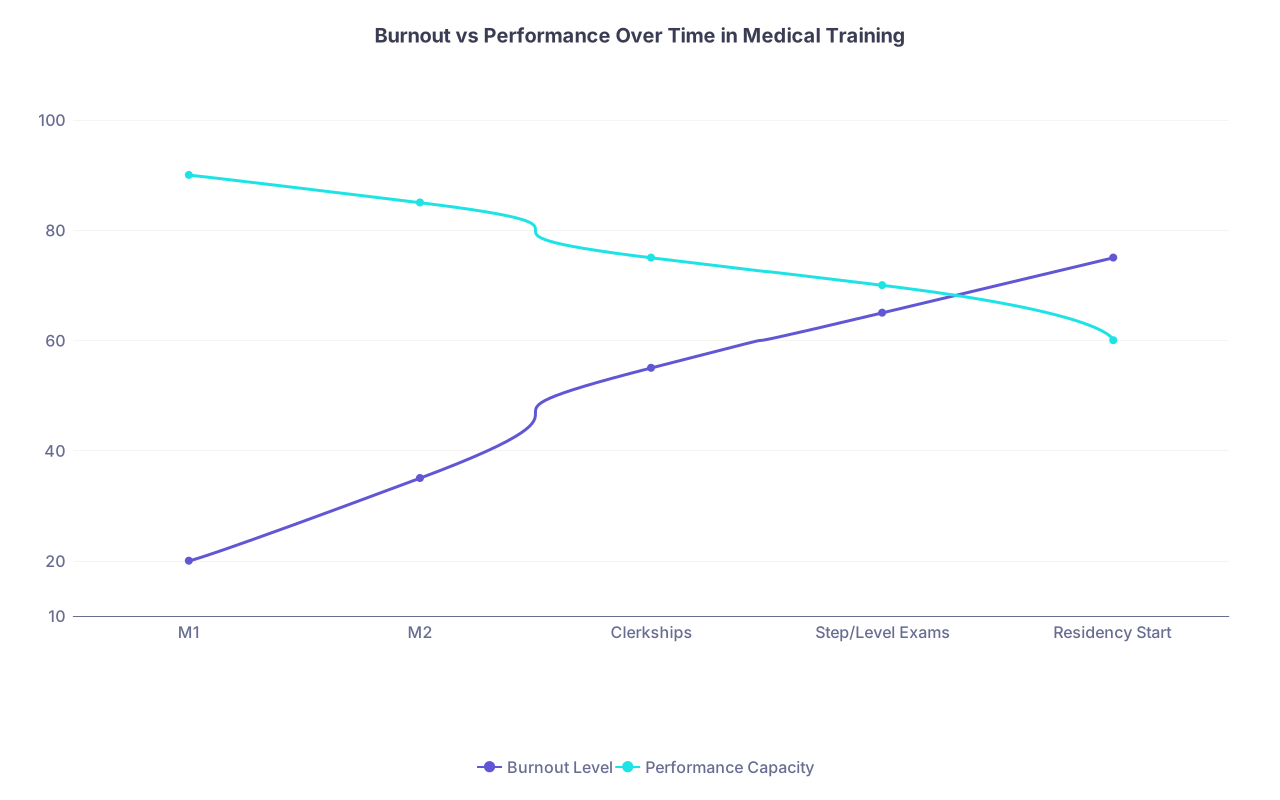
| Category | Burnout Level | Performance Capacity |
|---|---|---|
| M1 | 20 | 90 |
| M2 | 35 | 85 |
| Clerkships | 55 | 75 |
| Step/Level Exams | 65 | 70 |
| Residency Start | 75 | 60 |
Does everyone need therapy at the first hint of stress? No. But if your baseline has been “barely holding it together” for months, white-knuckling is not some noble sacrifice. It’s slow self-destruction dressed up as dedication.
There is a window where relatively modest intervention—therapy, sometimes meds, sometimes a short leave—prevents a catastrophe later. Most students wait too long and only accept help after a crisis has already blown up their exam schedule or rotations.
You do not get extra points for waiting until rock bottom.
Myth #6: “Residency programs only want bulletproof people.”
The fantasy is that PDs are sitting there thinking: “We only want people who never struggled, never needed help, never had a crack in the armor.”
That sounds tough. It’s also completely detached from reality.
Talk to actual program directors over coffee, not during pre-interview propaganda. The phrases you’ll hear instead are:
- “I need residents who won’t disintegrate under pressure.”
- “I care about insight and reliability.”
- “I’d take a 240 with resilience over a 260 who’s a black box.”
Programs care about function, not your ability to pretend you’re invincible. Someone who has learned to recognize when they’re sliding, get help early, and course-correct? That person is safer than the one who looks perfect until they explode in PGY-2.
And let’s point out one more thing: many attendings and residents have been in therapy. Quietly. Sometimes while you were rotating with them. This profession has higher-than-average rates of depression, anxiety, substance use, and suicide. You think no one else is getting help?
The people gatekeeping you are often the same people who see a therapist on their day off.
If anything, over the next decade, the direction of travel is obvious: more programs will start to expect that high-intensity professionals have some form of mental health support at different points in their training. Because the experiment of “just grind them until they break” has already failed.
Myth #7: “Therapy is for people with trauma; I’m just stressed.”
This is another dodge: “I’m not ‘traumatized’; I’m just tired.”
Translation: “I don’t feel bad enough to deserve help yet.”
Here’s the blunt version. You don’t have to be suicidal, hospitalized, or abused to qualify for therapy. You just have to be suffering enough that your life, relationships, or work are being impaired—or trending that way.
Medical school almost always meets that bar at some point.
Therapy isn’t only for massive, capital-T Trauma. It’s also for:
- The constant voice saying you’re not good enough if you’re not perfect.
- The inability to study unless the exam feels like the end of the world.
- The complete loss of joy in anything that isn’t productivity.
- The panic that grips you before every patient encounter because you “know nothing.”
Those things may not sound dramatic enough for a textbook case. But they erode your capacity year after year. They also respond to intervention.
If you wait until everything meets “textbook severe,” treatment is harder, slower, and more disruptive. Early therapy is preventative maintenance, not a last-ditch rescue.
How to Use Therapy Strategically During Med School
Let me be specific about how therapy can actually intersect with your performance, not float around as wellness fluff.
You can use therapy to:
- Unpack the catastrophic thinking that freezes you in front of Step or Level prep: “If I don’t get X, my life is over.”
- Build realistic study plans that account for your actual brain, not the imaginary machine in Reddit success posts.
- Rebuild after a failure—course, exam, clerkship—without internalizing “I am a fraud” as your permanent identity.
- Deal with attendings who humiliate, gaslight, or bully you without letting them colonize your self-worth.
- Navigate family or relationship pressure that’s bleeding into your ability to focus.
None of that is abstract. That’s what comes up in real med student sessions.
Here’s a sample of how it looks in practice:
You come in saying, “I’m lazy, I procrastinate, I’m failing.”
After 2–3 sessions, the picture shifts to: you study in unsustainable sprints, your standards are all-or-nothing, and the second you hit discomfort, you numb out with scrolling because you’ve wired your brain to associate studying with shame, not mastery.
Now therapy works on the actual problem. You start smaller, time-limited blocks. You learn to tolerate “average” days without hating yourself. You bypass 4-hour panic spirals the night before exams. Performance improves—not by magic, by removing internal friction.
That is not weakness. That is strategy.
What the Data Actually Support—and What Your Future Self Will Remember
If you strip away the whispers, the cultural bravado, the scare stories, and you just look at outcomes, the picture is boringly clear:
Students who address their mental health early and realistically perform as well or better, are less likely to burn out catastrophically, and often have longer, more sustainable careers.
Students who cling to “therapy is weakness” mythology may look strong on the outside for a while. Then they show up in the statistics you read about but never think will apply to you: failed exams, leaves of absence, resentful residents, attending suicides.
You do not get bonus credit for suffering silently. No residency ranking formula includes “number of panic attacks endured privately.”
Years from now, you’re not going to look back and admire how well you hid your misery from everyone. You’ll remember whether you treated yourself like a disposable tool—or like a person whose mind was worth protecting before it broke.