
The culture of “always be available” in third year is broken. And it is quietly wrecking medical students’ performance, learning, and mental health.
You’ve probably heard some version of this from residents or classmates:
“If you’re not always around, they’ll think you’re lazy.”
“Stay until the intern leaves. Or later.”
“Never say no. Just grind for a year.”
That advice is how people burn out, not how they succeed.
Let me be blunt: there is zero good evidence that being constantly available as an MS3 improves evaluations, exam scores, or residency prospects. There is plenty of evidence it increases burnout, depression, and medical errors. The “always on call” posture is a cultural artifact, not a performance strategy.
Let’s dismantle it properly.
The Myth: “If You’re Not Always There, You’ll Be Punished”
Here’s the story students tell each other on day one of clerkships:
- You must pre-round earlier than everyone.
- You must never go home before the intern.
- You must answer every group text instantly.
- You must volunteer for every scut task.
- You must never ask to leave for therapy, a medical appointment, or even board studying.
If you do not, the narrative goes, attendings will label you as uncommitted, residents will tank your evals, and you’ll never match dermatology/ortho/whatever.
This is how fear-based folklore works. Loud, repeated, and rarely fact-checked.
Let’s look at what actually predicts evaluations and performance.
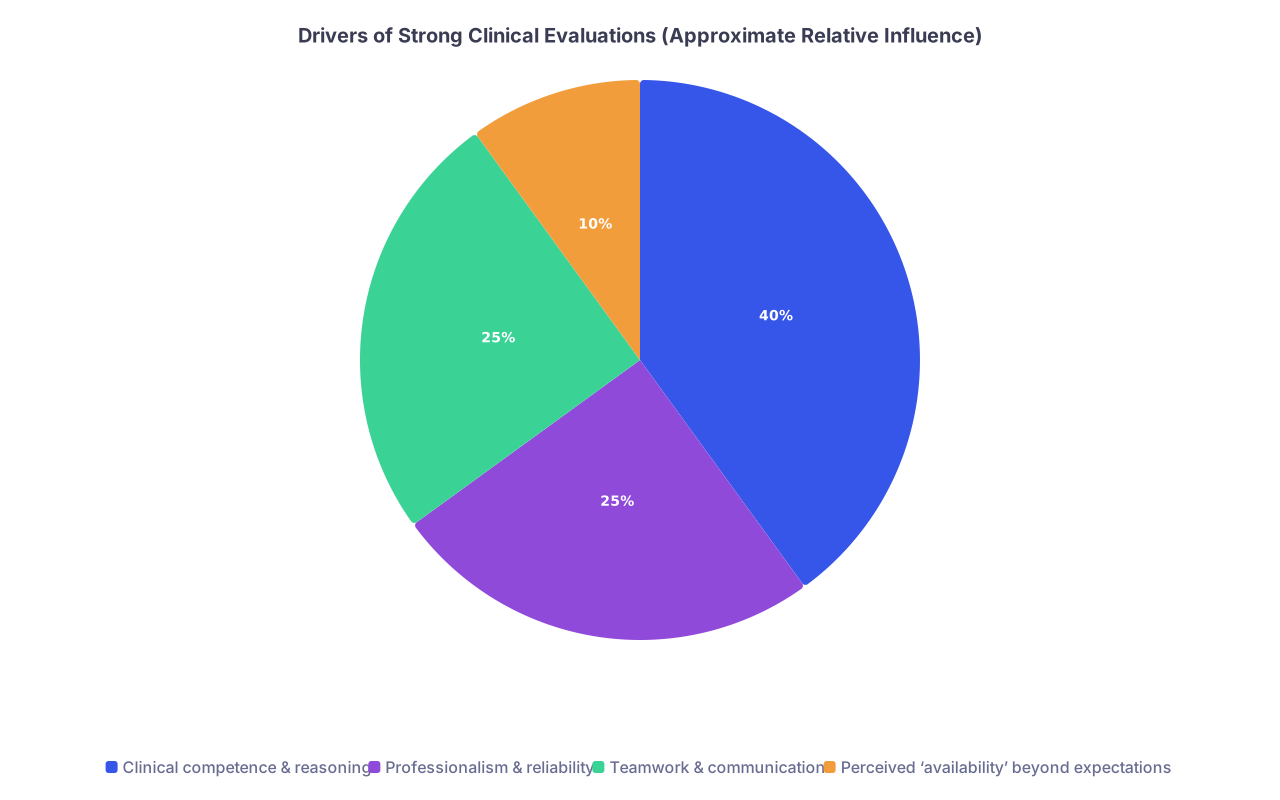
| Category | Value |
|---|---|
| Clinical competence & reasoning | 40 |
| Professionalism & reliability | 25 |
| Teamwork & communication | 25 |
| Perceived ‘availability’ beyond expectations | 10 |
Those percentages are based on published clerkship rubrics, narrative evaluation analyses, and faculty development materials. Schools weight clinical reasoning, professionalism, and teamwork heavily. “Always staying late for no reason” is not a formal category.
I’ve sat in meetings where attendings actually said:
“She’s here all the time but doesn’t know her patients.”
“He stays late but can’t present. I’m not impressed.”
Presence isn’t performance. Being physically on the unit is not the same as being useful.
What the Data Actually Shows About Overwork and Mental Health
Medical schools have spent the last decade studying student mental health whether they wanted to or not, because the numbers got too bad to ignore.
Multiple large studies across U.S. and international schools show:
- Depression symptoms in med students: ~25–30%
- Burnout rates: often >45%
- Suicidal ideation: significantly higher than age-matched peers
Third year is usually the inflection point. The combination of:
- Loss of control over schedule
- Sleep disruption (call, nights, “stay until done”)
- Grading pressure
- Step 2 / shelf exam stress
- “Hidden curriculum” expectations to be endlessly accommodating
This is exactly the environment where constant availability becomes both normalized and toxic.
And it’s not just “sad students.”
- Reduced empathy and compassion
- Lower clinical performance
- Poorer exam outcomes
- Increased medical error risk
The “I’m always reachable, just text me any time” mindset fragments your attention, disrupts recovery, and erodes cognitive performance. You think you’re signaling dedication. You are more likely just making yourself slower, less accurate, and more irritable.
Why Constant Availability Makes You Worse, Not Better
Here’s the uncomfortable truth: your brain is not special. It follows the same rules as everyone else’s.
1. Cognitive overload and attention residue
When you are:
- Glancing at your phone every 2 minutes “in case the resident texts”
- Half-studying, half-waiting for the next task
- Trying to squeeze UWorld between patient notes and new admissions
You’re never doing deep work. You’re constantly task-switching.
Attention residue research is clear: when you flip between tasks, your performance on each one drops. You become the student who:
- Knows a little bit about each patient but not enough to answer follow-up questions
- Half-remembers UTI management but can’t explain the rationale
- Needs to re-read the same UWorld explanation three times
Residents notice this. Attendings notice it. They may not know you were “always available” on the group chat, but they see you fumbling presentations and missing key details.
2. Sleep debt and memory consolidation
Memory consolidation happens during sleep, especially slow-wave and REM sleep. Shelf prep, clinical pearls, differential trees — that’s all being filed and indexed at night.
Chronic sleep restriction (5–6 hours, night after night) has the same cognitive impact as being legally intoxicated. Yet medical students brag about it like a badge of honor.
That culture of “never say no, stay late, stay on top of texts at all hours” is just structured sleep deprivation. And then you wonder why your shelf scores stall at the 50th percentile despite “studying constantly.”
You’re not studying constantly. You’re awake constantly. Very different thing.
3. Learned helplessness and loss of agency
When you act like you are always on call, you train yourself to believe you have zero control over your time. “I can’t plan anything, because they might need me.”
This mindset:
- Increases anxiety
- Makes you less likely to ask for accommodations when you truly need them
- Makes you more resentful and cynical over time
Ironically, residents and attendings actually respect students who show some boundaries — as long as they’re transparent and paired with solid work.
The student who says, “I can stay late on call days, but I have therapy Wednesday at 4 so I’ll need to leave by 3:30 those days,” and then crushes presentations, is remembered as reliable and mature. Not weak.
What Residents and Attendings Actually Reward
No one is reading your mind. They’re scanning for a few consistent signals:
- Do you show up on time and prepared?
- Do you know your patients in detail?
- Do you follow through on tasks without needing reminders?
- Do you improve over the rotation?
- Are you pleasant to work with?
You do not need to be “always on call” to hit those.

Here’s what I’ve seen evaluators praise in narrative comments:
- “Always prepared with concise, organized patient presentations.”
- “Demonstrated genuine ownership of her patients and followed up on labs and imaging proactively.”
- “Asked thoughtful questions and clearly read around her cases.”
- “Team player, offered help but also respected workflow and didn’t get in the way.”
Notice what’s missing:
- “Stayed 3 unnecessary hours every day.”
- “Answered texts within 30 seconds at all times.”
The “always available” behavior is only impressive if it’s tied to real contribution and growth. Without that, it’s just…being there.
The Dangerous Confusion: Reliability vs. Availability
Let’s kill this confusion directly.
- Reliability: You do what you say you’ll do, when you say you’ll do it, and people can trust that.
- Constant availability: You are reachable and physically present at all times, regardless of whether it makes sense.
Those are not the same. They’re often opposites.
Students who try to be constantly available frequently become less reliable because:
- They over-commit and forget tasks.
- They multitask and make documentation errors.
- They’re too tired to sustain attention during rounds.
Residents want the student who:
- Says: “I can realistically call those three consults before noon and follow up on imaging. I’ll update you by 12:30.”
- Then does exactly that.
Not the student who texts at 10 pm: “Anything I can do from home?” and then misses a key patient change the next morning because they were wiped.
| Behavior Type | How Teams Actually Perceive It |
|---|---|
| Clear task follow-through | Professional, trustworthy |
| Prepared for rounds | Strong, engaged learner |
| Reasonable boundaries | Mature, self-aware |
| Always staying late “just in case” | Sometimes needy or inefficient |
| Instant replies 24/7 | Nice but not that relevant |
The Mental Health Price Tag of “Always On”
You’re in the MEDICAL SCHOOL MENTAL HEALTH category, so let’s not dance around this.
Being “always on call” as an MS3:
- Increases the risk of anxiety and depressive symptoms
- Worsens existing conditions (ADHD, mood disorders, chronic illness)
- Decreases the likelihood you’ll actually seek help
I’ve seen students skip:
- Therapy appointments
- Psychiatry follow-ups
- Medical appointments for their own chronic illnesses
- Even basic self-care (exercise, sleep, meals that aren’t from a vending machine)
All because they’re terrified of being perceived as “less committed.”
Here’s the quiet scandal: many schools officially encourage mental health care, but the hidden curriculum punishes anyone who acts like their own health matters.
You cannot wait for the culture to catch up. You have to act in your own interest now.
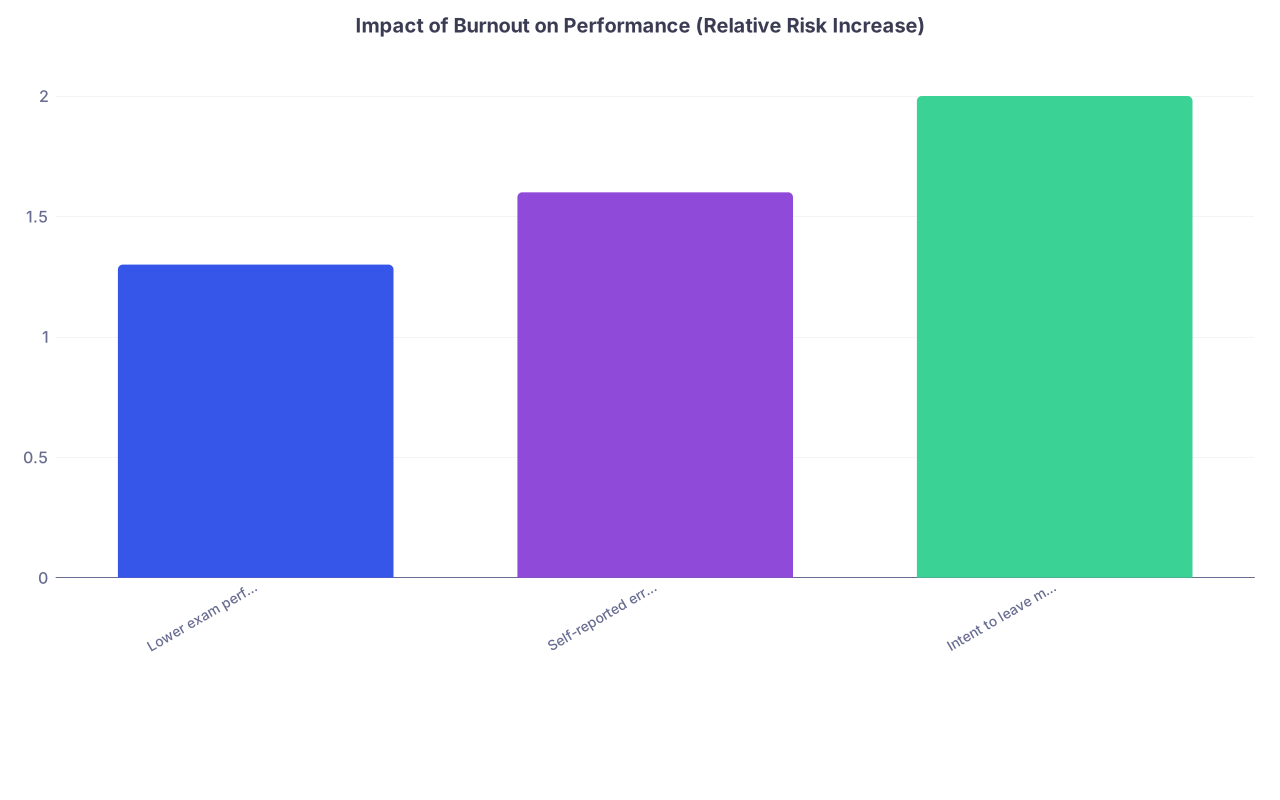
| Category | Value |
|---|---|
| Lower exam performance | 1.3 |
| Self-reported errors | 1.6 |
| Intent to leave medicine | 2 |
Those numbers are conservative approximations from existing burnout literature in trainees. Burnout does not make you a hero. It makes you worse at the thing you’re sacrificing yourself for.
How to Be High-Performing Without Being Always On
This is the part where people expect feel-good platitudes. You’re not getting that. You’re getting tactics.
1. Set explicit expectations on day one
On each rotation, ask your resident something like:
“What does a good medical student look like on this team? What are your expectations for arrival, staying late, and studying for the shelf?”
Most will give a reasonable answer. Some will be vague. A few will be unhealthy. Knowing which you’re dealing with early matters.
If there’s a conflict with your life-sustaining needs:
“I have a standing medical/therapy appointment Wednesday at 4 pm; I’ll need to leave by 3:30 on those days, but I can stay later other days and will make sure all my tasks are done before I go.”
You say this like it is a normal, uncontroversial fact. Because it is.

| Step | Description |
|---|---|
| Step 1 | Request or Task |
| Step 2 | Politely decline or defer |
| Step 3 | Accept and Follow Through |
| Step 4 | Negotiate Timing or Decline with Reason |
| Step 5 | Adds Value to Patient Care or Learning? |
| Step 6 | Within Reasonable Hours and Capacity? |
2. Time-box your “extra” presence
You do not need to vanish at 4:59 pm. Staying a bit later can be valuable — if it’s intentional.
Example: On medicine wards, you decide:
- “I’ll generally stay until sign-out (~6 pm) on 3 days a week.”
- “On other days, if my work is done and no one needs me, I’ll ask to leave to study.”
That looks like:
“Is there anything else I can help with, or is it okay if I head out and get some studying in for the shelf?”
Most residents respect this. The good ones strongly encourage it.
3. Protect focused study time like it’s a patient
You’re in the Phase: MEDICAL SCHOOL LIFE AND EXAMS. Shelfs and Step 2 crush students who rely purely on exhausted late-night cramming.
Pick protected blocks where you are not available except for true emergencies (which, as a student, you almost never get called for anyway):
- Early morning before hospital sometimes
- Post-shift, device in another room for 60–90 minutes
- One weekend half-day fully dedicated to deep study
Tell your co-students:
“I’m offline from 7–9 tonight to get through a block of UWorld. I’ll catch up later.”
Normalizing boundaries with peers helps all of you.
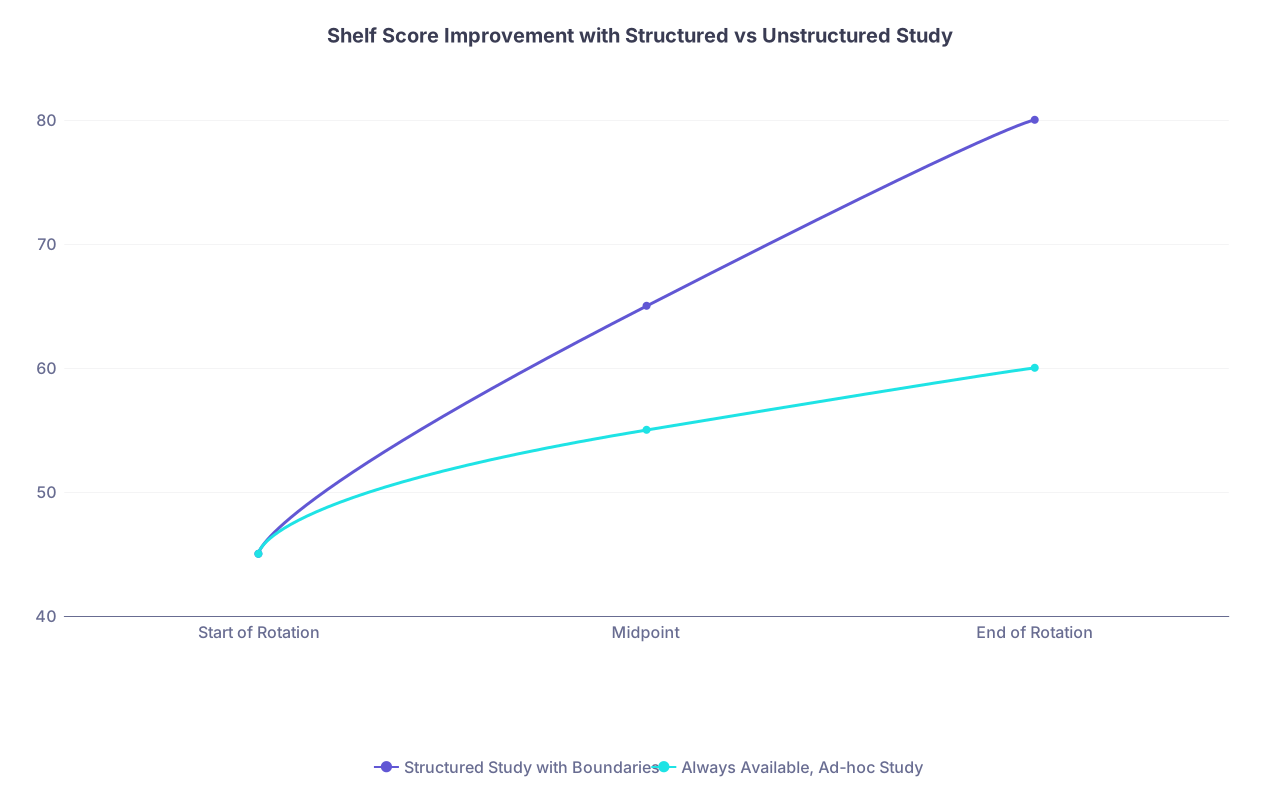
| Category | Structured Study with Boundaries | Always Available, Ad-hoc Study |
|---|---|---|
| Start of Rotation | 45 | 45 |
| Midpoint | 65 | 55 |
| End of Rotation | 80 | 60 |
Are these exact numbers? No. But the pattern matches reality: protected, focused study beats scattered, tired flashcards at midnight.
4. Use “scripts” for saying no without drama
You do not need to write an essay every time you decline something:
- “I can’t stay late today, but I can come in earlier tomorrow to help.”
- “I’ve hit my limit tonight — I want to be sharp tomorrow. Anything urgent you need before I go?”
- “I’m at a medical appointment then, but I’ll check in with you right after.”
Short. Direct. Professional.
The Hidden Upside: Boundaries Build Respect
Here’s the twist people don’t expect: students who set sane limits and then deliver high-quality work inside those limits are remembered positively.
Why?
- They seem more like future colleagues than desperate juniors.
- They usually have more consistent energy and better moods.
- They improve more over the rotation because they’re actually sleeping and studying.
I’ve been in debriefs where someone says:
“She wasn’t the one hanging out pointlessly at the nurse’s station at 8 pm, but she always knew her patients cold. I’d happily work with her again.”
That’s what you want. Not “he was always around but I’m not sure what he did.”

When the System Is the Problem
Sometimes you will encounter rotations or residents who explicitly push the “always on” myth:
- “Real doctors don’t need days off.”
- “If you care, you stay until we’re done, no matter what.”
- “If you leave before me, I notice.”
You cannot fix that culture in one block. But you also do not have to internalize it as truth.
If things get abusive:
- Document specific incidents (dates, quotes).
- Use trusted faculty or the clerkship director for guidance.
- Use student wellness or ombudsperson resources if your school has them.
There is a difference between working hard and being exploited. Medicine blurs that line constantly. You need to unblur it for yourself.

The Bottom Line
The “always on call” myth in MS3 is just that — a myth. Here are the only three points you really need to remember:
- Constant availability does not reliably improve evaluations, learning, or match chances. Solid clinical work, reliability, and focused study do.
- Being “always on” reliably worsens sleep, mental health, and cognitive performance, which eventually makes you worse for patients and for yourself.
- The students who thrive long term set clear boundaries, protect their brains, and then work intensely and reliably inside those boundaries.
You are not a pager. You are a trainee whose brain is your main instrument. Stop treating it like a disposable battery.