Using Brief Journaling to Process Code Blue and Bad Outcome Exposure
You are in the stairwell. Scrubs damp with sweat, N95 still hanging from one ear. The code just ended. Time of death was called two minutes ago. The room is already resetting for the next patient like nothing happened.
You are supposed to be “going to see your next admission” or “catching up on notes.” Instead you are leaning against a cinderblock wall, heart racing, with one thought: What just happened? And right underneath it: And why am I expected to just move on?
This is where brief journaling actually matters. Not as some fluffy wellness exercise, but as a practical, concrete mental health tool you can deploy in three minutes between pages.
Let me break this down specifically.
Why Codes and Bad Outcomes Hit So Hard in Med School
You are not crazy for being wrecked after a code or bad outcome. You are normal. The system is insane.
Here is what is happening under the hood.
You are emotionally underprepared and structurally overexposed.
Preclinical years glorify pathophysiology. They do not prepare you for a 6-year-old in asystole or the sound of a spouse screaming when time of death is called. Then third year hits: rapid exposure to human catastrophe with almost no decompression time.You have almost no control.
You do not run the algorithm. You do not push the epi. You stand at the foot of the bed, maybe doing compressions badly, desperately wanting to help. Helplessness plus responsibility is a nasty combination.You internalize everything as evaluation.
Your brain quietly turns it into:- Did I perform well?
- Did I look composed enough?
- Did I say something stupid?
The patient’s death becomes another test, which is emotionally distorted and frankly unfair.
You are expected to “keep moving.”
The team walks out of the room. Someone says, “OK, let’s pre-round on 12B.” The message is clear: feelings are optional; tasks are not. So most students shove the aftermath somewhere deep and hope it stays buried. It doesn’t.
Over time, this becomes cumulative trauma. Not “I had one bad code.” But:
- “I can picture every face.”
- “I hear that monitor tone when I try to sleep.”
- “I feel sick walking past that room.”
You need a fast, reliable way to metabolize these experiences instead of storing them raw. That is where brief journaling comes in.
What I Mean by “Brief Journaling” (And What I Do NOT Mean)
I am not talking about:
- Writing a beautiful reflective essay for your portfolio
- A 45-minute “brain dump” every night
- Forced “meaning-making” where you have to turn tragedy into a life lesson
You do not have that kind of time or emotional bandwidth on surgery week 2 at 3 a.m.
Brief journaling, done right, is:
- Short
- Structured
- Private
- Repeated
Think 2–6 minutes. On paper or in your phone. Specific prompts. Not a whole therapy session, but a mental reset button that lets you carry the memory without it carrying you.
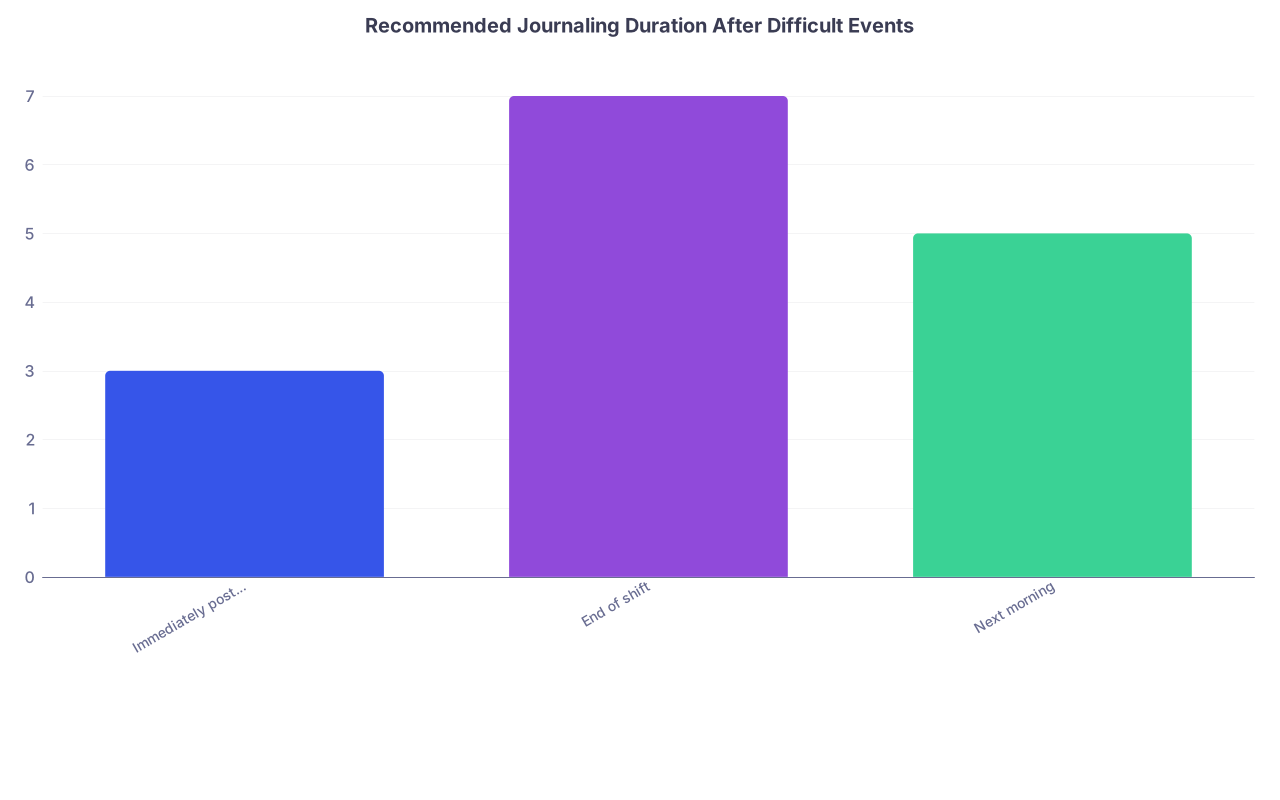
| Category | Value |
|---|---|
| Immediately post-event | 3 |
| End of shift | 7 |
| Next morning | 5 |
Those numbers are rough. The point: you do not need 45 minutes; you need a focused few.
The Psychological Mechanics: Why This Actually Helps
This is not magic. It is a targeted way to work with how your brain handles trauma and stress.
Three main mechanisms:
Containment
A code is chaotic: alarms, shouting, chest compressions, syringes flying, family crying. Your brain logs that as “unbounded threat.” Brief journaling turns it into a defined narrative: beginning, middle, end. That “containment” reduces intrusive replay.Cognitive integration
Without reflection, you store fragments: the smell, the sound of the last rhythm check, the time called. With even a few sentences, you integrate: what happened, what you felt, what it means for you as a trainee. That makes the memory less likely to pop back uninvited.Emotional permission
Writing “I felt useless” or “I am angry at how rushed we were” quietly gives yourself permission to have that reaction. That’s the opposite of how most med students operate: they self-criticize for not being “tough enough.”
If you want the psych jargon, this overlaps with expressive writing, emotional labeling, and basic trauma processing. But let’s skip buzzwords and just build a system you can actually implement on call.
Stepwise System: What To Do in the 0–24 Hours After a Code
I will give you a specific framework across three time windows. You customize the details.
1. The First 10 Minutes: Micro-Processing
You walk out of the room. Or the ED. Or the ICU pod.
You may not have time for anything more than a bathroom break. Use it.
Goal: Regulate your system enough so you can function. Not “heal.” Just avoid storing this as a raw, undigested trauma.
In those 3–5 minutes:
- Get somewhere semi-private: bathroom stall, stairwell, supply closet.
- Do one cycle of basic grounding:
- 5 slow breaths. In through nose, out longer through mouth.
- Press your feet into the floor. Feel the pressure. That’s it.
- Then write 3 lines. Literally three. In your Notes app or a tiny pocket notebook.
Use this template:
- “Event: …” (1–2 sentences)
- “What I felt during: …” (list 2–3 emotions)
- “What I feel right now: …”
Example from a third-year I worked with:
- Event: Code blue on 78-year-old with massive PE, prolonged CPR, time of death called at 09:42.
- What I felt during: Helpless, frantic, weirdly hyper-focused on the compressions.
- What I feel right now: Numb but shaky; part of me wants to cry, part of me wants to scrub this out of my brain.
That is enough. Close the note. Go back to work.
You have just:
- Marked it as significant
- Named the emotional state
- Prevented total suppression
Small, but clinically meaningful.
2. End of Shift: 5–10 Minute Structured Debrief
When you finally get off (or at least get 10 uninterrupted minutes in the call room), you expand.
This is where brief journaling pays off the most.
Use a repeatable 5-part structure so you are not staring at a blank page. I like this:
- Facts (no interpretation, just sequence)
- My role and actions
- My emotional reactions
- What is sticking with me
- One sentence of self-compassion or perspective
Let me show you what this looks like, because vague “reflect on your feelings” advice is useless.
1. Facts (2–5 sentences)
Write like you are dictating a brief HPI of the event:
- “55-year-old man on the floor for pneumonia. Rapid response called at 14:10 for hypotension and tachycardia. He lost pulse and a code was called. CPR for ~18 minutes, multiple epi doses, no ROSC. Time of death 14:32. Family present for the last 5 minutes.”
Stay neutral. No “should haves.” Not yet.
2. My role and actions (2–4 sentences)
Be specific and concrete:
- “I did compressions for the first and third rounds. I tried to stay out of the way and watch the algorithm. I handed over the chart when the resident needed to check meds. I did not speak to the family.”
This matters because it restores agency. Your brain stops filing you under “useless bystander.”
3. My emotional reactions (3–6 bullet phrases or short sentences)
Yes, you can use fragments here:
- Scared of messing up compressions
- Embarrassed when attending corrected my hand position
- Weirdly detached when time of death called
- Guilty walking past the family afterward
- Angry we only met this man this morning and he is already dead
No one else has to see this. Be honest.
4. What is sticking with me (2–3 sentences)
This is the “hot spot” work. Name the most disturbing element:
- “The wife’s face when she realized he was gone is the image that keeps replaying. Also the quiet in the room after the monitors shut off. I keep hearing that silence.”
If you identify the focal point, your brain has a target to process, instead of a diffuse cloud of “that was awful.”
5. One sentence of self-compassion or perspective (1–2 sentences)
Not toxic positivity. Not “everything happens for a reason.” Just something you would say to a friend:
- “I showed up, I followed instructions, and I was part of a team that did everything we could.”
- “Feeling shaken does not mean I am weak; it means I am human in a brutal environment.”
Write it even if you do not fully believe it yet.
That is your 5–10 minute debrief.
If you stick to a structure like this, your brain starts to anticipate, “This is how we process bad things,” which in itself becomes protective.
3. The Next 24–72 Hours: Brief Return, Not Rumination
The next few days are where most students either:
- Try to never think about it again, or
- Keep replaying it with “I should have / what if / why didn’t we” on a loop
You want something in the middle: intentional revisit, not obsession.
Here is a simple 5-minute follow-up you can do the next day or two:
Prompt #1: “What stands out now that I did not notice yesterday?”
Prompt #2: “What story am I telling myself about this event, and is it accurate?”
Prompt #3: “What is one way this will inform how I show up next time (skill, boundary, question to ask)?”
An actual example, anonymized but typical:
- “I realize I did not actually fail at compressions; the nurse even thanked me after. I also now remember how calm the senior resident was.”
- “Story I am telling myself: I was useless and in the way. More accurate: I was a learning team member in a chaotic scenario, and that is normal at my stage.”
- “Next time, I will explicitly ask before leaving: ‘Is it OK if I step out for a moment?’ so I do not just disappear without feeling like I abandoned the team.”
That is enough. Close the notebook.
Concrete Prompts You Can Use (Without Reinventing the Wheel)
You do not have time to design a curriculum for yourself on each rotation. So I am giving you short prompt sets.
You can rotate through these or pick 2–3 that resonate and stick with them.
Core 3-Minute Set (For Use Any Time)
- What happened? (2–3 factual sentences)
- What am I feeling right now? (name 2–4 emotions)
- What do I need in the next hour? (task, rest, call a friend, water, nothing)
Code Blue–Specific Set
- One sensory detail that is sticking (sound, image, smell).
- One moment I felt effective, even if small.
- One moment I felt powerless.
- If this were a classmate’s experience, what would I tell them?
Bad Outcome / Unexpected Death (Non-Code)
- What surprised me most about how this unfolded?
- What feels unfair or wrong about this situation?
- How is my view of medicine or myself as a future physician being challenged?
- One value I want to hold onto despite this.
You can pre-create a template note on your phone with these headings and duplicate it whenever needed.
Where and How to Journal Without Making It Awkward
Very practical problem: you do not want to be that student hunched over a notebook while everyone is writing discharge summaries.
A few strategies that actually work on real rotations:
Call room / resident workroom during a lull
You can type on your laptop under the guise of notes. No one knows you are writing to yourself, not about the patient.Bathroom stalls and stairwells, again
This is where most med students cry. You can also write there.Commute journaling
On the bus, on the train, in the Uber. Pop in headphones so you look like you are texting or listening to a podcast. Use your Notes app or a dedicated secure app (Day One, Journey, etc.).Bedside but off-chart
Do not put this in the EMR. Ever. This is personal, not discoverable. Keep it separate from patient documentation.
And no, you do not need a leather-bound journal with a fountain pen. Many of the best entries I have seen are:
- Messy notes app paragraphs
- Time-stamped one-liners between SOAP notes
- Phone voice-to-text transcriptions while walking to the cafeteria
Use what you will actually use. Perfection is your enemy here.
Protecting Confidentiality and Your Future Self
You are in medicine. You should be paranoid about privacy. Good.
A few simple guardrails:
- No full names, MRNs, or uniquely identifying data
- Vague age (“mid-70s,” “young child”) and rough scenario is fine
- If you are worried about legal discoverability, keep it general: “We lost a patient in the ICU today after prolonged efforts” instead of blow-by-blow.
| Type of Detail | Safe Example | Risky Example |
|---|---|---|
| Age | "elderly woman" | "83-year-old born Jan 2, 1941" |
| Location | "medicine floor" | "room 742B facing the courtyard" |
| Date/Time | "this morning" | "June 3rd at 14:37" |
| Identifiers | "husband at bedside" | "Mr. Smith, the CEO of [local company]" |
| Clinical specifics | "ARDS on vent, prolonged code" | "HIV+, TB+, rare genetic variant XYZ" |
Also: decide up front whether this is for processing now or for long-term record. If rereading is retraumatizing, you are allowed to delete entries after you write them. The benefit comes mainly from the act of processing, not from re-reading years later.
How This Fits Around Exams, Shelf Stress, and “No Time”
This is MEDICAL SCHOOL LIFE AND EXAMS, not “Mid-career attending wellness.”
Your days often look like:
- Pre-round 5:30–7:00
- Rounds 7:00–11:00
- Notes/procedures/random tasks 11:00–17:00+
- Try to study for shelf with remaining brain cells
So where does journaling fit without cannibalizing study time?
Here is the honest math:
- 3 minutes immediately after a bad event
- 5–10 minutes that evening / post-shift
- Maybe 5 minutes the next day
That is 13–18 minutes total.
If you skip that, what do you usually do with those minutes instead?
- Mindless scrolling
- Staring at the wall, dissociated
- Half-hearted “studying” while your mind replays the code
Brief journaling is not stealing time from exam prep. It is cleaning up your RAM so your prefrontal cortex can actually encode information.
I have watched students who adopted this:
- Sleep better after call
- Have fewer intrusive images mid-study session
- Feel less dread walking back into the ICU the next day
Less mental interference = more efficient learning. This is not wellness versus performance; it is wellness as a performance multiplier.
When Brief Journaling Is Not Enough (Red Flags You Should Not Ignore)
I am going to be blunt. Journaling is a tool, not a cure-all. There are situations where it helps but is not sufficient, and pretending otherwise is dangerous.
If, in the weeks after one or multiple bad events, you notice:
- Persistent nightmares about the code or patient
- Flashbacks where you feel like you are back in the room, not just remembering it
- Intense guilt that does not shift even when supervisors say you did nothing wrong
- Increasing avoidance of certain rotations, rooms, or types of patients
- Thoughts like “everyone would be better off if I were not here” or “I do not care if I get hit crossing the street”
You are beyond “normal student distress after a bad day.” Now we are in the territory of acute stress reaction or PTSD-like symptoms and/or major depression.
Your next moves should include:
- Talking to someone with actual training: student counseling, therapist, or psychiatrist
- Letting at least one trusted faculty member or dean know you are struggling with clinical exposure (does not have to be dramatic)
- Considering whether a short break from a specific environment is possible
Use journaling to clarify what is happening and to document the pattern. But do not let it become a way to silently white-knuckle your way through worsening symptoms.
Team Culture: You Are Not the Only One Affected
One more hard truth: many attendings and residents are walking around with their own unprocessed code blues from training. You feel alone; you are not.
Where journaling intersects with culture:
- You can use your writing as a scaffolding to talk to someone:
“I wrote about how that code felt last night, and I realized the part that really stuck was X. Have you seen that with other students?” - You can ask for micro-debriefs:
“Dr. R, after sign-out, could we spend 3 minutes unpacking the code earlier? I think it would help me learn from it.”
Do not expect some cinematic group-therapy circle. Sometimes you get:
- A resident saying, “Yeah, that was rough,” and giving one piece of advice.
- An attending briefly sharing their first bad code story.
Small, imperfect moments of humanity. They count.
A Simple, Repeatable Framework You Can Start This Week
Let me tie this together into something you can actually deploy tomorrow.

| Step | Description |
|---|---|
| Step 1 | Code or bad outcome |
| Step 2 | 3-line micro-journal in 10 min |
| Step 3 | Finish shift tasks |
| Step 4 | 5-10 min structured debrief at end of shift |
| Step 5 | Optional brief check-in 24-72 hrs later |
| Step 6 | Continue brief journaling as needed |
| Step 7 | Seek formal support |
| Step 8 | Persistent distress? |
If you want the bare minimum starter kit:
Create a note on your phone titled “Post-Code Template.”
Paste these headings:
- Event (facts):
- During the event I felt:
- Right now I feel:
- My role and actions:
- What is sticking with me:
- One sentence of kindness to myself:
Next time something hits hard, give yourself 5 minutes before sleep to fill it out. Then see how you feel the next day.
If two or three people in your class did this regularly, the mental health baseline on that rotation would shift. Less silent suffering, fewer “I thought I was the only one” spirals.
Key Takeaways
- Your reactions to codes and bad outcomes are normal; the pace and culture of training are not. You need fast, concrete tools to metabolize what you are exposed to.
- Brief, structured journaling—done in 3–10 minute blocks—gives your brain containment, agency, and permission to feel, without derailing your studying or performance.
- Use journaling as a first-line tool, not a final solution. If distress is persistent or escalating, pair it with professional support and, where possible, small shifts in your training environment.