
You’re on your third consecutive night on call, cross-covering half the medicine floor. A nurse pages you about new chest pain in 612, your senior is scrubbed in a procedure, and as you hurry down the hallway, your vision tunnels, your heart is pounding out of your chest, and you’re suddenly convinced you’re going to pass out. You stop. You’re in the hospital, on duty, and you’re having a panic attack.
If that sounds close to home, you’re not broken and you’re not alone. But you do need a concrete plan—because in the hospital, “just push through” is how small problems become dangerous ones.
Let’s walk through exactly what to do when panic hits in the hospital, step-by-step, without compromising patient care or your career.
First: Recognize What’s Actually Happening
You cannot handle a panic attack effectively if you mislabel it as “I’m dying” or “I’m about to faint.” This is where people lose time and spiral.
Typical panic attack pattern I’ve seen over and over in students and interns:
- You’re under high stress (new rotation, night float, exams, high acuity floor).
- Something tips you: a page, a bad outcome, a rude attending, a long code.
- Suddenly you get:
- Heart racing / pounding
- Shortness of breath or feeling you “can’t get a deep breath”
- Chest tightness (not always pain)
- Sweaty, shaky, jittery
- Lightheaded, “floaty,” derealized (world feels weird/unreal)
- Nausea, tingling in hands or around mouth
- Intense sense that something terrible is about to happen
And crucially: it spikes fast, often over a few minutes, not gradually over hours.
In the hospital, the first mental move is this:
“This feels like an emergency. That doesn’t mean it is an emergency.”
Your internal script, quietly and firmly:
- “These symptoms fit panic. I’ve seen this a hundred times in patients.”
- “My heart can beat 130–150 for a few minutes without killing me.”
- “Feeling like I’m going to die is a panic symptom. It’s not a prophecy.”
If you’re truly unsure (e.g., chest pain + risk factors + new onset), you can do a quick self-check after you stabilize care—which I’ll get to. But step one is naming it: this is probably panic.
Step Zero: Protect the Patient in Front of You
If you feel a panic surge in the middle of patient care, your priority is simple: stabilize their safety first, then step away.
That doesn’t mean ignoring your symptoms. It means 30–90 seconds of controlled triage.
Ask yourself three questions:
- Is this patient actively crashing? (Hypotensive, severe respiratory distress, code situation)
- Is there another licensed person in the room? (RN, RT, resident, attending)
- Can I safely step out for 3–5 minutes after handing off?
If the patient is actively unstable and you’re the only clinician in the room, your move is short-term containment, not heroics.
Your script to the nurse or team (even if your voice shakes):
“I’m suddenly feeling lightheaded. I’m going to step back to the wall, but keep doing compressions / bagging / charting. Keep going. I’m here, but I may need someone to swap if I worsen.”
You can:
- Move to a chair or lean on a counter/wall.
- Keep giving verbal instructions if you’re the most senior person.
- Let someone else put hands on the patient if there’s anyone available.
If the patient is not crashing (most situations):
- Finish the one critical sentence or action you’re in the middle of.
- Then do a micro handoff and step out.
For example, with a stable floor patient:
“I’m suddenly not feeling well—nothing to do with you. I’m going to step out briefly and will be right back or send someone else to check on you.”
To the nurse outside the room:
“I’m having a sudden episode of feeling very lightheaded and anxious. Patient in 612 is stable, but I need 5 minutes. Can you keep an eye on her? Page my senior if anything changes.”
You are not obligated to fully debrief your psyche to every nurse or attending. You are obligated to avoid passing out alone in a room with a patient on BiPAP.
The 5-Minute Panic Protocol (Anywhere in the Hospital)
You need an on-the-spot, practical playbook. Not theory. Not “self-care.” A discrete set of actions you can execute in a hallway, stairwell, or call room.
Here’s the one I recommend you memorize.
Step 1: Get to a Safe, Semi-Private Spot
Goal: You’re not collapsing in a hallway with a central line tray in your hand.
Best realistic options:
- An empty patient room (if allowed and truly empty)
- A bathroom
- A quiet corner of the stairwell
- The call room
- A family meeting room that’s unoccupied
Walking while mildly dizzy is usually safe. If you truly feel like you’ll faint, sit in the nearest chair, head between knees if needed, and tell someone:
“I suddenly feel like I might pass out. Can you sit with me for a minute and if I go down, get help?”
Yes, it’s uncomfortable. It’s still better than fainting alone.
Step 2: Give Yourself a 30-Second Medical Triage
Two reasons: 1) You’re a clinician; your brain won’t shut up unless you “rule things out” briefly. 2) Rarely, panic-like symptoms are not panic.
Mental checklist (not a full workup, just a quick sort):
- Did this start abruptly in the context of stress or anxiety?
- Any clear cardiac red flags: crushing chest pain radiating to arm/jaw, unequal pulses, severe SOB at rest?
- Any obvious non-psychiatric trigger: not eaten all shift, you’re on albuterol, lots of caffeine, new med like prednisone?
- Any focal neuro stuff: unilateral weakness, slurred speech, facial droop?
If any major red flags, you treat yourself like a patient later—after immediate patient care is safe. That might mean going to ED or employee health between shifts.
But 95% of the time for students:
- No focal symptoms.
- Vitals probably fine if you took them.
- Trigger? Yes: stress, no food, three coffees, conflict, bad eval, code, etc.
So you tell your brain:
“I’ve done a quick check. This fits panic better than anything else. I’m treating it as panic for the next 5 minutes.”
Step 3: Ground Your Body (Not Your Thoughts)
You can’t “think your way out” in the first 60–90 seconds. You calm the body first.
Use a 2-part grounding combo:
Square breathing (or 4–6 breathing)
Do this 5–8 cycles.- Inhale through nose for 4 seconds
- Hold for 4
- Exhale through mouth for 4–6
- Hold empty for 4
Count out loud if you can. Even a whisper helps anchor you.
Your mantra: “I’m driving my nervous system down, not my willpower up.”
Drop your anchor: feet + seat + hands
While breathing:- Press your feet flat into the floor. Wiggle your toes inside your shoes.
- Notice exactly where your body contacts the chair, bed, or wall.
- Press your fingertips together. Feel the pressure, temperature, texture.
Quietly name out loud: “Feet on floor. Back on chair. Hands touching.” It sounds corny. It works.
Step 4: Hook Your Attention Back to the Room
Now that your body is 10–20% less on fire, you pull your mind back from the “I’m dying / I’ll get fired / I’m weak” spiral.
Use a quick 5–4–3–2–1 check (modified for hospital speed):
- 3 things you can see (label them: “blue cart, whiteboard, IV pole”)
- 3 things you can feel (“scrubs on my skin, badge on my chest, bench under me”)
- 3 things you can hear (“vent hum, someone paging overhead, footsteps”)
Say them quietly. This drags you out of catastrophic future images and into what’s literally happening: you’re sitting in a stairwell, breathing, not dying.
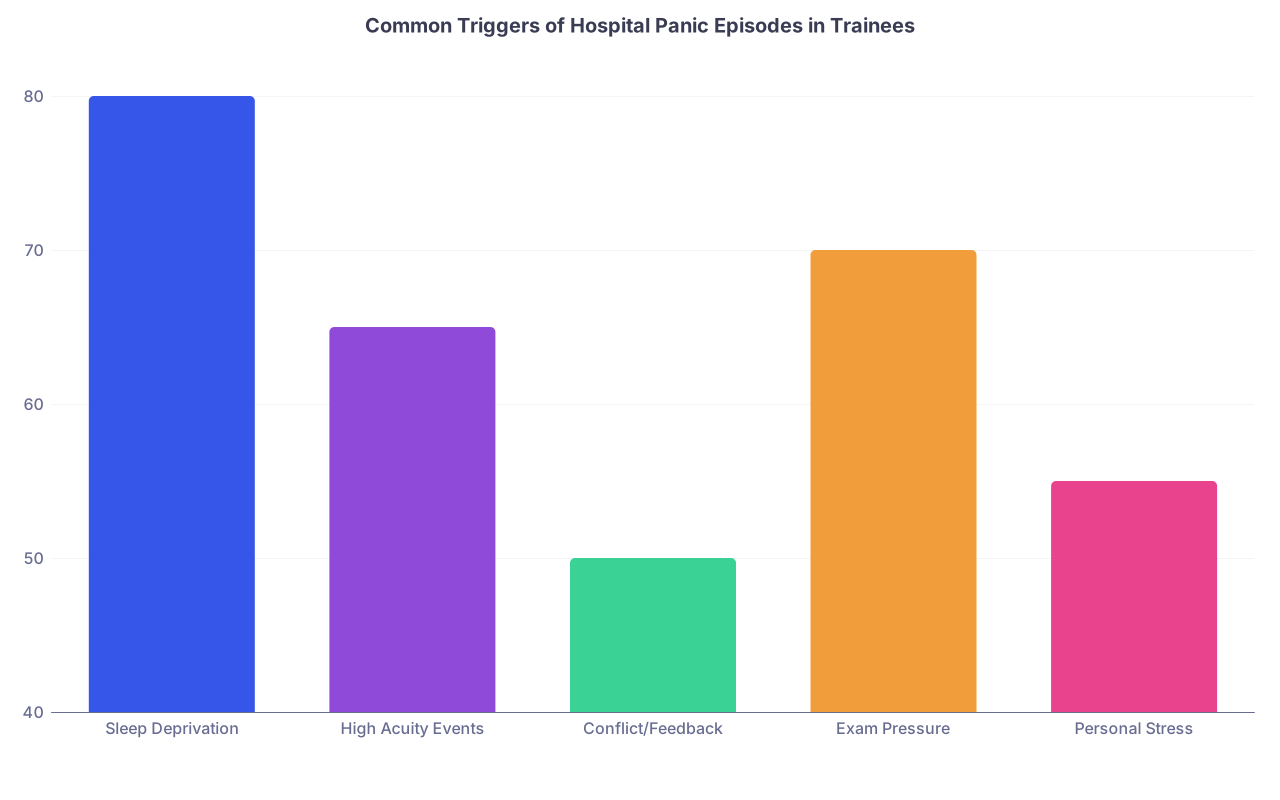
| Category | Value |
|---|---|
| Sleep Deprivation | 80 |
| High Acuity Events | 65 |
| Conflict/Feedback | 50 |
| Exam Pressure | 70 |
| Personal Stress | 55 |
Communicating in the Moment Without Torching Your Reputation
This is where students get stuck: “If I tell anyone, they’ll think I can’t hack it.” Different attendings and residents handle this differently, but I’ll be very blunt: hiding everything is usually worse.
Who You Tell Depends on Severity and Timing
There are levels here.
Level 1 – Mild, contained episode, you recover in 5 minutes, no patient impact.
You might not tell anyone in the moment. Document it privately for yourself. But if it’s recurring, you bring it up with someone later (advisor, therapist, PCP).
Level 2 – You need to step away from patient care for 10–20 minutes, but can still function the rest of the shift.
You tell your senior. Script:
“I just had a sudden panic episode. I stepped away to get it under control and I’m starting to feel better, but I need 10–15 minutes to fully reset so I don’t make mistakes. All my patients are stable right now. Can you field pages for a bit or redistribute anything urgent?”
You’re framing it around patient safety and short-term containment, not “woe is me.”
Level 3 – You’re not able to safely continue the shift.
This is when you’re still shaking, dissociated, or hyperventilating after 15–30 minutes, or episodes keep repeating.
You escalate. To senior + attending or chief. Script:
“I’m having ongoing panic attacks and I’m not stabilizing enough to safely care for patients. I need to step away and get evaluated. I’m worried I’ll miss something important if I stay.”
That’s the truth. And you put patient safety above pride.
What You Do NOT Need to Say
You don’t need to unpack childhood trauma, your relationship, your Step score, or your entire psych history in the workroom.
Keep it clinical and behavior-focused:
- Panic episode
- Symptoms (lightheaded, SOB, racing heart)
- How long it’s lasted
- Your own assessment: “I’m / I’m not safe to continue.”
That’s all most people need to hear to understand.
Preventive Moves That Actually Work in the Hospital Environment
Everyone tells you “sleep more, meditate, journal.” Fine. In a perfect world. On nights when you’re cross-covering 80 patients and filling out six death certificates, that advice is a bad joke.
Let’s talk about what actually works on rotations and call.
1. Eat and Hydrate Like You Expect to Panic
Many “panic attacks” on the floor are partially:
- Mild hypoglycemia
- Dehydration
- Caffeine overload
You can’t fix your entire lifestyle this month, but you can do this:
- Always have shelf-stable snacks in your white coat: nuts, protein bar, crackers.
- One bottle of water per half-shift. Refill when you walk past a dispenser.
- Cap caffeine at a hard limit (e.g., last coffee by 2 pm, max 3 coffees per day).
You do not need to be perfect. You need to be 20% less physiologically brittle.
2. Build a Mini Grounding Ritual Into Your Day
You don’t wait for the panic to practice the skills. You rehearse when you’re already calm so your brain finds them faster under stress.
Examples:
- Before prerounding, sit for 60 seconds, do 3 slow breaths and notice your feet.
- Every time you wash your hands, exhale slowly as the water runs. One full slow exhale.
- Before you push open a patient’s door whose family stresses you out, do one 4–4–6 breath.
You’re not doing “mindfulness retreats.” You’re inserting 5–20 seconds of deliberate nervous system downregulation into things you already have to do.
3. Know Your Hot Triggers and Pre-empt Them
Look at your last few bad episodes. There’s almost always a pattern:
- Walking into a code
- Reviewing critical results alone
- Getting pimped in front of a large team
- Pager going off nonstop at 3 am
Write down your top 2–3. Don’t overthink it.
Then, for each, pick a micro-strategy.
Example:
- Trigger: Codes
Plan: The second you hear “Code Blue…,” before you even start running, 2 slow exhales. While heading there, silently name three things you see in the hallway. - Trigger: Getting grilled on rounds
Plan: Before entering the room or starting case presentation, do one square breath. Remind yourself: “I can say ‘I’ll look that up’ instead of freezing.”
Sounds small. It stacks.

| Step | Description |
|---|---|
| Step 1 | Notice Panic Symptoms |
| Step 2 | Stabilize Patient / Call Help |
| Step 3 | Move to Chair/Wall |
| Step 4 | Excuse Yourself Briefly |
| Step 5 | Find Semi-Private Space |
| Step 6 | 5-Minute Panic Protocol |
| Step 7 | Return to Duties |
| Step 8 | Notify Senior / Leave for Eval |
| Step 9 | Patient Stable? |
| Step 10 | Able to Safely Continue? |
What About Exams, OSCEs, and High-Stakes Evaluations?
You’re not just in the hospital. You’re also a student staring down shelf exams, Step, OSCEs, simulation labs. Panic loves those, too.
Same principles apply, but logistics differ.
During an OSCE or Sim Lab
If panic hits in an OSCE station:
- Keep the standardized patient safe (they’re usually perfectly safe, but treat it as real).
- Sit down if you can. Say, clearly:
“I’m feeling a bit lightheaded. I need a brief moment.”
You can:
- Take one or two slow breaths.
- Ground your feet.
- Continue if you’re able.
If you genuinely can’t continue:
- Tell the proctor after the station:
“I had a panic episode during that station and was not functioning at my baseline. I need to talk with the course director about accommodations or a repeat.”
This is not gaming the system. This is exactly why accommodations exist.
For sim labs (codes, trauma scenarios), it’s actually valuable to get help because these are training for real life:
“During the sim, I had a panic response that felt unmanageable. I want help building skills so that during a real code, I can stay effective.”
That’s professional, not weak.
During Written Exams
Most schools already have disability/mental health accommodation pathways. If you’ve had recurrent panic:
- Talk to student health or a psychiatrist.
- Get formal documentation if there’s a diagnosable anxiety disorder.
- Ask for:
- Breaks during exams
- Separate testing room
- Extended time (in some cases)
- The ability to step out briefly if panic spikes
You’re not cheating. You’re leveling the playing field so you can show what you actually know.

When You Need More Than Self-Management
If panic attacks are:
- Becoming more frequent (e.g., weekly or more),
- Lasting longer,
- Coming out of nowhere, not just during obvious stress,
- Making you avoid certain rotations, attendings, or situations,
then this is not just a “coping skill” problem. You need actual treatment. Not when you “finally have time” in residency. Now.
Who to Involve
In a medical school setting, your best lineup is:
- Student mental health / counseling services
Often free, confidential, and used to med students. - Your own PCP
To rule out thyroid issues, anemia, arrhythmias, etc. - Trusted faculty/mentor
To help with schedules, rotation adjustments, and protect you from nonsense.
You don’t have to tell your clerkship director every detail of your diagnosis. You can say:
“I’m dealing with an acute anxiety condition and working with student health. I may need flexibility for appointments and possibly for high-acuity rotations.”
Again, tie it back to functioning and patient safety, not to your entire inner world.
Medications During Clinical Rotations
Not going to give you a treatment plan—that’s between you and a prescriber—but I’ll say this:
- As-needed benzos right before every shift are a bad long-term solution. They blunt panic but also attention, reaction time, and memory. Not ideal when you’re writing chemo orders.
- SSRIs or SNRIs are the usual first-line for recurrent panic disorder. They take weeks to work but don’t acutely sedate you.
- Beta blockers (e.g., propranolol) can help for performance-type situations (presentations, big exams) and sometimes for the worst physical symptoms, but be careful with baseline low BP, asthma, etc.
The rule: Any med that meaningfully affects alertness should be discussed honestly with your prescriber in the context of clinical duties. You’re not a desk worker. You’re responsible for lives.
Handling the Shame and “I’m Not Cut Out for This” Loop
Panic attacks alone are uncomfortable. Panic attacks layered with shame? That’s what breaks people.
Here’s the part you need to hear clearly: having panic attacks in the hospital does not mean you’re not cut out for medicine. It means your nervous system is reacting strongly to sustained stress in a high-stakes environment you’re still learning to navigate.
I’ve watched:
- Residents with brutal ICU panic early on become calm, reliable intensivists.
- Med students who nearly passed out in their first code lead resuscitations later without blinking.
- People who needed short leaves for anxiety come back, finish strong, and match well.
You are not on trial for your worth as a physician every time you feel your heart race.
Instead, judge yourself on:
- Did I prioritize patient safety even when I felt awful?
- Did I ask for help when my functioning dropped below safe?
- Am I taking this seriously enough to seek real treatment, not just white-knuckling it?
If the answers are generally “yes,” you are doing what you’re supposed to do.
Tight Summary: What To Remember When Panic Hits
When panic hits you in the hospital, you don’t need to be perfect. You need to be structured.
- Protect the patient first, even if that just means sitting down, calling for help, and handing off briefly. You’re allowed to step away if you’re unsafe.
- Run your 5-minute protocol: safe spot, quick self-triage, grounding breath, anchor your body, orient to the room, then decide if you can safely continue.
- Do not suffer in silence if this is recurring. Involve mental health, a mentor, and—when needed—your senior or program leadership, framing it around functioning and patient safety, not personal failure.
You’re allowed to have a human nervous system and still be a good doctor. The job is not to never panic. The job is to manage it in a way that keeps patients—and you—safe.