
Last winter, a second-year med student called me from a hospital parking lot, still in her white coat, crying so hard she could barely breathe. She’d just left a mandatory small group early because her mom, in the cancer ward upstairs, was suddenly short of breath. Faculty were emailing her about attendance. Her siblings were texting about insurance forms. She still had an exam in 3 days.
If some version of that feels uncomfortably close to your life, this is for you. You’re not dealing with “time management.” You’re trying to be a med student and a caregiver at the same time, inside a system that’s not really built for either nuance or mercy.
Let’s go straight to what you actually do next.
Step 1: Get brutally clear on your real situation
Not the version you tell classmates. The real one.
You need clarity on three things:
- How sick is your family member?
- How much are you actually responsible for?
- What are your non‑negotiable school requirements for the next 4–8 weeks?
Write it down. On paper, not in your head.
Ask yourself:
- Are we talking frequent ED visits and unstable status? Or mostly stable with lots of appointments and fatigue?
- Do you live with them, or are you commuting back and forth?
- Are you the primary caregiver (meds, appointments, ADLs), or sharing duties with others?
- What’s happening in school in the next 1–2 months: exams, OSCEs, mandatory labs, clinical duties?
You cannot manage stress you pretend you do not have. You also cannot ask for meaningful accommodations with a vague “family stuff is going on.”
Create a simple snapshot:
| Area | What’s Happening Now |
|---|---|
| Family health | e.g., Mom on chemo; weekly infusions |
| Care tasks | e.g., Meds, meals, transport 3x/week |
| School demands | e.g., Block exam in 10 days; 2 OSCEs |
| Sleep | e.g., 5–6 hours, interrupted |
| Support system | e.g., Sister nearby; friends at school |
Once that’s written, you stop gaslighting yourself with “I should be coping better.” No. You’re doing two hard jobs.
Step 2: Decide your role in the family crisis (on purpose)
If you don’t define your role, you’ll end up trying to do everything, failing at most of it, and blaming yourself for all of it.
You need one sentence that defines your role for this phase:
- “I am the medical interpreter and appointment coordinator, not the 24/7 bedside caregiver.”
- “I am backup caregiver on weekdays and primary on weekends.”
- “I am point person for medical decisions, but not daily logistics.”
Then you tell your family that. Directly.
Something like:
“I’m in the middle of exams and can’t be at every appointment, but I can handle all the MyChart messages, medication lists, and talking to doctors. I need help with transportation and day‑to‑day care.”
You’ll feel guilty drawing lines. Do it anyway. You are not an ICU nurse. You’re a student. If you burn out, you become useless to them and to yourself.
Step 3: Stop hiding from your school
This is the part students avoid the most. They try to “power through” until they’re failing exams, missing clinical days, or having panic attacks in the bathroom between OSCE stations.
Bad strategy.
You need to pull three levers early:
- Student affairs/dean’s office
- Course/clerkship directors
- Student mental health services
How to approach the dean’s office
You do not need to tell them every detail of your family’s illness. You do need to be specific about how it affects your functioning.
Use this structure:
- What’s happening (brief)
- How it’s impacting you academically
- What timeframe you’re worried about
- What you’re asking for
Example email:
Dear Dr. Lee,
I’m writing because my father was recently diagnosed with advanced heart failure and has had two hospitalizations in the last month. I’m the primary family member handling his appointments and hospital discussions.
This has significantly affected my sleep, ability to focus, and schedule, and I’m starting to fall behind in the current block. I’m particularly concerned about the next 3–4 weeks, with the upcoming exam and mandatory sessions.
I’d like to set up a time to discuss possible short‑term adjustments (such as flexibility with attendance and potentially rescheduling the block exam if needed) to help me get through this period safely while still meeting requirements.
Thank you for your time and understanding,
[Name], MS2
Then actually meet. In person or on Zoom. Bring that written snapshot you made—that’s your evidence.
Step 4: Quick triage of your academic load (what gives, now)
This situation is emergency medicine, not preventive care. You’re not optimizing. You’re stabilizing.
You must decide, for the next 4–6 weeks:
- What must be done perfectly
- What just has to be good enough
- What you can temporarily drop to the floor
Let me be blunt: your “A or bust” mentality is a liability here.
Use a quick triage:
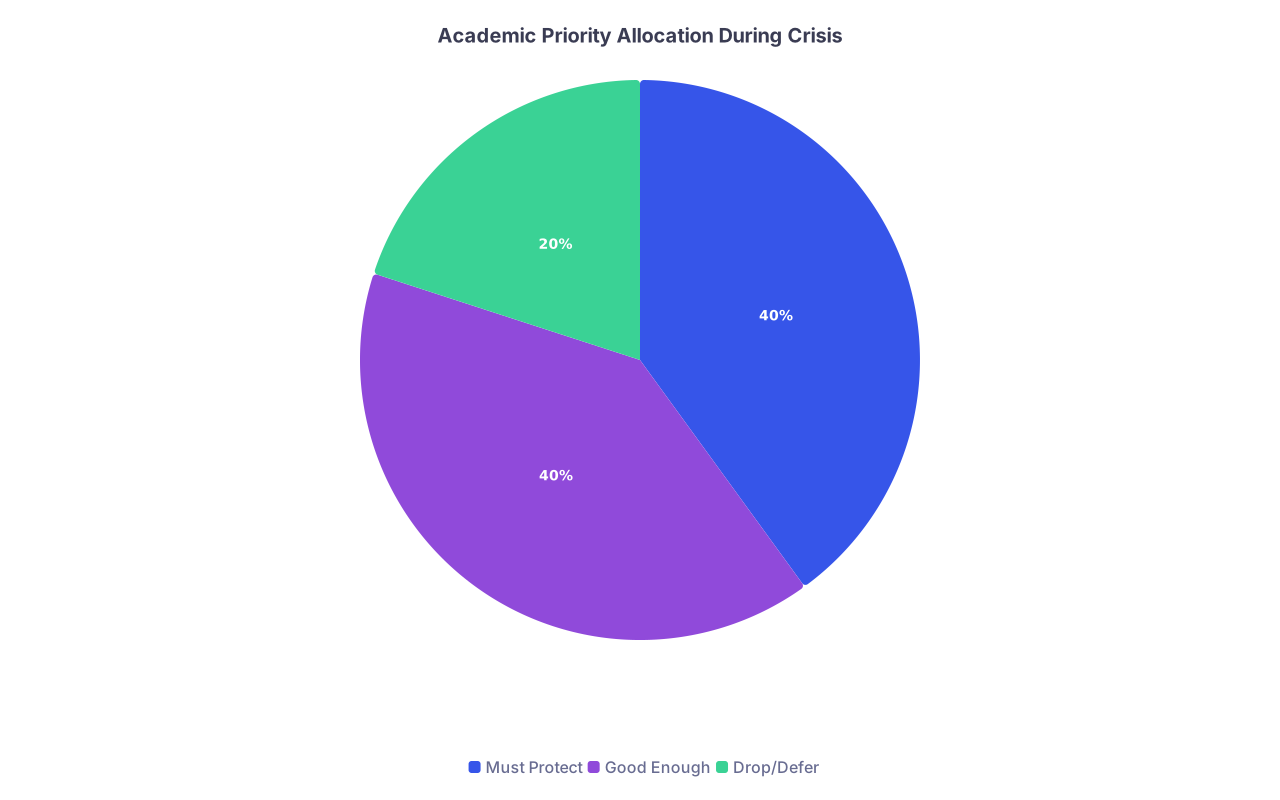
| Category | Value |
|---|---|
| Must Protect | 40 |
| Good Enough | 40 |
| Drop/Defer | 20 |
Examples:
Must protect:
- Major block exam that determines pass/fail
- Required clinical days (especially in core clerkships)
- Mandatory sessions that are truly mandatory
Good enough:
- Daily pre‑reading (skim instead of deep dive)
- Question bank volume (cut to 50–60% for a bit)
- Notes organization / Anki perfection
Drop or defer:
- Extra research meetings this month
- Optional lunch talks, interest group events
- Tutoring others, leadership extras, committee work
Send honest emails:
“I’m dealing with an acute family medical situation and need to step back from [research/club] responsibilities for the next month. I don’t want to hurt the project by being unreliable, so I’m formally pausing rather than overpromising.”
People respect that more than you ghosting.
Step 5: Redesign your days around caregiving reality
Your old schedule is dead. Stop trying to resurrect it.
You need a schedule that acknowledges:
- You may have unpredictable crises.
- You’re emotionally drained, not just busy.
- You might be studying in hospitals, cars, or waiting rooms.
I’ve seen this work well:
Identify 2 “protected focus blocks” per day, 60–90 minutes each.
That’s it. Not 8 hours of grinding. Two serious blocks.Decide your default locations:
- Hospital days: study in the cafeteria, car, or family lounge
- Home caregiving days: kitchen table / bedroom desk with noise‑cancelling or headphones
- Campus days: library or a quiet corner between sessions
Use “micro‑tasks” for the rest:
- 10–15 Anki cards while waiting for labs
- 5–10 UWorld questions, not 40
- Review one topic outline, not an entire chapter
Your goal isn’t to “stay on track” like nothing’s happening. Your goal is to slow the academic bleed so you don’t need a full transfusion later.
Here’s the mental shift: you’re in damage control mode, not optimization mode.
Step 6: Medical boundaries with your own family
You’re the med student. Which means everyone expects you to be the on‑call attending now.
You can help. You cannot be everything.
Set clear medical boundaries:
- You will:
– Keep a current med list
– Summarize history for new doctors
– Help explain what doctors said - You will not:
– Make all treatment decisions alone
– Be their 24/7 private clinician
– Replace palliative care, social work, or nursing
Say things like:
“I can explain what the cardiologist said and help you list questions, but I’m still a student. I’m not trained enough to decide which treatment is best. That has to be a conversation with the team.”
And with other relatives:
“I can’t be on every call. Let’s make a shared note in the family group where we put updates after each appointment so no one has to re‑tell the story 8 times.”
Also: use hospital resources. Social work. Case managers. Palliative care. They actually exist to take some of this weight off you. Let them.
Step 7: Keep your own physiology from completely crashing
You’re not going to become a wellness influencer right now. Fine. But you do need to stop the free‑fall.
Think in absolute minimums, not ideals.
Bare minimums I push students to commit to:
Sleep: Aim for 5.5–7 hours most nights. Non‑negotiable.
If you’re doing night caregiving, arrange shifts with others if at all possible. Trade days. Pay a sitter if you can. Burn your savings before you burn your CNS.Food: 2 “real” meals a day.
Real = some protein and something that grew in the ground. Hospital cafeterias are not great, but you can do: yogurt + nuts; salad + chicken; eggs + toast.Movement: 10–15 minutes, 4–5 days a week.
Walk the hospital hallways. Go up and down one stairwell. You’re not training for a marathon; you’re trying to keep your stress hormones from boiling over.Caffeine/Alcohol: Do not solve this with 6 coffees and nightly wine. That combo destroys your already fragile sleep and makes your anxiety worse. Two caffeinated drinks max. Save alcohol for rare, intentional moments if at all.
You don’t need perfection. You need to not fully crash.
Step 8: Use student mental health like an adult, not a hero
This is not “I’m kind of stressed about exams.” This is complicated grief, caregiver burden, anticipatory anxiety, sometimes full‑blown trauma.
Most schools have counseling that’s:
- Free or low‑cost
- Separate from evaluation/grades
- Used by more people than admit it
When you go, don’t minimize:
“My [parent/partner/sibling] is seriously ill, I’m helping with their care, and I’m in medical school. I’m having intrusive thoughts, my sleep is wrecked, and my concentration is tanking. I need concrete strategies and, if appropriate, to talk about meds short‑term.”
Therapy in this situation is not a luxury. It’s part of your survival plan.
And if your therapist isn’t practical enough—if they just say “try journaling” while you’re drowning—say so. Ask for very specific help:
- 10‑minute wind‑down routine before bed
- What to do when panic hits mid‑exam
- How to tell your family you need a 24‑hour break
If you’ve got a history of depression/anxiety, be on high alert now. This kind of stress lights that fuse quickly. Don’t wait until you’re fully nonfunctional to revisit meds or get support.
Step 9: Contingency planning if things get worse
Nobody wants to think about this part, so they don’t, and then everything explodes mid‑clerkship.
You need a “what if things escalate” plan. Quietly. In advance.
Two worst‑case scenarios to plan for:
- Your family member’s condition sharply deteriorates or they die.
- Your own functioning drops below safe levels (can’t study, can’t sleep, panic attacks, suicidal thoughts).
For #1, decide in advance:
- Who emails the dean and course/clerkship director if you’re in the middle of a crisis? Give a trusted friend/sibling a template.
- Are you willing to take a leave of absence if it gets that bad? You don’t have to commit now, just know your line.
- What rituals or attendance at services are non‑negotiable for you?
For #2:
- Write down 3 warning signs that mean you need help immediately (e.g., no sleep for 3 nights, thoughts of self‑harm, skipping multiple mandatory sessions).
- Have your emergency numbers in one place: campus crisis line, local crisis line, trusted friend, attending physician if you have one.
Here’s a simple flow to keep in your notes:

| Step | Description |
|---|---|
| Step 1 | Notice major decline |
| Step 2 | Contact therapist/dean within 24h |
| Step 3 | Call crisis line or go to ED |
| Step 4 | Adjust schedule/consider LOA |
| Step 5 | Stabilize first, academics second |
| Step 6 | Can I function safely? |
If you’re thinking “that’s dramatic,” I’ve seen med students white‑knuckle through this until they end up on inpatient psych. Plan early so you don’t become that story.
Step 10: Exam strategy when your brain is half‑fried
You will likely take at least one exam while emotionally wrecked. Let’s not pretend otherwise.
So you adjust your test strategy.
On the preparation side:
Focus on high‑yield over completeness.
Use review books and question banks that are already curated. No deep textbook dives.Lower your daily question target.
If you were doing 60 Qs/day, do 30–40, but review them properly. Learn from each one.Study in cycles: 25 minutes on, 5 minutes off.
When your concentration is shot, long study blocks are fantasy.
On exam‑day itself:
Decide in advance if you’re going to request a delay.
If you’ve had zero meaningful study and are actively in crisis (e.g., sleeping 2 hours, nonstop tears), advocate for a postponement. That’s not laziness. That’s sanity.If you must sit for it:
- Use breathing techniques between sections (4‑7‑8 breathing or simple box breathing).
- Give yourself permission to pass, not excel.
That means take the obvious answers, do not obsess over perfection on borderline questions.
Here’s the mindset shift: “This exam is one data point in my career, not a referendum on my worth as a physician or child.”
You can remediate an exam. You cannot remediate permanent psychological damage easily.
Step 11: Let some people in (selectively)
You do not need to tell your entire class what’s happening. But you do need 2–3 people who know enough to check on you and help you when things tip.
That might look like:
One classmate who:
- Shares notes
- Texts you key announcements
- Sits with you in the library when you can’t force yourself to go alone
One family member who:
- Agrees to own certain logistics (insurance phone calls, paperwork)
- Runs interference with extended family so you don’t field 12 “any updates??” texts a day
One faculty member/mentor who:
- Knows the real story
- Can vouch for you if something academic goes sideways
If you try to white‑knuckle this alone, you will probably crumble. I’ve watched too many students prove that point the hard way.
Step 12: When the dust starts to settle
Eventually, one of three things happens:
- Your family member stabilizes.
- They worsen and you’ve moved into a more chronic caregiving or grief phase.
- You’ve taken a leave and are coming back.
Whichever it is, you’ll have emotional whiplash. It’s common to crash after the crisis—suddenly you can feel everything you’d been suppressing.
Use that quieter phase to:
- Debrief your story in therapy. Not just what happened, but what it did to your sense of self as a doctor‑in‑training and family member.
- Rebuild your study structures more intentionally, now that you’re not constantly firefighting.
- Re‑evaluate your boundaries with family going forward, especially if the illness is now chronic.
You’re not the same person or student you were before this. That’s not all bad. You’ll carry a kind of gravity into patient rooms later that you can’t fake.
Just don’t rush the “back to normal” fantasy. There is no normal. There’s “how do I live with what’s happened and still move forward?”
FAQs
1. Should I take a leave of absence if a family member is seriously ill?
Take a leave if:
- You’re unable to meet basic academic requirements even with accommodations,
- Your mental health is deteriorating (panic, depression, inability to function), or
- The illness is at a critical stage (ICU, end‑of‑life) and you want to be fully present.
A leave is not failure; it’s a strategic pause. Talk honestly with student affairs and a therapist. If both independently say, “You might need a break,” listen.
2. How much do I need to tell the school about my family’s medical details?
You do not owe them protected health information. You owe them enough context to justify academic adjustments. “My mother has advanced cancer and multiple hospitalizations, and I’m her primary caregiver” is usually sufficient. If documentation is requested, it can often be a simple note from a treating physician verifying that there’s a significant medical issue affecting you.
3. What if my family doesn’t respect my boundaries and keeps asking for more?
You set boundaries. They push. That’s normal. You repeat them, calmly and consistently, and you adjust your behavior, not theirs. For example, if you’ve said you can’t answer calls during class and they still call, silence your phone and call back later. And loop in other relatives or external help (home health, respite care, community resources) so you’re not the only option.
4. Will this hurt my residency application if I ask for accommodations or take a leave?
Handled reasonably, no. A single leave or extended exam timeline for a documented life crisis doesn’t destroy your residency chances. Failing multiple courses or clerkships without explanation does more damage. If this period leads to gaps, you’ll eventually explain it briefly and honestly: that you were supporting a seriously ill family member and returned in good standing. Many PDs quietly respect that more than a flawless, drama‑free CV.
5. How do I deal with guilt when I’m studying instead of being at my family member’s side?
You don’t make guilt vanish; you put it in context. You remind yourself: “I can care better and longer if I finish this training. Studying right now is part of caring for them and for my future patients.” Then you structure time so you have dedicated “I’m fully with them” blocks and “I’m fully studying” blocks. Half‑doing both at once—Anki on your phone while pretending to listen—that fuels more guilt and less effectiveness.
You’re in one of the worst balancing acts there is: trying to learn medicine while watching someone you love suffer. There’s no version of this that feels easy or clean. But there is a version where you come out the other side still standing, still in school, and maybe a little fiercer and more grounded than you were before.
For now, your job is simple, not easy: stabilize this phase. Talk to your school. Trim your academic load. Draw some honest lines with your family. Take care of the body and mind that have to carry you through the rest of this road.
Once you’re on more solid ground—once the daily fires aren’t so constant—then we can talk about how you rebuild, how you integrate what this taught you into the kind of physician you’re becoming. That part comes later. For today, focus on not breaking. The rest will have its turn.