
You’re not terrified of hard work. You’re terrified of working this hard and still failing.
Welcome to clinical rotations: the place where being tired feels like your new personality and every small mistake turns into “what if I fail this rotation and ruin my career.”
If your brain is currently doing some version of:
- “I’m too tired to think, I’m going to miss something huge and kill a patient.”
- “My attending can tell I’m exhausted; they’ll think I’m lazy or unfit for medicine.”
- “If I fail this rotation, I’ll tank my chances at residency. One bad eval and I’m done.”
…yeah. I know that soundtrack. It’s brutal.
Let’s talk about what’s actually going on, what “failing a rotation” really looks like (hint: it’s not the same as “I’m not amazing right now”), and what you can do this week to protect both your grade and your sanity.
First: You’re Not Failing Just Because You Feel Like Garbage
Let me be blunt: feeling like you’re failing and actually being at risk of failing are not the same thing.
Rotations are designed on the assumption that you’re exhausted. That’s… the system. Terrible, but real. Attendings have seen sleep-deprived, anxious third-years for decades.
Most students who are convinced they’re going to fail are actually:
- Meeting expectations but comparing themselves to the absolute top 5%
- Mistaking “not perfect” for “disaster”
- Over-identifying with one bad day, one comment, or one patient interaction
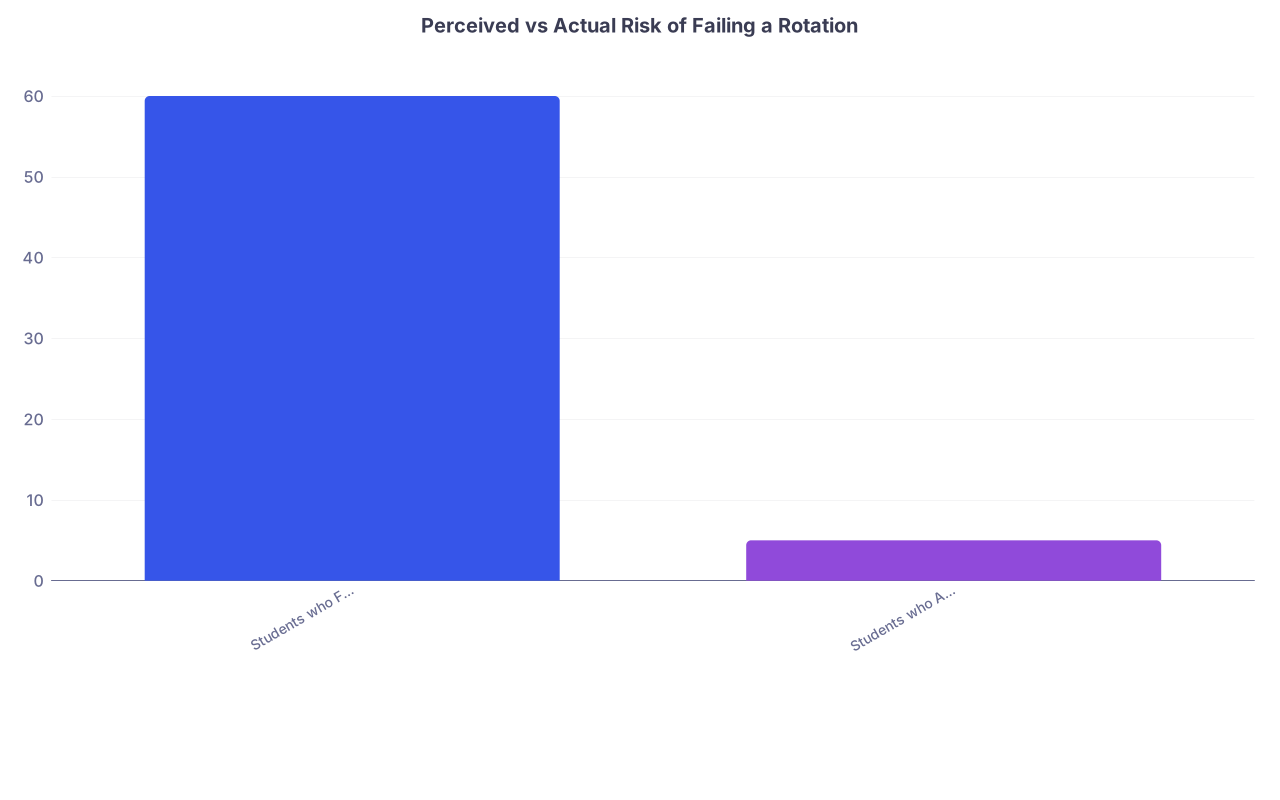
| Category | Value |
|---|---|
| Students who FEEL at risk | 60 |
| Students who ACTUALLY fail | 5 |
Those numbers aren’t exact across all schools, but the pattern is real: tons of students feel at risk; a small fraction actually fail.
Ask yourself these specific questions (not vibes-based, fact-based):
- Have I been consistently absent? (No = huge point in your favor)
- Has anyone explicitly told me I’m at risk of failing? (Not “you can improve,” I mean “you may not pass.”)
- Have I ignored clear feedback for weeks?
If the answer is no, no, and no, then your anxiety is probably louder than the actual danger.
Still, you’re exhausted. And exhaustion absolutely can push a borderline situation over the edge. So let’s assume the worst-case you’re afraid of and work backward: “I’m so tired that my performance is slipping and I might actually fail.”
Now we’re talking about what you can do.
Step 1: Get a Real Read on How You’re Doing (Not the Story in Your Head)
Your brain is not a reliable narrator right now.
When you’re exhausted, your self-assessment is usually garbage: you magnify every flaw and ignore every neutral or positive thing.
You need external data.
Do this in the next 48 hours:
Ask one resident and one attending some version of:
“I really want to improve and I don’t always have a good read on how I’m doing. Could you share 1–2 specific things I’m doing well and 1–2 things I should focus on improving this week?”
That wording matters. You’re not asking, “Am I failing?” You’re asking for concrete, usable feedback.
Pay attention to their tone and specificity:
- If they say things like “You’re doing fine,” “You’re right where I expect a student to be,” “Just read more and keep showing up” — that’s not failing territory.
- If they say things like “I’m concerned about your knowledge base / reliability / professionalism” — that’s your signal that we’re closer to actual risk.
Write their feedback down immediately, even in your Notes app, because your 3 a.m. brain will absolutely twist it later.

Here’s the uncomfortable truth: if your feedback is mostly “read more,” “speak up more on rounds,” “be more proactive,” that’s normal feedback. Not failure feedback.
Step 2: Separate Exhaustion From “I’m Just Not Cut Out for This”
This is the part where your brain gets mean.
When you’re tired enough, the narrative morphs into: “If I were meant to be a doctor, I wouldn’t struggle this much.”
That’s a lie. I’ve seen absolutely stellar future physicians crying in bathroom stalls on surgery because they’d been up for 20 hours and got snapped at over a note.
You need to differentiate three things:
Normal rotation exhaustion
- You’re tired, but you can still think with effort.
- You’re missing small details, not big safety issues.
- You recover noticeably with a real night of sleep.
Dangerous exhaustion / burnout
- You’re making basic mistakes you’d never make rested.
- You feel detached or numb with patients.
- You’re having intrusive thoughts like “I don’t care if I get in a car accident as long as I don’t have to go in tomorrow.”
- You start fantasizing about disappearing, quitting, or worse.
Chronic, long-term mismatch (this is much rarer than anxiety tells you)
- Across months and different settings, you feel misaligned, not just tired.
- You never, ever feel any moment of “this is meaningful” — not even a flicker.
- Feedback for years is consistently poor despite effort.
You’re asking this because you’re scared of failing this rotation. That’s not the same as “I picked the wrong career forever.” Don’t let your exhausted brain collapse those into one giant doom-ball.
Step 3: Protect the Two Things That Affect Your Grade the Most
Your rotation grade is usually driven by:
- Clinical evaluation (subjective as hell, but here we are)
- Shelf or end-of-rotation exam
Your exhaustion eats both.
So instead of trying to “fix your life,” you target the minimum effective changes that keep these two from tanking.
For clinical evals: look reliable, engaged, and not dangerous
You do not need to be brilliant. You need to be:
- On time (actually early)
- Prepared on your patients
- Not a safety risk
That’s it for passing. Honors is a different conversation.
Concrete, low-energy ways to look better than you feel:
Pick 1–2 patients and know them cold.
If you can’t read about everything, read deep on your main patient. Their meds, their disease, their overnight events. Attendings remember the student who owns one patient more than the one faking knowing all five.Use scripts when your brain is fried.
Before presenting: quietly tell yourself, “ID, overnight events, vitals, labs, assessment, plan.”
It’s not glamorous, but checklists are how tired people don’t sink.Ask one thoughtful question per day.
Literally one. That’s enough to signal engagement. Something like, “For this patient with heart failure, how do you decide between diuresing more vs holding because of their creatinine?”Show visible note-taking.
Exhausted students look spaced out. Force yourself to take notes with a pen and small notepad. It visually reads as “engaged” even when you’re barely following.
For shelves/exams: stop pretending you can study like pre-clinicals
You’re not going to bang out 6 focused hours after a 12-hour day. That fantasy dies now.
Aim for:
- 10–20 high-yield questions on weekdays
- 30–60 questions on one weekend day
- Brief, targeted review of your weak spots
| Time Available | What to Do | What *Not* to Do |
|---|---|---|
| 20–30 minutes | 10 Anki cards + 5 questions | Starting a new 30-page chapter |
| 45–60 minutes | 15–20 questions + quick review | Rewriting notes from scratch |
| Completely fried | Listen to 1 short audio review while commuting | Forcing yourself to “grind” and then doing nothing |
Protect weekends a little for deeper studying, but not at the cost of all sleep. If you sacrifice every bit of rest, the quality of your studying drops so low that you’d honestly be better off resting and doing fewer, higher-quality blocks.
Step 4: Have the Hard Conversation Before Things Collapse
This is the step everyone avoids: telling someone with power that you’re struggling.
But here’s the nasty catch—if your functioning actually slips to the point where failing is real, somebody will eventually say, “Why didn’t you tell us sooner?”
You are not weak for pulling the alarm before you crash.
Who you talk to, in order of safety:
A trusted resident
“I’ve been more exhausted than usual, and I’m worried it’s affecting my performance. I care a lot about doing well here. Could I get your advice on how to prioritize what matters most for this team?”Clerkship director / site director
This is if your exhaustion is starting to look more like real burnout, depression, or health issues.You might say:
“I’m finding that my level of exhaustion is affecting my performance and my ability to learn. I want to address this before it becomes a serious problem. Can we talk about resources or adjustments that might help me function safely and still meet expectations?”Student health or counseling
If you’re having any of those darker thoughts (“don’t care if something happens to me,” “everyone would be better off if I disappeared,” etc.), this isn’t negotiable. You reach out.

| Step | Description |
|---|---|
| Step 1 | Notice exhaustion hurting performance |
| Step 2 | Ask resident for feedback/support |
| Step 3 | Talk to clerkship director |
| Step 4 | Student health / counseling |
| Step 5 | Continue with adjustments |
| Step 6 | Still struggling? |
| Step 7 | Mood or safety concerns? |
Your fear is that if you admit you’re struggling, they’ll think you can’t hack it. Reality: people who quietly spiral and blindside the team with a failure get judged a lot harder than people who say, “I’m at my limit and trying to fix it.”
Step 5: If You Actually Fail (Or Almost Fail) — What Then?
Let’s play out the scenario you’re terrified of.
You fail the rotation. Worst case. The thing that feels like it would end everything.
Here’s how it actually tends to go:
- You meet with the clerkship director.
- You almost always get a remediation plan: repeat part of the rotation, do extra work, meet regularly, sometimes write something up.
- It goes in your record, yes. Some schools mention it in the MSPE, some emphasize it, some don’t much.
Is it ideal? No. Does it end your career? No.
I’ve seen:
- People fail surgery and still match general surgery.
- People remediate internal medicine and still match competitive specialties.
- People have two rocky clerkships and still land solid residencies by clearly owning what happened and showing an upward trajectory.
Residency programs care more about:
“Did you learn from this and improve?”
than
“Did you exist as a flawless robot for four years?”
I’m not saying “don’t worry, everything’s fine” — I’m saying: even your worst-case scenario is survivable and fixable.
That does not mean we just drift into it, though. We use that knowledge to reduce some of the paralyzing fear so you can think clearly now.
Step 6: Micro-Fixes for Exhaustion That Actually Work on Rotations
Everyone loves to throw around “self-care” like you’re going to take a bubble bath between trauma codes.
You don’t need wellness platitudes. You need extremely small, realistic adjustments that blunt the edge just enough that you can function.
Try a few of these, and not all at once:
Protect one non-negotiable sleep block.
Pick either pre-midnight sleep or total hours. Example: “I get 5.5 hours minimum, even if it means I study 0 minutes tonight.” A slightly better-rested brain can do more in 20 minutes than a dead one can do in 60.Pre-decide your food plan.
You will not cook elaborate meals. Stop pretending.
Set up: protein bars, trail mix, yogurt, microwaveable meals. Throw 2 snacks in your bag every night before bed. Decision fatigue is killing you more than hunger.Use your commute strategically.
- Walking → short audio review or literally nothing (give your brain 10 minutes of silence).
- Bus/train → 5 Anki cards or one small topic.
- Driving → NO questions if you’re exhausted. Music or a short, non-stressful podcast.
Have a 3-minute reset ritual before you walk onto the floor.
Stand or sit somewhere semi-private.
3 slow breaths.
Name 3 priorities for the day: “Own Mr. X, ask one question, finish notes by 4.”
That’s it. You’re not fixing your life, you’re narrowing your target.
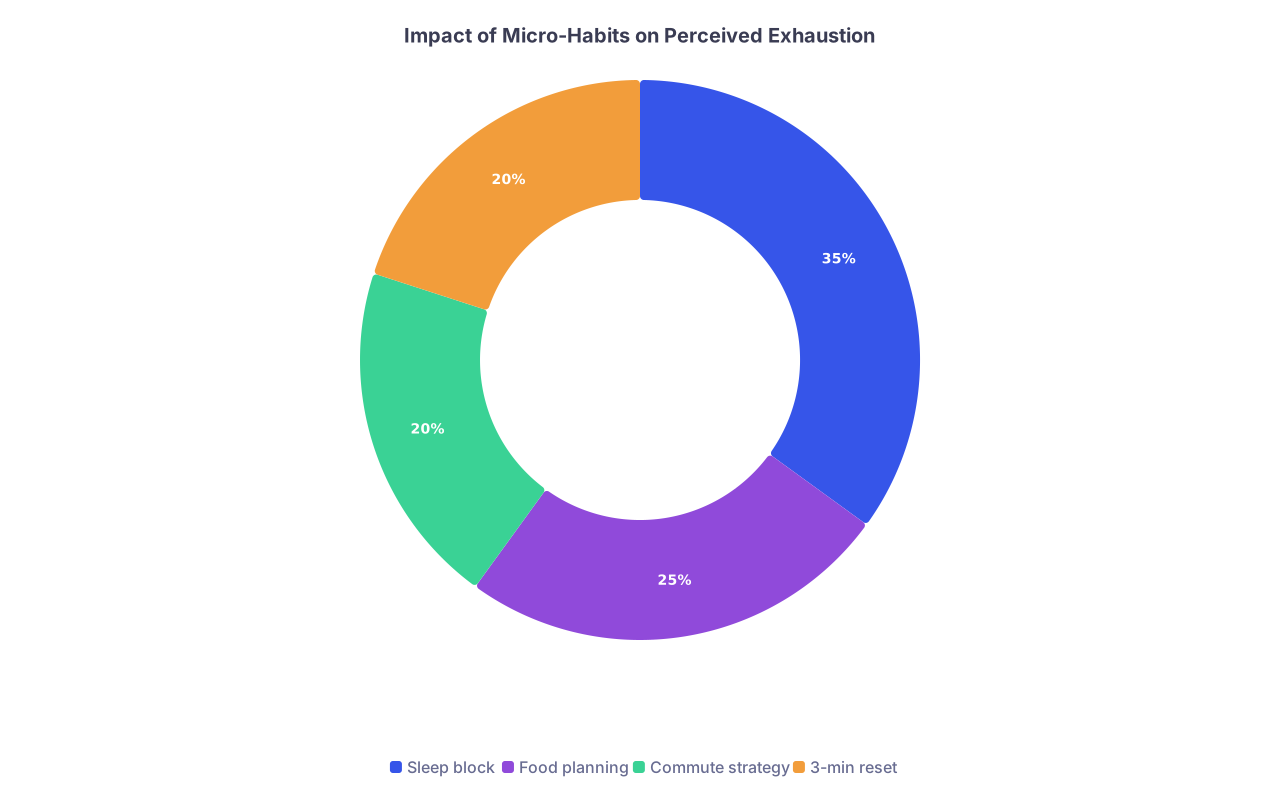
| Category | Value |
|---|---|
| Sleep block | 35 |
| Food planning | 25 |
| Commute strategy | 20 |
| 3-min reset | 20 |
These aren’t magical. They just give you 5–10% more function. That’s often the difference between “barely passing” and “sliding into remediation territory.”
What You Can Do Tonight
You’re probably reading this on a break, half-asleep, or doom-scrolling in bed.
So here’s the next step, not twenty:
Pick exactly ONE of these to do in the next 24 hours:
- Ask a resident for concrete feedback using that script.
- Decide on your minimum sleep block for the rest of this week.
- Pack two snacks and put them in your bag before you sleep.
- Do 10 questions and quit without guilt when you hit 10.
- Email student health or counseling if this has gone beyond “tired” into “I’m not okay.”
One move. Not a whole personality overhaul.
You don’t have to become the perfect student. You just have to stay in the game, keep yourself safe, and be functional enough to learn.
FAQ (Exactly 6 Questions)
1. What are the real signs I might actually be at risk of failing this rotation?
Red flags: repeated tardiness or absences, direct comments like “I’m concerned you may not pass,” being told you’re unprofessional, ignoring serious feedback, or making the same significant mistake after it’s been addressed. If your feedback is “read more,” “be more confident,” “speak up,” that’s usually not fail territory. If you’re unsure, ask directly: “Am I currently at risk of not passing this rotation?” You’re allowed to ask that.
2. Can I tell my attending or resident that I’m exhausted without looking weak?
Yes, but frame it around performance and safety, not complaining. For example: “I’ve been more exhausted than usual and I’m worried it’s affecting my learning and performance. I want to make sure I’m still meeting expectations — do you have advice on how I should prioritize?” That reads as responsible, not whiny. You don’t need to give a full mental health disclosure unless you want to.
3. How do I study for the shelf when I’m too tired to function after rotation?
Shrink your expectations. Instead of aiming for hours, aim for reps: 10–20 questions on weekdays, more on one weekend day. Use spaced repetition (Anki, Mini-cases) during tiny pockets of time: lunch, 15 minutes before bed, short breaks. Choose one primary question bank and stick to it. Half-quality, zombie-mode reading for two hours is less effective than 25 focused questions you actually review.
4. What if my exhaustion is from depression or anxiety, not just long hours?
Then this isn’t a “grind harder” situation; it’s a “you need treatment” situation. That could mean therapy, medication, accommodations, or schedule adjustments. It’s not a character flaw. It’s a medical issue in a medical student. Reach out to student health, counseling, or a trusted physician and say, “My mood and energy have been low enough that they’re affecting my performance and functioning.” You don’t have to figure out the whole plan before asking for help.
5. Will one failed rotation ruin my chances at residency?
No. It will complicate things, but it won’t ruin them. Programs look at the whole picture: trend over time, Step scores, letters, narrative in your MSPE. If you fail and then show improvement, own it in your application: briefly explain what happened, what you changed, and how you improved. I’ve seen people with a failed rotation still match well — the key is growth and honesty, not perfection.
6. How do I keep from crying or breaking down on the floor when I’m this tired?
Sometimes you don’t. Sometimes you cry in a bathroom stall, wash your face, and go back out. That’s not failure. But to lower the odds: sleep the minimum you need, eat something every few hours, have one person you can text unfiltered (“Today sucked. I’m dying.”), and give yourself permission to be “quiet and steady” instead of “enthusiastic and impressive” on the worst days. If you’re breaking down frequently or having scary thoughts, that’s your cue to loop in counseling or student health, not just “try harder.”
Open your schedule or notes app right now and write down one tiny change you’ll make tomorrow—even if it’s just “bed by 11” or “ask resident for feedback.” One concrete move beats another night of lying awake imagining the worst.