
The idea that “if you’re really stressed, you’re not cut out for medicine” is absolute garbage.
But it’s the sentence that loops in your head at 2 a.m. when you’re staring at First Aid, on your third cup of coffee, heart pounding, wondering if you’ve made a gigantic, irreversible mistake.
Let me name the fear directly, because I know it too well:
“If I can’t handle this—lectures, exams, endless notes—how the hell am I supposed to handle real patients, codes, residency, someone actually dying?”
You’re not asking about stress. You’re asking:
“Is my stress proof I don’t belong here?”
Let’s tear that apart slowly and honestly.
You’re Not Broken for Struggling. You’re Normal.
There’s this unspoken script in med school:
Real doctors are calm. Collected. Stoic. They thrive under pressure, juggle ten things, smile at patients, then go home and “read around cases” for fun. They don’t cry in their car after an exam.
Reality? I’ve seen:
- A student with a 260+ Step score throw up before every NBME because of anxiety.
- A “perfect” gunner quietly disappear for a semester for inpatient psych.
- People in top 10 schools who stare at the screen and mentally rehearse telling their parents they’re dropping out—every single exam block.
And they still became residents. Some of them damn good ones.
Med school is stressful because the system is brutal, not because you’re fundamentally weak. The volume, the speed, the stakes, the constant evaluations—it’s engineered to overload normal human coping. That’s not a character test. That’s a pressure cooker.
You being stressed is not some hidden diagnostic tool revealing “not cut out for this.”
It’s a human response to a relentless environment.
The Fear Behind the Fear: “What If This Never Gets Better?”
This is the part that really eats at you, right?
You’re not just thinking, “This week is hard.”
You’re thinking:
- “If pre-clinical is like this, clerkships will be worse.”
- “If I can’t memorize this, I’ll kill someone someday.”
- “If I’m this anxious now, residency will destroy me.”
That’s the real horror movie in your head: that this level of stress is permanent. That you’ll either break, or you’ll survive but become numb and miserable.
Here’s the uncomfortable truth: the stress does change. But not in a straight line.
Think of it like this:
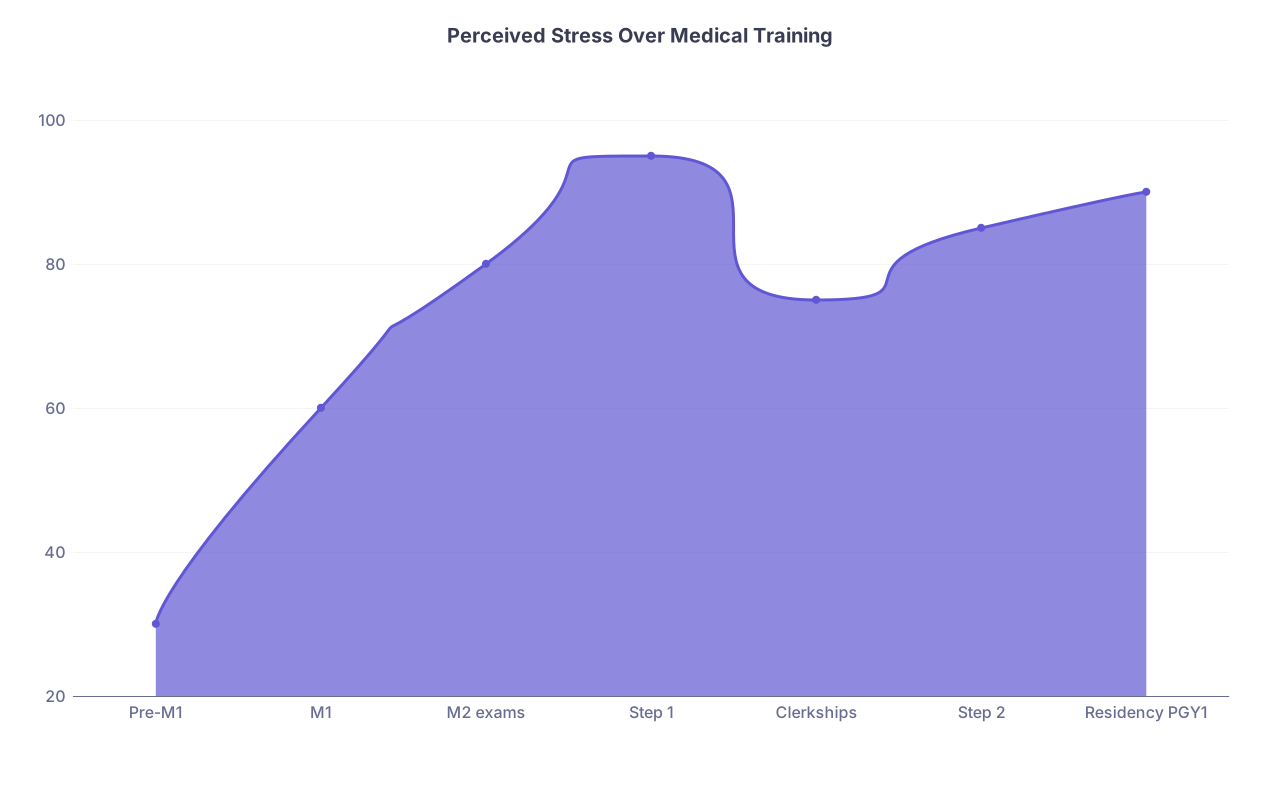
| Category | Value |
|---|---|
| Pre-M1 | 30 |
| M1 | 60 |
| M2 exams | 80 |
| Step 1 | 95 |
| Clerkships | 75 |
| Step 2 | 85 |
| Residency PGY1 | 90 |
The type of stress changes more than the raw amount.
- Pre-clinical: “I can’t learn all this.”
- Step: “This number will define my life.”
- Clerkships: “Everyone is watching and judging me.”
- Residency: “These are actual patients and I’m responsible.”
But here’s what also changes: you.
Not magically. Not by “getting tougher.”
By getting skills.
You learn where your limits are. You find coping strategies that are actually yours, not Instagram self-care nonsense. You get faster. More efficient. More ruthless about what you don’t care about.
The fear that you’ll always feel exactly like this—panicky, behind, fragile—is lying to you. States feel permanent when you’re inside them. They’re not.
Stress vs. “Not Cut Out for It”: They’re Not the Same Thing
Let me be blunt: There are people who eventually decide medicine isn’t for them. That’s real. But they don’t figure that out because they were stressed during M2 cardio.
Here’s what actually separates “I’m stressed but I belong here” from “Medicine may not be a good fit for me”:
| Pattern | Sounds Like | What It Usually Means |
|---|---|---|
| Normal stress | “I’m exhausted, anxious, but I still care about patients and learning.” | You’re overwhelmed, not misaligned. |
| Values conflict | “I hate the culture, not the patients or science.” | You may fit better in a different setting or specialty. |
| Persistent dread | “Even when I’m rested, I feel dead inside about all of this.” | That’s burnout or depression, not a momentary slump. |
| Curiosity vs. avoidance | “I still get interested in cases, even when I’m tired.” | The core motivation is alive. |
| No spark at all | “Nothing about any of this feels meaningful, even the human part.” | That’s when it’s worth seriously reevaluating. |
Notice something? Stress shows up in both sides of that table. It doesn’t tell you which category you’re in. It just tells you that your system is overloaded.
The big mistake is assuming: “I’m crying in the bathroom → therefore I’m unfit to be a doctor.”
No. You’re crying in the bathroom because your brain and nervous system are screaming “too much, too fast, too high stakes.” That’s… accurate?
The Ugly Middle: When Stress Starts to Look Like Failure
Let me walk through the scenario that freaks you out because I’ve seen versions of it:
You bomb an exam. Not just underperform. Bomb.
You barely pass—or you fail.
You were already studying hard. Now you’re out of tricks.
Your brain does this:
- “If I can’t pass an M2 exam, I won’t pass Step.”
- “If I can’t pass Step, I won’t match.”
- “If I don’t match, I’ve wasted years, debt, and disappointed everyone.”
- “If I disappoint everyone, what’s the point?”
And you don’t even realize you’ve jumped like ten steps in that chain.
Meanwhile, what might actually be true is something horribly unsexy like:
- You’re studying in a way that doesn’t match how you learn.
- You’re sleeping 4–5 hours and your memory is shot.
- You’re deeply anxious and your test performance doesn’t match your knowledge.
- You’ve hit burnout and your brain has quietly checked out.
That last one? I’ve watched insanely smart people look “lazy” because they were actually cooked. Not bad work ethic. Just scorched.
None of those explanations equal “not cut out for medicine.” They equal “your current system is unsustainable.”
And yeah, that’s fixable. Painful, but fixable.
But What About Residency? Codes? Real Life-or-Death Stuff?
Here’s a specific fear I hear constantly:
“If I melt down over exams, how will I handle a code blue or telling a family their loved one died?”
You’re comparing the worst version of yourself now to a future version of yourself who will have:
- Years more training
- Thousands of patient encounters
- Supervising attendings
- Protocols, teams, backup
- Actual scripts and practices for critical conversations
Right now you’re alone with a laptop and 600 pages of path. No support, and all the pressure is internal. It’s not shocking that your mind is louder and harsher during board prep than it might be during an actual clinical emergency when your brain can lock onto: “Airway, breathing, circulation. Call for help.”
I’ve watched the same person be a total mess over UWorld percentages and then be eerily calm putting in an NG tube on a crashing patient. Why? Because one is you vs. a number. The other is you with a team, doing something tangible, with clear steps.
You might actually function better in clinical chaos than you do in academic isolation. A lot of anxious, high-strung students do.
When Stress Is a Warning Light You Shouldn’t Ignore
Let me not sugarcoat this: there are times your stress is a red flag. Not that you’re unfit, but that something needs to change now, not “after this exam.”
These are not “everyone in med school goes through this” moments:
- You’re thinking about dying—not just “I wish I could disappear from this exam block” but actual plans.
- You’re dissociating, losing time, or can’t remember parts of your day.
- You’re using alcohol, benzos, weed, or anything else not just to relax, but because you can’t function without it.
- You can’t get out of bed, shower, or feed yourself regularly.
- Panic attacks are happening so often they’re wrecking your studying or sleep.
That’s not “med school is hard.” That’s “your brain and body are waving a giant red flag while you try to pretend it’s just a high-yield topic.”
In those cases, the bravest, most “doctor-like” thing you can do is what you’d tell a patient: this is a medical issue. You deserve treatment. Therapy. Maybe meds. Time off if you need it.
Taking a leave or going to counseling doesn’t mean you’re not cut out for medicine. It means you’re practicing exactly what the profession claims to believe: health first.
Comparing Yourself to the Chill People Is Killing You
You know that classmate who’s always like, “Oh yeah, I barely studied, it was fine”? The one who somehow goes for a run, cooks, watches Netflix, and still crushes exams?
Stop using them as the standard. You have no idea what’s actually going on.
I’ve seen:
- The “chill” student secretly doing 10+ hours a day and pretending otherwise.
- The one who looks put together but has weekly panic attacks alone at night.
- The seemingly lazy one who’s quietly doing spaced repetition every day since M1 and doesn’t need to cram.
You don’t know their brain wiring, their background in biochem, their support system, their meds, their sleep, their relationship drama. You’re taking your insides and comparing them to someone else’s filtered outside.
And then deciding you’re defective because you don’t match a fantasy.
It’s not a fair fight. Stop doing that to yourself.
Practical Things That Actually Help (That No One Tells You Early Enough)
I’m not going to insult you with “sleep more” and “eat healthy” like those are brand-new ideas. You already know that. You feel guilty you’re not doing it more.
Let’s talk about the stuff that actually moves the needle when your brain is in full “I’m not cut out for this” mode:
Shrink the time horizon. Aggressively.
Thinking in “specialty,” “residency,” or even “this semester” terms is gasoline on anxiety. Bring it down to: next 2–3 hours. Next task. You’re not deciding your whole future; you’re deciding what to do until lunch.Separate “I’m stressed” from “I shouldn’t be here.”
Literally say to yourself: “I feel like I don’t belong because I’m stressed. That doesn’t mean I actually don’t belong.” Label the thought as a symptom, not a prophecy.Let someone see the unedited version.
Not just “haha I’m so stressed” over group chat. I mean the raw stuff: “I’m scared that this means I’m a fraud.” A classmate, a therapist, a partner. Shame festers in silence.Treat your brain like a tired organ, not a moral failure.
When your legs give out on a marathon, you don’t say, “Guess I’m a failure as a human.” You say, “Okay, I pushed them too hard.” Your brain is doing the same thing.Use school resources, even if they seem lame.
Academic support. Counseling. Disability services if you have ADHD, anxiety, depression. I’ve seen accommodations like extra time, a quiet testing room, or scheduled breaks completely transform performance. It’s not cheating. It’s leveling.
You Can Rethink Your Path Without Being a Failure
This part matters:
You’re allowed to question medicine. Deeply. Repeatedly. And that doesn’t automatically mean you’re bailing.
Some people do med school, finish, and decide: “I’m going to do non-clinical work, or part-time, or something totally different.” That doesn’t make the years wasted. It makes them part of your story.
You’re also allowed to say, “I want to be a doctor, but not in a lifestyle-destroying specialty,” and choose something that actually lets you be a person. That’s not weak. That’s sane.
People imagine two options:
- Be perfectly okay and destined to be a doctor.
- Be stressed, doubt yourself, and therefore you should quit.
Reality has like 30 options in between. Including:
- Being stressed now, getting help, and still becoming an excellent physician.
- Doing a less intense specialty because you value your mental health.
- Taking longer to graduate and still practicing.
- Pivoting later to something connected-but-different (public health, med ed, consulting, etc.).
Stress isn’t a verdict. It’s data. You get to use it, not be ruled by it.
A Quick Reality Check on “Cut Out to Be a Doctor”
Let me say this as clearly as I can:
I’ve never seen someone who cares this much about “What if I’m not cut out for this?” and also be as hopelessly unfit for medicine as they think.
The ones who scare me? The ones who don’t care. Who don’t reflect. Who don’t worry about hurting people. You’re not that person. You’re literally up at night interrogating whether you’re safe enough to be in this profession.
That fear is uncomfortable. But it’s also evidence that you’re the type who’s careful, conscientious, and aware of your limits. That’s… kind of what you’d want in a doctor.
You’re not failing because you’re anxious. You’re human. In a dehumanizing system.

| Step | Description |
|---|---|
| Step 1 | Overwhelming Stress |
| Step 2 | Shame and Isolation |
| Step 3 | Seek Support |
| Step 4 | Adjustments and Skills |
| Step 5 | More Sustainable Functioning |
| Step 6 | Realistic Confidence |
| Step 7 | Burnout / Crisis |
| Step 8 | Meaning? |
You can’t always choose not to be stressed.
You can choose which story you tell yourself about what that stress means.
FAQ: The 5 Questions You’re Probably Still Afraid to Ask
1. What if my mental health issues make me unsafe to practice medicine?
If you’re actively suicidal, psychotic, using substances unsafely, or so impaired you can’t function, then in that moment you’re not safe to practice. That doesn’t mean “forever.” It means you need treatment and maybe time off, just like someone with uncontrolled epilepsy wouldn’t be safe to drive until treated. Plenty of physicians practice with well-managed depression, anxiety, bipolar disorder, ADHD. Managed is the keyword.
2. Should I tell my school how bad my stress is, or will they think I’m weak?
If it’s affecting grades, attendance, or safety, hiding it usually backfires. Schools are annoying and bureaucratic, but they’d rather get you support than deal with a disaster. You don’t have to tell everyone. Start with a counselor, mental health services, or a trusted faculty member who’s known to be student-friendly. You’re not the first one to crack under this.
3. Is it normal to think about quitting med school every week?
More common than anyone admits. The line I watch is intensity and duration. Passing “ugh maybe I should just quit and become a barista” thoughts? Common. Persistent, detailed planning to leave, mixed with despair and no joy anywhere in your life? That’s when it’s not just a fantasy escape hatch, it’s a sign of depression or burnout and you should talk to someone.
4. How do I know if I actually don’t like medicine vs. I’m just burned out?
Look at moments when you’re slightly rested and not under immediate exam threat. Do patients, stories, pathophys, or procedures ever spark anything in you? Curiosity, meaning, even a tiny flicker? If yes, burnout is likely muddying the water. If no—if everything feels flat all the time, and you can’t imagine any version of this work feeling worthwhile—that’s when it’s time to talk with someone (advisor, therapist) about whether your values and this path really match.
5. Will programs or licensing boards punish me for getting mental health treatment now?
This keeps way too many people from getting help. The short version: the trend is strongly toward protecting physicians who seek care, not punishing them. Many boards are shifting from asking “Do you have a mental illness?” to “Are you currently impaired?” Seeing a therapist, or taking meds, doesn’t equal “impaired.” Check your state’s current wording, but the risk of not getting help—academic failure, serious episodes, actual impairment—is almost always worse than the theoretical risk of disclosure later.
If you remember nothing else:
- Being stressed in med school doesn’t mean you’re not cut out to be a doctor. It means the environment is intense and your brain is reacting like a normal brain.
- Your stress is information, not a verdict. Use it to get support, make adjustments, and figure out what kind of training and career are actually sustainable for you.
- You’re allowed to struggle and still belong here. The fact that you’re this worried about doing right by future patients is itself a sign of the kind of doctor you could be.