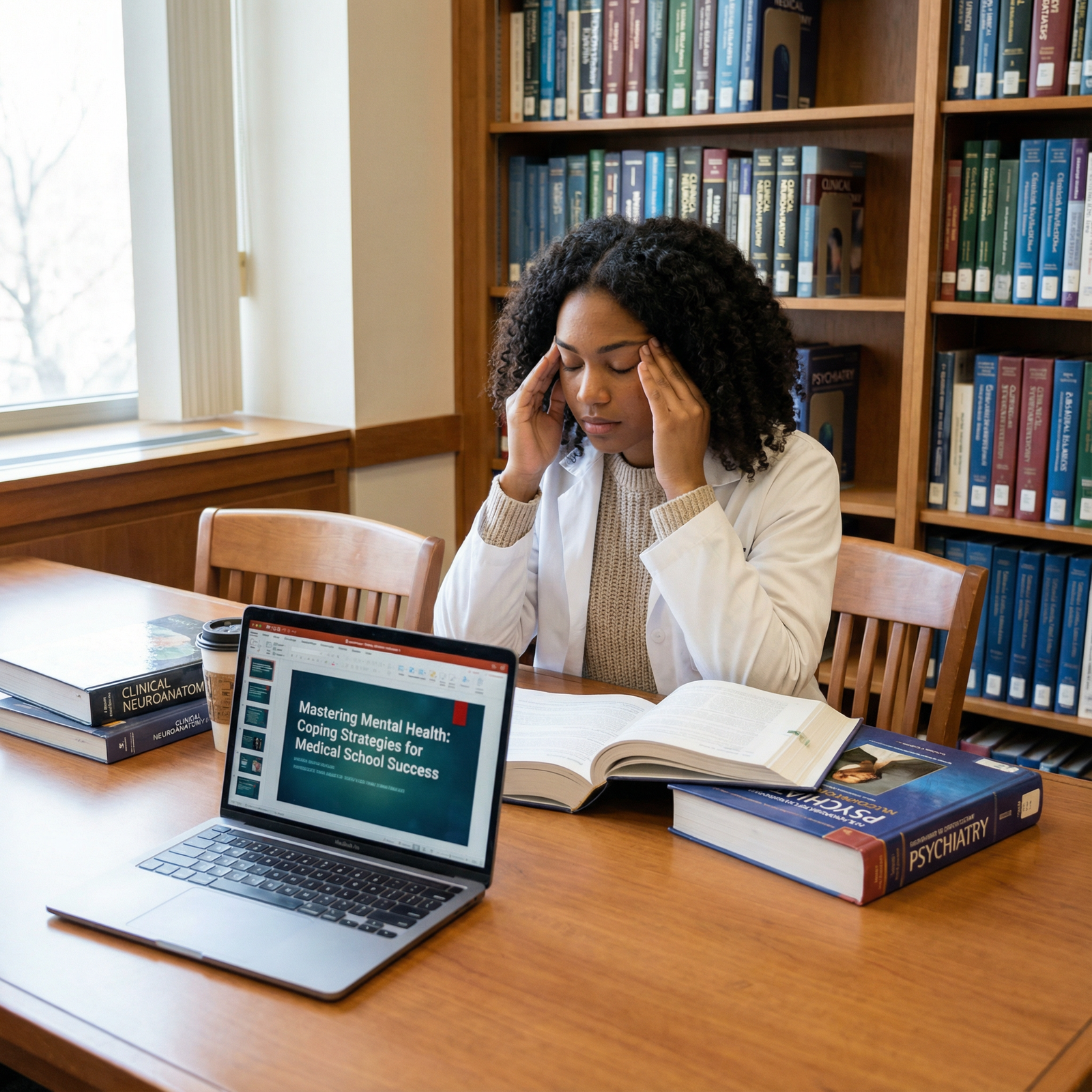
It’s 8:59 a.m. You’re in that freezing exam room, palms sweaty through your gloves, NBME interface glowing in front of you. First block just opened. You read the first question. And…nothing. Your brain doesn’t stall, it shuts down. Words look familiar but mean nothing. Heart pounding, ears ringing, you suddenly think: “Oh my god. I’m actually blanking. This is it. I’m going to fail, ruin my future, and I can’t stop it.”
That’s the nightmare, right? Not just doing badly. Completely blanking. Losing control.
Let’s talk about what actually happens if you blank from anxiety, how much real damage it causes (spoiler: usually less than your brain is screaming at you), and what “emergency level” damage control looks like during and after the exam.
First: What “Blanking” Really Is (And What It’s Not)
You’re scared that “blanking” means you suddenly became stupid. Or forgot medicine. Or proved you never knew anything in the first place.
That’s not what’s happening.
Blanking on exam day is basically your sympathetic nervous system hijacking your prefrontal cortex. You go into threat mode. The part of your brain that solves questions gets shoved aside by the part that’s convinced there’s a tiger in the Prometric center.
So you get:
- Tunnel vision on the timer
- Racing thoughts: “I’m failing, I’m failing, I’m failing”
- Physical symptoms: sweating, chest tight, nausea, shaking
- Memory retrieval feels like trying to open a locked door underwater
This is not:
“I didn’t study enough.”
This is:
“My body thinks this exam is a physical threat.”
The messed-up part: your knowledge is still there. The access to it is jammed.
Where people go from “this sucks” to “actual damage” is not the anxiety itself. It’s how they react in the moment.
Do they freeze on question 1 for 6 minutes?
Do they panic-quit mid-block?
Do they speed-guess everything and mentally walk out?
That’s the part we can control. Even if you feel like you can’t.
What Actually Happens to Your Score If You Blank?
Let me be direct: a few minutes or even one whole block of “foggy brain” doesn’t automatically fail you.
The exam is long. It’s built to absorb variance—bad questions, off blocks, mental dips.
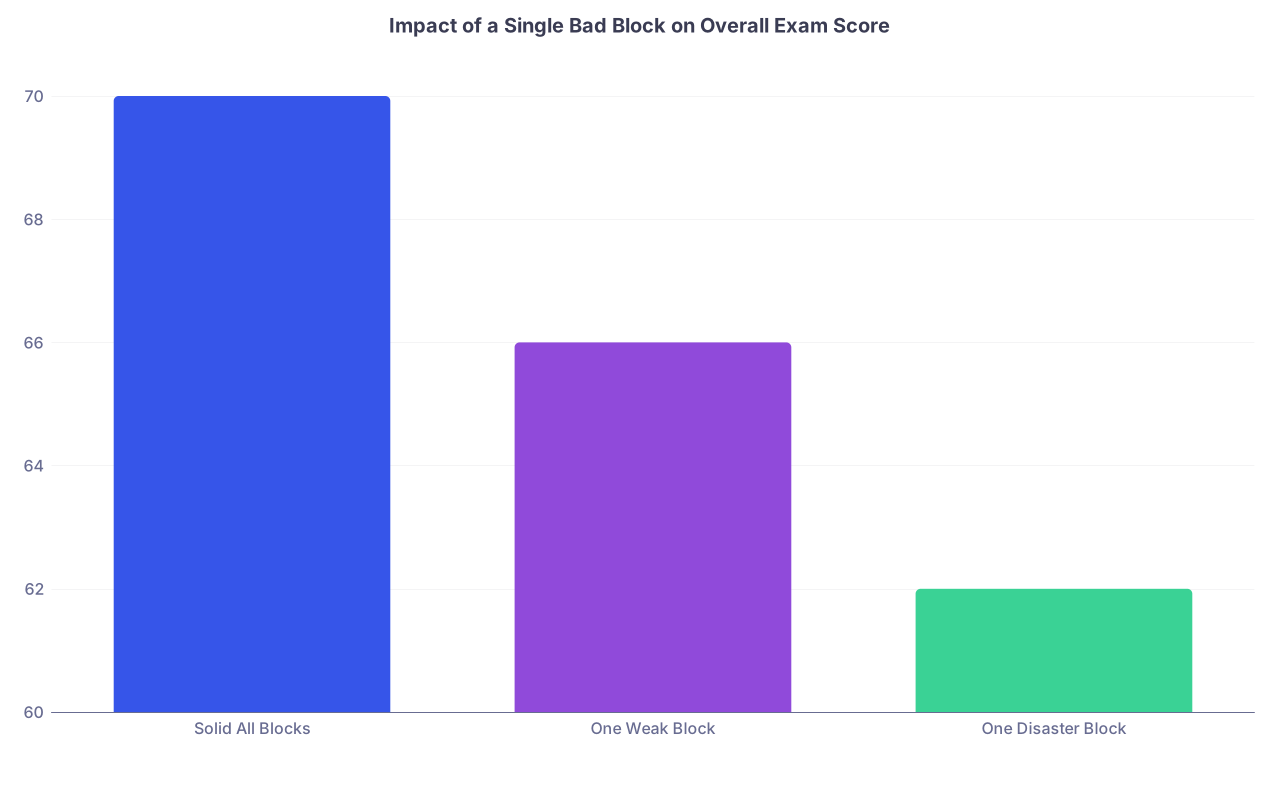
| Category | Value |
|---|---|
| Solid All Blocks | 70 |
| One Weak Block | 66 |
| One Disaster Block | 62 |
Look at that chart conceptually like this: if “70” is your expected performance (not percent correct, just relative score strength):
- One weak block might ding you a few points.
- One disaster block hurts, but it usually doesn’t annihilate your whole exam if the other blocks are OK.
Where it does become a bigger problem:
- You let anxiety domino across every block
- You rage-submit or leave huge chunks blank
- You don’t use any on-the-fly damage control, and the panic just keeps compounding
But this idea that “I blanked for 10 minutes, I’ve destroyed my career”? That’s your catastrophizing talking, not reality.
I’ve watched people:
- Walk out crying after block 1 of a shelf and still honor the exam
- Have a mini panic attack during Step 1, then settle and pass comfortably
- Feel like they guessed on 70% of questions and end up dead in the middle of the score distribution
Your internal “I bombed it” meter? Completely unreliable when your anxiety is jacked up.
Emergency Damage Control: What To Do During the Exam
You’re not going to turn into a Zen monk mid-block. But you can absolutely stop the freefall. Think of this like an in-flight fire. You’re not landing immediately, but you can keep the plane in the air.
Here’s a realistic script of what to do when you catch yourself blanking.
Step 1: Stop mentally arguing with the panic
The worst spiral is:
“I’m blanking.”
→ “If I’m blanking I’ll fail.”
→ “If I fail, I won’t match.”
→ “If I don’t match, my life is over.”
Your brain loves this drama.
Instead, literally say (in your head):
“Okay. I’m freaking out. Not helpful. But I’m still here. I can still click. Let’s survive the next 5 questions.”
You don’t need to feel calm. You just need to act like someone who can still move forward.
Step 2: Lock your body down for 30–45 seconds
Yes, I know, the timer is screaming at you. Ignore it for 30 seconds. It’s better to “lose” 30 seconds than to hemorrhage 15 minutes to sheer panic.
Try this mini reset you can do in your chair:
- Feet flat on the floor. Press them down. Feel the contact.
- Put your hands on your thighs. Feel the pressure.
- Inhale for 4 seconds. Hold for 4. Exhale slowly for 6. Do this 3 times.
- On the exhale, silently say: “Next question only.”
You’re forcing your nervous system to back off just enough so your prefrontal cortex can crawl back in.
Step 3: Switch to “minimal viable strategy” mode
You’re not aiming for perfection anymore. You’re aiming for “do the exam at 70% of your best instead of 20%.”
This is how that looks:
- If a question feels impossible on first read: pick a best-guess, flag it, move on.
- Don’t reread the same stem three times hoping your brain magically clears. That’s just feeding the panic.
- Use simple anchoring questions: “What organ system is this?” “What is the basic problem—too much, too little, blocked, broken?”
- Reframe the timer: instead of “I’m running out of time,” switch to “I have enough time to give each question one reasonable attempt.”
If you’re truly blank on content, guess. A chosen answer is statistically almost always better than a blank one. And movement itself reduces panic.
If a Whole Block Goes Bad: Can You Recover the Same Day?
Yes. It’s brutal. Yes, it feels like trying to study after a breakup. But you can recover enough.
Say block 1 was a mess. You cried during the break, your heart rate is still up, and your brain is whispering, “Just leave. Just quit.”
Here’s the harsh truth: walking out mid-exam almost always causes more long-term damage than pushing through.
During your break:
- Eat and drink something, even if nothing sounds good. A few sips of water, a couple bites of something salty/sweet. Your brain is freaking out partially because you’re dehydrated and low on glucose.
- Physically move. Stretch your arms overhead, roll your shoulders, walk to the bathroom slowly. Get out of the chair-hunched panic posture.
- Give yourself a very short script:
“Block 1 is done. It counts the same whether I obsess over it or not. My job now is to salvage as many points as I can from the remaining blocks.”
You’re not signing up for “crush the exam.” You’re signing up for “salvage operation.”
I’ve seen students completely tank one block (timing disaster, panic attack, whatever) and still land in a totally acceptable range because they stopped the bleeding and did “pretty okay” on the rest.
After the Exam: Worst-Case Thinking vs Reality
Walk out of the exam center. Your brain immediately starts running simulations:
“I failed.”
“I definitely failed.”
“I got 40%. Maybe 30%.”
“I should cancel my application. Change careers. Live in a cave.”
That mental movie is normal. Also mostly nonsense.
Here’s what usually actually happens when someone “blanks” or panics:

- Their score is lower than their practice average, but not catastrophic.
- They pass comfortably but feel like they barely survived.
- They underperform compared to their potential, but it’s still “good enough” to move on.
The truly catastrophic outcomes (actual fail, huge score drop) usually come from a combination of factors: weak prep plus uncontrolled anxiety plus terrible test-day decisions (like leaving sections blank or giving up entirely).
You can’t change what you did during the exam now. You can absolutely ruin the next few weeks by replaying every question and googling every vignette. But that’s self-torture, not strategy.
If you walked out thinking, “I blanked,” what you do in the days after matters:
- Sleep. Your brain will try to bargain: “If I stay up all night analyzing, maybe I’ll feel better.” You won’t.
- Don’t autopsy every question with friends. That rarely reassures anyone.
- Put a boundary on how long you allow yourself to catastrophize each day. Yes, literally: “I’m allowed 10 minutes to freak out after dinner, then I’m done.”
It sounds ridiculous, but if you don’t contain it, the anxiety becomes your full-time job.
What If It Was Really Bad? Retakes, Fails, and Not-Over Situations
Let’s go to the nightmare: you blanked, you panicked, and weeks later, the score report confirms it. You actually failed. Or you tested way below your practice range.
Does it suck? Yes. Does it permanently end your career? No. Despite what Reddit wants you to think.
Here’s the thing that people in school don’t always see clearly:
Medicine is full of people who have failed something. Step, shelf, OSCE, class, you name it. They’re attending now. No one hands out your USMLE history on rounds.
What matters next:
- You treat this like a medical error, not a personal moral failure. What went wrong? Knowledge? Test-taking? Anxiety? Sleep? All of the above?
- You document what happened—especially if there were genuine medical/psychiatric symptoms (panic attack, dissociation, etc.). This is not for drama; it’s for pattern recognition and accommodations if needed.
- You get actual professional help for the anxiety if it wasn’t just “first big exam nerves.” I’m talking therapist, maybe meds, maybe performance coaching. Not just more Anki and vibes.
There are accommodations for documented anxiety disorders and panic attacks. Extra time, separate room, breaks. Are they always easy to get? No. Are they impossible? Also no. You need documentation and time, but it’s an option.
Failing an exam because you blanked is a data point. It’s not a prophecy.
Building a Pre-Emptive Safety Net for Next Time
If you’re reading this before your big exam and living in fear of blanking, good. You’re ahead.
You can treat “test-day anxiety management” like any other content domain. Something you deliberately practice instead of hoping it behaves.
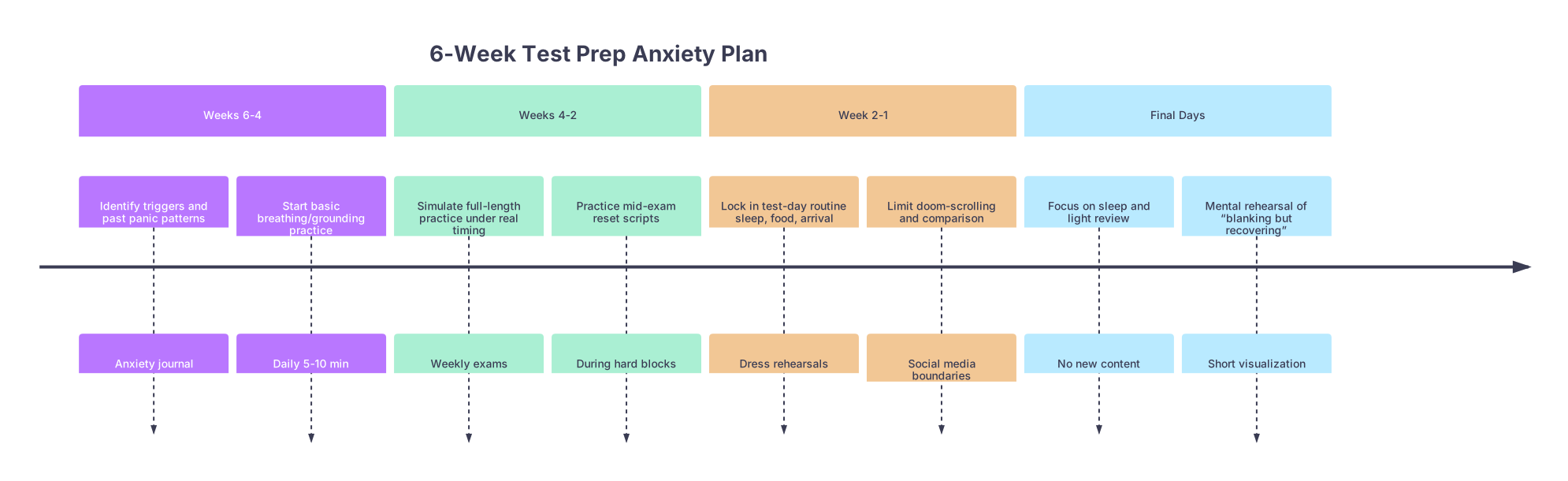
| Period | Event |
|---|---|
| Weeks 6-4 - Identify triggers and past panic patterns | Anxiety journal |
| Weeks 6-4 - Start basic breathing/grounding practice | Daily 5-10 min |
| Weeks 4-2 - Simulate full-length practice under real timing | Weekly exams |
| Weeks 4-2 - Practice mid-exam reset scripts | During hard blocks |
| Week 2-1 - Lock in test-day routine sleep, food, arrival | Dress rehearsals |
| Week 2-1 - Limit doom-scrolling and comparison | Social media boundaries |
| Final Days - Focus on sleep and light review | No new content |
| Final Days - Mental rehearsal of “blanking but recovering” | Short visualization |
Main idea: you don’t just practice content. You practice:
- Taking a full-length exam when you’re tired and grumpy
- Catching yourself when you’re spiraling during a block, and using the same reset every time
- Visualizing the worst (blanking) and then imagining yourself still moving through it, choosing answers, making it to the end
The brain likes rehearsal. If the first time you deal with blanking is test day, of course it feels apocalyptic.
When Anxiety Is More Than “Normal Nerves”
This part people avoid because it’s uncomfortable: sometimes, what you’re calling “test anxiety” is actually an untreated anxiety disorder.
If:
- You’ve had multiple exams where you’ve blanked or had panic symptoms
- Your baseline anxiety is high most days, not just before tests
- You avoid studying because thinking about the exam makes you physically sick
- You’re having intrusive thoughts about failing, dropping out, self-harm, or “everyone would be better off if I wasn’t here”
That’s not just “med school is stressful.” That’s your brain waving a massive red flag.

Talk to someone. School counseling center, therapist, psychiatrist. Not your equally-freaked-out classmate.
And if you ever get to “I don’t want to be here anymore,” that is immediate, same-day level seriousness. Crisis line, student health, ER. Your worth is not your score report. I promise you.
A Very Brief Reality Check
Let me zoom out for one second.
You’re terrified of blanking because, in your head, it equals:
“I’m not cut out for this.”
“I’m a fraud.”
“I’m weak.”
But anxiety during high-stakes exams doesn’t mean you’re weak. It means your nervous system reacts strongly to threat. Honestly? That’s exactly the kind of nervous system that double-checks meds, worries about missing a diagnosis, and cares enough to feel sick about making a mistake.
The skill you’re building here is not “never get anxious.” That’s fantasy.
It’s “function adequately while anxious.”
And that is very, very compatible with being a good doctor.
| Situation | Likely Outcome |
|---|---|
| Blank for a few minutes | Annoying, minimal score impact |
| One bad block, others okay | Score dip, usually still passing |
| Panic ruins multiple blocks | Possible underperformance or fail |
| Fail from anxiety, then retake | Setback, not career-ending |
| Seek help + adjust for next exam | Long-term improvement in performance |
FAQ (Exactly 5 Questions)
1. What if I literally can’t remember anything on the first few questions?
Then you move. You pick the most reasonable guess you can, flag it, and go to the next question. Your memory often unlocks once you’ve broken the freeze. Staying stuck on question 1 for 6 minutes does more damage than taking 30 seconds to guess and move on.
2. Is it better to void/quit the exam if I blank early?
Almost always no. By the time most exams give you a void option, you’ve already spent some time and emotional energy. People usually underestimate how many points they can still earn even while anxious. Voiding or walking out tends to turn a salvageable rough day into a guaranteed retake with a heavy psychological footprint.
3. How do I know if my anxiety is “bad enough” to get accommodations?
If your anxiety has caused repeated major performance drops, panic attacks, or functional impairment (not sleeping, can’t study, physical symptoms), it’s worth getting evaluated. A mental health provider can document this and help you apply for accommodations. Don’t self-reject because you think “it’s not that bad” when it’s clearly wrecking your life.
4. Can a single bad exam ruin my chances at residency?
One bad score can complicate things, yes. But ruin? No. Program directors look at patterns, context, and overall trajectory. Strong clinical performance, good letters, solid later exams, and a clear explanation of what happened can absolutely offset a rough step or shelf.
5. What should I do the night before if I’m terrified of blanking?
You do less, not more. Light review only, no new content, no late-night question blocks that will freak you out. Set out your clothes, snacks, directions. Practice a 2–3 minute breathing/grounding routine you’ll use during the exam. Then protect your sleep like it’s part of the exam. Because it is.
Key points: Blanking from anxiety feels catastrophic, but usually hurts your score less than your brain insists. The real damage comes from how you respond in the moment—freezing, giving up, or letting panic run the entire test. And even in the true worst case—a failed exam—you are not done. You regroup, get help, change your approach, and take the next step anyway.