
The myth about “gunners” is that they’re just ambitious students who care more. That’s wrong. In most med schools, a few unchecked gunners quietly poison the mental health of an entire class—and faculty rarely admit it out loud.
Let me walk you through what actually happens behind closed doors, both in dean’s offices and at exam review meetings, when your cohort’s “top performers” start playing games with each other’s sanity.
What a Gunner Really Is (From the Faculty Side, Not Reddit)
Students define gunners one way. Faculty define them very differently.
Students say “gunner” and think: the person who hogs the mic in small group, flexes their Step scores, or asks the “one last question” at 4:59 PM. Annoying, sure—but that’s the surface.
Behind the scenes, when course directors and deans use the word (yes, we use it—just not in emails), they mean something more specific:
High-achieving + anxious + competitive + willing to sacrifice peers’ well-being for personal advantage.
Not all high-achievers are gunners. Some of your top scorers are quiet, generous, and stabilizing forces. Most faculty know exactly who those people are and protect them.
The true gunners are the ones who create a measurable shift in class climate: increased office visits for “test anxiety,” more professionalism complaints, more breakdowns around exams. When that happens, we start tracing it back to who is stirring up what.
You rarely see that side. We do.
The Psychological Fallout You Do Not See Coming
The worst damage gunners do isn’t academic. It’s psychological.
Their behavior keeps everyone else in a constant state of perceived threat. Your nervous system can’t tell the difference between “a lion is chasing me” and “I’m a week behind that guy who finished Anki by October.” Chronic sympathetic overdrive is chronic sympathetic overdrive.
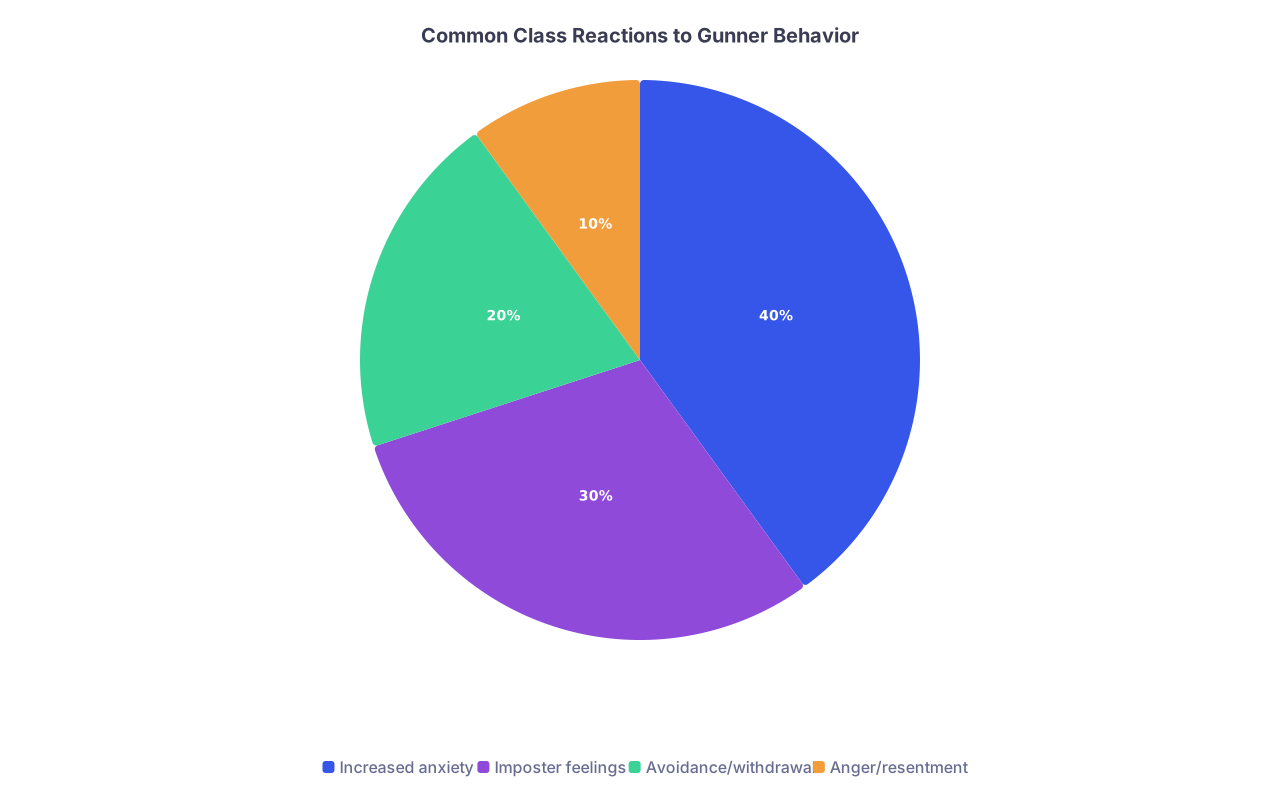
| Category | Value |
|---|---|
| Increased anxiety | 40 |
| Imposter feelings | 30 |
| Avoidance/withdrawal | 20 |
| Anger/resentment | 10 |
I’ve watched the same pattern play out over and over:
1. Anxiety Contagion
One super-anxious, status-obsessed student can elevate the anxiety baseline for 100 people.
Example you’ve probably lived: It’s two weeks before a block exam. The gunner announces (loudly, in the lounge) that they’ve done “3,000 questions” and are on their second pass of Boards and Beyond. Half the room immediately recalculates their self-worth.
Next week, my schedule in the dean’s office is suddenly full of:
- “I think I’m falling behind, everyone is so ahead.”
- “I heard people are already studying for Step 2 and I haven’t even finished Pathoma.”
- “I feel like I’m the only one not doing enough.”
They aren’t “everyone.” They’re competing with three people. But the gunner’s noise makes those three sound like the norm.
2. Distorted Norms and Imposter Syndrome
Gunners create fake baselines.
If the loudest voices say, “I only feel safe if I score 90+ on all exams,” that becomes the perceived standard, even when the actual class mean is 78.
I’ve seen perfectly solid students (top half of the class, easily matchable) spiral into full-blown imposter syndrome because they thought they were “barely hanging on” compared to the fantasy persona of the gunner in their anatomy group.
Key detail: the gunner usually edits out their own meltdown moments. You don’t see the 3 AM panic. Faculty do—when they show up begging for extra practice questions or “more practice NBME-style items,” already scoring in the 90th percentile.
3. Isolation and Silence
The more gunners dominate conversations, the less everyone else talks honestly.
Students stop sharing vulnerabilities. They don’t admit they’re tired. Or that they didn’t finish the question bank. Or that they forgot half of biochem.
So in small group, one or two people perform “I’m on top of everything,” and ten others quietly conclude, “I must be the only one struggling.”
Then they stop asking for help. They stop going to office hours because they don’t want to expose how “behind” they think they are. This is how we end up with students in real academic trouble who have been totally invisible until they’re already on probation.
How Gunners Warp Exam Culture and Study Sanity
Here’s the part nobody outside faculty meetings tells you: gunners can actually change how your exams feel—and not in a good way.
1. Escalating Arms Race Around Resources
Every class has that person who treats studying like an arms race: more Qbanks, more flashcards, more “secret” PDFs, more private tutors.
They brag—subtly or not—about it. That bragging doesn’t just annoy people. It pushes the class into escalation.
Then we start seeing patterns:
- Students using five different question banks badly instead of one or two well.
- People burning out mid-block because they’re trying to match an outlier’s routine.
- A spike in “I studied constantly and still don’t feel prepared” emails before every exam.
When this gets bad enough, faculty pick up on it indirectly. We notice score distributions getting wider. Top scores ridiculous, lower scores dropping. Middle gets hollowed out.
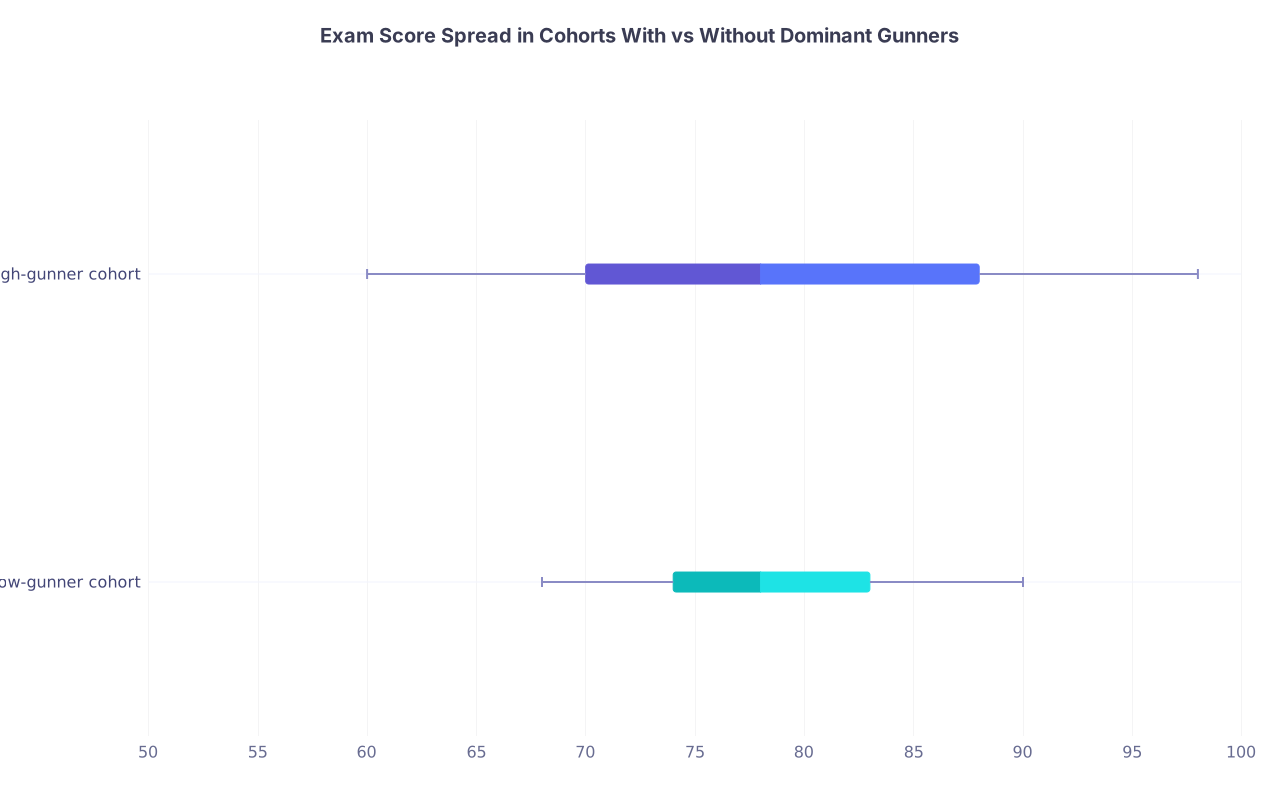
| Category | Min | Q1 | Median | Q3 | Max |
|---|---|---|---|---|---|
| Low-gunner cohort | 68 | 74 | 78 | 83 | 90 |
| High-gunner cohort | 60 | 70 | 78 | 88 | 98 |
Translation: in gunner-heavy cultures, a few people soar, more people crash, and the rest feel like they’re sprinting just to stand still.
2. Toxic “Questions After Questions” Culture
You know that one student who weaponizes questions at the end of lecture?
They raise their hand with 2 minutes left and ask something that’s obviously from an advanced resource, not the lecture material, and they phrase it like, “When I was reviewing the latest UWorld items on this topic…”
Faculty talk about this. We groan about it.
What students don’t realize: that behavior scares classmates into thinking they’re supposed to know this extra layer of detail. I’ve heard second-years whisper, “Wait, should we know that for the exam?” while still trying to figure out the basics.
Some lecturers respond by “clarifying” things they never intended to test at that granularity… and then occasionally those details sneak into exam questions because a zealous faculty member thinks, “Well, someone asked about it. They must be on that level.”
So yes, gunner behavior can literally push the exam difficulty ceiling upward over time.
3. Undermining Collaborative Study
Study groups live or die based on psychological safety. A single gunner can wreck that.
Patterns I’ve seen repeatedly:
- Turning group sessions into mini oral exams, grilling classmates instead of actually learning together.
- Flexing obscure facts instead of focusing on high-yield concepts.
- Making backhanded comments like, “Oh, you’re still on that deck?” or “Wow, I stopped using that resource months ago.”
What happens next is predictable. The quieter, more vulnerable students drop out of group study. They retreat into solo grinding, which looks productive but is often more anxious and less effective. Then they start slipping, and they’re embarrassed to come back.
The gunner? They just find a new group to dominate.
The Clinical Years: How Gunners Damage Mental Health on the Wards
If you think gunners are bad in pre-clinicals, wait until you meet them on your clerkships.
Clerkships magnify everything because now you’ve added attendings, residents, and grades that actually move your class rank.

| Step | Description |
|---|---|
| Step 1 | Preclinical Gunners |
| Step 2 | Study Anxiety & Resource Arms Race |
| Step 3 | Imposter Syndrome & Isolation |
| Step 4 | Clinical Gunners |
| Step 5 | Team Tension & Grade Insecurity |
| Step 6 | Burnout & Mental Health Crises |
1. Performing For Attending Approval
Here’s the classic clinical gunner move: they treat every patient presentation like an audition and everyone else on the team like background noise.
You’ve seen it:
- Hijacking presentations, turning a simple SOAP into a mini grand rounds.
- Answering questions directed at others.
- Volunteering for absolutely everything, then bragging/subtweeting about it later.
Attendings are not blind to this. Some love it (usually the more malignant ones). Others quietly mark it as “lacks insight” or “poor team awareness.”
But the real damage is to everyone else. I’ve watched capable students stop participating on rounds because they’re tired of getting cut off or out-flanked by the same person. That withdrawal gets misread as “quiet,” “less engaged,” or “needs to read more.” And again, mental health plummets.
2. Quiet Sabotage and Comparison
I wish I could say this is rare. It’s not.
The darker side of the gunner mentality shows up in how they talk about their peers to residents and attendings:
- “I was worried about the med rec, so I just went ahead and fixed it after X did it.”
- “I’m not sure Y is comfortable with this, so I did the note for them.”
- “Z seems really overwhelmed with the material.”
Those statements sound “helpful.” They plant seeds. Eventually you hear, in an eval meeting: “We had some concerns that this student might be a little less prepared than their peers.”
And shocker: that student starts to feel “less prepared,” even if they were perfectly fine before the narrative shifted under them.
Gunners create a climate where everyone feels surveilled. That’s brutal on mental health. You start censoring yourself, double-guessing every question, every answer, every time you say “I don’t know.” You feel like your peers are competitors, not allies.
3. Sleep, Burnout, and Silent Side-Deals
Another thing faculty see that you don’t: the gunner’s schedule is not sustainable, and it sets a standard that makes everyone else feel subhuman.
I’ve had students come into my office convinced they’re “lazy” because they “only” read an hour at night post-call, while another student claims they read 3–4 hours after every shift.
Here’s the part buried from view: that same gunner is often making quiet trade-offs:
- Skipping meals.
- Never working out.
- Never seeing family or friends.
- Sleeping 4–5 hours a night for weeks.
Short term, they might outshine everyone. Long term, they burn out hard. But the damage to the class climate has already been done: everyone else has been measuring themselves against a completely unsustainable yardstick.
What Faculty Actually Think About Gunners (The Stuff We Don’t Say On Record)
You think faculty worship gunners because they get high scores. Some do. Many don’t.
In closed-door meetings, the conversation is a lot more nuanced.

Here’s the honest breakdown from those rooms:
- We can tell the difference between “quietly excellent” and “performative aggressive.”
- We do track which students repeatedly generate complaints from classmates.
- Some course directors will absolutely cap narrative comments when they see clear patterns of ego-driven behavior.
What we notice and talk about:
Pattern of complaints: When multiple students separately mention the same person making them feel stupid, hogging air time, or undermining group function, we start using phrases like “developmental feedback needed” in committee.
Emotional wake: We pay attention to which students others want to work with. When a student’s name triggers collective eye-rolls in a clerkship orientation, that’s data.
Professionalism vs performance: For a long time, medicine quietly looked the other way as long as numbers were good. That’s changing. More schools are explicitly tying “team behavior,” “psychological safety,” and “respect” to clinical grades and AOA decisions.
Are there still attendings who reward raw performance and ignore toxicity? Yes. Especially in some surgical subspecialties and older-school departments. But the tide is shifting. Programs are sick of residents who are technically brilliant and emotionally radioactive.
You want the real secret? Many PDs would rather have a solid, teachable B+ student who makes their team better than an A+ who shreds everyone’s nerves.
How To Protect Your Own Mental Health Around Gunners
You can’t fix them. Do not waste your bandwidth trying. But you can absolutely stop them from living rent-free in your head and wrecking your mental health.

Here’s what I’ve seen actually work for students who stay sane in gunner-heavy classes:
1. Shrink Your Comparison Pool
Stop comparing yourself to the loudest 5%. They’re outliers. And sometimes liars.
Anchor your expectations to:
- The actual class averages and distributions (ask for them, they exist).
- Your own trend over time (are you improving, holding, or slipping?).
If your scores are above the mean and you’re functional as a human being, you’re not “behind.” You’re fine. Admissions and PDs know there are only so many true outliers per cohort.
2. Control Your Exposure
You do not need to be in every group chat. In fact, some of them are mental health disasters.
I’ve seen entire classes tank their mood daily reading a WhatsApp thread full of:
- “Just finished my 500 Anki cards for the day!”
- “Random UWorld 86% today!”
- “Anyone else already on second pass of Sketchy?”
It’s a highlight reel mixed with anxiety venting. Terrible combo.
You are allowed to leave. Or mute. Or only check once a day. The students who do this early on are almost always calmer by third year.
3. Recognize Over-Performing as a Coping Mechanism (Not a Standard)
Many gunners are not villains. They’re terrified.
Their entire identity is wrapped around being “the best.” Med school is the first place they realize they’re merely “one of many strong students,” and they panic. Their response is to crank up work hours and output to maintain an internal sense of safety.
You do not need to copy someone else’s coping mechanism, especially when it’s maladaptive. You can respect their stress without adopting their chaos.
4. Build Your Own Quiet Alliance
The healthiest students find 2–4 reasonable peers and commit to being honest with each other:
- “I didn’t finish the deck today.”
- “I bombed that quiz.”
- “I’m not reading tonight; I need to sleep.”
This creates a counterculture to gunner energy. You’ll notice something: your small circle’s reality and the gunner’s loud narrative don’t match. Believe your data.
When Gunners Seriously Harm the Environment: What You Can Do
Sometimes the behavior crosses into clear professionalism territory: sabotaging, harassing, repeatedly talking over peers, creating unsafe learning spaces.
That’s not “just annoying.” That’s reportable.
| Situation | Likely Action |
|---|---|
| Occasional bragging/flexing | Ignore or set boundaries |
| Repeatedly talking over peers in small group | Quiet word with facilitator or course director |
| Undermining peers to attendings/residents | Document and speak to clerkship director |
| Harassing, bullying, or discrimination | Formal professionalism or Title IX report |
You have more channels than you think:
- Anonymous course/clerkship evaluations (yes, we actually read these, and repeated patterns get flagged).
- Direct email to a course director: “This dynamic is making it hard for others to participate.”
- Quiet conversation with your dean or student affairs. We keep your name out of it when possible and watch for patterns.
What we look for is patterns, not single complaints. When we see the same name tied to the same behavior across different settings, we step in. Sometimes that’s coaching, sometimes formal remediation.
You’re not “being dramatic” for flagging behavior that’s crushing group morale. You’re describing reality that faculty can’t fully see without your input.
The Hard Truth: You Might Have Gunner Tendencies Yourself
If you’re reading this, there’s a non-zero chance this is about you.
You may not be malicious. You might just be anxious, driven, and used to over-performing. But if people regularly look exhausted when you start talking about your study schedule… there’s a message in that.
Ask yourself:
- Do you talk about your scores or routines a lot, especially right after exams?
- Do you answer questions directed at others on rounds or in small group?
- Do people stop volunteering once you start speaking?
- Do you feel itchy if someone else shines more than you on a given day?
If yes, you don’t need to torch your ambition. You just need to grow some self-awareness.
I’ve seen former gunners become phenomenal residents once they realize medicine is a team sport and that the real flex is making your team smarter, calmer, and more effective. Program directors remember those people. They’re the ones we want to work with at 3 AM.