
The culture of “say yes to everything” in medical school is quietly wrecking students’ mental health.
You are not being “lazy” if you cannot do it all. You are being realistic. The system is not.
Let me be crystal clear: the biggest mistake I see high-achieving medical students make is this—
They treat every opportunity as if it is mandatory.
That is how you burn out before Step 2. That is how you lose your identity, your relationships, and, sometimes, your compassion for patients.
Let us walk through the traps before you fall into them.
The Hidden Psychology Behind Saying Yes To Everything
You probably did not get into medical school by saying no.
You got here by:
- Volunteering for extra shifts.
- Taking on research you did not care about because “it will look good.”
- Joining ten clubs and actually showing up.
That strategy works in undergrad. It turns toxic in med school.
Here is the problem. Medical school adds:
- Longer hours.
- Higher stakes.
- Less structure.
- Constant evaluation.
But your brain is still running the same script: “If I say no, they will think I am not committed.”
Common distorted beliefs I see:
- “If I do not join this project, I will close doors forever.”
- “Everyone else is managing. I just need to push harder.”
- “If I say no to my attending, they will kill my evaluation.”
- “This is a once-in-a-lifetime chance.” (It rarely is.)
That fear-based decision making is how you end up doing 5 things poorly instead of 2 things well. And feeling like a failure anyway.
The people around you will not stop you. They benefit from your yes:
- The attending gets a free abstract.
- The student org gets a reliable officer.
- The dean gets a shiny “student engagement” slide.
Your mental health is not their primary metric. You have to make it yours.
The Real Costs: What Saying Yes to Everything Does to You
You will not notice the damage all at once. It creeps.
1. Sleep Debt That Never Gets Paid Back
No, you are not the exception. You are not “someone who does fine on 4 hours.”
What actually happens when you stack yeses:
- Evening meeting after class.
- Research data to clean.
- Question bank “you absolutely must finish.”
- Clinic prep for the morning.
So you push bedtime from 11 pm to 1:30 am. Then to 2:30 am. Then you are checking Anki cards half-asleep.
Chronic partial sleep deprivation:
- Impairs memory consolidation (the whole point of your studying).
- Increases anxiety and irritability.
- Dampens empathy and emotional regulation.
I have watched good students turn into “checked out” residents in their own lives. They are technically present. Emotionally absent.
2. Low-Quality Studying That Feels Productive
Another quiet cost: you are constantly “studying” but not actually learning.
Why?
- You are context-switching every 20–30 minutes: Slack messages, emails, texts, “urgent” club stuff.
- You are starting tasks late, when you are already mentally exhausted.
- You are studying with background anxiety: “I still need to send that draft to my PI.”
Result:
- You redo the same questions three times.
- You rewatch the same Boards & Beyond videos because nothing sticks.
- You feel behind no matter how many hours you log.
You think the solution is more hours. The real solution is fewer commitments.
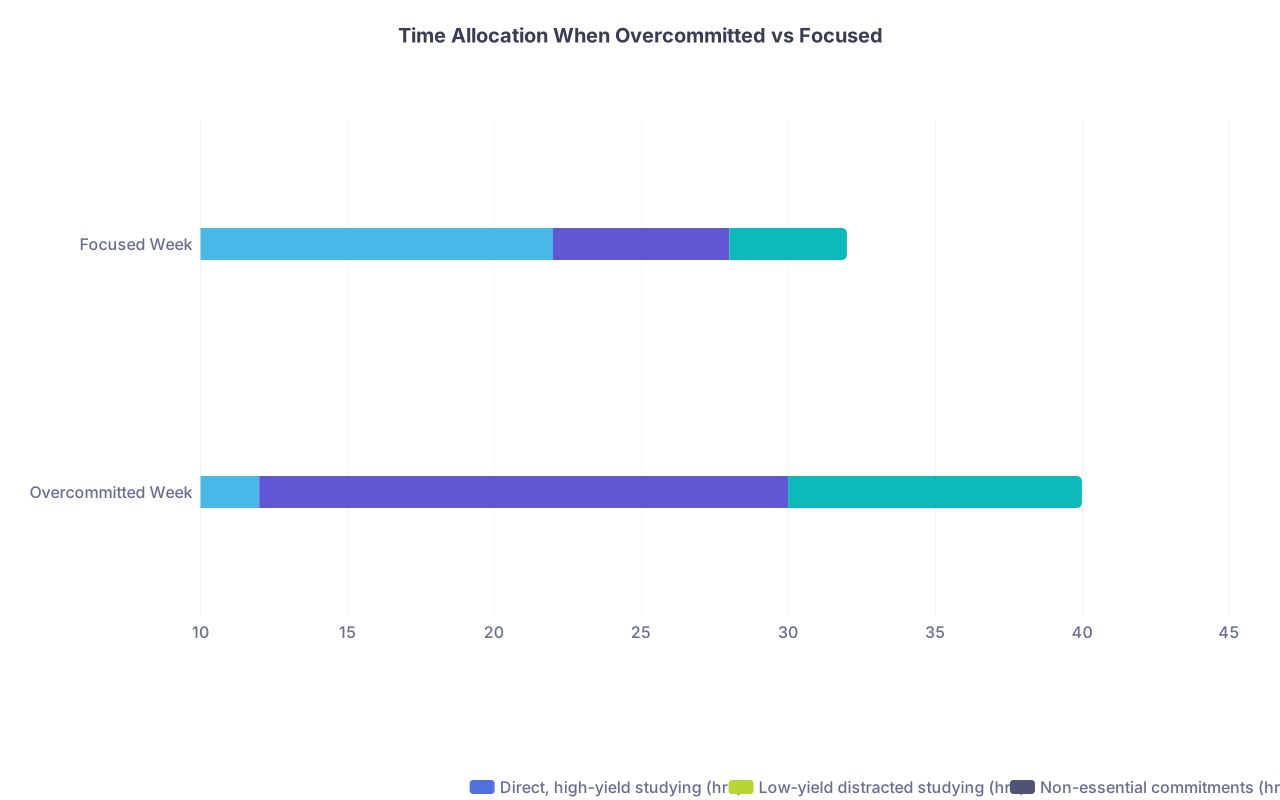
| Category | Direct, high-yield studying (hrs) | Low-yield distracted studying (hrs) | Non-essential commitments (hrs) |
|---|---|---|---|
| Overcommitted Week | 12 | 18 | 10 |
| Focused Week | 22 | 6 | 4 |
Look at that pattern. Most “busy” med students are not actually maximizing high-yield work. They are bleeding time into low-yield obligations they were too scared to refuse.
3. Relationships That Turn Transactional or Disappear
Another hidden cost: your personal life.
What I hear from overcommitted students:
- “I have not seen my partner in weeks.”
- “I call my parents on 2x speed during a walk to clinic.”
- “My friends know I am always ‘maybe’ because of my schedule.”
When you say yes to everything in med school, you are usually saying no to someone in your real life:
- No to the friend who invited you to dinner.
- No to the partner who wanted a quiet evening.
- No to yourself when you needed silence, not another Zoom.
And here is the subtle part: even when you do show up, you are half-there. Checking your phone. Thinking about the exam. Feeling guilty about the chart review you promised.
Eventually people stop inviting you. Not because they do not care. Because your life looks permanently unavailable.
4. Identity Shrinkage: You Become “The Med Student” and Nothing Else
Another serious mental health hit: you slowly erase everything that is not medicine.
- You used to play an instrument. Now it sits in a closet.
- You used to run or lift regularly. Now your back hurts from sitting.
- You used to read fiction. Now you read UpToDate “for fun.”
Saying yes to every medically-adjacent opportunity accelerates this.
You are no longer:
- A person who likes painting, running, or music. You become:
- Treasurer of X club.
- Sub-I on Y service.
- “The student who always volunteers.”
That looks impressive on paper. From the inside, it is hollow.
When boards are over and the CV games calm down, a lot of students realize: “I do not know who I am without this.” That is not a small problem. That is an identity crisis.
The System Will Not Protect You. You Must Draw the Line.
Let me be blunt. Med schools, attendings, and even residency programs talk about “wellness.” But their incentives still reward output.
They praise:
- Extra research.
- Extra leadership.
- Extra clinics.
- Extra coverage.
They rarely praise:
- Healthy boundaries.
- Protecting sleep.
- Saying “this is enough.”
So if you are waiting for an attending to tell you, “Hey, you look overextended, you should drop this project,” you will wait a long time. A few unicorn mentors will say it. Most will not.
Here is the part most students get wrong: they think they must be available to every opportunity to get strong letters or match well.
Not true.
Programs care about:
- Solid clinical performance.
- Evidence you can follow through.
- A focused story: “This person is genuinely interested in X and has done A, B, C to show it.”
- Not burning out in residency.
They do not need:
- 9 half-finished research projects.
- Leadership roles in 7 organizations.
- A personal life on fire.
High-Risk Traps: Opportunities That Look Great but Backfire Hard
Not all yeses are equal. Some are harmless. Some are landmines.
Here are the ones that most often blow up students’ mental health:
1. The “Passive” Research Project That Is Not Passive
You are told:
- “This will be low time commitment.”
- “We just need you to help with data collection.”
- “It is mostly done already.”
What actually happens:
- IRB issues delay everything.
- The dataset is a mess.
- You end up:
- Cleaning data.
- Chasing co-authors.
- Rewriting an abstract 6 times before a rushed deadline.
Red flag phrases from PIs or residents:
- “We just need a student.”
- “It should not take much time.”
- “You will probably get authorship.”
Those phrases often mean: there is no clear structure, no timeline, and you will be the free labor and project manager.
Before you say yes, ask:
- “Who is the main driver of this project?”
- “What are the concrete deliverables in the next 6–8 weeks?”
- “What is the expected time per week from me, realistically?”
- “Who will do the stats and writing?”
If they cannot answer cleanly, that “opportunity” will eat you.
2. Leadership Roles in Name-Only Organizations
Every med school has them. Clubs that:
- Have grand mission statements.
- Do very little, very slowly.
- Exist mainly to give executives a line on their CVs.
Students say yes because:
- “I need leadership.”
- “Everyone else is doing this.”
- “It might help for residency.”
Reality:
- Meetings that could have been an email.
- Endless planning for events that three people attend.
- Emotional energy spent on group dynamics and logistics.
Ask yourself:
- Does this role build a real skill I care about?
- Does this align with the specialty / interests I might actually pursue?
- Would I still want this job if it never appeared on a CV?
If the honest answer is no, skip it. You are not short on “experience.” You are short on bandwidth.
3. Unstructured “Shadowing” That Eats Your Weekends
Shadowing can be valuable. It can also be a black hole.
Red flags:
- You are asked to come “whenever you can,” with no structure.
- You are not allowed to do anything meaningful, just stand, watch, and stay late.
- You go home more exhausted than inspired.
One or two days of this is fine. Doing it weekly while you are in a heavy exam block or on a demanding rotation? That is self-sabotage.
You need:
- Defined goals: skills to observe, questions to ask.
- Clear limits: start/stop times, frequency.
You do not need:
- Three extra hours in clinic where you are too tired to absorb anything and then stay up late trying to “recover” your studying.
4. “Can You Just Help With This One Thing?” Favors
This one is sneaky.
You get:
- “Can you just help collect a few names for this event?”
- “Can you just make a quick flyer?”
- “Can you just review this survey?”
Each ask is small. But in aggregate, they crush you.
You become the “reliable person” everyone leans on. That is flattering. Until you are drowning.
You cannot fix departmental or class-level dysfunction by personally filling every gap. That is how you burn out for free.
A Simple Framework to Decide: Yes, No, or Not Now
You need something more concrete than “set boundaries.” Here is a simple filter that actually works when your brain is fried.
When a new opportunity appears, ask yourself 4 questions:
Does this clearly support my top 1–2 priorities for the next 6–12 months?
- Example priorities:
- Pass Step 1 with a competitive score.
- Explore 2–3 possible specialties meaningfully.
- Maintain baseline mental health and one real hobby.
- Example priorities:
Is there a clear ending or defined timeline?
- Good: “We need you for 6 weeks to collect data, then you are done or can opt into writing.”
- Bad: “You can help as much as you want, it is ongoing.”
Do I have at least 20–30% of my weekly time unscheduled right now?
- If your calendar is already wall-to-wall, you are borrowing from sleep, relationships, or your sanity.
Does this excite me enough that I would still want to do it if it never helped my CV?
- If the answer is no across the board, be very cautious.
| Question | Green Flag Answer | Red Flag Answer |
|---|---|---|
| Supports top priorities? | Yes, directly | Vague or unrelated |
| Clear end date / timeline? | Specific weeks/months | “Ongoing”, “We will see” |
| Enough unscheduled time this month? | Yes | Already near max capacity |
| Would I do it without CV benefit? | Yes | Definitely not |
If you cannot get at least 3 green flags, your default should be no or “not now.”
How to Say No Without Burning Bridges
You are not actually afraid of the work. You are afraid of the fallout from saying no.
So here is how to decline in a way that:
- Sets boundaries.
- Preserves relationships.
- Does not invite negotiation.
1. Keep It Short and Decisive
Mistake students make: over-explaining. When you do that, people look for angles to re-argue you into yes.
Use a structure like:
- Appreciation.
- Clear no.
- Brief reason.
- Close the loop or offer something tiny if appropriate.
Example to an attending:
“Thank you for thinking of me for this project, Dr. Smith. I am going to have to decline, because I am already at full capacity with my current research and exam schedule and do not want to overcommit and underperform. I appreciate the offer and hope we can work together on something in the future.”
To a student organization:
“Thanks for reaching out. I am not able to take on a leadership role this year because I have already committed to other responsibilities and want to protect my time for exams and personal life. Wishing you a strong year.”
Notice:
- No apologies.
- No “maybe later this semester” unless you mean it.
- No opening for them to negotiate (“I am pretty busy but…” is an invitation to push).
2. Stop Using Vague Half-Yeses
Phrases like:
- “Let me think about it.”
- “Maybe next month.”
- “I will try.”
Those are socially easier in the moment. But they:
- Keep the mental tab open in your brain.
- Force you into awkward follow-ups later.
- Signal to others you are still in play.
If you know it is a no, say no now. You do not owe anyone a week of pretending to consider something that will only stress you out.
Designing a Schedule That Actually Protects Your Mental Health
You cannot just subtract obligations. You must deliberately protect the time that keeps you whole.
Here is a sober picture of what a sustainable week might look like in pre-clinicals vs overcommitted chaos:
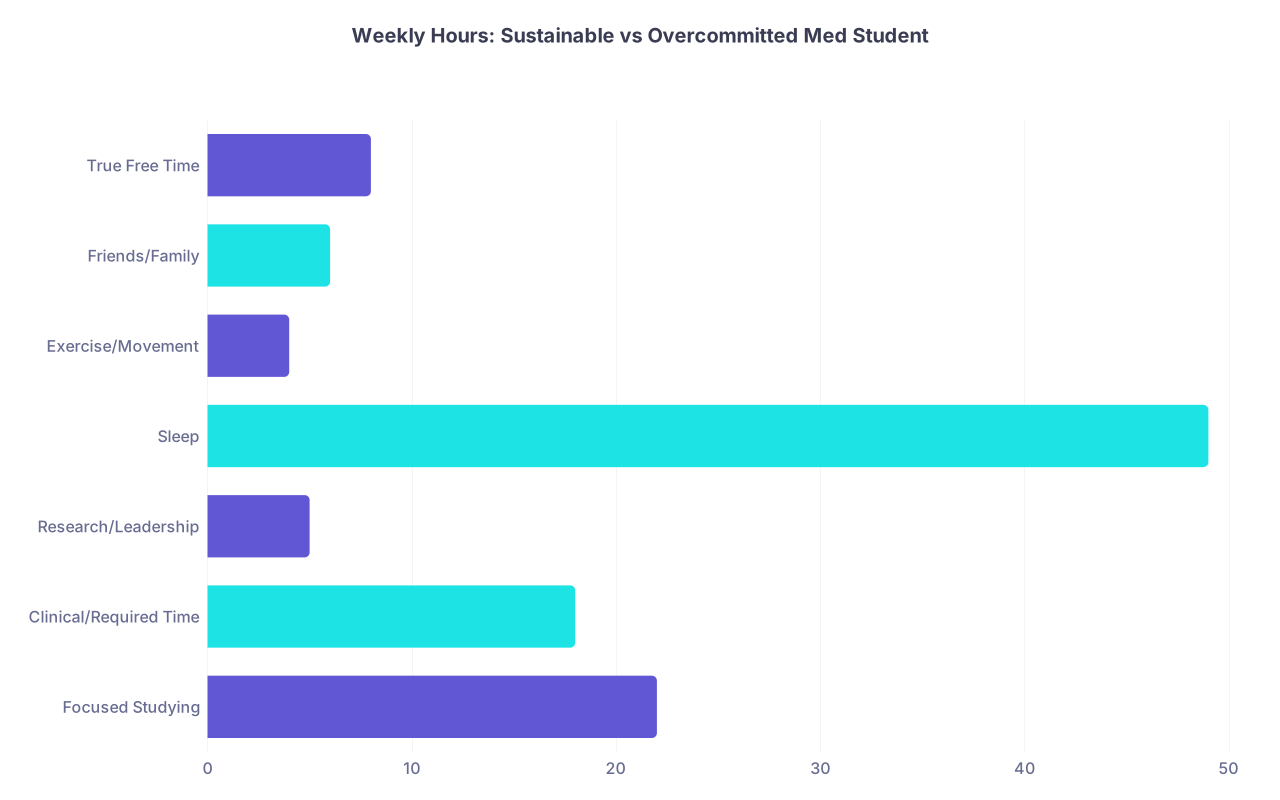
| Category | Value |
|---|---|
| Focused Studying | 22 |
| Clinical/Required Time | 18 |
| Research/Leadership | 5 |
| Sleep | 49 |
| Exercise/Movement | 4 |
| Friends/Family | 6 |
| True Free Time | 8 |
Above is a sustainable-ish mix (out of 112 waking hours minus adequate sleep). Now compare what I actually see students doing:
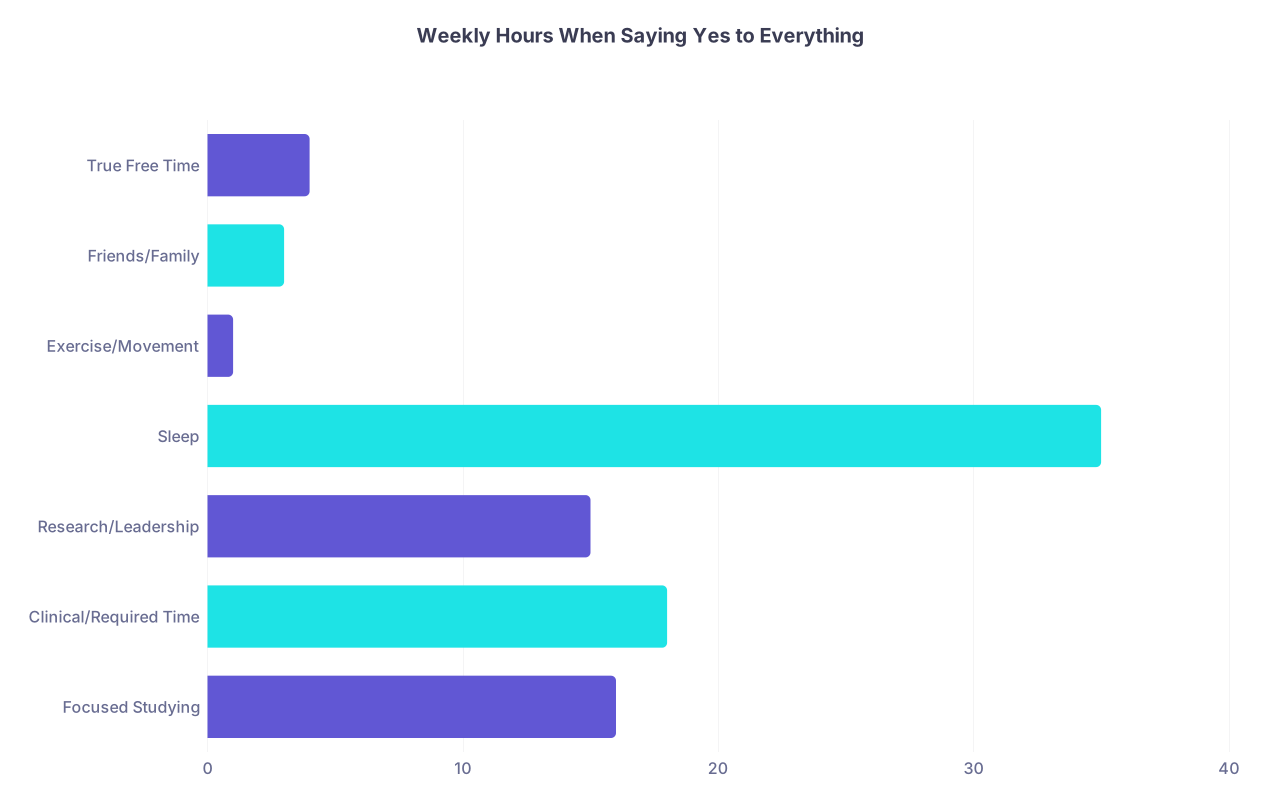
| Category | Value |
|---|---|
| Focused Studying | 16 |
| Clinical/Required Time | 18 |
| Research/Leadership | 15 |
| Sleep | 35 |
| Exercise/Movement | 1 |
| Friends/Family | 3 |
| True Free Time | 4 |
Look at the casualties:
- Sleep is cut.
- Exercise vanishes.
- Real free time evaporates.
- Research/leadership explodes.
Then students wonder why they are anxious, tired, and still feel behind.
You need non-negotiables:
- Minimum sleep window (e.g., 11 pm–6:30 am protected).
- One block of real time off weekly (no studying, no “catch up” work).
- 2–3 small movement sessions (even 20 minutes is better than zero).
- At least one meaningful conversation with someone not in medicine.
Schedule those first. Then see what is left for “opportunities.”
The Long Game: What Actually Matters for Your Future
Here is the part people do not say out loud. Most of the flashy opportunities you are pressured to say yes to… nobody cares about 3 years later.
Residency programs care about:
- Are you clinically competent?
- Do your letters describe you as reliable, kind, and teachable?
- Do you have 1–3 real things you stuck with? (A research project, a clinic, a genuine passion area.)
- Are you likely to crumble under stress or function as a team member?
You do not need:
- Fifteen poster presentations.
- A leadership position in every major student organization.
- To be the person who “never says no.”
You do need enough mental health left to:
- Show up fully on rotations.
- Learn from mistakes without falling apart.
- Be a human being with some resilience and perspective.
If you scorch your mental health to add marginal lines to a CV, that is not ambition. That is bad strategy.

| Step | Description |
|---|---|
| Step 1 | New Opportunity |
| Step 2 | Decline politely |
| Step 3 | Not now - revisit later |
| Step 4 | Say yes intentionally |
| Step 5 | Supports top 1-2 priorities? |
| Step 6 | Clear timeline & end point? |
| Step 7 | Enough free capacity this month? |
Use that as your mental flowchart. Your default is not “yes.” Your default is “prove to me you are worth my limited time.”
Final Takeaways
- Saying yes to everything in medical school is not dedication. It is a fast track to burnout, poor studying, and hollow achievements.
- Most “opportunities” have hidden costs: sleep, relationships, identity, and actual learning. You pay with your mental health even when the CV line looks good.
- You protect yourself by making your priorities explicit, using a ruthless filter for new commitments, and learning to say a clean, unapologetic no.