
If you’re crying after rotations every week, something is wrong with the system around you — not just with you.
Let me be blunt: regularly crying after clerkships is not a “normal rite of passage.” It’s common, yes. Normal, no. And if this is your life right now, you need an actual plan, not vague advice about “self-care” and “resilience.”
This is that plan.
Step 1: Name What’s Actually Making You Cry (Not Just “Rotations Are Hard”)
You cannot fix fog. You have to turn it into shapes.
When you get home after a brutal day and you’re crying in your car, your shower, or face-down on the bed, it all blends into one feeling: “I can’t do this.” But the fixes depend on the cause, and those are very different: abuse vs overload vs grief vs shame vs pure exhaustion.
For the next 5–7 days, do this:
- When you feel like crying (or after you do), write down:
- Time
- Rotation + team (e.g., “Surgery, blue team,” “IM nights”)
- Trigger (as specific as you can: “Attending ripped me apart in front of the whole team”; “patient died; first death”; “got pimped for 15 mins on something I never learned”; “my intern sighed every time I spoke”)
- What you told yourself in that moment (“I’m stupid”; “I’ll never match”; “I’m a burden”)
- What your body felt like (headache, chest tightness, nausea, shaking)
You’re not doing this for a diary. You’re doing it to map targets.
Typical patterns I see:
- Humiliation-based: attendings or residents who publicly shame, “What year are you? You don’t know this?”
- Fear-based: terrified of missing something, terrified of being evaluated poorly, terrified of getting a bad grade or LOR.
- Grief-based: frequent codes, deaths, heavy oncology or ICU rotations.
- Overload-based: constant 12–16-hour days, no breaks, studying at night, not sleeping.
- Isolation-based: feeling like everyone else is “fine” and you’re the only mess.
Each cause has a different playbook. But first you have to see the pattern on paper.
Do not overthink the writing. Two ugly lines in your notes app after you throw your backpack on the floor is enough.
Step 2: Stabilize Your Body So Your Brain Has a Chance
No, this is not “drink water and you’ll be fine.” But your nervous system is like an over-caffeinated intern—already wound tight. Any extra load tips you into tears.
You need a short-term, rotation-compatible stabilization plan. Not a fantasy wellness schedule.
Here’s the minimum viable version that I’ve seen actually work for students on surgery, medicine, OB, ICU — the hardest blocks.
Sleep: Non-negotiable floor, not ideal ceiling
Set a hard floor of 6 hours. Less than that for days in a row and your emotional regulation is shot.
- On call-heavy weeks: protect one post-call block as sacred: no studying, just food + shower + 3–4 hour nap minimum.
- If you’re “studying until midnight” just to survive shelf anxiety, cut 30–60 minutes and sleep. A 5% bump in shelf score is not worth daily breakdowns.
Micro-regulation during the day
You don’t have time for a 30-minute mindfulness session. Fine. Use 30 seconds.
Use this 3-breath pattern between patients, in the bathroom, in the stairwell:
- Breathe in through your nose for 4 seconds.
- Hold for 2.
- Exhale for 6–8 seconds through pursed lips.
- Repeat 3 times.
That’s under a minute. Do it:
- Walking to see a new admit.
- Before you call a consultant.
- After an attending grills you.
You’re not trying to feel “zen.” You’re dialing your system down from red to orange.
Bare-minimum physical care
On brutal rotations, this is the actual bar:
- Something with protein before you leave home (even 2 hard-boiled eggs or a protein bar).
- One real meal during the day. If that means pre-packing something you can eat in 7 minutes cold, do it.
- One bottle of water or electrolyte drink finished before noon.
Set a reminder on your watch or phone for two times: 10:30am, 2:30pm. At each:
- 3 breaths
- 3 big gulps of water
That’s it. You can do that even on trauma surgery.
Step 3: Separate “I’m Struggling” From “I’m Unsafe”
Sometimes you’re crying because this is a hard, emotionally intense training period.
Sometimes you’re crying because you are in a toxic or abusive environment.
You have to distinguish those, because the response is different.
Here’s a fast triage:
| Situation Type | Red Flags Present? | What This Usually Means |
|---|---|---|
| Emotional Struggle | No | Normal stress, heavy content |
| Borderline Toxic | 1–2 | Needs boundaries + support |
| Clearly Unsafe | 3+ | Needs escalation/intervention |
Red flags (count how many apply on your current team):
- Regular public humiliation or screaming.
- Threats about your career or future (“You’ll never be a doctor if…”).
- Retaliation or threats about evaluations if you speak up or set boundaries.
- Overt discrimination, racism, sexism, homophobia, etc.
- Expectation of illegal/unethical behavior (forging notes, falsifying times, unsafe orders).
- You feel dread that resembles fear, not just stress, every single day.
- 0 red flags: you’re in “this is hard, but not unsafe” territory. Focus on coping, structure, support.
- 1–2 red flags: you’re on a borderline-toxic team. You need containment and selective escalation.
- 3+ red flags: you’re in a potentially unsafe environment. This is where we talk to higher-ups, formally or informally.
Keep this classification in mind as we go forward.
Step 4: Build a Two-Person Minimum Support Team (Not 10 People, Just 2)
Medical school breeds secrecy. Everyone looks “fine.” So you assume you’re the only one falling apart in the parking lot.
You are not.
But you cannot keep this inside your own head and expect it to get better. You need, at minimum, two people in your corner:
- One peer-level person (classmate, co-rotator, close friend in med school).
- One institution-level person (advisor, student wellness counselor, dean of students, psychologist, or therapist).
How to tell a peer without feeling pathetic
You don’t need a TED talk. Send something like:
“Hey, I’m getting wrecked by this rotation and crying more days than not. Do you have 10 mins to talk sometime this week? I just need another human who gets it.”
Or after sign-out, while walking out:
“Is this rotation killing you too or is it just me? I’ve cried 3 times this week already.”
You’re not asking them to fix you. You’re breaking the isolation.
How to approach an institutional person
Almost every med school has some combination of: student wellness center, mental health services, academic support dean, or an ombuds office. Pick one.
Your script for an email can look like this:
“Hi Dr. X,
I’m a third-year on [rotation]. For the last few weeks I’ve been crying multiple times a week after leaving the hospital, and it’s starting to affect my sleep, studying, and sense of safety. I’d like to talk about how to handle this rotation and my mental health.
Are you available for a short meeting (in person or virtual) sometime this week?
Thank you,
[Name], MS3”
You’re not “weak” for sending this. You’re doing what functioning physicians do all the time: consulting someone when they’re out of their depth.
Step 5: Tactical Changes for the Next 1–2 Weeks on Rotation
Let’s get brutally practical now. What can you change this week?
1. Adjust your role expectations
A lot of the crying comes from this belief: “I must be perfect or I’ll fail and never match.”
Let me correct that for clerkships:
Your job is to be:
- Safe
- Teachable
- Prepared at a reasonable level
- Reliable
Not omniscient. Not superhuman.
Ask your resident tomorrow:
“What does a really solid medical student on this rotation look like to you?”
Let them define the bar. It’s usually less insane than the one in your head.
2. Use structured pre- and post-day rituals
You need psychological “bookends” so the rotation doesn’t eat 24 hours of your mental real estate.
Morning (5 minutes):
- One page of a notepad: three bullets only
- 1 patient you want to understand better
- 1 clinical skill to focus on (e.g., “improve my presentation flow,” “practice writing one good assessment/plan”)
- 1 self-care boundary (e.g., “leave by 6:30 unless I’m actively helping,” “eat something before noon”)
After you leave the hospital (10–15 minutes):
- Sit in your car or on your bed. Write:
- 1 thing that went badly or felt awful (yes, you’re allowed to say it sucked).
- 1 thing you handled okay (even if small: “I checked on that patient twice”; “I asked for help when I was confused.”)
- 1 thing you’ll carry forward tomorrow.
Then physically close the notebook. That’s you signaling: “Workday is over.” Your brain needs that boundary or it will chew on the day until 2am.
Step 6: If the Problem Is a Toxic Team or Attending
If your crying is directly tied to one person or team culture, you need a plan that doesn’t blow up your evals but also doesn’t keep you silently absorbing abuse.
This is tricky but doable.
Document quietly
In a secure note (not on hospital computers, not in the EMR):
- Date/time
- Who was present
- Exact words or behaviors (as close as you remember)
- How it affected you (emotionally, functionally)
You’re not being dramatic. You’re creating a factual record that, if needed, can back you up with an advisor or dean.
Use low-key boundary phrases in the moment
You don’t have power to “fix” an attending. You do have some power in how you absorb and how you respond.
Examples:
When you’re being grilled and it’s spiraling into shame:
“I’m not sure of the answer right now. I’d like to look this up and get back to you this afternoon.”
When an attending/resident is publicly humiliating you:
“I hear your feedback. I’ll work on this. If there are specific resources you recommend, I’d appreciate it.”
You’re not arguing. You’re subtly redirecting them from global character attacks to specific actionable feedback. Some will adjust. Some won’t. But you’re preserving your own internal boundary: “I am a learner, not a punching bag.”
Escalate strategically, not impulsively
If you have 2–3 documented episodes of abusive or unsafe behavior, bring them to:
- A trusted faculty mentor who is not on your grading chain for this rotation
or - Your student affairs dean / clerkship director (if they are known to be student-friendly)
You can say:
“I’m not trying to get anyone in trouble. I’m also not okay with how this is affecting my mental health and my learning. I’d like help figuring out how to proceed. Here are a few specific incidents I’ve documented.”
You’re asking for help, not walking in to start a war. That framing matters.
Step 7: When Crying Weekly Might Mean Depression, Anxiety, or PTSD
Sometimes this isn’t “just rotation stress.”
Red flags that you’re crossing into clinical territory:
- You’re crying multiple times per week for >3–4 weeks.
- You’ve lost interest in everything outside medicine (friends, hobbies, family).
- Sleep is either trash (early awakening, can’t fall asleep) or you’re sleeping 10+ hours and still exhausted.
- You’re having intrusive memories or images of clinical events.
- You’re starting to think: “If I got into a car accident and didn’t have to go in, that would be a relief.”
That’s not weakness. That’s your brain and body telling you they’re in overload.
At that point, you should:
- Schedule a mental health evaluation with a therapist, psychologist, or psychiatrist (through your school or outside).
- Be honest. Say the sentence out loud:
“I am crying after rotations almost every week and I don’t know how much longer I can do this.”
If a clinician suggests time off, medication, or formal accommodations, that is not the end of your career. I’ve seen plenty of residents and attendings who took time out in med school, used medications for a while, or needed accommodations. Their patients do not care. Their competence is not reduced to whether they once needed help.
Step 8: Adjust Your Study Strategy So It Stops Being Another Source of Shame
Another major cry-trigger: feeling like you’re failing both the clinical day and the exam expectations.
You will not survive if every night looks like: 14-hour day → 3–4 hours of UWorld → guilt → sleep at 1am.
Instead, move to an 80/20 approach:
- On heavy days: 20–30 minutes of intentional study. That’s it.
- On lighter days/off days: longer dedicated blocks.
For heavy days, pick one of these:
- 10 practice questions with full review.
- 3–5 pages of concise notes on topics that came up that day.
- One short video on a disease you saw.
Tie studying to your actual patients. It feels more relevant and less like extra punishment.
And let me say this clearly: a slightly lower shelf score is acceptable if the trade-off is your mental health staying intact. No one will care in five years whether you got a 75th vs 60th percentile on your surgery shelf. They will care if you burned out so hard you quit.
Step 9: Decide: Survive This Rotation vs Change the Bigger Picture
There are two time scales here.
- Acute (this week / this rotation): How do I stop crying constantly and make it through without breaking?
- Chronic (this year / this training path): Do I need to reconsider pace, supports, specialty choice, or school resources?
Once you’re not in constant breakdown mode, ask yourself some sharper questions:
- Is this emotional pattern happening on every rotation, or only the malignant ones?
- Do you feel fundamentally interested in medicine but crushed by training culture?
Or fundamentally misaligned with clinical medicine itself? - Have you felt like this (weekly crying, dread) since before clerkships? Or did it start with specific teams?
If it’s every rotation, every environment, and this has been going on for months or years, you’re not weak for asking deeper questions like: “Is this the right field for me?” That’s not betrayal. That’s honesty.
If it’s specific rotations/teams, your job is to build a system that can hold you up through the worst months: therapy, mentors, peers, realistic limits, and the knowledge that some of these cultures are simply broken—and temporary.
Visual: What a Stabilized Week Might Look Like
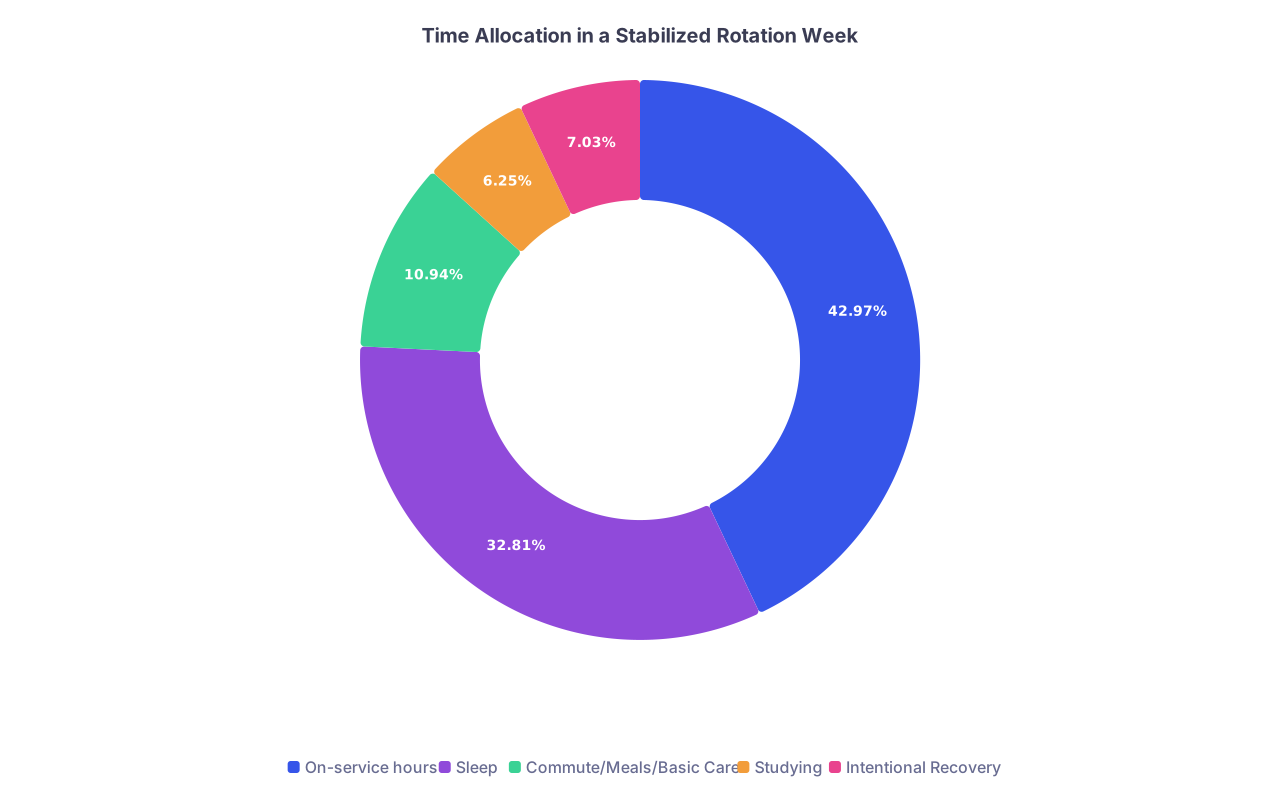
| Category | Value |
|---|---|
| On-service hours | 55 |
| Sleep | 42 |
| Commute/Meals/Basic Care | 14 |
| Studying | 8 |
| Intentional Recovery | 9 |
That “Intentional Recovery” slice (calls with friends, therapy, a walk, zoning out with a show without guilt) is not optional fluff. It’s the buffer between you and collapse.
Process Map: Handling a Breakdown Week on Rotation

| Step | Description |
|---|---|
| Step 1 | Notice repeated crying after rotations |
| Step 2 | Track triggers for 5-7 days |
| Step 3 | Focus on coping & structure |
| Step 4 | Document & adjust boundaries |
| Step 5 | Consult mentor/dean about toxicity |
| Step 6 | Build 2-person support team |
| Step 7 | Short-term body stabilization plan |
| Step 8 | Adjust study strategy |
| Step 9 | Maintain supports & finish rotation |
| Step 10 | Formal mental health eval & consider accommodations |
| Step 11 | Red flags present? |
| Step 12 | Symptoms improving in 2-3 weeks? |
How to Know You’re Actually Making Progress
Progress in this context is not “I’m happy now.” It looks like:
- You still cry sometimes, but not every week.
- The episodes feel more like pressure release than full meltdowns.
- You’re able to sleep without replaying the day for hours.
- You can name 1–2 people you can text on a bad day and actually do it.
- You’re angry at the system sometimes, not just ashamed of yourself constantly.
If none of this is shifting after 3–4 weeks of:
- basic body stabilization,
- support from at least one institutional person,
- and some attempt at therapy or counseling,
then this is no longer an issue to “push through.” This is where you say to your dean or counselor: “What I’m doing is not enough. What other options do we have?” That can mean schedule changes, time off, leave, or a more intensive treatment plan.
You are not failing by needing that. You are doing exactly what we tell patients to do.
FAQ (Exactly 3 Questions)
1. Is it “normal” for med students to cry this often during rotations?
Common, yes. Normal, no. A single rough day that ends in tears every now and then is completely expected in clinical training. Crying multiple times a week for weeks on end, dreading every day, and feeling like you’re barely holding it together is a sign that your load is exceeding your current support and coping. That might be because of a malignant team, perfectionistic expectations, unaddressed depression/anxiety, or all of the above. The point isn’t whether it’s “normal.” The point is that you shouldn’t just accept it as the cost of becoming a doctor.
2. Will talking to a dean or advisor about this hurt my grades or residency chances?
In most schools, no—if you’re smart about who you talk to and how. Choose someone outside your grading chain for that rotation (e.g., student affairs dean, wellness office, a faculty mentor in another department). Be concrete: describe specific behaviors, your symptoms, and what you’ve already tried. Frame it as wanting help to succeed, not as trashing your team. Programs and schools are under a lot of pressure now to address mistreatment and burnout; many will work with you to adjust your schedule, advocate quietly, or connect you with resources. Silence hurts you far more than a respectful, documented conversation.
3. How do I know if I should take a leave of absence vs just push through?
You consider leave when:
- Your functioning is tanking across the board (sleep, appetite, relationships, ability to concentrate).
- You’re having persistent thoughts like “I wish I wouldn’t wake up” or “if I got into an accident that took me out of rotations, that’d be a relief.”
- Even with therapy, medication (if used), and support, you’re not improving over several weeks.
- Your mental health provider recommends it.
Pushing through a temporary rough block makes sense if you can still find some stability day-to-day and your symptoms are starting to soften with support. Taking leave makes sense when continuing at the current pace is actively worsening your condition. A good mental health clinician, together with a trusted dean or advisor, can help you make that call in a way that protects both you and your long-term career.
Key points, stripped down:
- Weekly crying after rotations isn’t something you just “tough out.” Track triggers, stabilize your body, and get at least two people in your corner.
- Distinguish hard-but-fair training from toxic or unsafe environments; what you do next depends on which one you’re in.
- If you’ve tried supports and you’re still breaking, this is a mental health issue, not a character flaw—and you need formal help and possibly structural changes, not more grit.