
The way most medical students consume content is breaking their brains.
Endless Anki cards. Group chat firehose. Lecture recordings at 2x. UWorld. AMBOSS. Boards & Beyond. Pathoma. Sketchy. Discord. Reddit. Instagram reels with “top 5 memorization hacks.”
It is not a study plan. It is a denial strategy. You drown yourself in content so you do not have to confront the fact that your mental bandwidth is shot.
Let’s fix that.
You do not need more resources. You need a system to protect and direct your attention. What follows is a 7‑step protocol I have used with students who were one notification away from burning out and walking away from medicine. It is structured, specific, and absolutely doable while in the middle of exams or boards prep.
Step 1: Diagnose Your Bandwidth Leaks (30–45 Minutes)
Before you change anything, you need a brutally honest audit of where your brain is getting shredded.
Grab a sheet of paper. Not your Notes app. Actual paper. Draw three columns:
- Column A: Inputs
- Column B: Time per day
- Column C: Mental load (1–5, where 5 = completely draining)
Now list every single content source you touch in a typical weekday:
- Official: lectures, small groups, recorded sessions, required readings, LMS announcements
- Study: question banks, flashcards, review videos, outlines, textbooks
- Digital noise: group chats, Discord/Slack, Reddit, Instagram/TikTok, YouTube “study” videos
- Email: school announcements, research projects, extracurriculars, admin stuff
- Life: news, podcasts, Netflix, random scrolling
Estimate time honestly. Not what you wish were true.
Example from a second-year I worked with:
- Lectures (live/recorded) – 3 h – Load 3
- Anki – 2.5 h – Load 4
- UWorld – 1.5 h – Load 5
- Boards videos – 1.5 h – Load 4
- Group chats (WhatsApp + Messenger) – 1 h – Load 4
- Instagram/TikTok – 1.5 h – Load 3
- Reddit / Student Doctor Network – 30 min – Load 3
- Email – 30 min – Load 2
- Random YouTube – 45 min – Load 2
Total: 12+ hours of content hitting the brain. Daily. On top of existing stress.
Now circle the worst offenders:
- Anything with Load 4–5 that is not clearly essential to passing exams
- Anything you touch more than 60 minutes per day
You have just identified your primary bandwidth leaks. Do not try to fix all of them at once. You will fail. We will prioritize them in later steps.
Step 2: Shrink Your Content Universe on Purpose
You cannot process everything. The fantasy that “more sources = better prepared” is one of the biggest lies in med school culture. I have watched students with three resources beat students with ten resources over and over. Consistency wins. Not volume.
You need a Primary Stack and a Secondary Stack.
2.1 Build a ruthlessly simple Primary Stack
Your Primary Stack is what you commit to doing consistently. Everything else is optional seasoning.
For preclinical or Step/COMLEX prep, a solid Primary Stack usually looks like:
- 1 question bank (UWorld or AMBOSS – not both daily)
- 1 flashcard system (Anki or a focused deck you maintain)
- 1 content source (Boards & Beyond / Pathoma / Sketchy / school slides)
That is it. Three pillars.
- 1 question bank per rotation (UW/AMBOSS/Case Files questions)
- 1 concise text (Case Files, UptoDate summary, OnlineMedEd videos)
- Required patient care + notes (which is a cognitive load by itself)
Write your Primary Stack at the top of a notecard and tape it to your desk:
“Primary Stack: UWorld, Anki, B&B videos aligned to tomorrow’s lectures.”
If something is not on that card, it is not core. It might still have a role, but it goes to the Secondary Stack.
2.2 Put everything else in the Secondary Stack
Secondary = situational. You use it when you have extra bandwidth or a clear gap to fill, not by default. This usually includes:
- Extra videos (Sketchy if you are visual, Pathoma if you are pathology heavy)
- Supplemental texts (First Aid, UptoDate deep dives)
- Extra question sources (NBME practice, Rx, Kaplan)
The rule: You are never allowed to use Secondary resources until your Primary tasks for the day are done. Never. That one rule alone has pulled several students out of “fake studying” spirals.
Step 3: Build a Daily Mental Bandwidth Budget
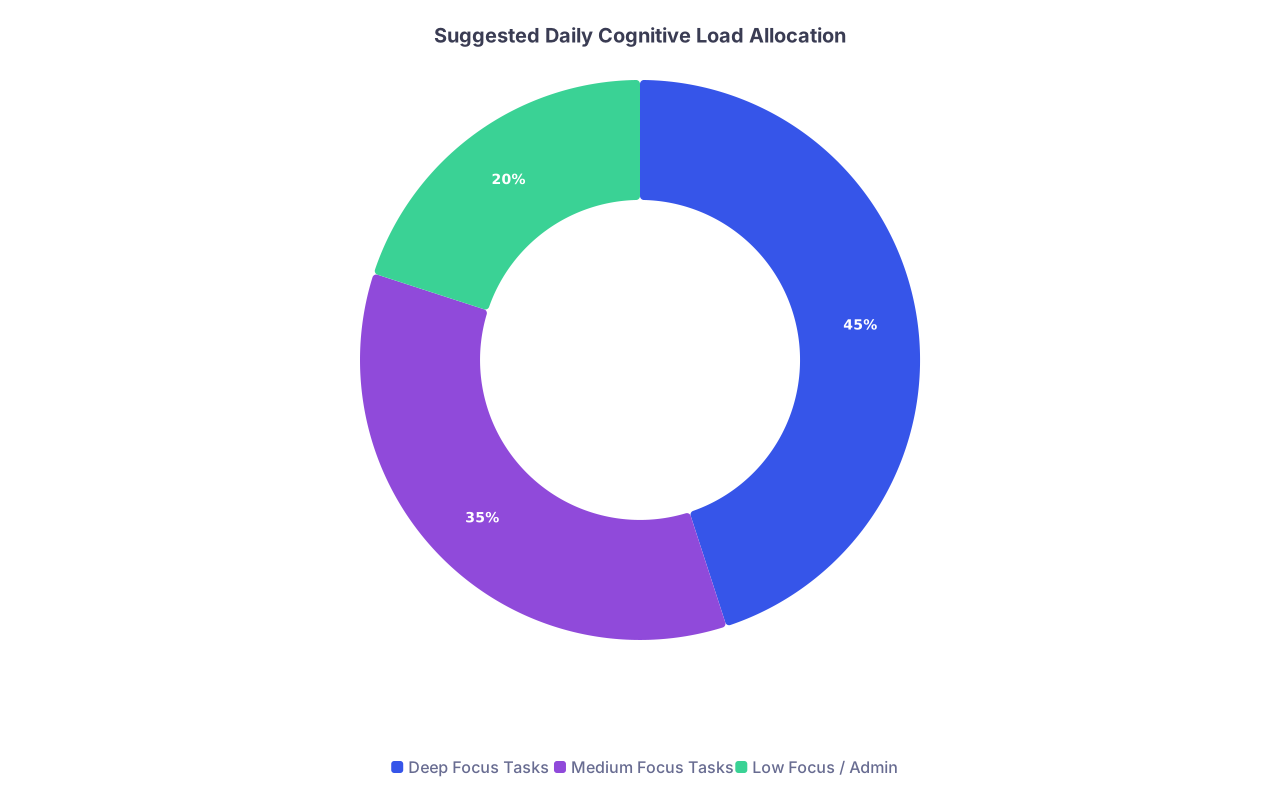
Your brain has a finite serious‑thinking capacity per day. Treat it like a budget, not an infinite charity fund.
Most students have:
- 3–5 hours of high‑quality focus (deep work)
- 2–3 hours of medium focus (routine flashcards, light reviewing)
- Low-quality scraps at the end of the day (social media, TV, half‑awake re-reading notes)
You will spend the high‑quality hours on the tasks that most directly move the needle: questions and active recall. Not on rewatching lectures for the third time.
3.1 Divide your day into blocks
Use rough blocks, not minute‑level micromanagement:
- Block 1 (Deep): 2–3 hours – immediately after you wake up and have eaten
- Block 2 (Deep/Medium): 2–3 hours – late morning/early afternoon
- Block 3 (Medium): 1–2 hours – later afternoon
- Block 4 (Low): whatever is left
Now plug in your Primary Stack, in order of cognitive demand:
- Block 1: New question bank blocks (e.g., 40 questions + review)
- Block 2: Anki + “fix your gaps” from today’s questions with your main content source
- Block 3: Lecture review / tomorrow’s material / lighter reading
- Block 4: Life admin, email, social, trash‑tier content
| Category | Value |
|---|---|
| Deep Focus Tasks | 45 |
| Medium Focus Tasks | 35 |
| Low Focus / Admin | 20 |
The key: you stop pretending your brain can do “hard mode” from 7 AM to midnight. It cannot. And trying to forces you into endless content hopping, which kills retention and spikes anxiety.
Step 4: Install Hard Boundaries on Digital Noise
If you keep all your notifications on, it does not matter what study plan you make. Your attention will be sliced into 5‑second fragments all day. You cannot regain mental bandwidth if your phone owns you.
You need structural fixes, not vague promises like “I will use my phone less.”
4.1 The 3 App Rule
Pick three categories that are allowed to interrupt you during study:
- Emergency communication (parents/partner/one close friend)
- Critical school admin (pager, official email if required)
- One messaging platform your team actually uses (WhatsApp or GroupMe, not eight apps)
Everything else loses the right to buzz.
Concrete steps:
Turn off all notifications for:
- Social media
- Non‑urgent group chats
- News apps
- Shopping / random apps
Move tempting apps off your home screen.
- Put them in a folder on the last page called “Later.”
- Add friction. If your thumb opens them by habit, you want it to fail at least once.
Use “Do Not Disturb” or “Focus” modes during Blocks 1 and 2.
- Allow calls from “Favorites” only.
- Disable message previews on lock screen.
If your brain is arguing with this already (“But my class group chat is essential!”) you have identified part of the problem. Most group chat traffic is anxiety, gossip, or last‑minute panic, not crucial information.
4.2 Scheduled checking protocol
Set specific windows to check non‑urgent stuff:
- Once mid‑day (10–15 minutes)
- Once early evening (10–20 minutes)
Outside those windows, it is off‑limits. If that sounds drastic, remember: this is not forever. It is an intervention to stop the hemorrhaging.
Step 5: Switch from Passive Consumption to Active Processing
You are overwhelmed largely because you consume too much and process too little. Endless input, minimal consolidation. Your brain stays in “inbox overflow” mode.
The fastest way to regain bandwidth is to convert most of your study from passive to active.
5.1 The 80/20 Active Study rule
Aim for at least 80% of study time spent on active methods:
- Doing questions
- Teaching concepts out loud (to a friend or your wall)
- Writing from memory (brain dumps, one‑page summaries)
- Explaining a mechanism step by step without looking
Passive methods (videos, re-reading, highlighting) are allowed, but only:
- To prime before active work (short targeted segments)
- To patch holes exposed by questions
An example daily structure for an MS2 during systems:
- 60–90 min: 40‑question block (mixed or system‑specific) – fully timed
- 90–120 min: Review each question deeply:
- Why is the correct answer correct?
- Why is each wrong answer wrong?
- What pattern is being tested?
- 60–90 min: Anki (focused + custom cards from missed questions)
- 60 min: Targeted content pass (video/text) ONLY on repeatedly weak topics from today’s questions
Notice what is missing: random video binging “just to understand better.” That is bandwidth theft disguised as productivity.

5.2 The One‑Pass Lecture rule
For school content: one serious pass. Not three half‑assed passes.
Protocol:
Before lecture (5–10 min):
- Skim objectives and a few key headings
- Write 3–5 questions you expect to be able to answer after (on paper)
During:
- Minimal notes. Focus on mechanisms, not transcription.
- Mark anything that seems exam‑able with a star.
After (within 24 hours, 30–45 min):
- Close the slides.
- Answer your pre‑written questions from memory.
- Turn unclear points into Anki cards or questions for your professor.
You do not go back and rewatch entire lectures unless you genuinely missed them and they are truly exam‑critical. And even then, you watch at 1.5–2x with a clear objective.
Step 6: Create “Bandwidth Recovery” Rituals (Micro and Macro)
You will not regain mental bandwidth if your only rest is doomscrolling lying in bed at 1 AM. That is not rest. It is self‑inflicted cognitive noise.
You need rituals that actually let your brain clear the buffer.
6.1 Micro‑resets during the day
Use 5–10 minute resets between blocks, not 45‑minute “breaks” that turn into an Instagram coma.
Good micro‑resets:
- Short walk without your phone
- 5 minutes of box breathing (4–4–4–4) or 4–7–8 breathing
- Stretching / mobility
- Staring out the window, not at a screen
- Making tea or a snack deliberately, no multitasking
Bad micro‑resets:
- Checking social media “for 2 minutes”
- Opening YouTube
- Answering non‑urgent messages
6.2 Macro‑recovery each day
You need at least one protected non‑study block daily where your brain is assigned only one job: be human.
This is not optional. This is maintenance.
Options:
- 45–60 minutes of exercise (gym, run, home workout)
- Dinner with a roommate or partner where phones stay off the table
- A hobby that is not pre‑med adjacent (music, art, gaming in moderation, reading something non‑medical)
You will feel guilty at first. That is the conditioning talking. Keep going anyway. Without real recovery, your “study” time becomes low‑quality sludge.
6.3 Weekly reset
Once a week (Sunday often works), do a 30‑minute reset:
Review last week:
- What actually got done?
- Which resources did you actually use?
- What felt most draining for the least gain?
Plan the coming week:
- Exam dates, assignment deadlines, major labs/clinics
- Where your deep work blocks will fit each day
- One concrete bandwidth fix to test (e.g., “No phone in the bedroom,” “40 questions every morning at 8.”)
Put this in your calendar like an appointment with someone important. Because it is.
Step 7: Build a Failsafe for When You Crash
You will have days when everything falls apart:
- Overnight call wrecked your sleep
- You bombed an exam and spiral on Reddit
- Family crisis, health scare, conflict with an attending
On those days, your normal plan is too heavy. If you force it, you will binge‑consume content in desperation, absorb none of it, and feel worse.
You need a Bare Minimum Protocol pre‑decided, so you are not making it up in crisis.
7.1 Design your Bare Minimum Protocol
Write this down somewhere visible. It should include:
One essential academic task:
- Example: “Do 20 high‑quality questions and review them.”
- Or: “Finish my Anki due cards only (max 60 minutes).”
One maintenance task:
- Eat one real meal away from your study space
- Take a 20–30 minute walk outside
- 10 minutes of stretching or yoga
One clean boundary:
- “No starting new resources today.”
- “Off screens 60 minutes before bed.”
That is it. If you do those three, the day is a success. Call it done. The point is to protect the system and prevent the shame spiral, not to “catch up.”
7.2 Recognize when “overwhelmed by content” is actually “I am not okay”
Sometimes content overload is a symptom, not a cause.
Pay attention if:
- You cannot focus on even simple tasks
- You feel detached, numb, or constantly on edge
- Sleep is wrecked for more than a week straight
- You are using constant content (podcasts, videos, noise) to avoid silence
At that point, you are not dealing with a study planning problem only. You are dealing with mental health, and you need real support.
Minimum actions:
- Email or message your school’s wellness/mental health office this week. Yes, even if you “don’t have time.”
- Tell one person in your real life, “I am not doing well; can we talk?”
- If you have thoughts of self‑harm or feel you might hurt yourself, you seek emergency help. That is non‑negotiable.
A system helps, but it is not a substitute for treatment when you are in real distress.
Putting the 7‑Step System Together
Let me stitch this into something you can actually run.

| Step | Description |
|---|---|
| Step 1 | Audit Inputs |
| Step 2 | Choose Primary Stack |
| Step 3 | Create Daily Bandwidth Budget |
| Step 4 | Lock Down Digital Noise |
| Step 5 | Shift to Active Study |
| Step 6 | Add Recovery Rituals |
| Step 7 | Define Bare Minimum Protocol |
| Step 8 | Weekly Review and Adjust |
A simple 7‑day implementation plan
Stop trying to flip your whole life overnight. Use a one‑week rollout.
| Day | Focus Change | Example Action |
|---|---|---|
| 1 | Audit | Complete content/time/mental load list |
| 2 | Stack | Define Primary and Secondary resources |
| 3 | Budget | Set deep/medium/low blocks for 1 day |
| 4 | Digital | Turn off non-essential notifications |
| 5 | Active | Convert 50–80% of study to questions/recall |
| 6 | Recovery | Establish daily micro/macro reset rituals |
| 7 | Failsafe | Write your Bare Minimum Protocol and do a weekly review |
If you do only these seven concrete changes over the next week, your sense of overwhelm will drop. Not to zero. But enough that you can think again.
Two Common Patterns I See (And How This System Fixes Them)
Pattern 1: The Content Collector
Profile:
- 6+ resources “in progress”
- Starts new video series whenever anxious
- Has enormous “to‑watch” and “to‑read” lists, does not finish any
System fixes:
- Step 2 forces a Primary Stack and relegates the rest
- Step 5 blocks passive bingeing unless driven by question gaps
- Step 7 prevents guilt‑driven content marathons on bad days
Pattern 2: The Notification Hostage
Profile:
- Phone face up on desk during study
- Replies to messages within seconds
- Constantly checking class group chat for “important info”
System fixes:
- Step 4 kills non‑essential interruptions and schedules check‑ins
- Step 3 protects deep work windows where no one gets access
- Step 6 teaches actual breaks that are not just more screen time
You probably see yourself in at least one of those. Most students do.
FAQs
Q1: What if my school requires a ridiculous amount of content, and I literally cannot cut any of it?
Then you prioritize how you engage with it, not how much. You still:
- Choose a Primary Stack for exam‑critical learning (e.g., your school’s slides + one question bank + Anki)
- Use lectures as a source of testable points, not as a script to memorize
- Apply the One‑Pass Lecture rule
- Protect deep question blocks daily, even if they are shorter (20–30 questions)
- Aggressively reduce non‑school digital noise, because that is the only thing you fully control
You may not be able to shrink input volume much, but you can stop adding unnecessary sources and you can make processing dramatically more efficient.
Q2: How do I know if I am cutting “too much” and under‑preparing?
Use feedback, not fear. If your:
- Question bank performance is trending up over 2–4 weeks
- Class exam scores are stable or improving
- You can explain major concepts out loud without looking at notes
then you are not under‑preparing, even if you are doing fewer resources. If metrics start to drop, you do not add five new resources. You adjust:
- Slightly more time to weak subjects during Block 2
- More targeted use of your existing Secondary resource
- Briefly increasing questions per day before an exam
The goal is not to feel “busy.” The goal is to feel clear and to see measurable improvement.
Open your notes app or grab a notecard right now and write down your Primary Stack and Bare Minimum Protocol. Put that card where you study. Today, follow it for just one deep work block. Not tomorrow. Today.