
The constant guilt cycle is not a personality flaw. It is a broken mental algorithm that medical training accidentally rewards and reinforces.
If you feel guilty when you study, guilty when you rest, guilty when you say no, and guilty when you say yes—you are not “just like this.” You are running a specific cognitive pattern that can be mapped, tested, and fixed.
This is the framework to do that.
1. Understand the Guilt Algorithm You Are Running
Before you fix it, you need to see it clearly. Not philosophically. Mechanistically.
Here is what I keep hearing from med students when they finally say the quiet part out loud:
- “If I am resting, I feel like I should be studying.”
- “If I am studying, I feel like I am still behind.”
- “If I am with family, I feel like I am neglecting medicine.”
- “If I am doing research, I feel like I am neglecting Step prep.”
- “Whatever I pick, it feels like the wrong thing.”
That is not random emotion. That is a repeatable loop.

| Step | Description |
|---|---|
| Step 1 | Trigger: Choice of how to spend time |
| Step 2 | Automatic Thought: It is not enough |
| Step 3 | Emotion: Guilt / Anxiety |
| Step 4 | Behavior: Overcompensate or Avoid |
| Step 5 | Outcome: Temporary relief + more behind |
| Step 6 | Belief strengthened: I am never doing enough |
This is the “constant guilt cycle” in structural form:
- Trigger
- You choose: study / sleep / gym / call your mom / watch Netflix.
- Automatic thought
- “This is not the best use of my time.”
- “Other people are doing more.”
- “If I were serious, I would be doing X instead.”
- Emotion
- Guilt. Shame. Anxiety. Sometimes resentment.
- Behavior
- You:
- Study longer but less effectively, or
- Multitask (half-studying, half-scrolling), or
- Freeze and avoid (YouTube, reels, meaningless “planning”), or
- Jump tasks constantly to chase the feeling of “the right thing.”
- You:
- Outcome
- Less real progress. More exhaustion.
- You end the day with fewer concrete wins than you could have had.
- Belief reinforced
- “See? I am behind. I really am not doing enough.”
- The algorithm tightens its grip.
You are not lazy. You are running code that guarantees dissatisfaction.
The good news: cognitive algorithms can be rewritten.
2. The Cognitive Framework: Separate Three Layers
You cannot fix guilt by telling yourself “do not feel guilty.” That is like telling a tachycardic patient “just slow your heart rate by willpower.”
You fix it by separating three layers that are currently fused together in your head:
- Values – What actually matters to you long-term.
- Standards – What “good enough” looks like for this specific phase.
- Metrics – What you will actually measure day to day.
Most med students mash these into one vague inner rule:
“I must always be maximizing my future success.”
That is garbage as a working rule. It is untestable, undefined, and punishes you for being human.
We will rebuild each layer.
3. Step 1 – Audit Your Hidden Rules (Cognitive Restructuring Lite)
You cannot adjust a rule you have not written down. So write them down.
Take 10–15 minutes. Pen and paper. Not in your head.
3.1 Extract your guilt rules
Write: “I feel guilty when…” and finish that sentence with as many specifics as you can.
Examples I have seen over and over:
- “I feel guilty when I stop studying before 11 pm.”
- “I feel guilty when I take a full day off.”
- “I feel guilty when I do not respond to group messages immediately.”
- “I feel guilty when I am not doing something that improves my CV.”
- “I feel guilty when I am not using Anki every single day.”
Then write: “Because that means I am…” and finish it for each.
- “…wasting my potential.”
- “…falling behind my classmates.”
- “…not serious about matching into derm / ortho / whatever.”
- “…selfish / lazy / ungrateful.”
Now you have explicit cognitive rules instead of a fog of discomfort.
3.2 Challenge the binary in each rule
Most of those hidden rules are binary and extreme. That is the problem.
Example:
“If I take a full day off, I am not serious about medicine.”
Ask three blunt questions:
- Is this actually true for everyone, or just for me?
- Does every successful physician you know never take a full day off?
- What real-world evidence contradicts this?
- Have you ever done well on an exam after taking rest days?
- Do attendings you respect take vacations? See their kids?
- What is a more accurate version that is still demanding but not insane?
- “If I take multiple unplanned days off near an exam, my scores will suffer.”
- That is true. And concrete.
You are not trying to “be nice to yourself.” You are trying to align your rules with reality so they stop generating useless guilt.
Write a revised rule next to each original.
Example transformation:
- Old: “If I am not studying every free minute, I am falling behind.”
- New: “If I average less than 35 focused hours per week of real study in pre-clinicals, I will likely fall behind.”
That new rule can be measured. Tested. It creates standards instead of vibes.
4. Step 2 – Build Realistic Standards for This Phase
Your brain is judging you against an imaginary med student who:
- Studies 10+ focused hours daily
- Sleeps 8 hours
- Exercises 1 hour
- Does 2 research projects
- Tutors
- Has a social life
- And is never tired or distracted
That person does not exist. Comparing yourself to them is not motivating. It is slow self-harm.
You need phase-appropriate standards.
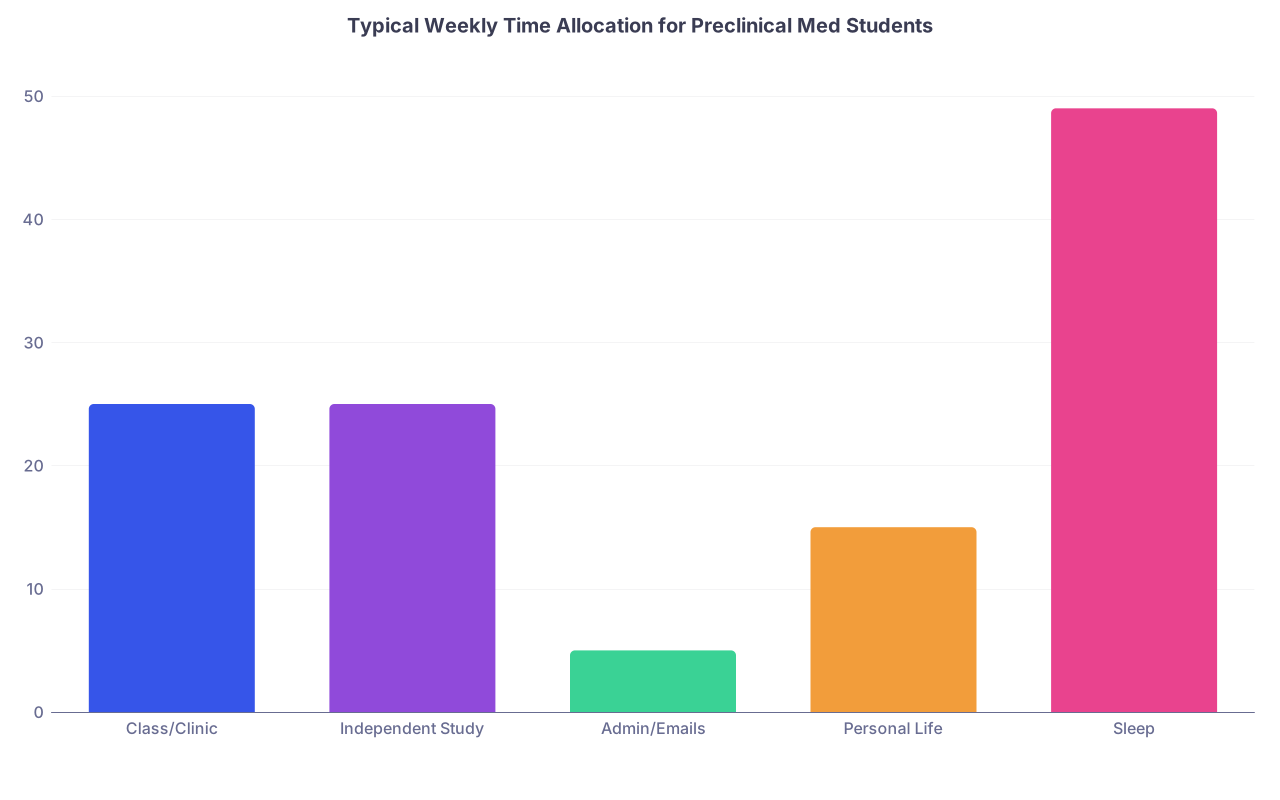
| Category | Value |
|---|---|
| Class/Clinic | 25 |
| Independent Study | 25 |
| Admin/Emails | 5 |
| Personal Life | 15 |
| Sleep | 49 |
Reasonable preclinical baseline (before boards crunch):
- 20–30 hours / week of quality independent study
- 20–30 hours / week of class / mandatory sessions
- 7–8 hours / night of sleep on average
- 5–10 hours / week of non-medicine life (friends, hobbies, whatever keeps you human)
Reasonable dedicated Step/Level baseline:
- 40–55 hours / week of focused studying
- 7-ish hours / night of sleep (maybe a bit less temporarily)
- 3–5 hours / week of actual rest / movement
These are not moral commandments. They are a reality check. Your guilt often comes from judging yourself against a fantasy schedule that no one sustains for more than a week.
How to set your own weekly standard
Do this once per block:
- Decide your total weekly study hours target
- Preclinical: pick a number between 20 and 35.
- Dedicated: pick a number between 40 and 60.
- Decide your sleep minimum
- “I will average at least 7 hours. 6.5 is my emergency floor.”
- Decide your life minimum
- “I will have at least one half-day off every week.”
- Or “I will protect Sunday morning for non-medicine life.”
Then write this as a concrete standard:
“For this 4-week block, my standard of ‘doing enough’ is:
– 30 hours of focused study per week
– 7 hours of sleep per night (average)
– One half-day fully off per week”
If you match or exceed those numbers, you have met standard, no matter what your guilt says.
We are going to use this as a shield later.
5. Step 3 – Shift From Outcome Guilt to Process Accountability
One major source of guilt: you are measuring yourself on outcomes that you cannot fully control:
- Class percentile
- Practice exam scores
- Where your classmates are in UWorld
Outcome metrics are lagging indicators. They react slowly and are contaminated by fatigue, test anxiety, question style, luck.
Your brain uses them to say: “You are not enough,” but they are awful day-to-day guides.
You must move your accountability from “results” to “inputs I control.”
The “Inputs, Not Feelings” protocol
Each day, you answer two questions only:
- Did I do the inputs I committed to?
- If no, do I need to:
- Adjust my inputs (they were unrealistic), or
- Adjust my behavior (I avoided, procrastinated, etc.)?
That is it. Not “Do I feel like I did enough?” Because you will never feel like it.
Inputs for a standard med school study day might be:
- 80 new Anki cards
- 200 reviews
- 40 UWorld questions with full review
- 3 hours of lecture content
You do not “negotiate” these with your feelings. You either did them or did not.

| Step | Description |
|---|---|
| Step 1 | Start of Day |
| Step 2 | Define Inputs |
| Step 3 | Work in Focus Blocks |
| Step 4 | Check: Inputs Completed? |
| Step 5 | End Work, No Negotiation |
| Step 6 | Decide: Adjust or Push |
If you did the inputs: You are done. Guilt is now noise, not signal.
If you did not: we troubleshoot. Without shaming. Like a QI project.
How to set input targets that actually work
- Take your weekly study hour target (say 30 hours).
- Divide by 6 study days (assume 1 full rest day) → 5 hours per day.
- Translate those 5 hours into blocks:
- 4 x 60 minute focus blocks (Anki, QBank, lecture review)
- 1 x 60 minute lighter block (flashcards, rewriting notes, etc.)
Your daily “enough” = those 4–5 blocks done with 80–90 percent focus.
If you do that consistently, your outcomes will move. Slowly, then obviously.
6. Step 4 – Rewrite How You Use Guilt
Guilt is not completely useless. It becomes useless when:
- The standard is vague or impossible
- The standard is not actually your value, but someone else’s fear
We are going to turn guilt into a diagnostic signal.
The Guilt Check: 4 Questions
Next time you feel that familiar wave—tight chest, scrolling Instagram, thinking “I should be doing something else”—run this:
- Did I meet today’s input targets?
- If yes → guilt is irrelevant. You already upheld your standard.
- If not, is today an intentional exception?
- Example: illness, family emergency, or pre-planned rest day.
- If yes → accept the deviation. That is not failure, that is being a human being.
- If neither, what exactly did I do instead of my inputs?
- Be specific: “Watched 2 hours of YouTube,” “Scrolled TikTok from 7–9 pm,” “Reorganized my notes instead of doing questions.”
- Does this misalignment matter enough to change tomorrow’s plan?
- If yes → modify tomorrow’s inputs slightly (NOT double them).
- If no → note it and move on.
The point: guilt is no longer a verdict on your worth. It is a prompt to run a quick audit.
When guilt screams and the answers to (1) and (2) are “yes,” you answer it with:
“I met my standard today. You are on mute.”
And you stop engaging.
This takes practice. But it works if you back it with clear metrics.
7. Step 5 – Protect Guilt-Free Rest With Explicit Contracts
A huge driver of chronic guilt is ambiguous rest.
You “rest” with one tab of UWorld open, your phone next to you, emails half checked, feeling like you might/should go back to studying any minute. That is not rest. That is just extended anticipatory anxiety.
You need contracts:
“From 7–10 pm tonight, I am off. No medicine, no email, no Anki. That is part of the plan, not a failure of the plan.”
You only earn the right to fully believe that if you did your inputs for the day. That is the trade.
Here is the protocol.
The Daily Contract
Each morning (or night before):
- List your inputs.
- Block your calendar:
- Focus blocks with start/stop times
- One main off-block (evening / afternoon)
- Add this exact line at the bottom of the page:
“If I complete these input blocks, I am done for the day. Any additional study is optional, not required.”
It is written down. That matters.
Then when 9 pm hits and your brain spins up with “You should do more,” you have something concrete to answer it with:
“We had a contract. I held my side. We are done.”
You will not believe it perfectly at first. That is fine. Keep doing it.
8. Step 6 – Handle Comparison Guilt Like a Professional
The other massive driver of guilt: everyone else.
Group chats, Slack channels, passive-aggressive comments like:
- “I already finished UWorld once.”
- “I am on my third pass of Anki.”
- “I basically live in the anatomy lab.”
Your brain: “I am behind. I am lazy. I am failing.” Even if your numbers are fine.
Here is the blunt truth: the data from your classmates is:
- Incomplete
- Selectively presented
- Often exaggerated
- Totally irrelevant to your personal standard
So you treat it the same way you treat weird lab results: interpret in context or ignore.
The Comparison Firewall
Use a 3-step firewall whenever you get hit with other people’s metrics:
- Check your block metrics
- Have you been hitting your 4-week standards (hours, question blocks, flashcards)?
- If yes, your system is working. Full stop.
- Translate their brag into your language
- “I did 100 questions today” → That is roughly 2–3 of my focus blocks.
- Compare against your schedule, not your feelings.
- Decide if you want to copy or ignore
- If their system is clearly better and realistic for you, test it for 1 week.
- If not, discard. No explanation needed.

You are not obligated to feel guilty every time someone else works differently than you.
Your standard is what you and your future self agreed is enough for your goals. As long as it is demanding and grounded in data (practice scores, question performance), it stands.
9. Step 7 – Install a Weekly Cognitive Review (Not a Vibe Check)
Most students run their life off daily anxiety and random feedback from exams.
You need a weekly review that is boring, data-driven, and ruthless in a good way.

| Step | Description |
|---|---|
| Step 1 | End of Week |
| Step 2 | Collect Data |
| Step 3 | Evaluate Against Standards |
| Step 4 | Adjust Inputs or Standards |
| Step 5 | Plan Next Week |
Set 30 minutes once a week. Treat it like a non-negotiable clinic slot.
What you actually do in that 30 minutes
- Collect data
- Study hours by day (rough estimates are fine)
- Number of questions done and reviewed
- Anki cards done
- Practice scores if any (NBME, shelf, etc.)
- Compare to your block standards
- Did you hit your average weekly study hours?
- Did you complete your planned QBank progression?
- Sleep: did you average near your target?
- Interpret like a scientist, not a prosecutor
- If standards mostly met but you feel awful → feeling is lying.
- If standards consistently missed → the system is off.
- Decide:
- Do I adjust the standard?
- Was it overly ambitious given real constraints (commute, clinic, call)?
- Or adjust my behavior?
- Where did I leak time (scrolling, pointless emailing, constant group chat)?
- Do I adjust the standard?
- Set one change only for next week
- Example: “No phone in study room during first two blocks.”
- Or: “Reduce daily Anki new cards from 80 to 50, increase questions from 20 to 40.”
Stop changing everything at once. That chaos is exactly what feeds guilt.
10. When Guilt Is Actually a Symptom of Burnout or Depression
Sometimes the constant guilt cycle is not just a cognitive pattern. It is a warning sign.
Warning flags I pay attention to:
- You meet your standards consistently, objectively, and still feel crushed every day.
- You used to care about medicine; now you feel nothing. Just numb or angry.
- Sleep, appetite, mood are falling apart across weeks, not days.
- You cry frequently, have thoughts like “Everyone would be better off if I disappeared,” or you start thinking about self-harm.
At that point, this is not just a self-optimization problem. It is a clinical one.
You are in a profession that screens for suffering early. Use it.
- Talk to student mental health or counseling.
- Loop in a trusted faculty mentor if you have one.
- If you have thoughts of hurting yourself, get help urgently (ER, crisis line, campus security—whatever is fastest where you are).
You would not tell a sepsis patient to “reframe” their way out of it. Do not do that to yourself if something deeper is going on.
11. A Concrete Example: Rewriting One Week
Let me show you what this looks like with a real-ish scenario.
The starting point
M2 student, 6 weeks before Step 1. Their internal monologue:
- “I am constantly behind.”
- “Everyone else has finished UWorld.”
- “I feel guilty if I sleep more than 6 hours.”
- Study pattern: 12 hours at the desk, 6–7 hours of actual work, constantly switching tasks, no true days off, collapsing into YouTube at 11 pm and hating themselves.
The intervention, week by week
Week 1 – Set standards + inputs
- Block standard:
- 45 hours / week of focused study
- 7 hours / night of sleep average
- One half-day off on Sunday
- Daily inputs:
- 60 new Anki, 250 reviews
- 60 UWorld questions + full review
- 1 hour of content review
At the end of the week:
- They hit 42 hours on average.
- Completed 5 of 7 days’ inputs fully, 2 days only 60 percent.
- Sleep average 6.8 hours.
- Took a real half-day off.
They still feel behind and guilty.
Cognitive review conclusion:
- Behavior: pretty solid.
- Standards: a bit heavy but realistic.
- Decision: Keep standards, tweak schedule to do QBank earlier in the day when fresher.
Week 2 – Add daily contract and guilt check
Same inputs, but now:
- 4 defined focus blocks per day
- Written daily contract: “If these are done, I am finished for the day.”
Guilt appears every night around 9:30 pm.
They run the Guilt Check:
- Did I meet my inputs? 5 days yes, 2 days partial.
- Were off days intentional? One was the half-day off, one was unplanned fatigue.
- Decision: Adjust tomorrow’s plan slightly after the unplanned day (add one extra QBank block over 2 days, not all at once).
By the end of week 2:
- Hours: 46.
- UWorld: on schedule.
- Sleep: 7.1 average.
Still some guilt, but lower intensity, more controllable.
Week 3 – Install comparison firewall
They hear: “My friend finished UWorld twice already.”
Old pattern: spiral, extend studying to midnight, panic.
New pattern:
- Check their own data: On track with first pass, NBMEs trending upward.
- Ask: Is their friend’s system better for me?
- Likely no. Different baseline, different starting point.
- Decision: No change for now. Will reassess after next NBME.
This is how the cycle starts to die. Not overnight. But predictably.
12. Put It All Together: The Framework
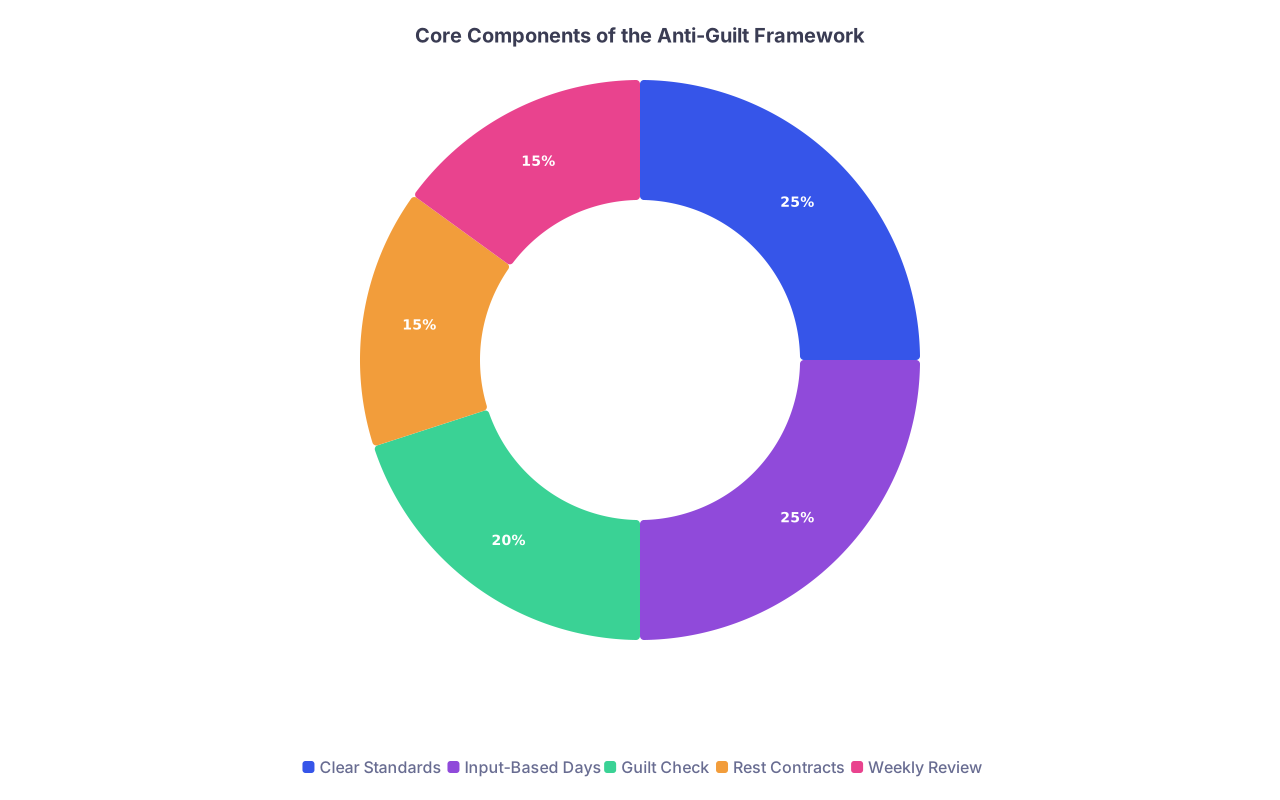
To break the constant guilt cycle as a med student, you are doing five concrete things:
| Category | Value |
|---|---|
| Clear Standards | 25 |
| Input-Based Days | 25 |
| Guilt Check | 20 |
| Rest Contracts | 15 |
| Weekly Review | 15 |
You write down your hidden rules and rewrite them into realistic standards.
- No more internal commandments like “always maximize.”
- Replace with block-specific, measurable expectations.
You judge your days by inputs, not vibes.
- Define what “enough” work is today.
- If you did it, you are done. Full stop.
You use guilt as a diagnostic, not a verdict.
- Run the 4-question Guilt Check.
- If standards are met, guilt is noise. If not, adjust inputs or behavior.
You protect guilt-free rest with explicit contracts.
- Rest is part of the plan, not a deviation from it.
- Ambiguous half-resting is banned.
You run a weekly review like a professional, not like an anxious intern.
- Look at the data. Adjust one thing at a time.
- Ignore random comparison noise unless it survives scrutiny.

You will not become a guilt-free robot. You are in a high-pressure profession; doubt and worry are baked into the culture.
But you can take guilt out of the driver’s seat and relegate it to a weak background process. Annoying, but not in control.
Key points:
- Chronic guilt in medical school is a cognitive algorithm, not your identity. Rewrite the rules: clear standards, input-based days, and weekly reviews.
- Rest without guilt only exists when you define “enough” concretely and keep your end of the contract. Then the guilt is just noise.