
Your study schedule is probably too fragile for the life you actually live.
Medical school schedules are usually built for the version of you who is well-rested, emotionally stable, and thinking clearly. That version of you exists maybe 30% of the time. The rest of the time you are tired, anxious, depressed, or at least mildly overloaded.
If your plan only works on good mental health days, then it is a bad plan. Let’s fix that.
Below is a step‑by‑step way to design a study system that still works when you are not okay—without tanking your grades or burning you out harder.
1. Stop Designing for “Ideal You”
Most med students make the same mistake: they backward-plan from the exam, count total hours, divide by days, and then cram those hours into a calendar like a Tetris game.
Looks “clean.” Completely unrealistic.
Build for your actual baseline, not your fantasy self
First question: How many genuinely focused hours can you deliver on a normal day without wrecking yourself?
Be honest.
For most med students:
- Pre-clinical: 4–6 real focus hours is normal. 8+ is fantasy.
- Clinical: 2–4 real focus hours outside the hospital is already impressive.
If you schedule for 8 and only hit 4, you live in permanent failure mode. That constant sense of “I am behind” is rocket fuel for anxiety and depression.
Instead:
Define 3 levels of day:
- Level 1 – Good day: mind is clear, mood is okay.
- Level 2 – Meh day: tired, mildly anxious, distracted.
- Level 3 – Bad day: depressed, panicky, or emotionally flooded.
Assign realistic focus capacity:
- Level 1: 5–6 focused hours (pre-clinical) / 3–4 (clinical)
- Level 2: 2–3 hours (pre-clinical) / 1–2 (clinical)
- Level 3: 0–1 hour, tiny tasks only
Now you have a language for your days. You wake up and ask:
“Which level am I today?”
Then you run the plan for that level. Your schedule is adaptive by design, not shattered by guilt.
2. Separate “Must Pass” From “Perfect World”
The next big error: treating everything as equally important. On bad days, something will drop. If you have not decided what is optional, your brain will panic and shut down.
You need two tracks:
- Survival track – What keeps you on track to pass.
- Optimization track – What moves you toward honors/Step score/clinical flex.
Build your survival track first
Ask: What is the minimum ongoing work required to pass this course/rotation and your boards safely?
That usually means:
- Watching or reading core content (lectures / structured resources)
- Spaced repetition (Anki or equivalent)
- Question practice at a slow but steady pace
Do this for each major exam or board:
List:
- Must-watch lectures or chapters
- Required question bank sets
- Daily/near-daily Anki or flashcards
Assign bare-minimum weekly quotas:
- Content: e.g., “8 micro lectures per week”
- Questions: e.g., “75–100 UWorld questions per week” (not per day)
- Cards: e.g., “Keep Anki reviews under 250/day by pruning / tagging”
Then build an optimized target:
- Content: “12–14 lectures per week”
- Questions: “150–200 questions per week”
- Extra reading / videos
The survival track must be doable even if 2–3 days per week are Level 2 or 3 days.
| Area | Survival Track (Minimum) | Optimization Track (Extra) |
|---|---|---|
| Content | 1–2 core lectures per day | Extra review videos / textbooks |
| Question Bank | 10–20 questions per day | 30–40 questions per day |
| Anki | Only due cards, strict cap | New cards + custom decks |
| Extras | None required | Group study, extra practice cases |
If your “minimum” week still looks brutal, your assumptions are wrong. Shrink it until a tired, anxious version of you can complete it.
3. Design a Three‑Tier Daily Plan
You do not need one schedule. You need three. One for each level of mental health day.
Think in “modules,” not rigid time blocks.
Step 1: Define your core study modules
Example modules:
- 25 min Anki block (~60–80 cards)
- 40 min “watch and outline 1 lecture”
- 30 min “review notes from yesterday”
- 45 min “do 10 UWorld questions + review”
- 20 min “light review of marked questions”
Each module should be:
- Small enough to start when you feel awful.
- Specific enough that you do not waste energy deciding what to do.
Step 2: Build templates for Level 1, 2, and 3 days
Level 1 day (good day – full plan)
Example pre‑clinical template:
- Morning
- Anki: 2 blocks (50 min)
- Content: 2 lectures (80 min)
- Afternoon
- Qbank: 20–30 questions (90–120 min)
- Content: 1 lecture (40 min)
- Evening
- Light review or group study (30–45 min)
This is your optimized track day.
Level 2 day (meh day – reduced but productive)
Example:
- Morning
- Anki: 1 block (25 min)
- Content: 1 lecture (40 min)
- Afternoon
- Qbank: 10–15 questions + review (60 min)
- Evening
- Optional: 20 min reviewing notes or flashcards
This is your survival track day.
Level 3 day (bad day – crisis‑tolerant)
Example:
- One Anki mini-block: 15–20 min
- Optional: 5–10 UWorld questions only if it feels doable
- Then you stop and move to mental health first‑aid (more on that later)
Or if it is truly awful:
- Zero study
- You are still in the plan, because Level 3 allows zero.
Print or write these three templates somewhere visible. That way on a bad day, you are not “failing the plan”; you are switching plans.
4. Build Slack Directly Into Your Week
A schedule without slack is guaranteed to break the minute your brain does.
You need:
- Daily slack – empty time that is truly unscheduled
- Weekly repair blocks – for catching up or closing loops
- Protected mental health time – non-negotiable off time
Daily slack
Minimum:
- 60–90 minutes per day of non‑study time that is not sleep and not chores.
Walk. Shower too long. Call someone. Sit and stare at a wall. Do not fill this with more questions.
Resist the urge to “be efficient” and pack this with extra studying. That is how you end up crying on a random Tuesday over a renal phys question.
Weekly repair blocks
At the beginning of each week, schedule:
- 1–2 blocks of 60–90 minutes labeled “REPAIR / CATCHUP.”
Use them for:
- A lecture you bailed on during a bad day
- A leftover Qbank set
- Cleaning up Anki if your reviews exploded
If you do not need them? Great. They become actual rest. But never pre‑assign them to normal work. They are your shock absorbers.
Protected mental health time
Pick at least:
- 1 half‑day per week (e.g., Sunday morning)
No studying allowed. Not “probably off.” Actually off.
If you have chronic depression or anxiety, you may need:
- 2 shorter protected blocks (~3–4 hours) instead of one big one.
Non‑negotiable. You are not a machine that needs more optimization. You are a human that needs margin.
5. Write a “Bad Day Protocol” in Advance
On a bad mental health day, your decision‑making will be trash. You will think in extremes: “If I cannot do everything, I might as well do nothing.”
So you decide ahead of time: What happens when today is bad?
Literally write this somewhere:
Example Bad Day Protocol (Level 3)
Check the basics (3 minutes):
- Did I sleep at least 4–5 hours?
- Have I had water and some food?
- Did I take my meds (if applicable)?
Pick the tiniest possible win (15–30 minutes max):
- Option A: Anki – 1 mini-block of 20 cards, not 80
- Option B: 5 Qbank questions, open book, rushed review
- Option C: 10 minutes rewatching the hardest part of yesterday’s lecture
If even that feels impossible → skip to Step 4.
Communicate (5–10 minutes):
- If there is a quiz/mandatory session: decide if you can show up.
- If not, email the course coordinator or clerkship admin early. You do not need a life story.
- “I am dealing with an acute health issue today and may not be able to attend X / complete Y. I will follow up with the appropriate documentation if needed.”
Mental health first‑aid (30–90 minutes):
- Short walk outside
- Breathing exercise (4–7–8 breathing or box breathing)
- 10–15 minutes of something mindless but soothing: shower, low‑stakes TV, music
- If you have a therapist or psychiatrist: send a message or schedule the next slot.
Reassess in 2–3 hours:
- Can I upgrade to Level 2 day? If yes, pick one survival task.
- If not, accept this as a full Level 3 day. Protect your future self by not piling on shame.
Having this written turns “I am failing” into “I am running the Level 3 protocol today.”
6. Use Question Banks and Anki Without Letting Them Own You
Qbanks and Anki are powerful. They are also anxiety machines if misused.
When your mental health is shaky, endless red bars and overdue cards feel like judgment.
You need to control them, not be controlled by them.
Hard rules for Qbanks on bad days
Turn off the timer.
Timed blocks are for when your anxiety is under control. Untimed blocks are still valid studying.Shrink the block size.
- Level 1: 20–40 questions
- Level 2: 10–20 questions
- Level 3: 0–10 questions, or none
Redefine success:
Success on a bad day = “I touched the material.” Not “I got 70%.”Tag questions instead of obsessing over them:
- Tag as “revisit later,” move on. Your future self (on a Level 1 day) will clean it up.
Hard rules for Anki on bad days
If your Anki feels like a monster hunting you, you are using it too rigidly.
Set a maximum daily review cap.
- Example: 200 reviews. Even if Anki says 350 are due, you stop at 200. This is legal. You are not going to forget everything overnight.
Suspend aggressively.
- Overlapping cards from 3 decks? Suspend duplicates.
- Cards you keep failing? Tag “garbage” and either re‑write them later or delete them. Bad cards ruin motivation.
-
- 10 cards while waiting for rounds.
- 15 cards while coffee brews.
- On a Level 3 day, that might be the only thing you touch. Still counts.
Do not add new cards on bad days.
- Survive the reviews only. Adding new will just swell the tidal wave.
7. Plan Around Your Mental Health Patterns, Not Against Them
Most people’s mental health has a pattern. Certain triggers, times of day, or phases of the block are worse.
If you pretend you are “the same every day,” your schedule will constantly collide with those patterns and break.
Map your predictable weak spots
Look back at the last 2–3 months and ask:
- When do I usually crash? (Afternoons? After call? 3 days before exams?)
- Which rotations or courses hit me hardest?
- Do I get worse around certain stressors (presentations, shelf week, social stuff)?
Then preemptively design around those.
Example: You always crash 3 days before exams
Most students:
- Stack more content and more Qbank into those days.
- Then wonder why they melt down.
Instead:
- Front‑load the heavy lift 7–10 days before.
- Plan the final 3 days as review‑only:
- Re‑do key questions you missed
- Review high‑yield Anki / summary sheets
- Shorter, calmer days with earlier cut‑off time
Example: You are useless after long clinic days
Then stop pretending:
Schedule most studying:
- Early morning (one core block)
- Lighter, maintenance‑only in the evening: 10 Anki minutes, 5 questions max.
Use weekends for heavier blocks. Protect one major study block per weekend morning, and one catchup block.
The point: accommodate your brain. Do not fight it like an enemy.
8. Protect Sleep Like It Is Part of Your Curriculum
I have watched more students wreck a rotation or a Step score by chronic sleep debt than by “not working hard enough.”
On bad mental health days, the temptation is:
- Study later to “make up”
- Scroll late to escape
- Wreck the next day
You need explicit sleep rules baked into your study design.
Non‑negotiables
Cut‑off time: Set a hard time when all studying stops (e.g., 10:30 pm).
No “just one more block” after that. You are now spending tomorrow’s brain.
If you are on a rotation with early mornings:
- Back‑calculate: need to wake at 5:30 → asleep by 11:00 → devices off by 10:30.
On bad days:
- If you are spiraling and tempted to study to punish yourself, switch the goal:
- Goal for today = protect tomorrow’s brain.
- Get to bed, even if you did little work. Future you will use that brain.
9. Coordinate With Real Humans: Faculty, Peers, Professionals
A study system that survives bad mental health days is not purely solo. You cannot engineer your way out of everything with better time blocking.
You also need:
- Reasonable expectations from faculty (where possible)
- Peers who can swap notes or slides
- Mental health professionals if your symptoms are more than just “stress”
What to say to faculty or admins
You do not need a TED talk. Keep it short and factual.
Example email:
Dear Dr. ___,
I am managing a documented health condition that occasionally affects my ability to attend or fully participate on certain days. I am committed to meeting the learning objectives and will proactively make up any missed work.Can we briefly discuss what options or flexibility exist for [attendance / assignment deadlines / shelf prep] in situations where my symptoms are severe?
Sincerely,
[Name]
If you have student health / disability services:
- Register early, not when you are already drowning.
- Typical accommodations that help:
- Flexibility on attendance
- Adjusted exam environments or timing
- Access to recorded lectures
Use peers strategically
Have at least:
- One person you can text: “Can you send me today’s slides / main points?”
- One person who is willing to swap outlines or distilled notes in exchange for yours on better days.
This is not about laziness. It is about redundancy, like backup power.
Professionals
If you are:
- Frequently having Level 3 days
- Contemplating self‑harm
- Barely holding function together
You are past “schedule optimization.”
You need care: therapist, psychiatrist, or both.
Your study schedule can support treatment (by building in appointments and rest), but it cannot replace treatment.
10. How to Actually Build Your Weekly Schedule (Step‑By‑Step)
Let me put this all together in a concrete workflow you can copy this Sunday.
Step 1: Define your weekly minimums
For the upcoming week, write:
- Core lectures to cover: e.g., 10
- Qbank goals: e.g., 100 questions
- Anki goal: daily reviews with cap 200
That is your survival track baseline.
Step 2: Place your hard constraints
Block these first:
- Class / mandatory sessions
- Rounds / clinic times
- Commute
- Non‑negotiable life tasks (meds pickup, key appointments)
Step 3: Insert daily core blocks
For each day, add:
- Morning: 1 Anki block + 1 content block on most days
- Afternoon / evening: 1 Qbank block on 4–5 days per week
Keep blocks 30–90 minutes. No giant 4‑hour blocks; they always crumble.
Step 4: Add weekly repair/catchup blocks
- 1–2 blocks of 60–90 minutes labeled “REPAIR.”
- Schedule them toward the end of the week (Fri/Sat or Sat/Sun).
Step 5: Mark protected off time
- One half‑day where NOTHING academic goes.
- A daily cut‑off time.
Step 6: Attach the Level 2 and 3 versions
On the side of your planner / digital calendar, write:
Level 2 default:
- Anki: 1 block
- Content: 1 lecture
- Qbank: 10 questions
Level 3 default:
- Anki: 10–20 cards or nothing
- No questions unless you really want to
- Run Bad Day Protocol
Every morning:
- Rate your day (Level 1/2/3).
- Apply that day’s template.
- If you upgrade later (Level 2 → 1), add one more block.
- If you downgrade (Level 1 → 2), cancel a block guilt‑free.
11. What This Looks Like in Real Life (Example Week)
You are an MS2 studying cardio block with Step 1 in 5 months.
Weekly minimums:
- Content: 10 cardio lectures
- Qbank: 100 cardio questions
- Anki: cap 200 cards/day
By Thursday:
- You were Level 1 on Mon, Level 2 Tue, Level 3 Wed (panic attack night).
Old pattern:
- Fall behind by 2 lectures + 30 questions
- Spend Thu–Sun in guilt mode, sleep less, crash harder, half‑learn everything.
New pattern:
- Monday (L1): Hit full plan (3 lectures, 30 Qs, 2 Anki blocks)
- Tuesday (L2): Only 2 lectures, 15 Qs, 1 Anki block → still on survival track
- Wednesday (L3): 20 Anki cards, no Qbank, no content, ran Bad Day Protocol
- Thursday (L2): 1 lecture, 10 Qs, 1 Anki block. Used evening catchup block to finish 1 missing lecture
- Saturday repair block: Knock out remaining 20 Qs and skim a summary of the missed content.
Result:
- You are slightly behind the “perfect” schedule, but still on track to pass, still sleeping, and not in full meltdown.
- Your system bent. It did not break.
12. Three Things to Stop Doing Immediately
To make any of this work, you need to drop a few habits.
Stop rewriting your whole schedule every time you have a bad day.
You do not need a new master plan. You need to switch to Level 2 or 3, then use repair blocks.Stop using self‑hatred as a motivator.
“I am lazy / I am behind / I am failing” is not a productivity hack. It is a slow‑acting poison that guarantees more bad days.Stop believing you are the exception who can ignore sleep, therapy, or rest.
Every year, some very “strong” students prove themselves wrong with a breakdown. You do not get extra credit for suffering more.
Visuals to Reinforce the System
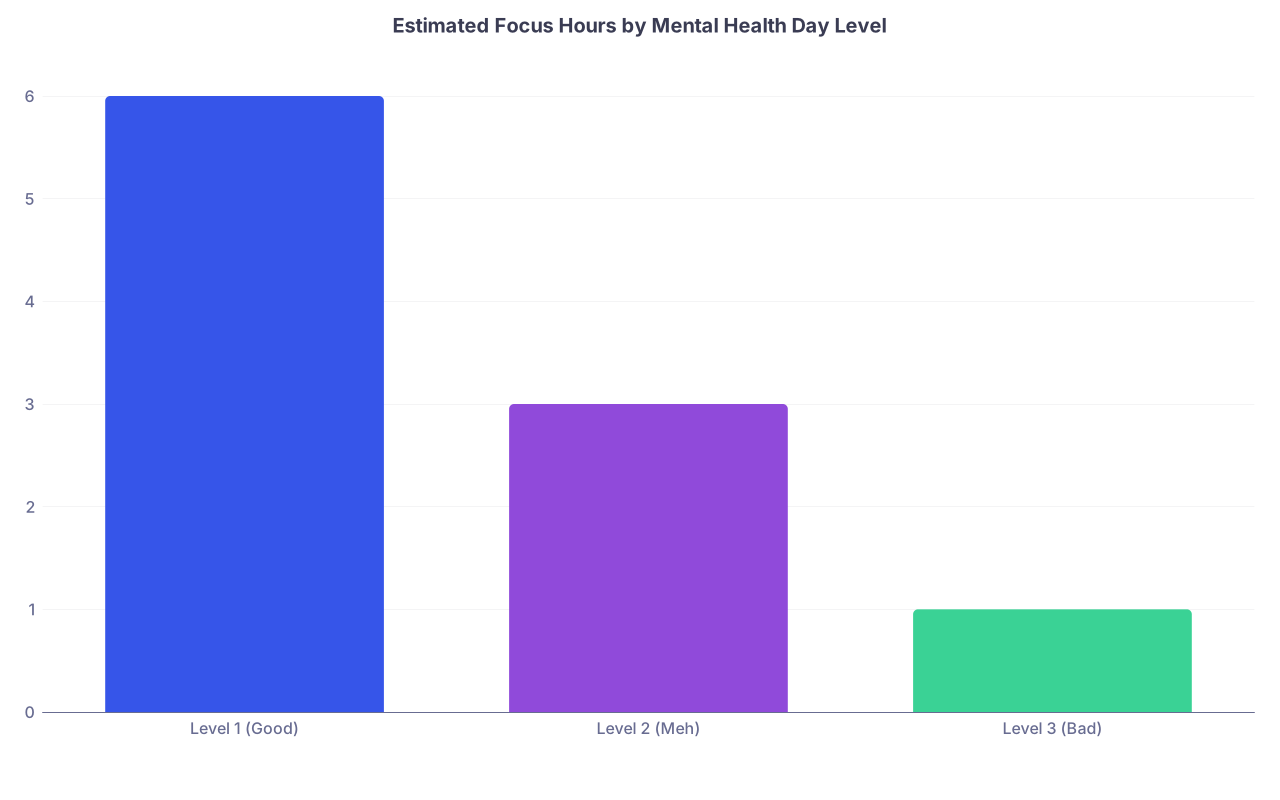
| Category | Value |
|---|---|
| Level 1 (Good) | 6 |
| Level 2 (Meh) | 3 |
| Level 3 (Bad) | 1 |

| Step | Description |
|---|---|
| Step 1 | Wake Up |
| Step 2 | Run Full Plan |
| Step 3 | Run Reduced Plan |
| Step 4 | Bad Day Protocol |
| Step 5 | Stop Studying, Protect Sleep |
| Step 6 | Rate Day: 1, 2, or 3 |
| Step 7 | After Rest, Any Better? |
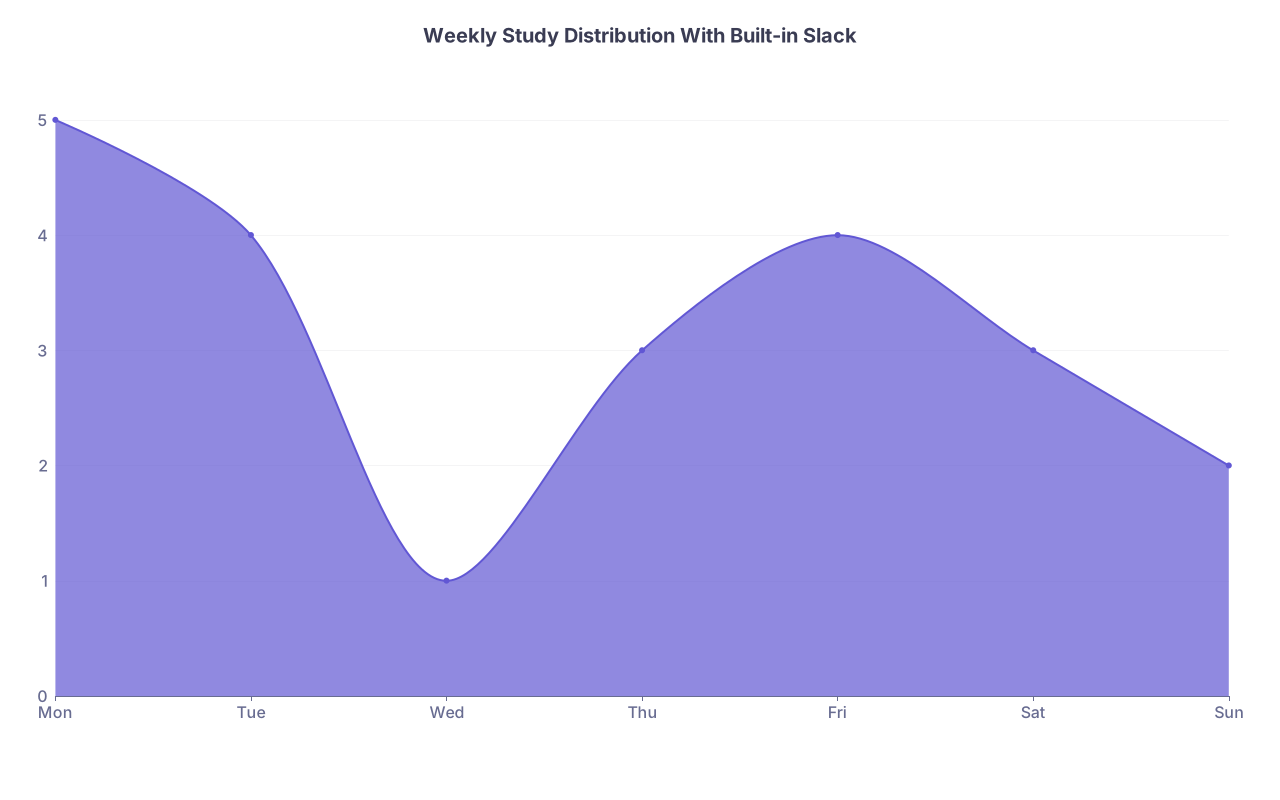
| Category | Value |
|---|---|
| Mon | 5 |
| Tue | 4 |
| Wed | 1 |
| Thu | 3 |
| Fri | 4 |
| Sat | 3 |
| Sun | 2 |

Final Takeaways
- Design a three‑level system, not a single perfect schedule. Good days, meh days, and bad days each get their own realistic plan.
- Protect a survival track of minimum work plus built‑in slack. Use repair blocks and protected time off so bad days do not destroy your entire week.
- Write and follow a Bad Day Protocol. Decide in advance how you will behave when your mental health crashes, so you do not let shame and panic run the show.
Do that, and your study schedule will finally match the life—and the brain—you actually have. Not the imaginary one you keep failing to be.