
The worst time to design your mental health plan is when you are already falling apart.
If you start medical school without a personal crisis plan, you are gambling. With your grades, your relationships, and your safety. The culture will not protect you. The calendar will not give you space. You have to build the system before you need it.
I am going to walk you through exactly how to do that.
Not vague “take care of yourself” nonsense. A concrete, written, step‑by‑step crisis plan you can pull out at 2:17 a.m. the week before your pharm exam when your brain is spiraling and you cannot think straight.
This is not about being dramatic. It is about being prepared.
Why You Need a Crisis Plan Before Things Get Bad
Let me be blunt: medical training is a pressure cooker.
You already know the talking points:
- Long hours
- High stakes
- Constant evaluation
- Competitive classmates
- Debt hanging over everything
What people underplay is how fast things can slide from “stressed” to “not safe.”
I have watched:
- A first‑year go from “I am just tired” on Monday to “I do not trust myself to be alone” by Friday.
- A third‑year on surgery clerkship who thought he was “just burned out” end up driving aimlessly at night because he “did not care if something happened.”
- Several students who only realized they were in real trouble when they failed an exam and started having daily panic attacks and stopped returning messages. By then, everything is on fire.
In those moments, you do not:
- Remember subtle self‑help advice
- Feel like “reaching out”
- Have the executive function to Google “nearest therapist”
What does work:
- A simple written plan you made on a good day
- Clear instructions: “If X is happening, do Y, then Z”
- Phone numbers already saved
- Decisions already made
Think of it like a code blue protocol. You do not start debating interventions during the arrest. You follow the algorithm you prepared.
Same idea here.
Step 1: Build Your Personal “Red Flag” List
You cannot intervene early if you do not know what “early” looks like for you.
Everyone has a different pattern when they start sliding. Your job is to identify yours now, before the next exam block hits.
1.1 Identify your early warning signs
These are the subtle things that show up 1–3 weeks before a full‑blown crash. Think “yellow flags,” not yet “code red.”
Common early signs:
Sleep:
- Taking 45+ minutes to fall asleep several nights in a row
- Waking up at 3–4 a.m. with racing thoughts
- Sleeping 9–11 hours but still waking up exhausted
Mood:
- Baseline irritability, snapping at people for small things
- Constant sense of dread about school
- Feeling numb or detached most of the day
Behavior:
- Dropping hobbies you usually enjoy
- Ghosting group chats or study groups
- Procrastinating so hard you avoid even opening Anki or your LMS
Body:
- Daily headaches or GI issues with no clear medical cause
- Chest tightness, racing heart, or shortness of breath during simple tasks
- Constant muscle tension, jaw clenching, nail biting
Thoughts:
- “I am never going to catch up”
- “Everyone else is doing better than me”
- “What is the point? It will not matter how hard I try”
Now customize. Think back to previous intense periods (pre‑med finals, MCAT month, major life stress). What actually happened?
Write a short list of your top 5–10 early warning signs. For example:
My early warning signs:
- Scrolling my phone in bed for 1+ hour instead of sleeping
- Skipping the gym 3+ times in a row
- Ignoring texts from close friends for more than 24 hours
- Eating one real meal or less per day
- Re‑reading the same page of notes over and over and retaining nothing
Put this in your crisis plan document. This becomes your “yellow zone” list.
1.2 Define your crisis-level signs
Now the uncomfortable part. You need to explicitly define what “too far” looks like.
These are “red flags.” If any occur, you do not negotiate with yourself. You follow your crisis steps.
Examples:
- Suicidal thoughts with a plan or intent
- Thoughts like:
- “If I got hit by a bus, that would be easier”
- “I do not care if I wake up tomorrow”
- Self‑harm urges or actions (cutting, burning, hitting yourself, etc.)
- Suddenly using alcohol or substances heavily to cope
- Not attending mandatory school activities for more than a day
- Going >24 hours without eating and not caring
- Not sleeping for >36 hours or sleeping >14 hours and still feeling dead inside
- Panic attacks that interfere with basic functioning
- Complete emotional breakdown (uncontrollable crying, screaming, or shutting down)
You do not need all of these. You need a core list of “If this happens, I treat it like an emergency.”
Write 3–7 specific crisis triggers for yourself.
Example:
My crisis-level signs:
- Thinking about self‑harm or suicide more than once in a day
- Drinking alone enough to feel drunk, more than twice in a week
- Skipping class/clinical duties for 2 days without telling anyone
- Not responding to messages from my closest person for 48 hours
- Feeling like I might lose control (screaming, throwing things, or hurting myself)
This is your red zone.
Step 2: Create a Simple Crisis Plan Document
You want something you can open quickly on your phone or print and stick in a drawer. Not a manifesto. One or two pages, max.
Best formats:
- A note in your phone (Notes, Google Keep, Notion, etc.)
- A Google Doc with offline access
- A printed sheet in your desk + a copy in your backpack
Title it clearly:
“[Your Name] Personal Crisis Plan – Open When Overwhelmed”
We will fill this with:
- Your red/yellow flag lists
- Your “if/then” action steps
- Contact list
- Medication / medical conditions (if relevant)
- Safety and environment changes you will make
- Follow‑up plan after the crisis
We will build each piece.
Step 3: Set Explicit “If/Then” Rules For Yourself
Stress makes your decision‑making useless. You want pre‑decided rules that remove debate.
Create two tiers: Yellow Zone (early intervention) and Red Zone (crisis).
3.1 Yellow Zone Protocol – “I am sliding”
Link this to your early warning sign list.
Write something like:
If I notice 2 or more early warning signs for 3 days in a row, I will:
Tell one human being what is going on.
- Options: roommate, close friend, partner, sibling, or trusted classmate.
- Script if you hate talking about feelings:
- “I am not doing great mentally and I promised myself I would tell someone. You do not need to fix it; I just need someone to know.”
Adjust my schedule for 48–72 hours.
- Add:
- One guaranteed 30–60 minute break per day (walk, nap, non‑med show, etc.)
- A strict bedtime window (e.g., in bed by 11:30 p.m., no studying after that)
- Remove or cut back:
- Non‑essential commitments (extra leadership, optional events, volunteering)
- Add:
Add one structured self‑maintenance habit.
You pick realistic, boring things. For example:- 10–15 minute daily walk outside, no phone
- 2 real meals per day, minimum
- 5–10 minutes of guided breathing or meditation with a specific app (e.g., Insight Timer, Headspace, Calm)
Check my mental health support options.
- Log into your school portal, review counseling options
- If you are not in therapy and historically struggle with mood/anxiety, this is where you schedule a counseling intake—even if you feel “not that bad.”
Write your exact yellow zone actions into the plan. Make them:
- Specific
- Time‑bounded
- Realistic even on a busy week
3.2 Red Zone Protocol – “This is a crisis”
Again, tie this to your crisis‑level signs.
Write:
If I have any crisis-level sign, I will:
Tell a person immediately.
- Choose 2–3 “first call” people and write them by name.
- Example:
- “First call: Alex (roommate), Second: Mom, Third: Jamie (classmate)”
- Script you can copy‑paste/text:
- “I am not safe alone right now. I need you to stay on the phone with me / come over / help me get somewhere safe. I have a crisis plan I am following.”
Remove immediate risks from my environment.
Depending on your situation:- If you self‑harm: give sharps/razors/meds to a roommate temporarily
- If you binge drink: ask someone to hold your alcohol or lock it up
- If you have access to firearms: they need to be stored outside your living space with safe, agreed‑upon access rules
Contact professional help the same day.
This is where people stall. You will not.
Your plan should list:- School counseling center phone + walk‑in hours
- National / local crisis line numbers
- Nearby urgent care or ED that handles psychiatric crises
| Resource Type | Example to Fill In Yourself |
|---|---|
| Campus Counseling Center | Phone: ___, Walk-in hours: ___ |
| National Crisis Line | 988 (US); others by country |
| Local Crisis Line | Phone: ___ |
| Nearest ED with Psych | Hospital name, address |
| Trusted Faculty/Dean | Name, email, phone (if appropriate) |
Your red zone “professional help” rule should be something like:
- “If I have suicidal thoughts with any intent or plan, I will either:
- Call 988 (or local crisis line) or
- Go to [Hospital Name] ED or
- Go to campus counseling during walk‑in hours that day.”
- Suspend academics temporarily if needed.
If you are in true crisis, you are not doing high‑quality studying anyway.
Your rule might be:- “If I am in red zone, I give myself permission to miss or reschedule:
- 1 lecture day
- 1 small group
While I contact support. I will email the course coordinator with:
‘I am experiencing an acute health issue and working with student health services. I will follow up regarding make‑up work.’”
- “If I am in red zone, I give myself permission to miss or reschedule:
Write that email template into your plan so you can copy/paste.
Step 4: Build Your Support Team Now, Not Later
Do not wait until you are spiraling to figure out who “your people” are.
You need three layers:
- Peer support
- Professional support
- Institutional support
4.1 Peer support: your “first line”
Identify:
- 1–2 classmates
- 1 non‑med friend or partner
- Possibly a family member you actually trust with this stuff
Talk to them before you are in trouble. Literally say:
“I am creating a crisis plan because med school can be rough. Can I list you as someone I would text or call if I am really not okay? That would just mean listening, staying with me (virtually or in person), and helping me follow my plan. You do not have to fix anything.”
Most decent humans will say yes.
Put in your plan:
- Names
- Phone numbers
- Time zones / usual availability
And be explicit about what you might need:
- “If I text you ‘I am in red zone,’ please:
- Call me if you can
- Stay on the phone until I am with another adult or at a clinic/ED
- Remind me to grab my ID and insurance card if I go in somewhere”
4.2 Professional support: who you will call
At minimum, you should know:
Campus counseling center:
- How to book
- Walk‑in or urgent care options
- Limits (session caps, referral process)
Community options:
- At least one local provider directory (Psychology Today, Zencare, school‑vetted lists)
- Student health insurance mental health coverage basics
Primary care provider:
If you are on meds for anxiety, depression, ADHD, etc., your crisis plan must include:- Prescriber name and contact
- Pharmacy number
- What to do if you run out of meds or have severe side effects
If you already see a therapist or psychiatrist, add:
- Their crisis or after‑hours instructions (they usually tell you this day one; if not, ask)
- Note whether they are okay with brief crisis texts/emails
4.3 Institutional support: deans and policies
Learn your school’s:
- Policy on leaves of absence (LOA) for health reasons
- Who handles academic accommodations (Office of Accessibility/Disability)
- The “student affairs” or “dean of students” contact for personal crises
You are not planning to fail. You are planning to avoid blowing your life up when you are vulnerable.
Put in your plan:
- Name and email of the student affairs dean or similar
- Generic email template for “I am going through a medical/mental health issue and may need temporary support/accommodation”
You want this written when you feel calm so you do not overshare or under‑communicate during a crisis.
Step 5: Protect Your Physical Baseline During High-Stress Periods
You cannot think your way out of a crisis with a wrecked body.
No, you do not need a perfect wellness routine. You just need a “minimum operating standard” for your body that you do not cross, especially during exam weeks or rotations.
5.1 Set non‑negotiable minimums
Write your personal minimums into your plan. For example:
Sleep:
- “Absolute minimum: 5.5 hours. If I am planning to get less than this to study, I will stop and sleep instead.”
Food:
- “Absolute minimum: 2 real meals or 1 meal + 2 substantial snacks per day. If I hit dinner and have not eaten, I will order something rather than skip.”
Movement:
- “Absolute minimum: 5–10 minutes of walking or stretching daily, even on exam week.”
Substances:
- “Max: 2 drinks on any given night, 4 per week. No alcohol the night before exams or clinical duties. No new substances during stressful times.”
This looks trivial. It is not. These guardrails prevent you from digging a deeper hole when you are already sliding.
5.2 Pre-plan “crisis food” and logistics
When you are exhausted and anxious, your executive function tanks. So:
- Make a list of 3–5:
- Fast, decent meals you can prepare from your pantry/freezer
- Takeout places you will use when you cannot cook
Example list:
In‑apartment:
- Frozen burritos + bagged salad
- Microwave rice + canned beans + shredded cheese
- Oatmeal + peanut butter + banana
Takeout:
- Thai place: veggie + protein + rice
- Diner: omelet + toast
- Grocery hot bar
Add this list to your plan. You want as few decisions as possible.
Step 6: Decide Your Tech and Social Media Rules
Your phone can either keep you connected or fuel your anxiety. In crisis, it usually does the latter by default.
Create rules now for what you will do with:
- Group chats
- Social media
- Study apps
6.1 Group chats
In yellow or red zones, med school group chats often make everything worse:
- Constant score talk
- People flexing their 5000 Anki cards
- Rumors about grading
Your rule might be:
- “If I am in yellow or red zone, I will mute all large school group chats for 24–72 hours.”
You will not miss anything critical. If there is truly urgent information, it will find you.
6.2 Social media
Scrolling your way through a crisis usually inflames it.
Write a clear rule:
- “If I am in red zone, I will delete Instagram/Twitter/TikTok from my phone for at least 48 hours.”
If deleting feels too extreme, at least log out and bury the app in a folder.
6.3 Study apps
What you do not want: spiraling about your Anki stats while you are barely hanging on.
Your rule:
- “If I am in red zone, Anki streaks and stats are irrelevant. I will:
- Reset or suspend overdue cards
- Do a max of 30–60 minutes of light review only if I feel up to it. Otherwise, I will not study until I am safe and have spoken with a professional.”
This is tough. But you cannot outrun a mental health crisis by memorizing pharm side effects.
Step 7: Safety First – Concrete Actions If You Feel Unsafe
This is the part most students avoid planning, then wish they had.
You need a very simple, stepwise action sequence for moments of real danger.
Write this verbatim in your plan and adjust names/locations:
If I feel like I might hurt myself or cannot keep myself safe:
I will not stay alone with those thoughts.
- I will go to a roommate, neighbor, or common area OR
- I will call [Name] and stay on the phone
I will physically change my environment.
- Put on shoes
- Grab my ID, insurance card, phone charger
- Leave my room and go to:
- Option A: campus counseling center
- Option B: student health
- Option C: [Nearest ED name and address]
I will contact one of these numbers on the way or once there:
- 988 (US) or local crisis line
- Campus counseling urgent line: [number]
- National or local equivalents in your country
If I cannot get myself there, I will ask someone to take me or call 911 (or local emergency number).
Script:- “I am having suicidal thoughts and I do not feel safe. I need to go to the emergency department.”
You are not being dramatic. You are being alive.
Step 8: Plan for the Day After the Crisis
Crisis is not the end of the story. What you do in the 24–72 hours after can determine whether you actually recover or just crash again.
Add a “Post‑Crisis Plan” section.
8.1 After any serious episode, within 24–72 hours:
You will:
Debrief with one trusted person.
- What triggered it?
- What helped? What did not?
- Do you need to adjust your plan?
Inform appropriate school supports (at the right level).
Options:- Email student affairs / wellness dean:
- “I experienced an acute health issue and received care at [location]. I am working with [counselor/clinician] and may need [brief flexibility/rescheduling]. Could we set a time to discuss options?”
- Email student affairs / wellness dean:
Update your academic plan.
- Adjust exam prep timeline
- Drop any non‑essential roles (extra leadership, committees) for the next 2–4 weeks
- Consider temporarily lowering your performance expectations (aim for “pass stable” not “honors or die”)
Set a short follow‑up check-in with yourself.
- Put a calendar reminder 1 week later:
- “Check in: Are early warning signs decreasing? Did I follow up with counseling/PCP? Do I need to escalate support?”
- Put a calendar reminder 1 week later:
This is how you convert a crisis into data and better guardrails, not just another scary memory.
Step 9: Put the Plan Where You Can Actually Use It
Your plan is useless if you forget it exists.
Do this:
- Save it as:
- “Crisis Plan – READ THIS FIRST” in your notes app
- Star/pin it so it lives at the top
- Print one copy and:
- Put it in your desk or next to your bed
- Optional: tell a trusted roommate where it is
Then:
- Tell your main support person that it exists
- Offer to send them a copy if you are comfortable
And once per block (every 4–8 weeks):
- Set a 10–15 minute “plan review” on your calendar
- Ask:
- Did I see any early signs this block?
- Did I ignore them?
- What needs updating (contacts, resources, triggers)?
This is not a one‑and‑done document. It is a living protocol.
Example Mini-Template You Can Copy
Here is a compressed structure you can paste into your own doc and customize:
[YOUR NAME] PERSONAL CRISIS PLAN
1. Early Warning Signs (Yellow Zone)
- [List 5–10 specific signs]
2. Crisis Signs (Red Zone)
- [List 3–7 specific crisis triggers]
3. Yellow Zone Actions (If 2+ early signs for 3 days):
- Tell: [Names]
- Adjust schedule: [Specific changes]
- Self-maintenance minimums: [Sleep, food, movement]
- Counseling step: [Book intake / resume therapy]
4. Red Zone Actions (If any crisis sign):
- Tell [Name 1], [Name 2]
- Remove risks: [What you will physically do]
- Contact professional help:
- Campus counseling: [phone, hours]
- Crisis line: [numbers]
- ED: [name, address]
- Academic note: use email template to course director/student affairs
5. Support Contacts
- Peer 1: [Name, phone]
- Peer 2: [Name, phone]
- Family/partner: [Name, phone]
- Therapist: [Name, phone, crisis instructions]
- PCP: [Name, phone]
- Dean/student affairs: [Name, email]
6. Safety & Environment
- Firearms: [Storage plan if relevant]
- Medications / sharps: [Plan if self-harm risk]
- Tech rules: [Mute chats, delete apps, etc.]
7. Post‑Crisis Plan (Within 72 hours)
- Debrief with: [Name]
- Inform school (if needed): [Template]
- Adjust workload: [Specific steps]
- Calendar check‑in in 1 week
You do not need it to look pretty. You need it to be usable.
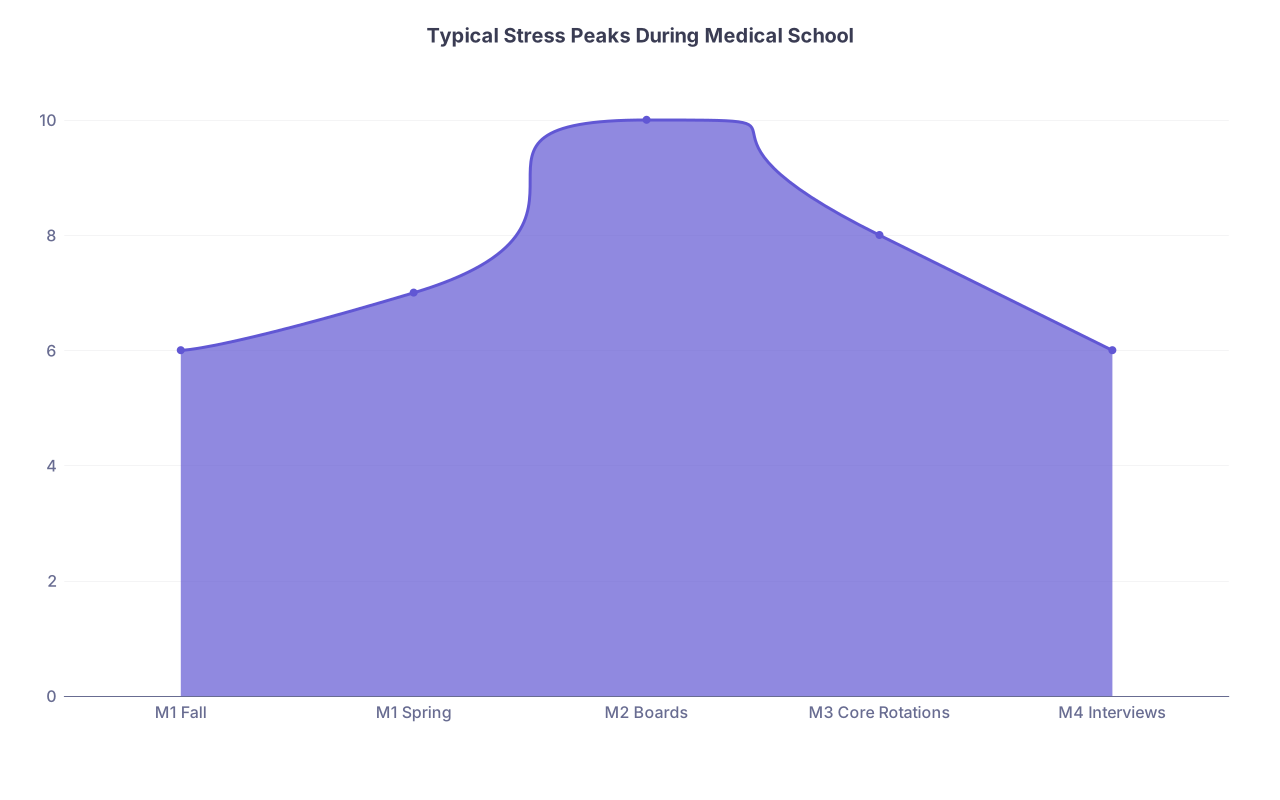
| Category | Value |
|---|---|
| M1 Fall | 6 |
| M1 Spring | 7 |
| M2 Boards | 10 |
| M3 Core Rotations | 8 |
| M4 Interviews | 6 |

| Step | Description |
|---|---|
| Step 1 | Notice distress |
| Step 2 | Yellow Zone |
| Step 3 | Red Zone |
| Step 4 | Tell support person |
| Step 5 | Adjust schedule + self-care |
| Step 6 | Book counseling |
| Step 7 | Contact trusted person immediately |
| Step 8 | Remove immediate risks |
| Step 9 | Contact crisis line / ED / counseling |
| Step 10 | Stabilize |
| Step 11 | Post-crisis debrief |
| Step 12 | Update plan + academic adjustments |
| Step 13 | Early or crisis signs? |
FAQ (4 Questions)
1. Should I tell my medical school about my crisis plan or mental health struggles?
Tell individuals, not “the school” as an abstract entity. Your crisis plan is personal. You do not owe it to anyone. When you need formal accommodations, then you contact the appropriate office (student affairs, disability/access services) with a simple, medically framed message. You do not need to give graphic details. You need enough information for them to understand you are managing a legitimate health issue and may need adjustments.
2. What if I feel like my problems are not “bad enough” to use the crisis plan?
That hesitation is predictable and dangerous. You made the plan when your head was clearer. Trust that version of you. Use the yellow zone steps early and often. The entire point is to act before you hit rock bottom. You will not get extra points for waiting until you are completely incapacitated.
3. How does this work on clinical rotations when my schedule is not my own?
You adapt, you do not abandon it. On rotations, your yellow zone might focus less on big schedule changes and more on small, consistent habits and fast check‑ins with support people. Your red zone steps still apply: if you are unsafe, you step out, tell someone (resident, chief, dean), and get care. No rotation is more important than your life. And no decent program director will prefer a student who hides a serious crisis over one who seeks appropriate help.
4. What if my family or culture does not “believe” in mental health issues?
Then they are not part of your crisis team. You can love them and still keep this separate. Your support network can be classmates, non‑med friends, mentors, therapists, partners. You do not need family permission to protect your brain. Medical training is hard enough without filtering your suffering through other people’s denial. Build the team that will actually show up for you, not the one that looks good on paper.
Key takeaways:
- You need a written, specific crisis plan before things go bad, just like a code algorithm.
- Define your personal warning signs, set clear if/then rules, and pre‑save contacts and scripts.
- Practice using the yellow zone steps early so you rarely have to fully activate the red zone.