
Your mental health will fall apart faster than your professionalism if you ignore it on the wards.
That is the uncomfortable truth. And in medical school culture, most people do the opposite: they guard the appearance of professionalism and let their brain quietly burn down in the background.
I have watched students white‑knuckle through call with panic attacks, survive on three hours of sleep for weeks, dissociate through patient encounters, and then apologize for “not being a team player” when they finally collapse. That is backward.
You are allowed to have limits. You just need a clear, credible way to renegotiate your clinical duties when your mental health is slipping. That is what this guide is for.
Step 1: Name the Problem Precisely (Not Vaguely)
Vague distress gets ignored. Specific, functional impact gets action.
Do not walk into a conversation saying, “I am really stressed and overwhelmed.” That is the background noise of medical training. It will not move anyone.
You want to translate your mental health symptoms into concrete functional problems that relate to clinical work and patient safety.
Use these three questions:
What exactly is happening?
Not “anxiety,” but:- “I am having daily panic attacks, including on rounds.”
- “I cannot fall asleep until 3 a.m. even without call.”
- “I am crying in the bathroom twice a day and cannot stop.”
How is it affecting your work?
- “I am forgetting key lab results when I present.”
- “I am making charting errors late in the day because I cannot concentrate.”
- “I am avoiding patient rooms because I feel overwhelmed and frozen.”
What are the safety / professionalism implications?
- “I am worried I will miss important information and compromise care.”
- “I am not safe driving home after 28‑hour call on this level of sleep.”
- “I am starting to have passive thoughts of not wanting to wake up.”
Once you have that, write it down briefly. You will use this language when you talk to people.
Here is a one‑paragraph template you can adapt:
“Over the past X weeks, I have developed [specific symptoms]. This is causing [specific impairments] on the wards, and I am concerned about [safety/professionalism risk]. I need to adjust my current clinical duties while I get urgent support so I can function safely and effectively.”
That is clear. It is grounded in function and patient safety, not drama or self‑pity.
Step 2: Decide What You Actually Need (Concrete Adjustment Menu)
You are not going to walk in, say “I am struggling,” and let the system design a solution for you. That rarely ends well.
You want to come with at least one or two specific, reasonable asks that match the severity of your situation.
Think in tiers.

Tier 1: Mild to Moderate Slippage (Still Functioning, But Strained)
Symptoms:
- Sleep down, irritability up
- Tearful at home, holding it together at work
- Concentration reduced but still safe
Reasonable asks:
- “Can I be excused from staying past X pm on non‑call days for the next two weeks while I stabilize with treatment?”
- “Can we cap my patient list at [number] so I can focus on doing thorough work?”
- “Can I shift to fewer overnights and more day shifts for the rest of this rotation?”
Tier 2: Significant Impairment (Functioning Is Unreliable)
Symptoms:
- Panic attacks on rounds or in patient rooms
- Serious concentration issues, near errors
- Frequent crying episodes at work
- Thoughts like, “I do not care what happens to this patient anymore”
Reasonable asks:
- “I need to be temporarily removed from overnight call for the rest of this rotation.”
- “I need a brief leave of absence from this rotation (1–2 weeks) to stabilize with my psychiatrist/therapist.”
- “I need to shift to a lower‑acuity or outpatient setting temporarily.”
Tier 3: Acute Risk (Stop. Safety First.)
Symptoms:
- Active suicidal thoughts, with or without plan
- Self‑harm or serious urges
- Unable to get out of bed or stop crying long enough to function
- Using substances to get through the day
At this level, you do not negotiate tweaks. You request immediate removal from clinical duties and urgent evaluation.
Reasonable asks:
- “I am not safe to be on the wards today. I need to be removed from duties and connected to emergency mental health evaluation.”
- “I need an urgent leave of absence to address suicidal thoughts.”
This is not weakness. This is risk management. For you and for patients.
Step 3: Choose the Right Person and Channel (And in What Order)
Here is the basic power structure you are dealing with:
| Person / Office | Primary Role |
|---|---|
| Student health / CAPS | Clinical care, documentation |
| Disability office | Formal accommodations |
| Dean of students / wellness | Policy-level adjustments |
| Clerkship director | Rotation-specific changes |
| Site director / attending | Day-to-day expectations |
You do not start by trauma‑dumping on your intern. You also do not open with a confrontation to the clerkship director about “toxic culture.” That is how you get labeled “difficult” before you get help.
The Order That Actually Works
Student mental health / counseling / student health
- Goal: Document that this is a legitimate mental health issue, not just “stress.”
- Ask for:
- Evaluation
- Treatment
- A letter or summary that says: “Student is under my care for a significant mental health condition. I recommend [X, Y, Z] temporary restrictions or accommodations for [time frame].”
Disability or accommodations office (if available)
- Especially important if this is not your first episode or will be long‑term.
- They can request adjustments without disclosing your diagnosis to faculty.
Dean of students / wellness dean
- This is your process navigator. They know the political and policy landmines.
- You show them your documentation and say:
“My clinician recommends [X]. I need your help implementing this on rotation while protecting my standing and future evaluations.”
Clerkship director / course director
- You usually get to this person only after steps 1–3, ideally with backing from the dean or disability office.
- Conversation goal: translate clinical recommendations into concrete schedule changes, grading adjustments, or a modified rotation plan.
Site director / attending (as directed)
- Usually informed by clerkship director / dean.
- You keep your language functional and brief, not confessional.
If you skip directly to the attending without any backing, you put everything on your own shoulders. And you risk a “professionalism” narrative forming before a “medical condition” narrative.
Step 4: Script the Hard Conversations
You do not need a perfect speech. You do need a clean, credible script that you can deliver under stress.
Let me give you versions for each level.

| Step | Description |
|---|---|
| Step 1 | Notice mental health decline |
| Step 2 | Self-assess severity |
| Step 3 | Contact student health |
| Step 4 | Emergency care + immediate removal from duties |
| Step 5 | Get documentation |
| Step 6 | Disability office (if needed) |
| Step 7 | Dean of students |
| Step 8 | Clerkship director |
| Step 9 | Site director/attending |
| Step 10 | Mild/Moderate? |
| Step 11 | Severe/Unsafe? |
Script: Student Health / Counseling
You:
“Over the past [time], I have had [specific symptoms]. I am on clinical rotations and it is affecting my ability to function safely at work. I need evaluation, treatment, and I may need documentation that I should have temporary restrictions on overnight call / long shifts / high‑acuity rotations.”
You are not asking them to “fix your clerkship.” You are asking them to treat you and give you the medical backing you need.
Script: Dean of Students / Wellness Dean
You:
“I am under the care of [mental health clinician] for [a significant mental health condition]. It is causing [brief functional description]. My clinician recommended [specific limitation], and I have this documented. I want to continue my training safely, and I need help implementing these recommendations on my current and upcoming rotations without being penalized in evaluations or future opportunities.”
Then stop talking. Let them respond. If they are decent at their job, they will:
- Ask clarifying questions
- Outline process
- Tell you what documentation they need
- Suggest options (temporary leave, altered schedule, no call, different site)
If they start talking about “resilience” and “we all struggle” and do not move to concrete process very quickly, you redirect:
“I understand stress is part of training. I am beyond that. I am asking you specifically: what is the process to adjust my clinical duties based on my clinician’s recommendations?”
You are not asking for motivational posters. You are asking for process.
Script: Clerkship Director
You (ideally with dean already looped in):
“I have been working with [student health/disability/dean] about a significant mental health issue that is currently affecting my functioning. Based on my clinician’s recommendation, the school has approved [X adjustment] for [time frame]. I am committed to doing the work and learning the material. I want to figure out how to meet the core requirements of this rotation within these constraints.”
Then, offer options instead of “fix this for me”:
- “Could I complete the inpatient weeks without overnight call, and add an extra week of days to make up some experience?”
- “Could we shift me to the outpatient block for the remainder of this clerkship?”
- “Is there a way to complete the required patient encounters with a lower daily cap?”
You are framing yourself as collaborative, not demanding. That matters.
Script: Attending / Team (Minimal Disclosure)
You do not owe them your diagnosis.
You might say:
“I have been working with the school on a temporary health‑related accommodation. For this rotation, I am excused from overnight call and extended shifts past [time]. I am still expected to meet core learning objectives. I want to be upfront about that so we can plan my responsibilities accordingly.”
If they push for details:
“I prefer to keep the specifics private. The dean and clerkship director are aware, and this has been officially approved. I am happy to talk through how to structure my responsibilities so I can contribute effectively.”
If they suggest you are “not committed”:
“I am committed enough to be honest about my limits so I do not put patients or the team at risk. This is a temporary adjustment while I get appropriate treatment.”
That is firm without being antagonistic.
Step 5: Protect Your Grades and Future While You Protect Your Brain
Your fear is predictable: “If I admit I am struggling, I will get bad evaluations, I will not match, and everything is over.”
Here is the reality. Unmanaged mental health problems hurt your future more reliably than documented, supported accommodations do.
You still need to be strategic.
Get Everything in Writing
- Email summaries after meetings:
- “Thank you for meeting today. To summarize, we agreed that for the remainder of my medicine rotation, I will [X], and I will be excused from [Y]. This is in effect from [date] to [date].”
- Keep:
- Letters from clinicians
- Accommodation letters
- Dean emails confirming plan
- Save them in a secure, backed‑up place.
Clarify Evaluation Expectations Up Front
Ask directly:
“How will these adjustments impact how I am evaluated for this rotation?”
Push for specifics:
- Will you still be eligible for Honors?
- Will missed days require make‑up time?
- Will narrative comments mention accommodations?
If the answer is vague:
“I want to avoid any surprises on my record. Can we specify in writing how my evaluation will be handled under this modified schedule?”
This is not being difficult. This is damage control.
Know When a Temporary Hit Is Worth It
Sometimes, you cannot have everything:
- Maybe you will not get Honors on one rotation because you took two weeks off.
- Maybe you switch from a high‑powered inpatient site to a slower community site.
Ask yourself one hard question:
“If I keep going as I am, what is actually going to happen?”
If the honest answer is:
- “I will fail this rotation.”
- “I will make dangerous mistakes.”
- “I will end up in the ED or hospitalized.”
Then taking a small, controlled hit now is smarter than a catastrophic one later.
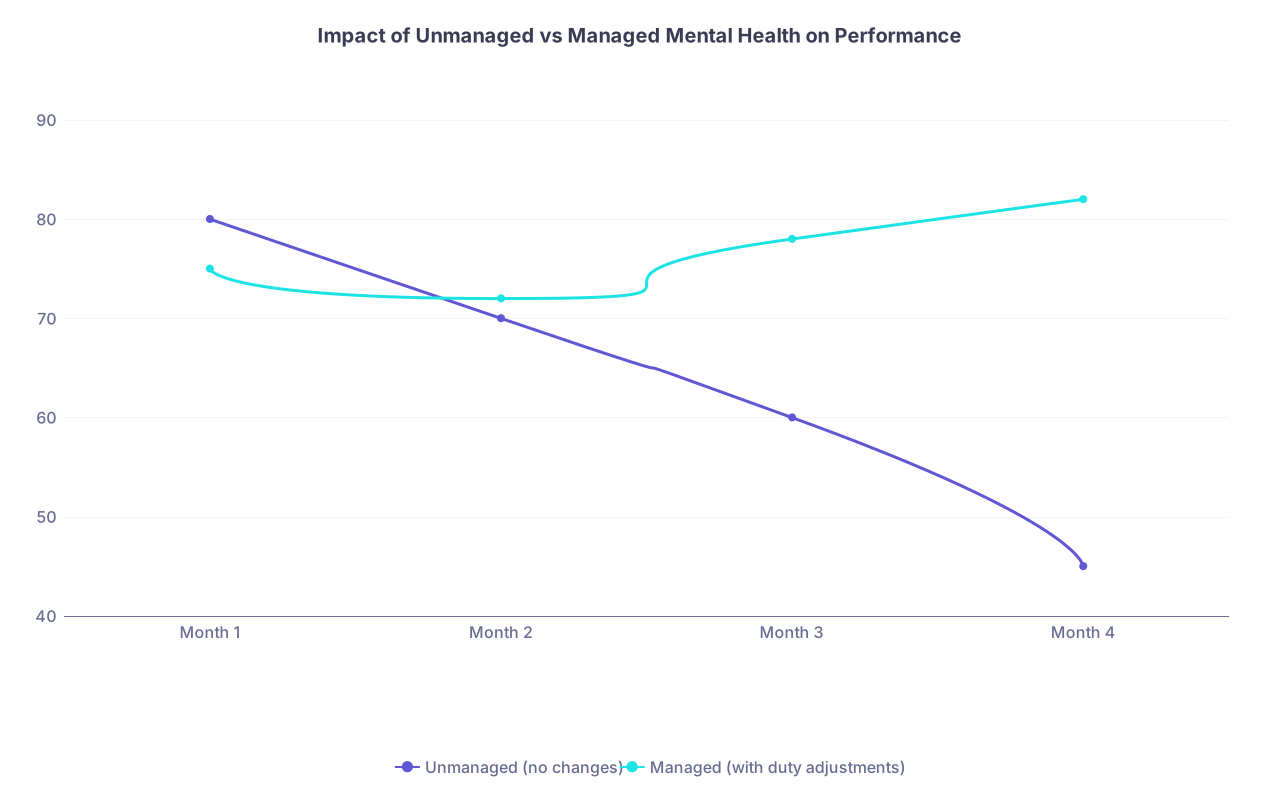
| Category | Unmanaged (no changes) | Managed (with duty adjustments) |
|---|---|---|
| Month 1 | 80 | 75 |
| Month 2 | 70 | 72 |
| Month 3 | 60 | 78 |
| Month 4 | 45 | 82 |
The rough idea: performance trends down when you ignore it, and stabilizes or improves when you intervene early.
Step 6: Adjust Your Day‑to‑Day on the Wards (Tactical Fixes)
Negotiating duties is one part. You also need to change how you operate within those duties so you stop burning through your remaining mental reserves.
Strip Your Day to Non‑Negotiables
When your mental health slips, you do not have the bandwidth for optional heroics.
Here is your priority list, in order:
- Patient safety tasks
- Critical labs, imaging, vital sign trends, urgent pages.
- Required learning objectives
- Core presentations, notes, direct patient care interactions.
- Basic team functioning
- Being reachable, reliable, closing the loop.
Everything else is “if energy allows”:
- Extra consults nobody asked you to see
- Reading every trial ever published on heart failure tonight
- Meticulous color‑coded notes that nobody else reads
You are in mental triage mode.
Simple Ward Rules When You Are Not Okay
Never silently suffer on call if you feel unsafe.
If you are having a panic attack at 2 a.m.:- Page your resident: “I am having a medical issue and need 5–10 minutes to step away and reset. I do not feel safe making decisions right this minute.”
- Then go somewhere private, use grounding/breathing, text/Call a support person if needed. If it does not resolve, escalate to leaving and getting help.
Use checklists for everything.
When your concentration is shot:- Pre‑round checklist
- Sign‑out checklist
- “Before I present, I confirm: vitals, labs, imaging, overnight events, plan for each system.”
Block micro‑breaks without apology.
On a long day:- Step away for 3 minutes every few hours.
- Bathroom stall, stairwell, outdoor bench—whatever.
- One minute of 4‑7‑8 breathing will do more than doomscrolling for 10.
Cut the performative extras.
You do not need to impress that one malignant fellow with obscure guideline trivia right now. You need to stay upright.
Step 7: Know When to Stop Completely
There is a line where “adjusting duties” is not enough. You need to step away.
Here is that line, bluntly:
- You are actively suicidal or seriously self‑harming.
- You are using alcohol, benzos, or other substances to get through call.
- You are missing obvious clinical details repeatedly.
- Supervisors have expressed concern about your performance or reliability.
- You wake up and your first thought is, “I hope I get into a car accident so I do not have to go in.”
If you are there, your next step is not negotiation. It is removal from duty and emergency care.
That means:
- Call your school’s on‑call dean / emergency line
- Go to ED / crisis center
- Tell someone you trust immediately
And yes, it might mean:
- Leave of absence
- Delayed graduation
- Explaining it later on residency applications
Is that ideal? No.
Is it better than being dead, or harming a patient, or being removed from school for unprofessional behavior after months of decline? Obviously.
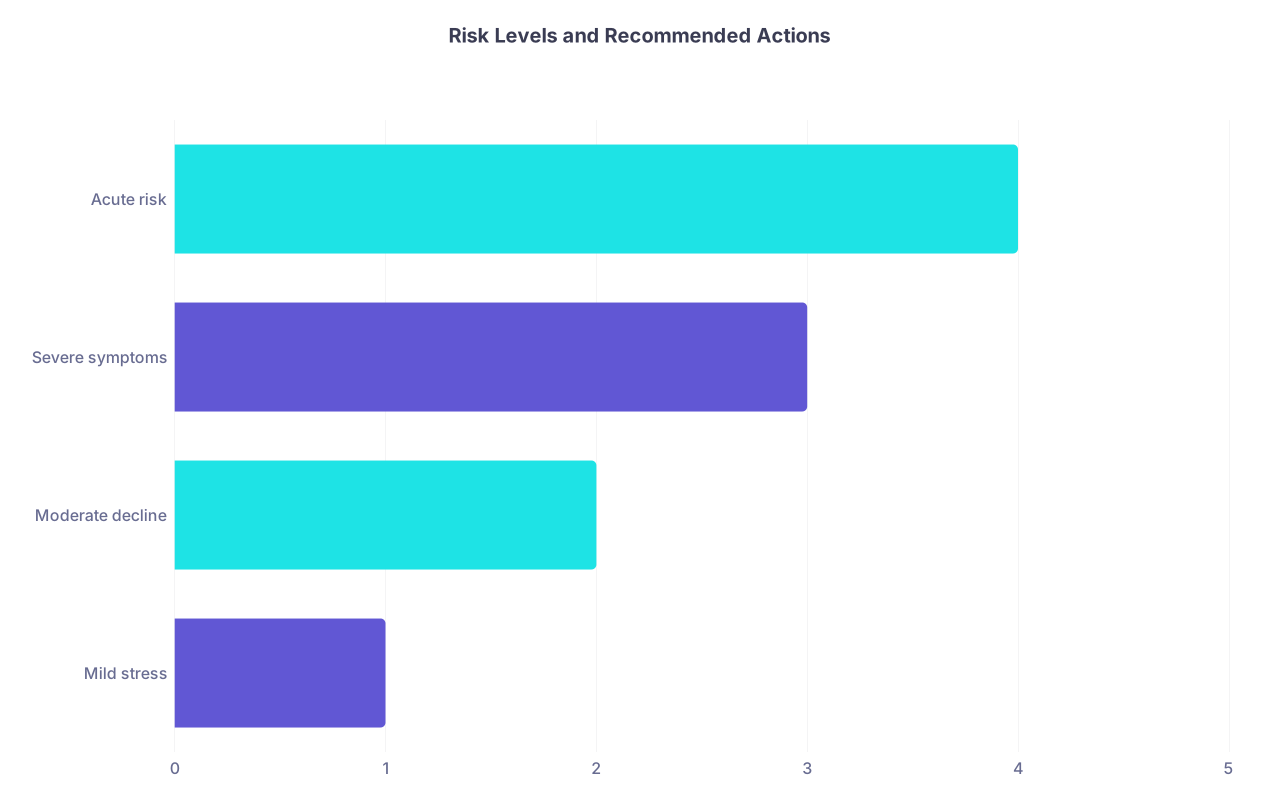
| Category | Value |
|---|---|
| Mild stress | 1 |
| Moderate decline | 2 |
| Severe symptoms | 3 |
| Acute risk | 4 |
(1–4 is basically: watchful waiting, duty tweaks, structured adjustments + treatment, emergency removal from duty.)
Step 8: Plan for the Next Rotation (So You Do Not Repeat This)
The problem with “just making it through” one rotation is that the next one is waiting. Sometimes worse.
You need a medium‑term plan, not just crisis patching.
Before the Next Block Starts
Sit down with:
- Your mental health clinician
- Dean / disability office (if involved)
Answer these:
What are your non‑negotiable limits right now?
- Max hours per week?
- No 28‑hour calls?
- No trauma service for the next 6 months?
What ongoing supports do you need locked in?
- Weekly therapy at a consistent time
- Medication management follow‑up during tough blocks
- A designated point person at school you can email early if you start sliding
Which rotations should be rearranged?
- Moving heaviest services (surgery, ICU) later
- Doing outpatient or electives while stabilizing
- Avoiding back‑to‑back brutal blocks

Once you decide this, put it in writing with the dean. Then have the scheduling office implement it rather than trying to negotiate anew with every clerkship.
Create an Early‑Warning System
Your mental health usually does not collapse overnight. The signs show up early. The problem is you ignore them.
Define 3–5 early warning signs that for you mean “time to intervene”:
Examples:
- Two nights in a row of <4 hours sleep, not from call
- Skipping meals without noticing
- Driving home and not remembering the route
- Crying more days than not
- Starting to think: “If I get hit by a bus, it would be fine”
Write these down somewhere you actually see.
Then, make a simple rule:
“If I hit 2 of these signs for more than 3 days, I will email [clinician / dean point person] the same day.”
This is boring and unheroic. That is why it works.
Step 9: Handle the Shame and Cultural Nonsense
You are in a culture that treats suffering as currency. So when your mental health slips and you scale back duties, the shame hits hard.
Let me be uncomfortably direct.
- You are not weak for needing adjustments. You are realistic.
- The “always show up, no matter what” person is not more professional than you. They are often more reckless.
- The student who builds a sustainable career with boundaries wins. Period.
You will hear comments:
- “In my day, we did Q3 call and survived.”
- “Everyone is stressed; you just push through.”
- “Are you sure this is not just a time management issue?”
Most of that is defensiveness. People who suffered without help often need to believe it was necessary. Otherwise they have to face that they were harmed pointlessly.
You are not obligated to repeat their mistake.

Practical tactics:
Limit disclosure.
Not everyone gets to know your business. You pick:- One or two trusted peers
- Your clinician
- The minimum required at school
Use neutral language.
- “Health‑related accommodation” instead of “I am anxious and depressed.”
- “Restricted from call” instead of “I cannot handle call.”
Anchor on professionalism.
- “I am doing this so I can be safe and effective, not so I can coast.”
One Thing to Do Today
Do not wait until you are sobbing in a call room at 3 a.m. to figure this out.
Today, before the next crisis:
- Open a blank note on your phone or laptop.
- Write three sections with bullet points:
- My early warning signs (3–5 concrete things)
- My first contacts (names/emails for student health, dean, disability office)
- My default ask if I start slipping (for example: “No overnight call for 2 weeks while I re‑stabilize with treatment”)
You do not need a full plan right now. You need a first move.
Because when your mental health slips, the hardest part is thinking clearly enough to ask for what you need. If you do the thinking now, you will be able to act later.