
The idea that you need an entire “self-care day” to avoid burnout is nonsense. What you actually need is a ruthless, repeatable 20‑minute reset you run every single day, especially when you are drowning in material and living on call schedules and caffeine.
You are not going to magically get more time. So you build a system that fits inside the time you actually have.
This is that system.
The Reality: You Do Not Need More Time, You Need a Protocol
If you are a medical student on the edge of burnout, you already know the symptoms:
- You reread the same Anki card three times and retain none of it.
- You stare at UWorld explanations and feel your brain slide off the page.
- You snap at your partner or co‑MS over something tiny.
- You fantasize about walking out of the library and never coming back.
Here is the part everyone skips: your problem is not just “too much work.” It is a fried nervous system running in constant threat mode. High cortisol. Shallow breathing. Zero recovery.
You cannot “willpower” your way out of that. You have to manually downshift your brain and body. That is what this 20‑minute reset routine does.
This is not fluffy wellness. It is a structured, specific protocol you run like a checklist.
The 20‑Minute Reset: Overview
This routine is built for one thing: getting you from overwhelmed and scattered to calm and focused in under 20 minutes. You can use it:
- Between study blocks
- Before bed
- After a brutal exam
- On call breaks during rotations
Here is the breakdown:
- Minute 0–2 — Hard Stop & Micro‑Environment Reset
- Minute 2–7 — Physiologic Downshift (Breath + Body)
- Minute 7–12 — Mental Declutter (2‑Page Brain Dump)
- Minute 12–17 — Tiny Win (One Deliberate Micro‑Action)
- Minute 17–20 — Re‑Entry Plan (3‑Item Restart List)
You can compress this to 10–12 minutes on insane days, but the full 20 is ideal.
Let us walk through it step by step.
Step 1: Minute 0–2 — Hard Stop & Micro‑Environment Reset
If you do not create a clean break, your brain drags all the mental noise into your “reset” and sabotages it.
So you start with a hard stop.
What you do (2 minutes):
Close the loop on whatever you are doing.
- Pause your question bank or video.
- Jot a 1‑line note: “Stopped at Q 23/40” or “Paused at 12:43 in cardio path video.”
- This tells your brain, “We are not abandoning this. We are parking it.”
Physically change your position and micro‑environment.
- Stand up. Push your chair back.
- If you are in the library: step into the hallway, stairwell, or a different table.
- On the wards: duck into a quiet corner, empty patient room, or call room.
Visual reset: clear your immediate visual field.
- Flip your notebook closed.
- Minimize windows or turn your screen off.
- If possible, look at something far away for 10–15 seconds (out a window, down a hallway). It literally relaxes the extraocular muscles and reduces visual fatigue.
You are telling your nervous system: that last block is over. This is a new block.
Step 2: Minute 2–7 — Physiologic Downshift (Breath + Body)
If your heart rate is up and your muscles are tense, your brain will not reset. Your body has to cooperate.
Use a 5‑minute combo: targeted breathing + simple movement.
2.1 Breathing: 3 Minutes of Cyclic Sighs
This is not generic “deep breathing.” Use a specific pattern that actually works.
Cyclic sigh (proven in actual lab data to reduce physiological arousal):
- Inhale through the nose normally
- Take a second short inhale on top of that (like topping off your lungs)
- Slow exhale through the mouth, longer than both inhales combined
That is one cycle.
Do this:
- 1 breath every ~10 seconds
- 18–20 breaths = about 3 minutes
Practical script:
- Set a timer on your phone for 3 minutes
- Close your eyes or soften your gaze
- Run cyclic sighs until the timer ends
If cyclic sighs feel uncomfortable, alternative: 4‑6 breathing — inhale for 4 seconds, exhale for 6 seconds, repeat.
2.2 Movement: 2 Minutes of Tension Release
You do not need yoga pants or a mat. You just need to convince your muscles to stop acting like you are being chased by a bear.
Here is a fast sequence:
Neck:
- Drop right ear to right shoulder, hold 10 seconds.
- Left ear to left shoulder, 10 seconds.
- Slow neck circles, twice each direction.
Shoulders:
- Shrug shoulders up to ears for 3 seconds, then drop them. Repeat 5 times.
- Roll shoulders forward 10 times, backward 10 times.
Back and hips:
- Stand, hinge at the hips, let arms dangle toward the floor, hang for 20–30 seconds. Slight bend in the knees.
- Slow twist left and right, hands on hips, 10 times each side.
If you are in a call room or somewhere private: add 10 slow bodyweight squats. Full range. Focus on the sensation, not speed.
Step 3: Minute 7–12 — Mental Declutter (2‑Page Brain Dump)
Here is why most “breaks” do not work: you step away physically, but your mind is still spinning through:
- Shelf exam
- Step 2
- Patient on the floor who decompensated
- That attending who humiliated you on rounds
- The lab PI waiting for your draft
You need to offload mental RAM. You do that with a brain dump that is structured, not a vague journal entry.
You need:
- A small notebook or a sheet of paper (physical is better than digital)
- A pen
- 5 minutes
Two pages. No more. No less.
Page 1: Raw Dump (No Structure, No Filter)
For 2–3 minutes, write everything flying around your head:
- “Need to email Dr. K about schedule change”
- “Terrified I am going to fail neuro shelf”
- “Still thinking about that missed question on AKI management”
- “I have not called my mom in 2 weeks”
- “I cannot keep doing 12‑hour days and then Anki until midnight”
Do not censor. Do not organize. Just list as fast as you can.
Page 2: Sort into Three Buckets
Draw three headings on the next page:
- 1. Today
- 2. This Week
- 3. Not My Problem Right Now
Now go back to Page 1 and rewrite each item under one of the three.
Examples:
- “Need to email Dr. K about schedule change” → Today
- “Terrified I am going to fail neuro shelf” → Not My Problem Right Now (because the fear itself is not an action)
- “Review AKI management algorithm x3” → This Week
- “Step 2 score goal 245+” → Not My Problem Right Now
- “Call mom” → This Week (or Today if you want)
You are training your brain to see the difference between:
- Actionable tasks
- Longer‑horizon planning
- Pure noise
The third bucket is crucial. You are explicitly telling your mind: “We are not dealing with this now.”
Step 4: Minute 12–17 — Tiny Win (One Deliberate Micro‑Action)
Now that your body is calmer and your mind is slightly decluttered, you create a small, controllable win. This flips you out of helplessness mode.
The mistake most students make: they go straight back to the hardest task (e.g., UWorld blocks) while still half‑fried. Then they wonder why nothing sticks.
Do one tiny, bounded action that is both achievable and relevant.
Criteria for your Tiny Win:
- Takes 3–5 minutes
- Has a clear finish line
- Aligned with your current phase (pre‑clinical, clerkships, dedicated, etc.)
Examples:
Pre‑clinical:
- Rewrite one confusing pathway (RAAS, glycolysis, complement cascade) as a 3‑step sketch.
- Summarize one lecture slide deck into 5 bullet points.
Clinical/clerkships:
- Rewrite one patient’s problem list in priority order.
- Craft one clean one‑liner for a patient you are following.
Dedicated exam prep:
- Review 3–5 missed flashcards (just one pass, not perfection).
- Re‑explain one recent missed UWorld question aloud or on paper, focusing on the “why” of the correct answer.
You want something you can point to and say: “I did that.” Concrete. Not vague.
This is not about productivity. It is about re‑establishing a sense of competence.
Step 5: Minute 17–20 — Re‑Entry Plan (3‑Item Restart List)
The last thing you do before re‑entering study or clinical work is decide, very specifically, how you will step back in.
Most people end their breaks passively. Scroll their phone until guilt kicks in. Then vaguely “go back to work.”
You are going to do the opposite. You end with a 3‑item Restart List.
On the bottom of Page 2 or a fresh line, write:
“When I go back, I will:”
List exactly three items. No more.
Examples:
- “Finish UWorld cardio block (Q 23–40), no pausing”
- “Review CKD staging and indications for dialysis x15 minutes”
- “Text Rohan about swapping call shifts next week”
Or on a ward day:
- “Pre‑round on Mrs. J, update vitals and I/Os in my note”
- “Look up 1 question on her hyperkalemia management”
- “Refill water bottle before afternoon rounds”
You now have a simple, pre‑decided ramp back into work. That kills the friction and decision fatigue that eat up half your energy.
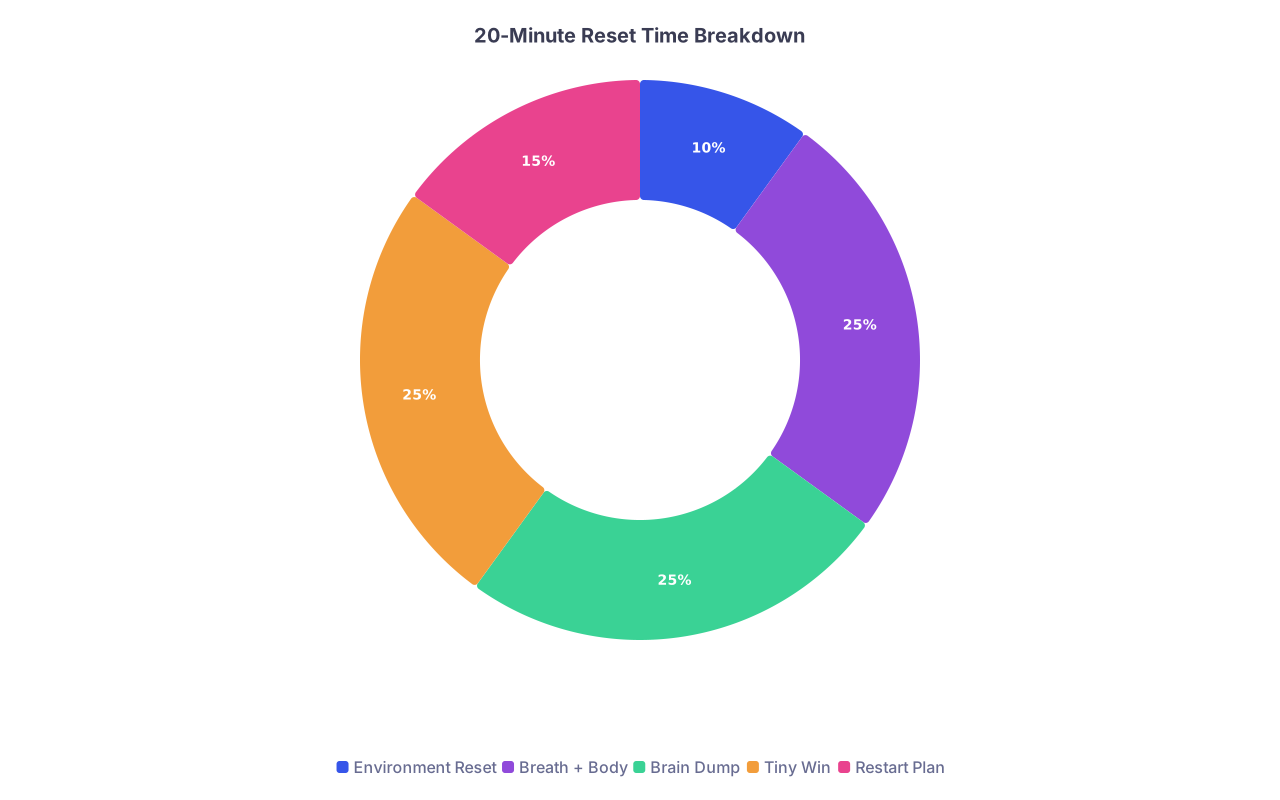
| Category | Value |
|---|---|
| Environment Reset | 2 |
| Breath + Body | 5 |
| Brain Dump | 5 |
| Tiny Win | 5 |
| Restart Plan | 3 |
Where This Fits In Your Day: Practical Use Cases
You do not need this routine ten times a day. That becomes avoidance. You use it strategically at leverage points.
1. Between Study Blocks (Ideal)
You are doing 90‑minute focused blocks for board prep. You feel yourself sliding:
- Reading the same paragraph three times
- Picking up your phone every 6 minutes
- Randomly checking your email mid‑question block
Instead of stretching that sad, weak “study” into a 3‑hour slog, you:
- Stop at 60–75 minutes
- Run the 20‑minute reset
- Do another tight, focused 60–90 minute block
Two high‑quality blocks with resets will beat 5 hours of half‑conscious grinding every time.
2. Post‑Exam Decompression
After a big exam (unit test, shelf, NBME), you are usually:
- Physically exhausted
- Mentally replaying every question you might have missed
- Tempted to either:
- Collapse into bed, or
- Immediately start “fixing weaknesses” in a panic
Do this instead:
- Walk out of the exam.
- Physically leave the building or change floors.
- Run the 20‑minute reset before you look at anything exam‑related.
On the brain dump page, you will write garbage like:
- “Pretty sure I failed”
- “Forgot the dose for enoxaparin AGAIN”
- “Why did I second‑guess that AKI question”
Most of that will go under “Not My Problem Right Now.”
The point is not productivity. It is to break the rumination loop so you do not sabotage the rest of your week.
3. Nightly Reset Before Bed
If you are lying in bed, scrolling, feeling your heart race about tomorrow’s cases or your question bank percentages, run a compressed reset:
- 1 minute: Hard stop, put phone face down across the room
- 3 minutes: Cyclic sighs
- 3 minutes: Brain dump + 3‑item “Tomorrow morning” list
- Skip the Tiny Win
- Sleep
You will fall asleep faster because your brain has a plan and a parking lot for the noise.
Non‑Negotiables: Boundaries That Make This Work
You can absolutely screw this routine up. Here is how med students usually do it:
- Turn the “brain dump” into a 40‑minute journaling session
- Replace cyclic sighs with Instagram reels
- Let the reset bleed into “oh wow it has been an hour, I should get back to work”
So you put guard rails on it.
Rule 1: Timer For Each Segment
Use your phone or watch. Set:
- 2 minutes
- 5 minutes
- 5 minutes
- 5 minutes
- 3 minutes
Or a single 20‑minute timer if that is easier, and write timestamps in your notebook the first few times.
You treat it like a code: when the timer goes, you move to the next step. No negotiation.
Rule 2: Phone Is Tools‑Only
Your phone is allowed for:
- Timer
- White‑noise or breathing app if you use one
It is not allowed for:
- Messages
- Social media
If you know you will cheat, put it in airplane mode and physically flip it over.
Rule 3: Do Not Skip the Physical Piece
The most common shortcut: “I will just do the mental part.” Translation: you sit still, think about your stress in a slightly more organized way, and call it a reset.
That does not work. Your body informs your brain. Skip the breath + movement and you are trying to debug software on a melting motherboard.
How to Make This Routine Stick (Even on Rotations)
You might be thinking, “Sure, nice in theory, but on surgery I do not even get 20 minutes to pee.”
Fine. You adapt. You still apply the same framework, just compressed.
Compressed Version: 8–10 Minutes On The Wards
- Minute 0–1: Hard stop. Step into stairwell or empty hallway. One sentence note in your pocket notebook about where you left off.
- Minute 1–4: 3 minutes of cyclic sighs, standing.
- Minute 4–7: One‑page brain dump, then draw a line down the middle: “Today” and “Not Now.” Sort as fast as possible.
- Minute 7–10: 2–3 item Restart Plan: “When I step back on the floor, I will…” (ex: “Check labs on Mr. S, update signout, ask senior about discharge plan.”)
Rotation‑friendly tweaks:
- Use a tiny pocket notebook instead of a full journal.
- If breathing with eyes closed feels weird in public, keep your eyes open and just soften your gaze at the floor or wall.
- Shoulder rolls and neck stretches can be done in a white coat without drawing attention.

| Step | Description |
|---|---|
| Step 1 | Start Day |
| Step 2 | First Study Block |
| Step 3 | 20-Minute Reset |
| Step 4 | Second Study Block |
| Step 5 | Evening Tasks/Clinical |
| Step 6 | Short Night Reset |
| Step 7 | Sleep |
| Step 8 | Focus dropping? |
Common Failure Modes And How To Fix Them
You will hit resistance. Your brain will say all kinds of stupid things. Here is what it will probably sound like, and how to respond.
“I Do Not Have Time For This”
I have watched students waste 45–60 minutes doom‑scrolling, then say they “do not have time” for a 20‑minute structured reset.
The fix:
- Commit to trying it once on a day you are already cooked.
- Compare how you feel starting your next study block after the reset versus after a “quick break” on your phone.
If the reset does not leave you at least 20–30 percent clearer, adjust. But at least test it honestly.
“Brain Dumping Makes Me More Anxious”
That happens when you:
- Write everything down
- Then stop there
You just created a list of problems with no structure. Of course you feel worse.
The fix:
- Never stop after Page 1.
- Always sort into Today / This Week / Not My Problem Right Now.
- Force yourself to put at least a few items into the “Not My Problem Right Now” bucket, even if your brain resists.
You are training your mind that not every scary thought earns your immediate attention.
“I Start, Then Drift Off Into Random Tasks”
You start the Tiny Win and accidentally slide into email rabbit holes. Or you start cleaning your room “just a little” and suddenly you are organizing your closet.
The fix:
- Define the Tiny Win before you do it. One sentence, specific.
- Use a 5‑minute timer while you do it.
- When the timer goes off: stop, even if you want to keep going.
Your goal is not maximal productivity, it is maximal control.

Minimal Gear, Maximal Return
You do not need a wellness starter kit. You need three cheap tools and some discipline.
| Item | Purpose |
|---|---|
| Small notebook | Brain dump + restart lists |
| Pen | Fast, tactile offloading |
| Phone timer | Segment timing + guard rails |
Optional add‑ons if you want:
- Noise‑blocking earbuds (for breath work in loud spaces)
- Reusable water bottle (pair resets with hydration)
That is it. If you are waiting to start until you get the perfect journal or app, you are avoiding the actual work.
When This Is Not Enough: Red Flags You Should Not Ignore
Let me be blunt. A 20‑minute reset routine is powerful, but it is not magic. There are situations where it is necessary but not sufficient.
You need more than a reset if:
- You wake up every day dreading life, not just exams.
- You find yourself thinking “If I got hit by a bus, at least I could rest.”
- You are using alcohol, stimulants, or benzos just to function.
- You are crying in bathrooms, stairwells, or your car several times a week.
- You have lost interest in things that used to matter to you (friends, hobbies, anything non‑medicine).
At that point, please stop trying to white‑knuckle this alone.
Actions, not vague intentions:
- Reach out to your school’s counseling service. Every med school has one. Many are free and confidential.
- Talk to someone in your circle. One real person. Not a group chat. “Hey, I am not okay. Can we talk?”
- See an actual physician or mental health professional if you have thoughts of self‑harm or feel like you are losing control.
The reset routine still helps. But it sits on top of real support, not in place of it.
How To Start: 3‑Day Trial
Commit to a tiny experiment instead of a life overhaul.
For the next 3 days, pick one moment per day to run the full 20‑minute reset:
- Day 1: After your first major study block
- Day 2: After a long day on the wards before evening studying
- Day 3: Post‑exam or before bed
After Day 3, ask yourself:
- Do I feel less scattered when I start the next task?
- Am I ruminating less at night?
- Are my study blocks slightly less miserable?
If the answer is yes for even one of those, you have a tool worth keeping.

Key Takeaways
- You do not need a spa day; you need a daily 20‑minute reset protocol that downshifts your nervous system and clears mental clutter.
- The routine works because it combines physical, mental, and behavioral steps: environment reset, breath + body, brain dump, tiny win, and a 3‑item restart plan.
- Used consistently, this becomes your daily “control‑alt‑delete” for burnout, keeping you functional, focused, and a little less miserable in a system that will not slow down for you.