
Structured Reflection: A 4-Question Tool to Defuse Imposter Spirals
It is 11:47 p.m. You just left the library after a UWorld block that went badly. Again. You walk past the anatomy lab doors and think, “Everyone else is getting this. I am the weak link.”
By the time you get home, it is not “I missed those questions.”
It is “I do not belong here. They made a mistake admitting me. I am going to fail Step, fail rotations, fail my patients.”
That is an imposter spiral.
And if you are in medical school, you are not special for having one. Almost everyone does. The difference between students who get eaten alive by it and students who function is not who has the thoughts. It is who has a process to interrupt them.
This is where structured reflection comes in.
Specifically, a four‑question tool you can run in 5–10 minutes to pull yourself out of the spiral and back into reality.
I am going to walk you through it step by step, show you how to use it on real med‑school problems, and give you a protocol to make it a habit instead of a one‑off “that was nice” exercise you never touch again.
What You Are Actually Fighting: The Anatomy of an Imposter Spiral
Before we fix it, look at what you are up against.
An imposter spiral usually follows a very predictable chain:
Trigger event
- 58% on an NBME.
- Attending grills you on rounds and you freeze.
- Friend casually mentions their 260 practice score.
- You blank on an “easy” question in small group and everyone turns to look.
Instant interpretation
- “That was bad” is normal.
- “This proves I should not be here” is the jump.
- Your brain goes from data → identity in one move.
Emotional spike
- Shame, anxiety, dread, sometimes anger.
- Body goes into fight‑or‑flight: racing thoughts, tight chest, doom‑scrolling AMBOSS forums at 1 a.m.
Behavioral fallout
- You stop doing question blocks because “what is the point.”
- Or you overcompensate with panicked, unfocused 14‑hour “study” days that are mostly staring.
- You avoid asking questions on rounds. You hide.
None of this is because you are weak. It is because you are human and under continuous evaluation in a high‑stakes environment that rewards comparison.
You are not going to stop the triggers. Tests, attendings, peers with higher scores—they are all staying.
What you can change is what happens after the trigger.
That is the job of structured reflection: a short, scripted way of thinking that keeps you from free‑falling.
The 4‑Question Structured Reflection Tool
Here is the tool, in its entire form. Then we will unpack it.
When you notice the spiral starting, you sit down (or stand in a hallway, fine) and run through:
- What exactly happened? (Just the facts.)
- What story did my brain instantly tell about what this means about me?
- What is a more accurate, specific interpretation of this event?
- Given that more accurate interpretation, what is one concrete action I can take in the next 24 hours?
That is it. Four questions.
Looks simple. But I have watched this pull residents out of shame spirals after bad feedback and MS2s off the ledge after catastrophic NBME scores. It works because it forces three things:
- Separation of event vs. identity
- Shift from vague global self‑attack to specific, local problem
- Shift from rumination to action
Let me break each question down and then show you exactly how to use it with common med school scenarios.
Question 1: “What Exactly Happened?” – Force Reality Back into the Room
When people spiral, they almost never have a clean picture of what happened. It is all blended:
- the event,
- how they felt about it,
- what it “means”,
- and all the prior failures they just dragged in mentally.
Your job in Question 1 is to strip everything down to raw data.
Rules for this step:
- Only things an external observer with a camera could verify.
- No adjectives about yourself. No “I was embarrassing,” “I was incompetent.”
- Concrete details: numbers, specific behaviors, exact words.
Examples
After a bad shelf practice test:
- “NBME Form 7: 64% correct, converted to 222 equivalent.”
- “Time used: full 2 hours; marked 10 questions to come back to; changed 5 answers, 3 of which I changed from right to wrong.”
After a tough pimp session on rounds:
- “Attending asked 6 questions about heart failure management. I answered 2 correctly, 1 partially, and for 3 I said, ‘I am not sure.’ He said, ‘You need to review this tonight,’ in front of the team.”
After hearing about a classmate’s score:
- “Classmate said they got a 250 on Step 2 CK. I do not know how much they studied or what their practice scores were. I have no score yet.”
You want 2–6 bullet points. That is it. No drama. No conclusions. Just a log.
You will feel resistance here because your brain is used to skipping straight to judgment. Force yourself to stay with the data.
Question 2: “What Story Did My Brain Instantly Tell?” – Expose the Automatic Narrative
This is where you write the ugly stuff. The thoughts you do not want to admit you are having.
You are not endorsing them. You are surfacing them.
You answer:
“Based on that event, my brain immediately told me that…”
And you list the actual sentences your mind threw at you, word‑for‑word. No editing.
Example after the 64% NBME:
- “This proves I am not smart enough for medicine.”
- “A 222 means I will never match at a good program.”
- “Everyone else is ahead of me.”
- “I knew I was faking it getting into this school.”
Example after getting corrected on rounds:
- “The intern and resident think I am stupid.”
- “The attending now has me on his mental ‘do not rank’ list.”
- “If I cannot answer basic questions, I am going to hurt a patient someday.”
You are looking for patterns:
- “I am stupid.”
- “I should not be here.”
- “They will find out.”
These thoughts are almost always:
- global (about your entire self),
- permanent (“always,” “never”),
- and predictive of catastrophe.
You cannot challenge what you have not named. This step names it.
Question 3: “What Is a More Accurate, Specific Interpretation?” – Replace Vague Doom with Targeted Truth
Now we move. This is the heavy lift.
You are not trying to become a motivational poster. You are not going from “I am a fraud” to “I am a genius and everything is fine.” That is nonsense, and your brain will reject it.
You are doing something much more powerful:
You are forcing specificity and proportionality.
Ask yourself:
- What are other plausible explanations that fit the facts?
- What did this event actually measure—and not measure?
- If my best friend described this same event, what would I tell them?
Then write 2–5 sentences that are:
- anchored in your facts from Question 1,
- limited to this situation,
- and honest.
Example: NBME 64% → “I am doomed.”
More accurate interpretation might be:
- “A 64% on this form means my current knowledge would likely convert to a low‑220s on test day, which is below where I want to be, but far from a failure.”
- “This form focused heavily on nephrology and rheumatology, which are weaker for me. I have not done targeted review in those yet.”
- “Changing right answers to wrong ones suggests a test‑taking / confidence issue, not only content gaps.”
- “This is information about my current prep strategy, not my overall intelligence or worth as a physician.”
Notice what I did:
- I stayed grounded in the numbers.
- I named specific domains (nephro/rheum), not “I suck at medicine.”
- I separated “test‑taking process” from “knowledge.”
Example: Harsh feedback on rounds → “They think I’m incompetent.”
More accurate:
- “The attending expects students to know first‑line management cold. I did not review this week’s topic thoroughly, and it showed.”
- “Saying ‘You need to review this tonight’ was feedback on my preparation, not a declaration I should not be in medicine.”
- “I answered ~50% of the questions. That is not great, but also not zero.”
- “This is a signal to tighten my daily reading routine, not evidence I am unfit.”
Again: specific, limited, honest. No sugarcoating. But no apocalypse either.
You are training your brain to interpret events like a decent attending:
direct, specific, focused on remediation, not character assassination.
Question 4: “Given That Interpretation, What Is One Concrete Action in the Next 24 Hours?”
Reflection without action is just rumination dressed up in academic language.
You end every reflection with one tangible, do‑able action. Not a giant life overhaul. One step.
Criteria for the action:
- Specific (you could record it in Google Calendar).
- Measurable (you know if you did it or not).
- Time‑bounded (start and end in under 60 minutes, usually).
You are answering:
“If that more accurate story is true, what is the next right move?”
Examples
From the NBME case:
- “Tomorrow from 7–8 p.m., I will:
- re‑review nephrotic vs nephritic syndromes (Boards & Beyond videos),
- then do 10 UWorld nephro questions untimed and review explanations.”
From the harsh attending feedback:
- “Tonight from 9–9:30 p.m., I will:
- review first‑line treatment of systolic and diastolic heart failure and write a 1‑page summary for myself.
- Tomorrow morning before prerounds, I will quickly glance at that summary.”
From hearing a classmate’s 250:
- “This weekend, I will:
- pull my last three NBME practice scores,
- list my three highest‑yield weak systems,
- and schedule three 45‑minute blocks over the next week for those systems.”
Not “I will fix everything.”
“I will do this one thing that logically follows from the actual data.”
That action does two things:
- It proves to your brain you are not helpless.
- It slowly, steadily moves your actual performance.

Putting It Together: Worked Examples from Real Med School Life
Let’s run three common med school situations straight through the 4‑question tool.
Scenario 1: Failing an Anatomy Practical
You get your score back: 62%. Cutoff was 65%. You are convinced you are too “hands‑off” to be a good doctor.
1. What exactly happened?
- Anatomy lab practical, 80 questions.
- I scored 62% (50/80). Passing was 65% (52/80).
- I missed many questions on upper limb structures and nerve pathways.
- I attended all labs but skipped 2 of the open review sessions.
- I passed the written portion of the exam (78%).
2. What story did my brain tell?
- “I am not cut out for the hands‑on part of medicine.”
- “Real doctors know anatomy cold and I clearly do not.”
- “Everyone else got this; I am the only one failing.”
- “If I cannot even pass this, I will never pass Step.”
3. More accurate, specific interpretation
- “I failed this particular practical by 2 questions. That is close, not catastrophic.”
- “My weaknesses are concentrated in upper limb and nerve pathways, not all of anatomy. My written exam suggests I can learn the material from text.”
- “Skipping the open review sessions likely hurt me; that is a modifiable behavior, not an innate inability.”
- “This exam tested 1st‑year anatomy skills. Step and clinical practice rely on multiple domains; this is one piece, not the whole picture.”
4. One concrete action in next 24 hours
- “Tomorrow from 3–4 p.m., I will:
- book a table in lab,
- go through upper limb prosections,
- and label 20 tagged structures with a classmate using last semester’s practice practical.”
This is how you transform “I am not cut out for medicine” into “I missed 2 questions; fixable with X and Y.”
Scenario 2: Low Step 1 Practice Score
(For schools that still have internal numerical practice exams even if Step is pass/fail.)
You take a school‑mandated practice exam and get a 198 equivalent. People in your group chat are talking about 230+.
1. What exactly happened?
- NBME 25 full‑length taken under timed conditions.
- Score report: 198 equivalent.
- Stronger: Cardio, Pulm near passing.
- Weaker: Biostats, Immunology, Endocrine well below passing.
- I have been averaging 20 questions/day, not full blocks.
- Exam date is 6 weeks away.
2. What story did my brain tell?
- “198 means I am barely passing; I am probably going to fail.”
- “Everyone else is already in the 220s.”
- “I am not smart enough for standardized tests.”
- “I always choke on big exams; MCAT was a fluke.”
3. More accurate, specific interpretation
- “A 198, 6 weeks out, means my current study strategy is not sufficient, but there is still time to improve.”
- “My weaknesses are biostats, immunology, and endocrine—discrete, high‑yield areas I have not systematically reviewed.”
- “Doing 20 random questions a day is not the same as timed blocks; my strategy has been more comfort‑seeking than exam‑like.”
- “My MCAT and course exams show I can perform on standardized tests when I have a structured plan; my issue right now is strategy and time allocation, not innate intelligence.”
4. One concrete action in next 24 hours
- “Tomorrow, 8–10 a.m., I will:
- complete 1 timed 40‑question block focusing on endocrine,
- thoroughly review explanations,
- and create a 1‑page endocrine summary sheet.”
Then you can add: the next day, repeat for immunology. And so on.
The important part: your first move is not “panic and add 4 extra unplanned study hours.” It is a specific, targeted block tied directly to the data.
Scenario 3: Being the “Slow” One on Rotations
Your co‑student presents in 2 minutes, crisp and confident. You stumble, forget parts of the plan, and the attending keeps interrupting.
1. What exactly happened?
- Today on internal medicine rounds, I presented 3 patients.
- My presentations:
- took ~5 minutes each,
- were often interrupted for missing key labs and overnight events.
- Co‑student consistently presented in ~2–3 minutes, more structured.
- Attending commented to me once: “Try to be more concise and lead with the assessment.”
- I found myself reading from notes instead of speaking freely.
2. What story did my brain tell?
- “I am slow and disorganized; I am not a ‘clinical’ person.”
- “The team thinks I am incompetent.”
- “I am dragging everyone down.”
- “I will get a bad eval and it will trash my application.”
3. More accurate, specific interpretation
- “I am currently less efficient with oral presentations than my co‑student, particularly in summarizing and prioritizing info.”
- “The attending gave specific feedback: ‘be more concise’ and ‘lead with the assessment.’ This is about structure and style, not my overall worth.”
- “I rely heavily on reading my notes, which slows me down; I have not practiced presenting from memory outline form.”
- “Being less polished at this stage is common. I am early in my clinical training and have not yet developed a personal template.”
4. One concrete action in next 24 hours
- “Tonight from 7:30–8 p.m., I will:
- write a standard SOAP oral presentation template,
- and practice presenting 1 of today’s patients out loud, recording on my phone and aiming for under 3 minutes.”
Next day, you can build repetition. Two more patients. Same template.
This is how growth happens: not from deciding you are a genius, but from taking targeted actions that slowly make you better.
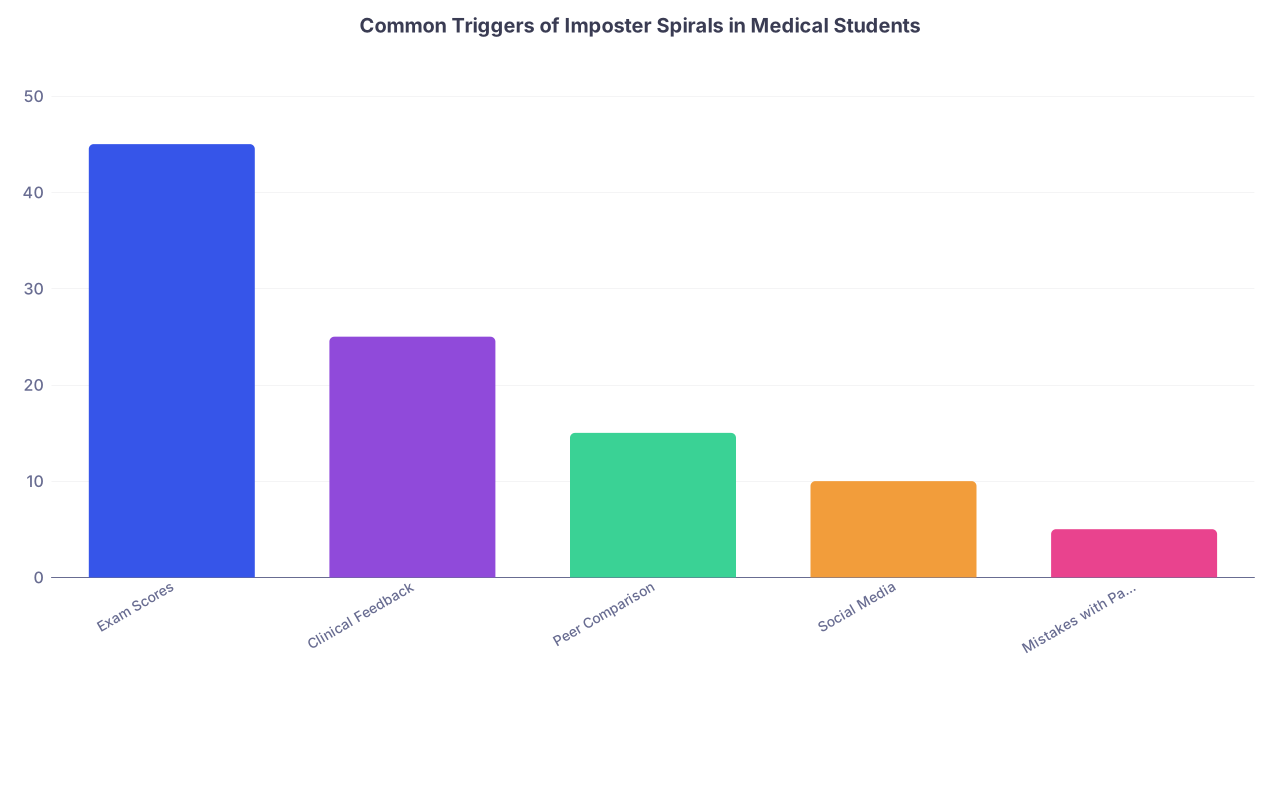
| Category | Value |
|---|---|
| Exam Scores | 45 |
| Clinical Feedback | 25 |
| Peer Comparison | 15 |
| Social Media | 10 |
| Mistakes with Patients | 5 |
How to Make This Tool Automatic Instead of “Nice in Theory”
If you only use this when you are calm and motivated, it is useless. You need it when you least feel like doing it.
That means you need a protocol, not just an idea.
Step 1: Pre‑Commit a Trigger
Decide ahead of time:
“When X happens, I will run the 4 questions.”
Some good triggers:
- Any exam score below your goal by >10 points.
- Any clinical feedback that stings or loops in your head for more than 10 minutes.
- Any time you catch yourself thinking “I do not belong here” more than once in a day.
You are not going to do this for every minor annoyance. Use it when:
- your mood noticeably drops, and
- the thought sticks.
Step 2: Use a Dedicated Place
Do not keep this in your head. You will lose it.
Options:
- A small pocket notebook labeled “Reflection.”
- A dedicated Google Doc (“Imposter Spiral Log”).
- Note template in Notion / OneNote.
Template:
- Q1. What exactly happened?
- Q2. What story did my brain tell?
- Q3. More accurate, specific interpretation:
- Q4. One concrete action in next 24 hours:
That is all you write. You are not journaling your life. You are doing a surgical intervention.
Step 3: Time‑Box It
You do not need an hour. You need 5–10 minutes, max.
Try:
- 2–3 minutes for Question 1 (facts),
- 2–3 minutes for Question 2 (story),
- 3–4 minutes for Questions 3–4 (reinterpretation + action).
Set a timer for 10 minutes. When it is done, you stop writing and move to the action you identified, if possible.

| Step | Description |
|---|---|
| Step 1 | Trigger Event |
| Step 2 | Auto-pilot Rumination |
| Step 3 | Open Reflection Template |
| Step 4 | Q1: Facts Only |
| Step 5 | Q2: Automatic Story |
| Step 6 | Q3: More Accurate View |
| Step 7 | Q4: 24h Action Step |
| Step 8 | Do The Action |
| Step 9 | Return to Study/Work |
| Step 10 | Noticing Spiral? |
Step 4: Do Regular “Post‑Mortems” on Your Reflections
Every 2–4 weeks, spend 15–20 minutes scanning your reflections. Look for patterns:
- Same trigger repeatedly? (e.g., biostats, the same attending, the same peer.)
- Same automatic story? (“I am stupid,” “They hate me,” “I am always behind.”)
- Same type of helpful action? (E.g., “targeted review,” “asking for help,” “structuring my day.”)
This does two things:
- Shows you in black and white that your worst fears usually do not materialize.
- Highlights recurring weak points—both cognitive and academic—that you can work on upstream.

Common Ways Students Screw This Up (And How to Fix Them)
You are human. You will try to turn this into either a vent session or a self‑flagellation ritual. Catch yourself.
Mistake 1: Sneaking Judgment into Question 1
Bad Q1:
“Got humiliated on rounds, bombed all the questions, looked like an idiot.”
That is Question 2 territory.
Fix:
Rewrite as:
“Attending asked 5 questions; I answered 1 correctly, 1 partially, 3 ‘I do not know.’ Attending responded, ‘You should know this by now’ in front of the team.”
If you feel adjectives creeping in (“humiliating,” “embarrassing”), strip them.
Mistake 2: Using Question 3 as Toxic Positivity
Bad Q3:
“Actually I’m amazing and this does not matter at all. I’m great!”
Your brain will not buy it.
Fix:
Stay anchored to the data. Acknowledge what went poorly and what is limited, specific, and fixable. You are not trying to feel ecstatic. You are trying to get to accurate.
Mistake 3: Making Question 4 Too Big
Bad Q4:
“I will completely redo my entire study schedule, review all of cardiology, and fix my test anxiety.”
You will not.
Fix:
Shrink it until it is doable tomorrow in under an hour.
One focused block. One conversation. One email to a mentor. One practice oral case.
Mistake 4: Only Doing It When You Feel Okay
If you only use this tool when you are calm, you will never rewire anything. The point is to use it in the storm.
So pre‑decide: first week of a new rotation, first NBME of a study block, and first real “bad day” each month—you run the script. No debating.
| Aspect | 4-Question Tool | Typical Imposter Response |
|---|---|---|
| Focus | Specific event | Global self-worth |
| Time | 5–10 minutes | Hours of rumination |
| Output | One concrete action | No action or frantic overstudying |
| Emotion | Discomfort → clarity | Shame → paralysis |
| Pattern Over Time | Identifiable, fixable | Feels random, overwhelming |
When You Should Get Extra Help
This tool is strong, but it is not magic. If any of this is showing up, you need more than a notebook:
- Persistent thoughts of self‑harm or “everyone would be better off if I quit/disappeared.”
- Panic attacks before every exam or shift.
- Inability to study or function because of anxiety or shame.
- Bingeing, restricting, or substance use ramping up to cope.
At that point, you involve:
- Campus counseling or a therapist (ideally one familiar with medical training).
- Your school’s wellness office or student affairs dean.
- A trusted faculty mentor who can help advocate for accommodations or schedule changes if needed.
Using a reflection tool and getting professional help are not mutually exclusive. The tool will actually make therapy more effective because you will bring clear examples of how your thinking spirals.
If You Remember Nothing Else
Keep these three points:
Event ≠ Identity. A bad exam, a rough day on rounds, or someone else’s high score is data about a situation, not proof that you are a fraud. The 4 questions force that separation.
Specific beats vague. “I am terrible” cannot be fixed. “I missed nephrology questions and rush my second pass on UWorld” can be fixed. Structured reflection pushes you from global self‑attack to local, solvable problems.
Action ends the spiral. Every reflection ends with one concrete step in the next 24 hours. Not a life philosophy. A behavior. That is how you convert shame into traction.
Print the four questions. Stick them inside your white coat or next to your desk.
Next time your brain starts screaming “You do not belong here,” you have an answer ready. Not a pep talk. A process.