I still remember the hollow look in my friend Daniel's eyes. Fourth-year medical student, solid Step 1 score, genuinely kind human. He was doing his fifth away rotation. Fifth. He'd already secured three strong letters, but the fear whispered: "What if it's not enough? What if they think I'm lazy?"
So he stacked an intensive care sub-I on top of a cardiology elective, on top of studying for Step 2 CK. The math doesn't work. It never does. Two months later, he bombed the practice exam. Not because he didn't know the material, he didn't have the cognitive bandwidth left to access it. He was a shell running on cortisol and cold brew.
This article is your wake-up call. The trap of stacking rotations and Step prep is real. I've watched it break people I respect. Don't let it break you.

This article is for educational purposes only. It is not financial advice, not legal advice, and not tax advice. Figures vary by individual circumstances, so consult a qualified professional before acting.
The Silent Saboteur: Why "Just One More" Rotation Breaks You
Medical students are terrible at subtraction. Your default survival mechanism is accretion, add another research project, another elective, another late-night UWorld block. You think you're building a fortress. You're just piling bricks on your own chest.
(See also: How to Avoid the Burnout Trap of Stacking Rotations and Step Prep for more.)
The Stacking Trap isn't a scheduling issue. It's a psychological compulsion. You see peers posting about their sub-I in New York and their away in Chicago, and panic sets in. So you scramble to add a superfluous rotation purely for CV padding. You ignore the law of diminishing returns because the fear of being "average" feels existential. But here's the ugly truth: a frantic, exhausted medical student performing at 60% capacity on three extra rotations looks significantly worse than a rested student crushing it on two.
The Cognitive Load Crisis is the silent killer here. Switching contexts isn't just annoying, it's neurologically expensive. When you run from a 12-hour surgery rotation, grab a cold burger, and crack open UWorld, your brain hasn't shifted gears. It's stuck in the fog of mental inertia. You're reading the words but not synthesizing the concepts. You reread the same paragraph three times. That's not studying. That's eye exercise. This decision fatigue bleeds into your clinical performance, too. You miss subtle signs in a patient's history. You look unprepared. Residents notice.
Program directors sniff this out. I've heard directly from selection committee members who look at an application with eight random away rotations and see a red flag. Not ambition, disorganization. They see a student who couldn't prioritize, who confused motion with progress, who might not have the self-awareness to manage a demanding residency schedule without imploding. Mistaking hustle for competence is a dangerous misread of what medical education leadership actually values. They want a reliable intern, not a burnout statistic.
And let's talk about the biological cost. You're not a machine. Chronic overwork spikes your cortisol levels, which literally shrinks the hippocampus, the part of your brain you're relying on to consolidate memories for Step. So, you log more hours at a desk, but your neurochemistry is actively working against you. You're pushing the accelerator with the parking brake on. You're paying for extra rotations with the currency of your own memory function.
The Data Doesn't Lie: Diminishing Returns on Away Rotations
Hard truth: there is a ceiling on the utility of away rotations. The idea that "more rotations = more interviews" is a costly fallacy. Let's look at the actual return on investment.
After three, maybe four, targeted rotations within your intended competitive specialty, the marginal gain drops off a cliff. You're not opening new doors. You're just wearing out your welcome and your body. You're spending weeks adapting to a new EMR, learning where the bathrooms are, and shivering in short-term housing, weeks that could have been spent mastering biostatistics or heart failure management.
The quality vs. quantity fallacy with Letters of Recommendation (LORs) is staggering. I've watched residency committees sift through files. One glowing, detailed letter from a known attending who worked with you for four weeks and can describe your clinical reasoning? Gold. Three generic, "the student was punctual and engaged" letters from programs where you were just passing through? Recycled paper. You need depth, not a stack of bland endorsements.
Then there's the financial and logistical drain. We rarely talk about the grinding hidden costs because we pretend we're above money in medical training. You're hemorrhaging cash on VSLO application fees, cross-country flights, Airbnb apartments with dodgy internet that cuts out during your virtual mock exams, and eating out for a month. This expenditure does not correlate linearly with interview invitations. It's a luxury tax on anxiety.
Most painfully, calculate the opportunity cost. Every travel day between rotations, the packing, the unpacking, the disorientation, is a lost study day. Add up those dead hours. You could have finished an entire pass through a UWorld organ system block in the time it took you to find a place in a new city that does laundry.
The Scheduling Minefield: When to Stop Studying for Step
If stacking rotations is the crime, bad timing is the accomplice. The scheduling of your Step 2 CK exam will make or break your application cycle. I've seen brilliant students commit the "Late Step" Error, pushing the exam to the very end of their elective cobweb. Their logic: maximize study time. The reality: zero buffer.
If you schedule Step after your final, grueling rotation, you've gambled everything on not getting the flu, not having an emotional breakdown, and not suddenly needing a retake. The universe laughs at that kind of hubris. I've seen a student test positive for COVID the week before their exam, with no available date to reschedule before score report deadlines. Don't be that person.
Context switching penalty? Real. Studying for Step between trauma surgery cases is a joke. It's a recipe for anxiety. During intense rotations, your brain needs organ-recovery protocols, not pharmacotherapy algorithms. Trying to force both creates a muddled slurry of half-knowledge. It's ineffective and makes you feel stupid, which spirals into imposter syndrome. You need dedicated, unsullied time.
How to negotiate this? Protecting study time requires a script. Walk into the rotation and, day one, tell the attending: "I'm committed to performing at a high level on this service, and to ensure I bring my best, I've blocked off these specific dates post-rotation for my exam prep. I'd appreciate any flexibility on those last two days to wrap up my clinical duties efficiently." This signals planning, not weakness. Attendings respect self-aware students who can manage a calendar.
Mandate buffer weeks. I'm talking 2-3 weeks of pure, structured rest and review before your test date. Not "I'll just do some light reading" time. True neural recovery time. Your brain needs to defragment. Sleep. Walk. Do light, targeted reviews. Walk into Prometric sharp, not shattered. This buffer is a biological requirement for adequate test retrieval, not a vacation.
Recovery Protocols: Building Resilience Without Guilt
Most medical students have a toxic relationship with rest. You've convinced yourself that if you're not consuming content, you're wasting time. That belief is wrong, and it's dangerous.
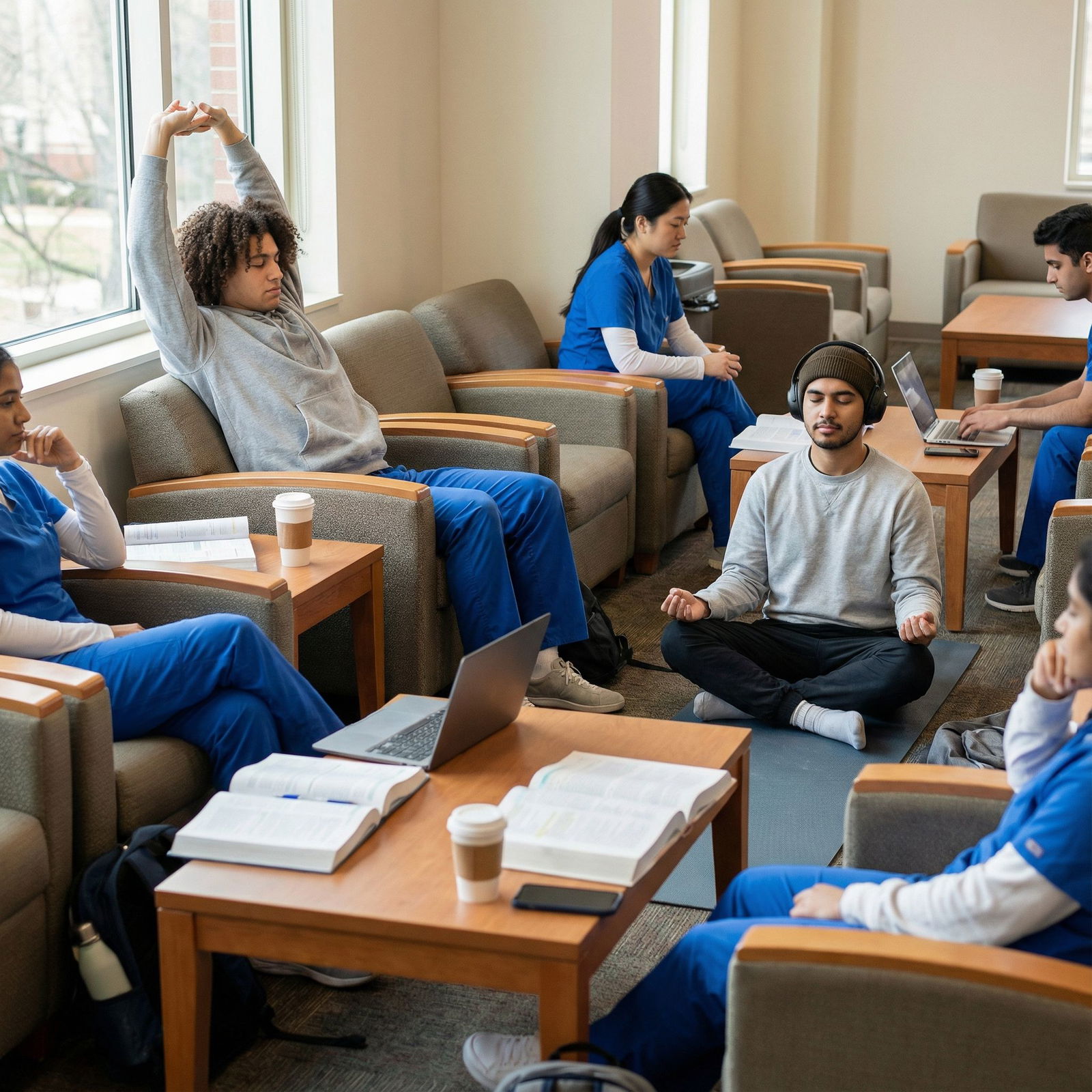
Let's debunk the biggest myth: scrolling Instagram is not rest. Watching Netflix while feeling guilty isn't rest. That's passive zoning out. Active recovery means non-screen, low-stimulus activities. Walking outside for 20 minutes without a podcast. Drawing something badly. Calling a friend from home. Lying on the floor and staring at the ceiling. These activities lower your arousal baseline, genuinely resetting the sympathetic nervous system. You come back from active recovery with increased processing speed. You come back from a doom-scrolling session with brain fog and self-loathing.
Sleep hygiene is a competitive advantage. Stop treating sleep as "time off." It's critical work time. During slow-wave sleep, your brain replays and consolidates the day's learning, transferring fragile short-term memories in your hippocampus into durable storage in the cortex. If you skimp on sleep after a rotation day or a heavy study session, you're literally failing to save the file. The student who slept 8 hours learned more than the student who "powered through" on 5.
Set harsh boundaries with peers. The culture of boastful misery in medicine must die. You'll be in a group chat where someone brags, "Just finished a 14-hour case, heading home to do two blocks of UWorld!" This is presented as dedication. Call it what it is: a vulnerability. That behavior is unsustainable and dangerous. It is a coping mechanism dressed up as ambition. Don't let that toxic positivity dictate your self-worth. Your ability to rest is a sign of intelligence, not laziness.
Learn your 'Stop' signals. Everyone has personal burnout triggers. For me, it's a distinct moment of sharp irritability followed by a sense of profound cynicism where I start thinking, "What's the point?" This is not a personality flaw; it's a physiological warning light. When that hits, you must have a pre-planned action plan. A shower. A walk. A hard stop on all work until morning. Ignoring these signals to squeeze in another hour isn't productivity, it's self-sabotage.
Action Plan: How to Escape the Trap Before It's Too Late
You recognize the red flags. Now, cut the dead weight. Here's your salvage procedure.
1. Audit your schedule. Now. Pull up your calendar for the next six months. For every single block, ask: "Does this rotation actively get me a letter from a known specialist in my field I haven't already secured?" If the answer is no, or if it's a generic "tissue biopsy elective" to check a box, seriously consider dropping it. Canceling is not giving up. It's strategic triage. The temporary discomfort of sending the cancellation email is nothing compared to the misery of a burnout collapse.
2. Script the hard conversations. Call your advisor or mentor today with words like this: "I'm worried my current schedule prioritizes volume of experiences over performance quality. I want to focus intensely on acing Step 2 and shining on my remaining commitments rather than spreading myself thin. I'm planning to drop elective X. What are your thoughts?" Using the language of "performance quality" and "sustainability" reflects executive decision-making maturity. It makes you sound ready for residency.
3. Treat well-being metrics like vital signs. Start tracking objective data points: nightly sleep hours, a simple 1-5 daily anxiety rating, frequency of contact with friends. Treat these metrics with the same seriousness as your UWorld block percentage. If your sleep dips below 6 hours for a full week, or your anxiety rating is a 4 or 5 repeatedly, that is a medical error waiting to happen. It is a critical lab value. Adjust your schedule accordingly.
4. Inhale this final truth. Your worth is not defined by your productivity. The residency application process baits you into believing that exhaustion is a marker of value. It is not. Residencies don't need an applicant who can suffer endlessly; they need an intern who can think clearly at 3 AM when a patient is crashing. Sustainable performance beats short-term heroics. Longevity beats martyrdom. Ditch the trap, schedule your rest, and trust that showing up as a healthy, sharp version of yourself is the most competitive thing you can do.