
This article is for educational purposes only. It is not financial advice, not legal advice, and not tax advice. Figures vary by individual circumstances, so consult a qualified professional before acting.
When Great Curriculum Work Disappears Into the Background
Picture this. You spent 18 months rebuilding the second-year clinical skills simulation. Needs assessment, new learning objectives, standardized patient scripts, assessment rubrics, faculty training on three campuses. Learners rated it higher, failure rates dropped, two other programs asked for your materials.
Then your annual review comes. Your chief nods politely. Your promotion committee letter says your file is "light on scholarship" and heavy on "teaching service." The message is clear: this doesn't really count.
It does. The system just does not know how to see it.
This is the central dysfunction I see in educator promotion after promotion cycle. Institutions publish mission statements that celebrate educational innovation. Committees then reward what is easy to count. Publications, grants, named titles. Curriculum work is messy, collaborative, iterative, and often invisible unless you force it into view.
The mismatch is not personal. It is structural. Lecture hours go in a spreadsheet. Grant dollars go in a spreadsheet. Longitudinal curriculum design that changes how 200 learners are trained does not fit in a spreadsheet. So it gets mislabeled as routine service.
This article fixes that. No more hoping the committee understands. You make it legible.
What Promotion Committees Usually Count, and What They Miss
Most academic medical centers slice promotion into buckets. Teaching, educational leadership, curriculum development, educational scholarship, and service. On paper, curriculum development has its own lane. In practice, the hierarchy is brutal.
What is highly visible: first-author papers, extramural funding, formal titles like Course Director or Vice Chair of Education, invited national talks.
What is low visibility: the actual work that makes education function. Writing competency-aligned objectives, building session sequences, creating valid assessments, analyzing evaluation data, revising after failure, onboarding faculty, sustaining the thing year after year.
A single grand rounds talk often gets more promotion credit than a 40-hour interprofessional curriculum you built from scratch. That is wrong. It is also predictable. Committees reward artifacts with external validation. A PubMed ID is undeniable. A curriculum binder on your hard drive is not.
The other trap: scope, scale, and outcomes are missing from most CVs. I have reviewed CVs that list "Involved in curriculum renewal, 2021-2023." That sentence compresses hundreds of hours into nothing. The committee has no way to know if you attended one meeting or led a system-wide overhaul.
When documentation is vague, deep work looks like routine service. Service does not get you promoted in the educator track. Scholarship and leadership do.
The Documentation Gap: Why Strong Work Still Looks Weak on Paper
Strong educators lose at promotion for one simple reason. They do the work, but they do not build the evidence trail while they do it.
Here are the failure points I see every year:
- No central log of curriculum activities. Dates, hours, roles blur after 12 months.
- No version history. The committee cannot see iteration and improvement.
- No metrics. Number of learners, sessions, sites, years sustained.
- No learner impact data. Pre-post knowledge, skills performance, patient care indicators, downstream behavior.
- No external validation. No peer review, no adoption elsewhere, no invitation to share.
Committees cannot reward what they cannot see. Documentation is the difference between "helped with course" and "directed evidence-based redesign resulting in measurable improvement."
You need to translate labor into promotable artifacts. Every curriculum project should produce at least four of these: a formal needs assessment summary, a syllabus or curriculum map with your name and role, assessment tools you created or revised, evaluation data with trends not just averages, a faculty development guide, meeting minutes showing leadership, and dissemination products.
And name your role precisely. Committees distrust inflated titles and they ignore vague ones. Creator, co-creator, director, associate director, lead for assessment, lead for evaluation, implementation lead, sustainability lead. Each means something different. Pick accurately.
How to Package Curriculum Work So Committees Can Actually Count It
Stop listing teaching as a list. Build a portfolio case.
Here is the system that works. Use it for every major curriculum project.
1. Write a short role statement for each project. One paragraph. What problem you solved, what you were responsible for, how long, at what scale. Example: "From July 2022 to June 2024, I served as director of the Internal Medicine clerkship simulation curriculum (120 learners/year, 3 sites). I led needs assessment, objective alignment, scenario design, and assessment revision. I supervised 6 faculty and 4 standardized patient trainers."
No filler. Role, scope, scale, timeframe.
2. Attach tangible outputs. Not descriptions. Actual files. Curriculum map before and after. Learning objectives with Bloom levels. Assessment blueprint. OSCE checklist. Evaluation summary table. Link or appendix.
3. Quantify impact. Relentlessly. Committees understand numbers. Give them numbers.
- Learners reached per year and cumulative.
- Sessions delivered, hours of direct teaching.
- Evaluation scores with N, response rate, and 2-3 year trend.
- Performance outcomes: OSCE pass rates, knowledge scores, skill retention.
- Adoption: other departments, other institutions, MedEdPORTAL, societies.
- Efficiency: reduced redundancy, reduced cost, saved faculty hours.
4. Frame as scholarship when it is scholarship. Curriculum becomes scholarship under the classic Glassick criteria: clear goals, adequate preparation, appropriate methods, significant results, effective presentation, reflective critique. You do not need a randomized trial. You need peer review and dissemination. Submit to MedEdPORTAL, present at a national education meeting with peer-reviewed abstract, write a descriptive innovation paper, get an external letter from someone who adopted your work.
5. Translate into institutional language. Read your [[[[[[[[[[[promotion criteria document](https://residencyadvisor.com/resources/medical-teaching-careers/how-promotions-really-work-in-medical-academia-what-chairs-look-for)](https://residencyadvisor.com/resources/medical-teaching-careers/how-promotions-really-work-in-medical-academia-what-chairs-look-for)](https://residencyadvisor.com/resources/medical-teaching-careers/how-promotions-really-work-in-medical-academia-what-chairs-look-for)](https://residencyadvisor.com/resources/medical-teaching-careers/how-promotions-really-work-in-medical-academia-what-chairs-look-for)](https://residencyadvisor.com/resources/medical-teaching-careers/how-promotions-really-work-in-medical-academia-what-chairs-look-for)](https://residencyadvisor.com/resources/medical-teaching-careers/how-promotions-really-work-in-medical-academia-what-chairs-look-for)](https://residencyadvisor.com/resources/medical-teaching-careers/how-promotions-really-work-in-medical-academia-what-chairs-look-for)](https://residencyadvisor.com/resources/medical-teaching-careers/how-promotions-really-work-in-medical-academia-what-chairs-look-for)](https://residencyadvisor.com/resources/medical-teaching-careers/how-promotions-really-work-in-medical-academia-what-chairs-look-for)](https://residencyadvisor.com/resources/medical-teaching-careers/the-truth-about-education-tracks-what-they-doand-dontdo-for-promotion)](https://residencyadvisor.com/resources/medical-teaching-careers/how-promotions-really-work-in-medical-academia-what-chairs-look-for) line by line. Seriously. Highlight phrases like "educational leadership," "sustained impact," "regional or national recognition," "innovation." Then map your work to those exact phrases in your dossier. Use their words. Committees scan for language match. Make it impossible to miss.
One more rule I enforce with mentees: one project equals one narrative page. Not a CV line. A page that includes problem, role, approach, outcomes, dissemination, and future direction. Put the details where the committee must read them, not buried in an appendix.
What to Do Before Your Next Promotion Review
Do not wait until the dossier deadline. Fix visibility now.
Audit your CV this week. Print it. Circle every curriculum item that says "participated," "involved," "contributed to," or "member of." Those are invisible. Rewrite each with role, scope, and outcome.
Build a curriculum impact file for each project. Make a folder right now. Not later. Inside:
- Your original needs assessment notes or emails.
- Drafts with timestamps showing iteration.
- Syllabi, maps, checklists, assessment tools.
- Evaluation reports, raw comments that show change.
- Adoption emails, requests from other schools, thank-you notes from learners, yes, those count.
- Presentation slides, submission confirmations, links.
Stress-test your story. Meet with your division chief, a senior educator who has succeeded on the promotion track, and if possible, a promotions officer or senior member of the committee. Give them a 10-minute version: here is what I built, here is evidence of impact, here is how it meets criteria X and Y. Ask them: what is missing? Where does this sound like service instead of leadership? What external validation would close the gap?
Get the right letters. Generic praise letters kill educator files. Ask letter writers for specifics. Tell them: "Please comment on my role as director of X, the educational innovation, the learner outcome data, and any adoption or national reach." Strong letters describe impact, not personality. National reach does not require a Harvard title. Adoption 60 miles away is regional impact.
This is solvable. But only if you document while the work is happening.
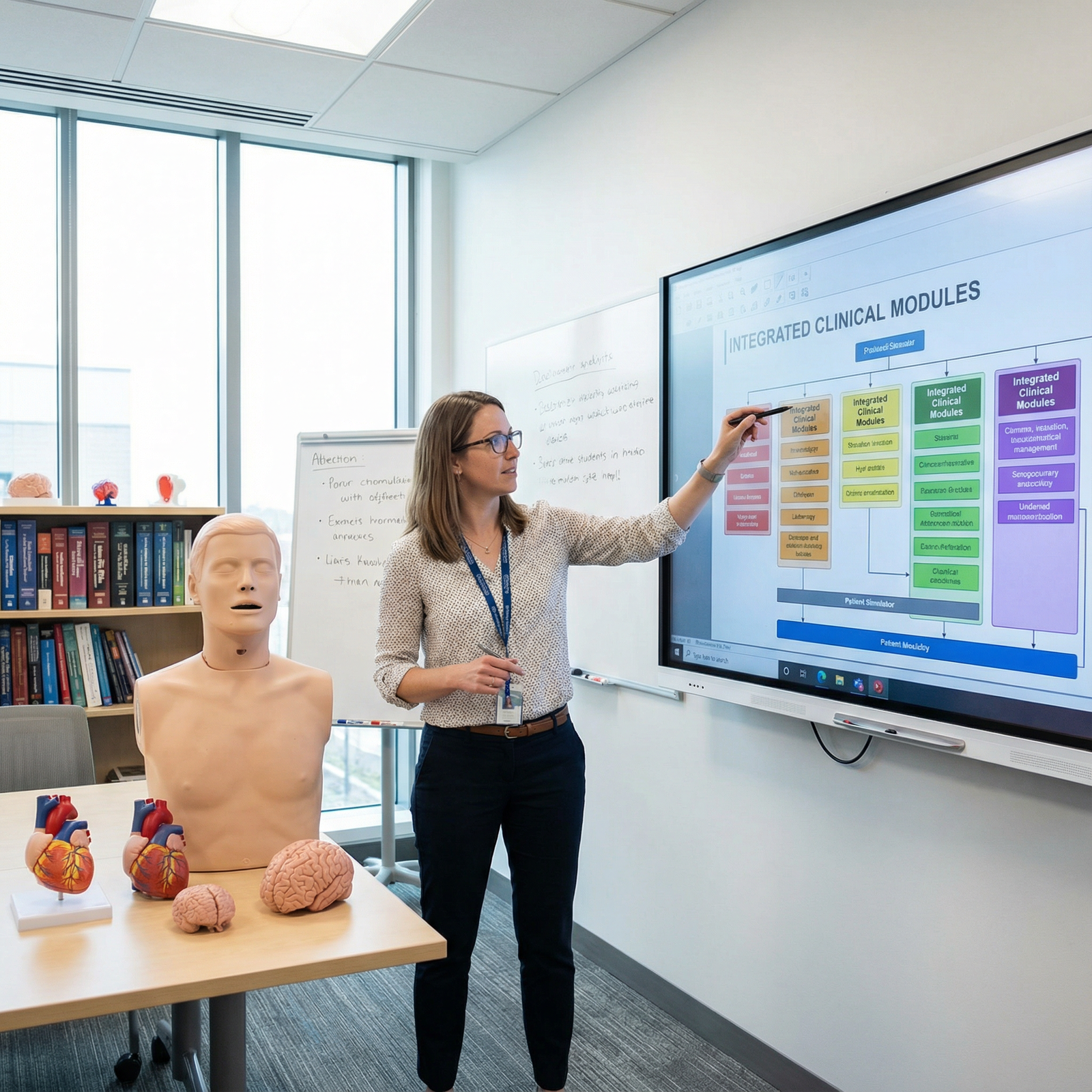
A Simple System to Keep Curriculum Work Promotion-Ready All Year
Promotion should not be a last-minute scramble every five years. You need a maintenance system.
I tell faculty to maintain three folders. Digital. Backed up. Updated monthly.
Folder 1: Outputs. What you made. Maps, objectives, cases, checklists, lesson plans, faculty guides. Date every version.
Folder 2: Outcomes. What changed because you made it. Evaluation scores, assessment performance, competency data, retention, patient safety events if relevant, qualitative learner comments that illustrate impact.
Folder 3: Recognition. Who noticed. Invitations to present, emails requesting your materials, peer review comments, adoption at other sites, awards, media, coverage in program reviews or accreditation reports.
Then a rhythm:
- Monthly: 15 minutes, drop new artifacts into folders. Save emails.
- Quarterly: 30 minutes, update numbers, learners reached, scores trended.
- Annually: 60 minutes, map folders to promotion criteria. Identify one gap to close with a dissemination product or external letter.
This system protects you against the two killers of educator promotion: forgetting and vague memory. Forgotten contributions do not exist. For a committee that meets for an hour to judge your five-year career, clarity beats volume. Every time.
If you want curriculum work counted, make it impossible to ignore.