
It’s July 1st. The department secretary just sent out the annual “Faculty Actions” email. Your name is on the list of people eligible for promotion in 12–18 months.
You scroll. See the deadlines. See “full teaching portfolio,” “updated CV,” “external letters,” “evidence of educational impact.”
And you realize: you’re not ready. Not even close.
This is the moment most people finally start thinking about promotion. It’s also 3–5 years too late to build the kind of track record that makes promotion an easy “yes” instead of a painful borderline discussion in the P&T committee.
So let’s rewind.
Below is a five-year backwards timeline — starting 5 years before your proposed promotion date and moving forward to the day your packet is due. Month-by-month where it matters, year-by-year where that’s enough. At each point, what you should actually be doing, collecting, and saying “no” to.
First: Know Your Target Promotion Date and Track (Year 0 Anchor)
Before we go backwards, you need the anchor.
At this point (now):
- Decide when you want to go up for promotion.
- Confirm what track you’re on and what criteria apply (clinician-educator vs tenure vs educator track, etc.).
- Get the actual written promotion criteria from your institution, not just hallway gossip.
Typical examples:
- Assistant → Associate: 6–8 years after first appointment
- Associate → Full: 5–7 years after last promotion
If you’re already mid-stream, adjust this timeline so “Year 0” is your likely submission year.
Now, rewind five years.
Year −5: Clarify Your Educator Identity and Say “No” Correctly
You’re five years out from submitting your promotion packet.
At this point you should:
Pick a lane — your educator identity Stop being “person who says yes to all teaching.” That person does not get promoted easily. You need a recognizable niche.
Examples:
- “I design and lead simulation-based curricula for emergency medicine residents.”
- “I’m the clerkship-level assessment person in pediatrics.”
- “I run QI curricula for internal medicine residents and medical students.”
- “I’m the ultrasound education lead for the department.”
If you can’t describe your educator identity in one sentence, you’re not ready for promotion in five years. Fix that now.
Read your institution’s promotion criteria like a contract Sit down with:
- The promotion guidelines PDF
- Three promotion packets of people who actually got promoted in your track in the last 3–4 years
- Your current CV
Highlight where you’re already strong, and where you’re basically at zero.
Common required buckets:
- Teaching quantity and quality
- Educational leadership / program development
- Scholarly output (education research or at least scholarly teaching)
- Service and reputation (local, regional, national)
Have the uncomfortable conversation with your division chief In a 30–45 minute meeting, you should:
- State explicitly: “I’m targeting promotion to [rank] in ~5 years.”
- Ask: “In your view, what are the biggest gaps between where I am and someone who easily gets promoted here?”
- Clarify: protected time, expectations, and major roles.
If your chair/chief can’t articulate your niche, the promotions committee won’t be able to either.
Start your “promotion evidence” habits Today, not later:
- Create a “Promotion” folder on your computer with subfolders:
- Teaching Evaluations
- Syllabi & Curricula
- Leadership Roles
- Invited Talks & Workshops
- Scholarship (Manuscripts, Posters, Abstracts)
- Start a teaching log (spreadsheet is fine): date, audience, topic, # learners, role (lecturer, course director, etc.).
Ten minutes after every teaching activity: log it and download the evals. Do not rely on the LMS to keep them forever. I’ve seen too many people lose a decade of evaluations in a platform migration.
- Create a “Promotion” folder on your computer with subfolders:
Year −4: Build Depth, Not Just Volume
By Year −4, you should stop collecting random teaching and start constructing a coherent body of work.
At this point you should:
Double down on 1–2 signature educational activities Choose things that can plausibly become:
- “Longitudinal curriculum I designed and led”
- “Program I built and grew”
- “Assessment tool I developed and studied”
Examples:
- Turn your recurring resident lecture into a structured, outcomes-focused curriculum with pre/post assessments.
- Take over a flabby clerkship component and rebuild it — clear objectives, mapped assessments, faculty development.
Get basic training in education If you do not have formal education training, fix that now:
- Medical education certificate program
- MEd / MHPE degree (if feasible)
- At least a longitudinal faculty development series (6–12 sessions)
Not because letters like “MEd” are magic, but because promotion committees like to see evidence you take education seriously as a discipline.
Create your “early scholarship” pipeline At minimum aim for:
- 1–2 education abstracts/posters per year
- Turn the best ones into manuscripts within 12–18 months
You’re not trying to cure cancer here. You’re showing:
- You can evaluate your own educational work
- You understand basic study design and outcomes
Start saying “no” using your niche Any time someone asks you to teach:
- If it aligns with your niche → strong yes or “yes, but with clear role.”
- If it’s random and adds nothing to your narrative → consider no, or a one-off favor, but don’t build your career on it.
A simple script:
- “My main focus right now is [simulation curriculum / assessment reform / clerkship design]. I’m trying to be very intentional so I can build a strong promotion packet in a few years. I can’t take this on, but I’d be happy to suggest someone else.”
Year −3: Secure Roles, Start Leadership, and Formalize Mentorship
By Year −3, you should look less like “junior helper” and more like “emerging leader.”
At this point you should:
Hold at least one clearly defined educational leadership role Examples:
- Clerkship director or associate director
- Residency associate program director
- Course director for a preclinical course
- Director of simulation, assessment, remediation, or faculty development
If you don’t have a titled role yet, explicitly ask for one. Titles matter in promotion discussions.
Formalize mentorship — both directions You need:
- 1–2 senior mentors who’ve actually been through promotion in your track
- 1–2 mentees (residents, fellows, junior faculty) where you’re clearly listed as mentor on paper
Meet with your promotion mentor at least twice per year and literally review your CV together.
Tighten the link between education and scholarship Wherever possible, your leadership roles should generate scholarship:
- New curriculum → needs assessment → pilot → outcome study → abstract → paper
- Assessment tool → validation study → faculty development → dissemination
You’re going for “program of scholarship,” not unrelated one-offs.
Track your trajectory quantitatively You should start to see a curve like this:
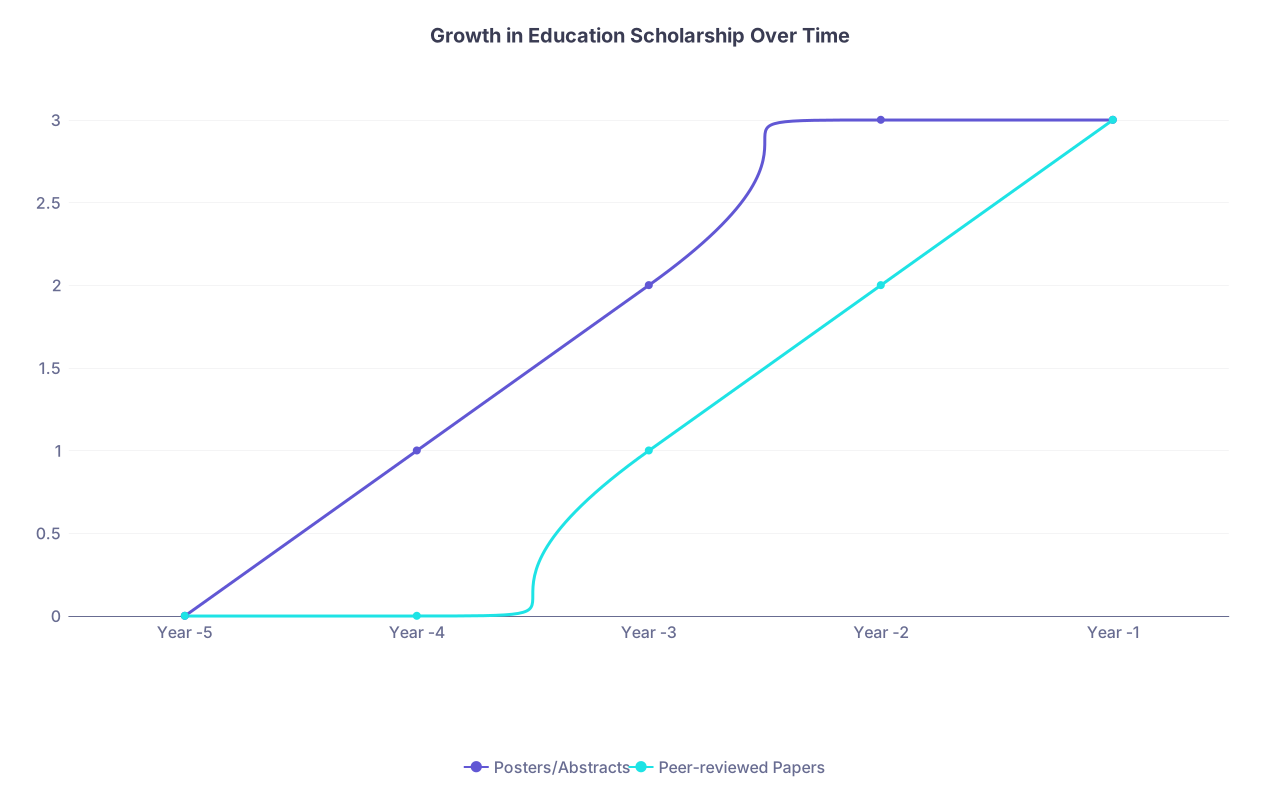
| Category | Posters/Abstracts | Peer-reviewed Papers |
|---|---|---|
| Year -5 | 0 | 0 |
| Year -4 | 1 | 0 |
| Year -3 | 2 | 1 |
| Year -2 | 3 | 2 |
| Year -1 | 3 | 3 |
If your line is flat at zero in Year −3, promotion in three years is fantasy. Either accelerate aggressively or shift your target date.
Year −2: Align With Criteria and Build External Reputation
Year −2 is where people either solidify an “easy yes” case or drift into “borderline.”
At this point you should:
Do a mid-course promotion check with someone on the P&T committee Ask specifically:
- “If I submit this CV in 2 years, am I in the ‘yes’ zone, borderline, or no?”
- “Where am I below the median of successful candidates in my track?”
This is the year to correct course, not Year −1.
Build regional and national visibility in your niche You need people outside your institution who’d recognize you as “the [X] person.”
Concrete moves:
- Present workshops at national meetings (AAMC, SGIM, SAEM, APDIM, etc.)
- Join a national education committee in your specialty society
- Co-chair or lead something, not just “member”
Make your CV promotion-ready in structure Clean structure by now:
- Clear educator-focused sections (Curriculum Development, Teaching Activities, Educational Leadership, Educational Scholarship)
- Bold or highlight your niche-related accomplishments
- Remove old noise that doesn’t serve your story
Standardize your teaching evaluation strategy Stop hoping your evals will magically look good.
Actions:
- Calibrate your teaching sessions: clear objectives, active learning, feedback loops
- Ask for mid-course or mid-rotation feedback, not just end-of-course ratings
- Keep a “best of” file: top comments, strong ratings, evidence of improvement
Promotion committees are not impressed by cherry-picked comments alone, but clear upward trajectory and consistent high ratings — that matters.
Draft the skeleton of your teaching portfolio and educator’s statement Do not wait until Year −1. Start now:
- One-page educator statement: your philosophy, niche, impact
- Outline sections of your teaching portfolio and plug in what you already have
You’ll revise this a dozen times. Starting early is the only way it ends up coherent instead of desperate.
Year −1: Assemble the Packet and Lock in Letters
This is the heavy build year. By now, you should be collecting and organizing evidence, not scrambling to generate it.
At this point you should:
Meet with your chair and promotion mentor with a near-final CV Agenda:
- Review CV line by line against institutional criteria
- Confirm your planned promotion year and rank
- Create a timeline backward from the official submission deadline
Identify potential external letter writers You need:
- People who know your work enough to comment on impact
- Not your close collaborators or former mentors (depends on your rules, but generally they want semi-independent evaluators)
- Ideally people who’ve seen you at national meetings, on committees, or through collaborative projects
Make sure your pattern of national work has already put you on their radar. Cold letters to strangers are weak.
Polish your educator narrative This is often the most undercooked part. Your narrative should:
- Clearly state your niche and how it evolved
- Tie roles, curricula, and scholarship into a single coherent story
- Include outcomes: learner performance, program expansion, adoption by other sites, publications
If your narrative reads like a chronological list rather than a trajectory, rewrite it.
Finalize your teaching portfolio structure Typical sections:
- Teaching responsibilities (with time estimates)
- Teaching effectiveness (summarized evals, awards)
- Curriculum development
- Educational leadership
- Educational scholarship
- Learner and peer testimonials (if allowed)
Do not drown the committee in raw data. Use summary tables with selective appendices.
| Section | Key Evidence Types |
|---|---|
| Teaching Activities | Teaching log, course roles, schedules |
| Teaching Effectiveness | Summarized evals, awards, comments |
| Curriculum Development | Syllabi, objectives, materials |
| Leadership | Titles, committee roles, programs led |
| Scholarship | Education papers, posters, grants |
Audit for gaps and aggressively close what you still can With 9–12 months left, you can still:
- Submit 1–2 manuscripts already in draft
- Accept 1–2 strategic invited talks
- Tighten outcome measures for ongoing curricula
You cannot invent a five-year national reputation or a leadership role you never had. Don’t fake it. Just highlight what’s real and strongest.
The Final 12 Months: Month-by-Month Countdown
Now we’re inside the last year before your packet goes in. This is where people either methodically finish strong or melt down.
Month −12 to −9: Lock Structure, Not Content
At this point you should:
- Freeze the structure of your CV, narrative, and portfolio
- Decide which roles and projects will be foregrounded
- Compile all teaching evaluations into clean summary tables
Also:
- Confirm exact submission deadlines and internal review processes
- Clarify how external reviewers are selected (some departments want your suggestions; others don’t)

Month −9 to −6: External Letters and Final Outputs
At this point you should:
Provide your chair with a curated list of potential external reviewers (if asked) For each:
- Name, rank, institution
- How they know your work (committees, conferences, publications)
- Why they’re appropriate evaluators of someone in your niche
Push final scholarly products across the finish line
- Get manuscripts actually submitted, not “almost done”
- Update your CV when they’re accepted or in press
Sanity-check against the written promotion criteria again Ask yourself bluntly:
- “If I were on the committee, would I see clear evidence of excellence in teaching, leadership, and scholarship in my chosen niche?”
- “Is this packet better than the last three successful promotions I’ve seen?” (you should have copies or at least know them)
Month −6 to −3: Internal Reviews and Fixes
At this point you should:
Go through whatever internal pre-review your institution offers:
- Departmental promotions committee
- Vice chair for faculty affairs
- SOM-level review
Take their feedback seriously, especially when they converge on the same weaknesses:
- “Your educator statement is too generic.”
- “Your impact isn’t clear outside your institution.”
- “Your teaching evaluations are fine but not outstanding — highlight qualitative impact more.”
You still have room for small strategic moves:
- A few last invited workshops
- A final local award nomination (teaching, mentoring, innovation)
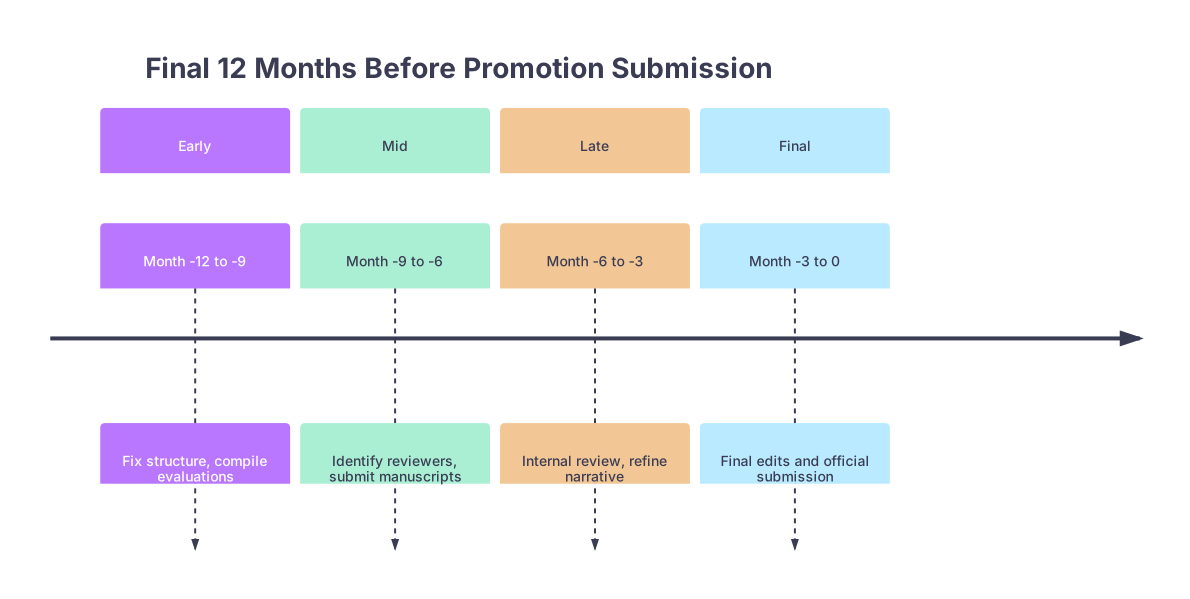
| Period | Event |
|---|---|
| Early - Month -12 to -9 | Fix structure, compile evaluations |
| Mid - Month -9 to -6 | Identify reviewers, submit manuscripts |
| Late - Month -6 to -3 | Internal review, refine narrative |
| Final - Month -3 to 0 | Final edits and official submission |
Month −3 to Submission: Polish, Proof, and Stop Adding
Final quarter.
At this point you should:
Stop adding new big things to your packet They won’t mature in time to look real. Committees can smell last-minute padding.
Obsess over clarity and coherence
- Is your niche obvious in the first page of your narrative?
- Do your CV, portfolio, and letters all point to the same story?
- Are your tables clean, readable, and not microscopic?
Proofread like your career depends on it (because it does) Have:
- One colleague in your department read for accuracy and completeness
- One colleague outside your field read for clarity of impact (do they understand why you matter?)

- Submit early, not at 4:59 PM Administrative glitches happen. Files corrupt. Systems crash. Don’t be that story.
If You’re Already Late in the Game
Some of you aren’t five years out. You’re 18 months out. Or less.
You can still use this backwards timeline — just compress aggressively:
- Prioritize: clarify niche, clean CV and narrative, summarize teaching excellence, make whatever scholarship you already have look organized and intentional.
- Delay if needed: if you’re clearly below par now, it’s often better to wait 1–2 years and go up strong than to get a no and have that on your record.
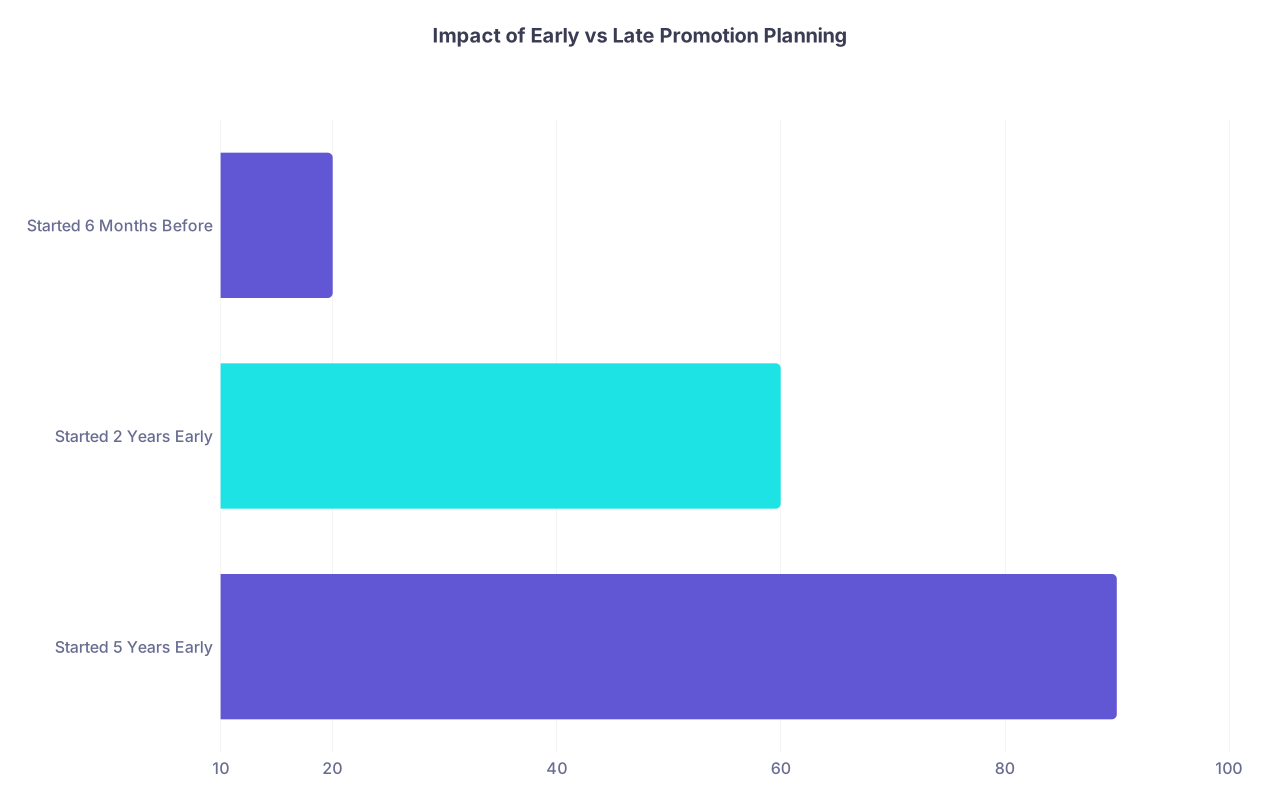
| Category | Value |
|---|---|
| Started 5 Years Early | 90 |
| Started 2 Years Early | 60 |
| Started 6 Months Before | 20 |
(Think of those numbers as “chance of an easy yes,” not real statistics but very close to what I’ve seen.)

Three Things To Walk Away With
- Promotion as an educator is not about last-minute paperwork; it’s about a 3–5 year pattern of coherent teaching, leadership, and scholarship in a clear niche.
- Every year, ask: “How would this look in my promotion packet?” Then say no to things that don’t fit that story.
- The strongest packets are boring for committees: obvious niche, clean trajectory, external recognition, and documentation already in order — start now so yours looks like that.