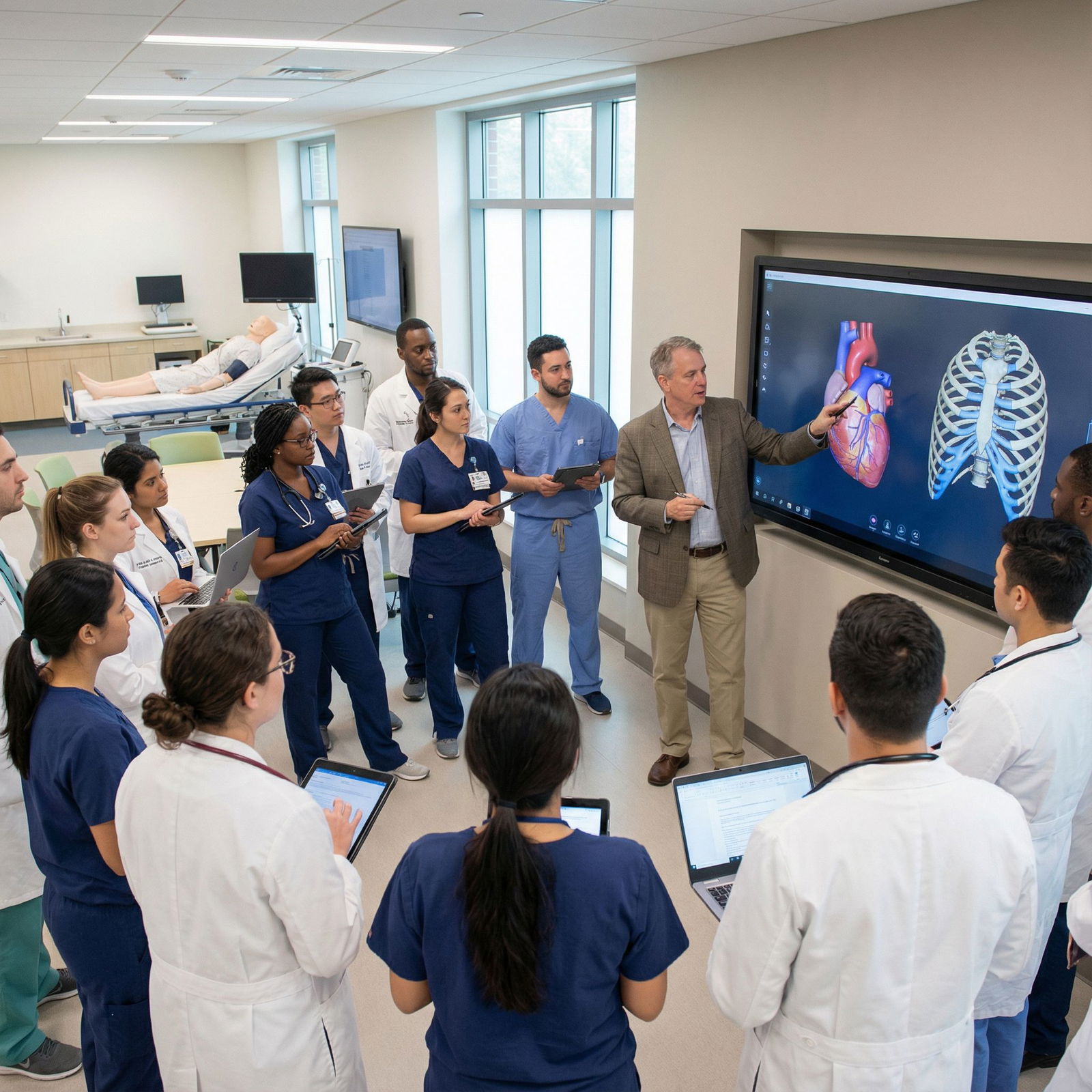
The way most attendings try to teach at the bedside is broken: too long, too unfocused, and too disconnected from what trainees actually need during a busy service.
You do not need an academic half-day, slides, or an empty clinic schedule to be a high-yield teacher. You need a system you can run in 3–7 minutes, repeatedly, without tanking your workflow.
Here is that system.
Step 1: Fix Your Mindset About “Teaching Time”
Stop waiting for “protected teaching time.” It is not coming. Build teaching into what you are already doing.
You have three reliable teaching currencies as a busy attending:
- Micro-time – 1–3 minutes between tasks
- Live clinical work – rounds, admissions, family meetings, sign-out
- Feedback moments – right after someone does something (good or bad)
Your job is not to add a separate “teaching block.” Your job is to convert those three currencies into learning.
Think of it like this:
- You still round.
- You still staff consults.
- You still review orders, notes, and results.
You are simply going to instrument those activities with a few repeatable teaching moves.
Core principle: Always teach to a decision
High-yield teaching is not trivia. It is tightly linked to a real decision:
- “Admit vs discharge?”
- “Antibiotic choice?”
- “Test or no test?”
- “Escalate care or watch?”
If your teaching moment does not touch a decision, it is usually low yield for trainees and forgettable by the afternoon.
So your new rule:
Every teaching point ties to a decision we actually made (or considered) for that patient, today.
Step 2: Build a 3-Minute Teaching Template You Can Reuse
You need one simple template you can run over and over so you are not “winging it” each time.
Use this 3-minute structure:
- Anchor to the patient (30–45 seconds)
- Ask a focused question that matters (45–60 seconds)
- Have them commit, then briefly discuss (60–90 seconds)
- Deliver one concise teaching point + takeaway (30–45 seconds)
Let’s break it down with specifics.
1. Anchor to the patient
Do this out loud, in one or two lines:
- “On this patient with new a-fib and sepsis…”
- “For this 4-year-old with first wheezing episode…”
- “On this patient with chest pain and a nondiagnostic ECG…”
Why? It:
- Tells learners: pay attention, this is about this patient.
- Signals: this is applied teaching, not a random lecture.
2. Ask a focused question that matters
Bad questions:
- “So, what do you guys know about heart failure?”
- “Tell me everything about COPD exacerbations.”
These are lazy and inefficent.
Good questions:
- “What is your threshold to start anticoagulation in new a-fib here?”
- “What three diagnoses absolutely cannot be missed in this kid with abdominal pain?”
- “Which single lab or test will change our plan right now, if any?”
You want:
- 1 clinical decision
- 1–2 constraints
- Answerable in 1–2 minutes
3. Force commitment, then discuss briefly
Do not let the group answer as a blob. Pick a person.
- “Okay, Sarah, what would you do?”
- “You are the senior. Commit: admit or discharge?”
- “You are writing the orders. Which antibiotic and why?”
Then:
- Let others react.
- Allow disagreement for 30–60 seconds.
- Moderate, do not monologue.
You are trying to make them:
- Expose their reasoning
- Feel the pressure of commitment (safely)
- Engage, not passively listen
4. One teaching point + one sentence takeaway
End with a very short, explicit point. Something like:
- “Key point: in new a-fib with sepsis, rate control and treating the infection usually come before rhythm control.”
- “Key point: any kid with right lower quadrant pain, fever, and guarding deserves a serious appendicitis workup before sending home.”
- “Key point: imaging for low back pain is rarely helpful in the first six weeks unless you see red flags like neuro deficits, fever, or history of cancer.”
Then finish with a line like:
- “So on rounds today, every time you want a CT, ask: what will I do differently with the result?”
- “For the rest of the week, I want you to say out loud your admit vs discharge threshold.”
If you cannot summarize it in one or two sentences, your point was not focused enough.
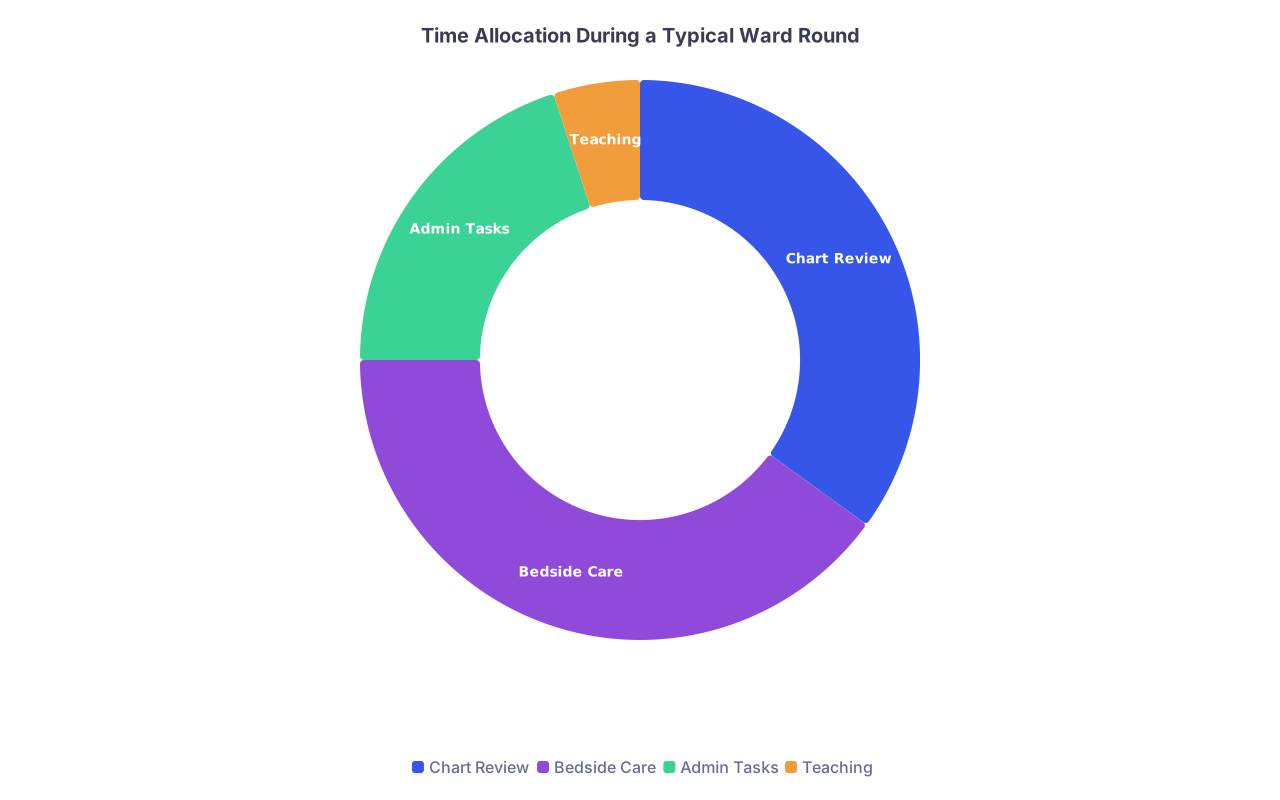
| Category | Value |
|---|---|
| Chart Review | 35 |
| Bedside Care | 40 |
| Admin Tasks | 20 |
| Teaching | 5 |
Step 3: Use Structured Micro-Tools Instead of Lectures
Busy attendings waste teaching energy on mini-lectures. They feel good, but learners retain almost nothing.
Use short, structured “teaching tools” that you can plug in anytime.
Here are four that work extremely well.
Tool 1: The “One-Liner Upgrade”
Residents and students are bad at one-liners. You can fix that in 90 seconds.
Process:
After a presentation, say:
- “Give me your one-liner on this patient. One sentence.”
Then upgrade it:
- Add acuity/trajectory: “stable, improving, deteriorating”
- Add highest-risk issue: “at risk for decompensation because…”
- Remove meaningless fluff.
Example:
- Original: “Mr. Jones is a 68-year-old male with a history of diabetes, hypertension, and hyperlipidemia presenting with shortness of breath.”
- Upgrade: “Mr. Jones is a 68-year-old man with known CAD presenting with acute shortness of breath and hypoxia, most concerning for decompensated heart failure.”
Teaching point (out loud):
- “Your one-liner should say: who is this person, what brought them here, and why we should care today.”
You have just improved their communication and clinical reasoning with zero extra time.
Tool 2: “What are you most worried about?”
Ask this to the presenter or intern. Then shut up.
- “In one sentence, what are you most worried about in this patient?”
- “What is the one thing that will hurt this patient in the next 24 hours if we miss it?”
Listen for:
- Vague answers: “I am worried they might get worse.”
- Laundry lists: “Well, there is infection, and bleeding, and maybe arrhythmia…”
Then refine:
- “Pick one. What is the thing you’d want the night team to know they cannot miss?”
Use 30 seconds to tighten their risk assessment.
Tool 3: The 3-Bucket Differential
For almost any complaint, you can teach a fast differential framework:
- Bucket 1: Must-not-miss / life-threatening
- Bucket 2: Common and likely
- Bucket 3: Benign / self-limited
At the bedside:
- “Abdominal pain. Give me: one life threat, two common, one benign.”
- “Shortness of breath. Same pattern.”
You are teaching them to:
- Prioritize danger first
- Not get lost in a 20-point list
Tool 4: The “Next Test or No Test?” Drill
Tests are over-ordered because attendings do not teach why not to order.
Ask:
- “What is the single most useful next test here—or is it no test?”
- “If this CT is normal, what will you actually do differently?”
If they cannot state how the result will change management, you say:
- “Then we are not ordering it. Key point: every test needs an answer to: ‘How does this result change my next move?’”
You just taught diagnostic stewardship in under 2 minutes.

Step 4: Create a Default Bedside Teaching Script for Rounds
Rounds are often the worst-taught part of the day. Too long. Too disorganized. Too many tangents.
You need a script. Not for the words. For the order.
Use this standardized flow for each patient:
Presentation (1–2 minutes)
- One-liner
- “Overnight events / last 24 hours”
- New data only
Plan by problem (2–3 minutes)
- Problem list
- Brief plan for each
One decision-based teaching question (2–3 minutes)
- Using the 3-minute template above
Feedback / expectation (30–60 seconds)
- One micro-praise or micro-correction
If you are on a very heavy service, you do not need a teaching question on every single patient. Use:
- High-yield cases for question-based teaching
- Routine cases for feedback on presentations, notes, or efficiency
Concrete example: Medicine ward patient
- Intern presents:
“Ms. Lee is a 72-year-old woman with COPD and heart failure admitted for pneumonia, now improving on day 3 of therapy…” - Plan: oxygen wean, diuresis, transition to PO antibiotics, discharge readiness.
Your teaching segment:
- “We are thinking of sending her home tomorrow. Question: what are your three discharge criteria for someone admitted with pneumonia and COPD?”
- Intern answers; senior adjusts.
- You end: “Key point: before discharging a pneumonia patient with COPD, make sure: 1) they can maintain oxygen on their home regimen or close; 2) they can take and tolerate oral meds; 3) they have clear follow-up within a week.”
Done. 2–3 minutes. Everyone got something.
| Segment | Time (min) | Focus |
|---|---|---|
| Pre-round team huddle | 5 | Priorities, sick list |
| High-acuity patients (3) | 25 | Decisions + deeper teaching |
| Lower-acuity patients (5) | 20 | Efficiency + micro-teaching |
| Wrap-up & assignments | 10 | Plans, tasks, expectations |
Step 5: Make Feedback Automatic, Not Awkward
Most attendings tell me they “give feedback all the time.” Residents almost always say they rarely get any.
The problem: you think of feedback as a separate event. It should be embedded.
Use this 3-part micro-feedback script that takes 30–45 seconds:
Label it
- “Quick feedback on that presentation.”
- “Two-second feedback on how you handled that family conversation.”
One specific strength
- “You were concise on the overnight events and highlighted what changed.”
- “You did a very good job pausing to let the family talk.”
One specific next-step improvement
- “Next time, start with your assessment in one sentence instead of re-listing the vitals.”
- “Next time, summarize what you heard from the family at the end to close the loop.”
Do not ramble. Do not add five suggestions. One plus one.
Timing: When to give it
- Immediately after: presentation, procedure, difficult interaction, discharge talk, consult call.
- During hallway walks between rooms.
- Near the end of rounds: “You improved X from yesterday.”
You are trying to create a culture where feedback is background noise, not a dramatic event.
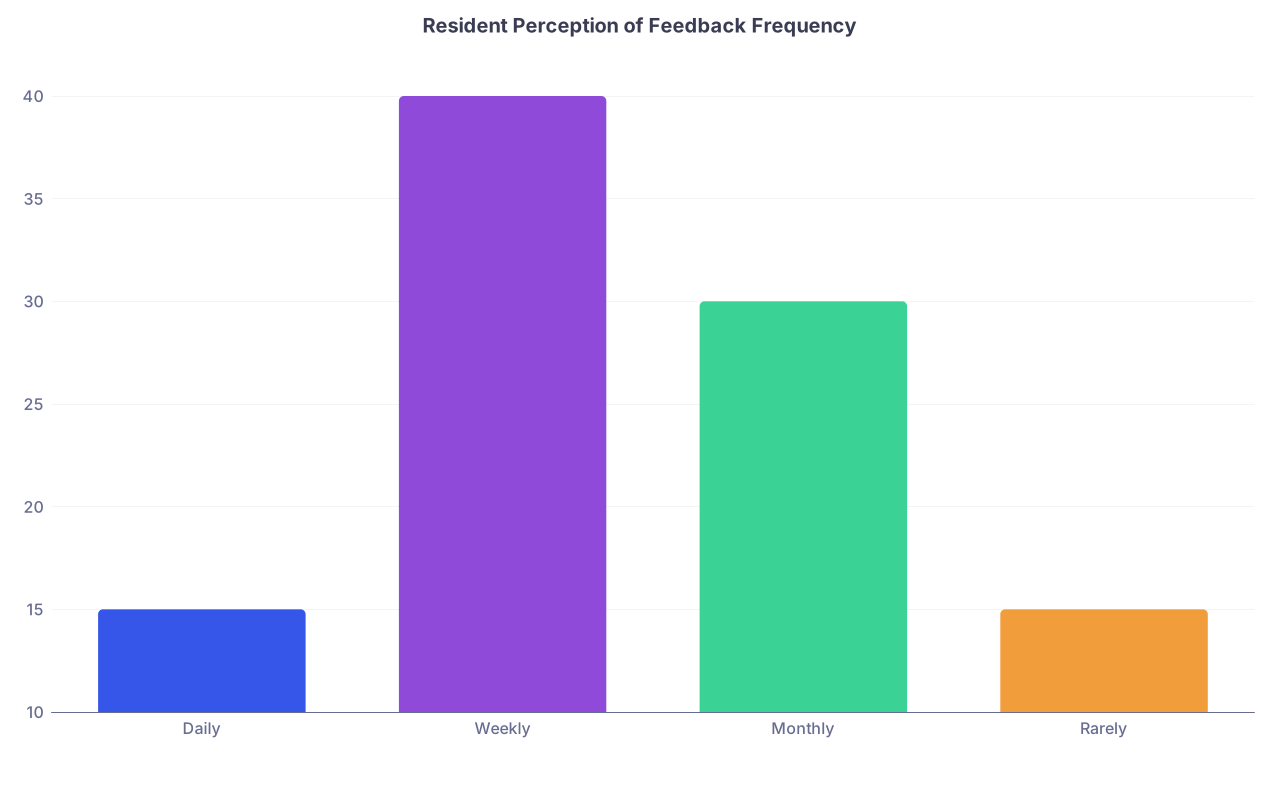
| Category | Value |
|---|---|
| Daily | 15 |
| Weekly | 40 |
| Monthly | 30 |
| Rarely | 15 |
Step 6: Build a Simple “Teaching Bank” You Can Reuse
Trying to think of a fresh pearl on the spot is exhausting. Stop doing that.
Build a teaching bank: 10–20 high-yield, reusable teaching items relevant to your specialty.
Categories:
- Admission criteria
- Discharge criteria
- Most common “don’t miss” diagnoses
- Interpretation shortcuts (ECG, imaging, key labs)
- High-risk medications (and when to avoid them)
- One or two “classic” physical exam maneuvers actually worth teaching
You can keep this:
- As a note on your phone (“Teaching Pearls – Wards”)
- On a single printed sheet in your coat
- In a shared document for your division so others can steal
Example entries for general internal medicine:
- “3 reasons not to order a troponin.”
- “5 must-not-miss causes of acute kidney injury.”
- “Simple framework for hyponatremia: hypovolemic, euvolemic, hypervolemic + 1 typical cause each.”
Then, on rounds, you simply pick 1–2 items per day that match a patient.
You are not inventing teaching content on the fly. You are mapping prefabricated, vetted bites onto real patients.

| Step | Description |
|---|---|
| Step 1 | See Patient |
| Step 2 | Use 3 min teaching template |
| Step 3 | Use micro-tool - one liner or worry question |
| Step 4 | Link to teaching bank item |
| Step 5 | Give 30 sec feedback |
| Step 6 | Time > 3 min? |
Step 7: Protect Your Sanity with Clear Boundaries and Expectations
High-yield teaching does not mean saying yes to everything.
If you are not careful, your own work and your sanity get crushed under “Can we review X?” and “Can you watch me do Y?” all day.
Use three protective habits.
1. Set expectations on day 1
At the start of the rotation, say something very explicit:
- “I teach almost entirely through real cases on rounds and during admissions. You will get daily feedback, but I will rarely do long chalk talks.”
- “If there is a topic you want, tell me 24 hours ahead and I will build it into rounds.”
- “You are expected to ask at least one clinical question per day that directly relates to a patient we are seeing.”
You just:
- Protected yourself from endless off-topic requests
- Told them what you will do well
- Put some responsibility on them
2. Time-box discussions
When someone asks for a deep dive and you are slammed:
- “That is a great question for later. For now, in 30 seconds: [give headline answer]. If you are still curious, email me tonight and I will send you a paper or short summary.”
Or:
- “I can answer this two ways: the 2-minute version now, or the 15-minute deep dive this afternoon if we finish early. Which do you want?”
This keeps you in control.
3. Say “no, but” instead of just “no”
If a learner wants to do a teaching-intensive thing that is not realistic right now:
- “No, I cannot watch that procedure now because of time and acuity. But if you schedule the next one during X time tomorrow, I will come.”
- “I cannot do a full EKG workshop this week. But every time you see an EKG that confuses you, flag it, and we will spend 2 minutes on it during rounds.”
You are drawing lines while still signaling support.
Step 8: Measure Whether Your Teaching Is Working (Fast and Honest)
Most attendings never check if their teaching is actually helping. They just repeat habits from whoever trained them.
You need a quick feedback loop that doesn’t require forms or committees.
Use two simple methods.
Method 1: Two questions at the end of the week
On the last or second-to-last day:
- “Tell me one thing I did this week that was helpful for your learning.”
- “Tell me one thing I should do differently next time to teach better.”
Require an answer. Wait through the awkward silence.
If you see patterns—“We love how you force us to commit,” “We need more clarity on expectations,” “We want more feedback on notes”—adjust one thing next week. Just one.
Method 2: Watch for behavior change
Teaching is only good if it changes what they do.
Things to track over the rotation:
- Are their one-liners sharper by week 2?
- Are they ordering fewer useless tests after your “next test or no test” drill?
- Do they now preemptively state admit/discharge thresholds?
If behavior is not changing, your teaching is not landing. Shorten it. Sharpen it. Tie it more closely to immediate decisions.
Step 9: Build One Signature Teaching Move
The best teachers are remembered for one or two distinctive habits. You do not need to be everything.
Pick one “signature move” to intentionally own. A few examples I have seen work brilliantly:
The Prognosis Attending
Always asks, “What is this patient’s likely 6-month and 2-year trajectory?” Forces trainees to think beyond the admission.The Threshold Attending
Constantly pushes, “What is your threshold to treat / admit / image?” Residents from those rotations leave much more decisive.The Debrief Attending
Always takes 3 minutes after a code, rapid response, or difficult family meeting to say: “What went well? What will we do differently next time?”
Choose something that fits your style and your specialty. Lean into it.
You will still use all the generic tools above. But your signature move is what students talk about when your name comes up. And it keeps you engaged instead of burned out by doing bland, generic teaching forever.
Final Tighteners: What to Start Tomorrow
Do not try to implement everything at once. That is how people fail.
Pick three things to start on your very next shift:
- Use the 3-minute bedside teaching template on at least two patients.
- Fix one intern’s one-liner using the “one-liner upgrade” tool.
- Give micro-feedback (1 strength + 1 change) to each learner once per day.
Once those feel natural, layer in:
- A teaching bank of 10 pearls
- A clear day-1 expectations talk
- A simple end-of-week two-question debrief
You will find something surprising: you are actually less exhausted, not more. Because your teaching is structured, crisp, and aligned with what you are already doing, instead of being yet another vague obligation on top of your real work.
The Bottom Line
Three things matter most:
- Teach to real decisions in real time. No more disconnected mini-lectures.
- Use repeatable micro-structures. A 3-minute template, a few tools, and automatic micro-feedback.
- Protect your time with boundaries and scripts. Clear expectations, time-boxing, and one signature move keep you effective without burning out.
Do those consistently, and you will be the attending everyone actually learns from—even on the busiest service in the hospital.