The common belief that you need a medical education fellowship to become core faculty is exaggerated.
You don’t need one. But not having one is starting to cost you in certain settings.
Let’s walk through when a medical education fellowship actually matters, when it doesn’t, and how to build a core faculty career either way.
The Short Answer: No, You Don’t Need It — But It Can Absolutely Move You Up the Pile
If your only question is, “Do I need a medical education fellowship to become core faculty?” the answer is: no.
You can become core faculty without:
- A medical education fellowship
- A master’s in education
- A formal certificate in teaching
Plenty of program directors, APDs, and long-standing core faculty never did a med ed fellowship. Many were in practice before these fellowships even existed.
But here’s the updated reality:
- At large academic centers, a med ed fellowship or similar training is now a strong positive signal.
- For early-career applicants with similar CVs, the one with formal med ed training often wins.
- In highly competitive specialties or desirable locations, it’s becoming more than “nice to have.”
So the better question isn’t “Do I need it?” It’s:
“Given where I want to end up, is a medical education fellowship the highest-yield way to get there?”
For you, the answer depends on three things:
- Your career goals
- Your current CV
- Your institution’s culture
Let’s break those down.
What “Core Faculty” Actually Means (and What Programs Look For)
First, get clear on what you’re trying to qualify for.
“Core faculty” is not just “people who like teaching.” It usually means:
- You’re listed as core on the ACGME roster
- You attend CCC or PEC meetings
- You have formal responsibilities: didactics, evaluation, mentorship, curriculum, QI, recruitment
- You contribute to program improvement, not just show up and precept a clinic
So what do program directors actually care about when naming core faculty?
Roughly, they’re looking for:
- Reliability and presence: You show up, answer emails, finish evaluations, attend meetings.
- Teaching skills: Learners actually learn from you; evals don’t say “teaches at too high or low level,” “demeaning,” or “disorganized.”
- Educational work products: Lectures, curricula, simulation sessions, rotations you helped build.
- Evidence of “educator identity”: You’re not just doing a favor; you see yourself as an educator and act like it.
- Some scholarship: Poster, workshop, publication, MedEdPORTAL piece, or at least involvement in QI/education projects.
A medical education fellowship is basically a shortcut way of demonstrating several of these at once:
- Training in curriculum design, assessment, feedback
- Built-in mentored education project
- Peer group and network in education
But it’s not the only route.
When a Medical Education Fellowship Helps You the Most
Let me be blunt: a med ed fellowship is high-yield in some situations, and low-yield in others.
Here’s where it really moves the needle.
1. You Want a Leadership Role in Education
If your goal is:
- APD or PD
- Clerkship director
- Site director
- Director of simulation, ultrasound, or similar education area
then a medical education fellowship (or equivalent like a Master’s in Health Professions Education) is often a big accelerator.
Why? Because those jobs require:
- Understanding assessment systems
- Writing learning objectives that aren’t garbage
- Designing rotations and curricula that actually map to milestones
- Leading faculty development
Fellowship gives you structured training and a project you can point to in interviews:
- “I led a redesign of our inpatient teaching curriculum.”
- “I developed and implemented a direct observation tool for interns.”
- “I created a simulation-based bootcamp and evaluated outcomes.”
That’s catnip for PDs looking for future leaders.
2. You’re Early Career With a “Generic” CV
If your CV right now is:
- Med school → residency → chief or straight to attending
- A few posters, nothing special
- Good teacher, good clinician, but nothing that screams “educator” on paper
then a 1–2 year med ed fellowship can:
- Give you focus
- Produce 1–3 concrete education projects
- Generate letters from known education faculty
- Differentiate you from the giant stack of “strong but generic” applicants
This matters at big academic centers that get 40 applications for every open faculty job.
3. You’re Switching Institutions or Regions
If you’re staying at your home institution, your reputation may be enough. People already know your work ethic and teaching style.
If you’re moving:
- To a new region
- To a more academic program
- To a more competitive specialty program
then you lose that “we know you” advantage. A med ed fellowship is portable proof:
- “I’ve been vetted and trained as an educator.”
- “I completed a structured curriculum that your PD colleagues respect.”
When a Med Ed Fellowship Is Probably Overkill
It’s not always the right move. Sometimes doing a fellowship is like bringing a bazooka to a mosquito problem.
1. You’re in a Community-Based Program That Hires From Within
Plenty of community/residency hybrid programs care more about:
- Clinical productivity
- Being pleasant to work with
- Showing up for learners
than about formal education training.
If your PD has literally said things like:
- “We don’t really care about degrees; we care about people who show up,”
or - “Our core faculty are mostly long-term clinicians who teach well and commit to the program,”
then you can easily become core faculty by:
- Volunteering for teaching responsibilities
- Taking on a small curriculum or QI role
- Doing a few scholarly or QI projects with residents
No fellowship necessary. The barrier is trust and commitment, not credentials.
2. You Already Have Strong Education Experience
If you:
- Were chief resident with real educational responsibilities
- Have led a recurring rotation or course
- Have a couple of MedEd publications or national workshops
- Have glowing teaching evals and clear education leadership experiences
then you may already look like “informal core faculty” on paper. A fellowship might add polish, but it won’t be transformative. You might get just as much or more from:
- A part-time certificate program in medical education
- A one-year institutional teaching scholars program
- Targeted courses on assessment, simulation, or curriculum design
With less delay and without another full-time fellowship year.
Alternatives to a Medical Education Fellowship That Still Get You Hired
Here’s the part people skip: you can build a core-faculty-worthy education portfolio without a med ed fellowship.
Think in terms of outputs, not labels.
You want your CV to show four things clearly:
- You teach regularly.
- You develop or improve something educational.
- You assess and give feedback thoughtfully.
- You participate in scholarship or program improvement.
Here’s how to do that without a fellowship.
1. Volunteer for Specific, Visible Education Tasks
Don’t just say “I like teaching.” That’s white noise.
Instead, grab concrete roles:
- Lead the intern bootcamp session on X
- Own a specific didactic series for residents or students
- Take charge of a recurring morning report format
- Run a skills workshop (airway lab, procedures, ultrasound, EKGs, etc.)
Document it. Build a one-page “Education Portfolio” with:
- Titles of sessions
- Frequency
- Approximate number of learners
- Any feedback data
2. Do a Small but Real Education Project
You don’t need a randomized trial. You need something like:
- “We created a new handover curriculum and measured sign-out errors.”
- “We implemented direct-observation cards for interns and tracked usage and satisfaction.”
- “We piloted a flipped-classroom model for our weekly didactics and compared evals.”
Turn it into:
- An abstract at your specialty’s annual meeting
- A poster or workshop at a regional med ed conference
- A MedEdPORTAL submission if appropriate
This shows you can not only teach, but build and evaluate education.
3. Get Some Formal Training (Short of a Fellowship)
Use existing programs instead of adding a full extra year:
Options commonly available:
- Institutional “Teaching Scholars” or “Clinical Educator” programs
- A one-year, one-evening-per-month medical education certificate
- Online courses in curriculum design, assessment, or simulation
- A part-time Master’s degree in Health Professions Education while working as faculty

These give you:
- Language: “objectives, milestones, entrustment, validity, reliability”
- Tools: how to write good questions, how to evaluate a curriculum
- Evidence: a certificate and a structured project
4. Get Mentored by Someone Already in Med Ed
Find the APD, clerkship director, or education champion who:
- Already goes to national meetings
- Already publishes here and there
- Already runs some piece of the curriculum
Tell them directly:
“I want to build a career as core faculty and educator. I’m not doing a fellowship. Can you help me design 1–2 solid education projects and roles over the next 1–2 years so my CV reflects that direction?”
Most true educators will say yes. And they’ll remember you when roles open.
How Programs Actually Compare Applicants (With and Without Med Ed Fellowships)
Programs don’t sit there thinking, “Fellowship or bust.” They’re matching needs to people.
Here’s how it often looks in real life.
| Feature | Candidate A (No Med Ed Fellowship) | Candidate B (Med Ed Fellowship) |
|---|---|---|
| Teaching evaluations | Strong | Strong |
| Formal roles | Led intern report, clinic precept | Led curriculum project, simulation series |
| Scholarship | 1 QI poster | 2 med ed abstracts, 1 workshop |
| Formal training | Local teaching certificate | 1–2 year med ed fellowship |
| Match to “future APD” role | Moderate | High |
Who gets hired?
- For a highly academic program wanting a future APD and someone to build new curricula: probably Candidate B.
- For a smaller or community program wanting a reliable teacher and clinician: Candidate A might be just as attractive, especially if they’re local and known.
The point: the fellowship is one package of training, projects, and mentorship. You can build a similar package yourself, if you’re intentional.
A Simple Decision Framework: Should You Do a Med Ed Fellowship?
Use this as a sanity check.

| Step | Description |
|---|---|
| Step 1 | Do you want a major education leadership role? |
| Step 2 | Skip fellowship - strengthen current portfolio |
| Step 3 | Med ed fellowship is high yield |
| Step 4 | Med ed fellowship helpful but optional |
| Step 5 | Do you lack strong med ed projects or training? |
| Step 6 | Are you targeting highly academic programs? |
If you land on:
- “High yield” → Seriously consider it.
- “Helpful but optional” → Compare opportunity cost vs alternatives.
- “Skip fellowship” → Build your portfolio with projects, roles, and short programs instead.
What You Can Do This Month If You Want to Be Core Faculty (With or Without Fellowship)
Let’s get concrete. Here’s a one-month action plan to move you closer to core faculty territory regardless of your path.
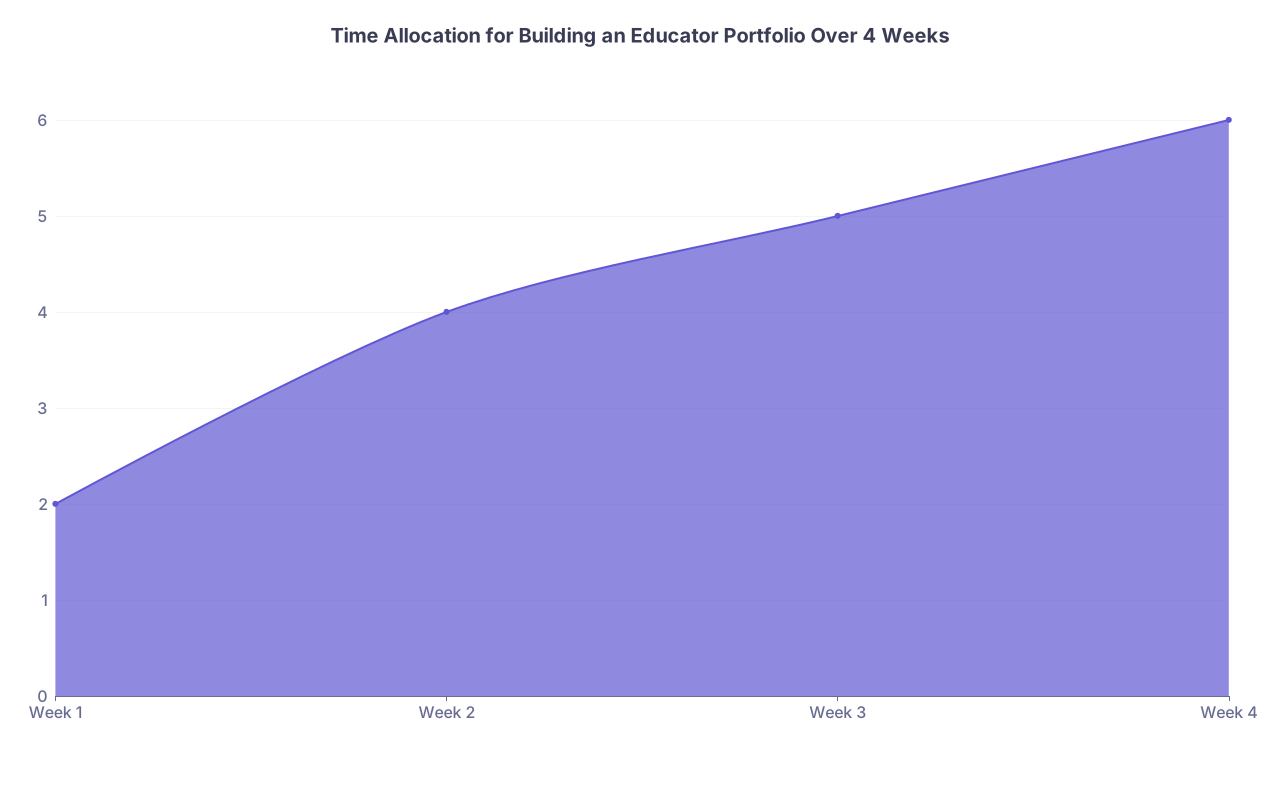
| Category | Value |
|---|---|
| Week 1 | 2 |
| Week 2 | 4 |
| Week 3 | 5 |
| Week 4 | 6 |
Use 2–3 hours per week for:
Week 1:
- Meet with your PD, APD, or clerkship director.
- Ask directly: “What would make someone an obvious choice for core faculty here in 1–2 years?”
- Write down their exact words. Those are your targets.
Week 2:
- Volunteer for one specific recurring teaching role.
- Ask to help with 1 small curriculum or assessment task (even just revising eval forms or building a session).
Week 3:
- Identify or design one small education or QI project: new orientation session, new direct observation tool, skills lab, etc.
- Sketch a simple plan and timeline.
Week 4:
- Find a med ed mentor at your institution. Show them your plan. Ask: “Does this project actually count as scholarship? How do we make it presentable at a meeting?”
You’re now doing the core-faculty-building work that a med ed fellowship formalizes. You’re just doing it locally.
FAQs
1. Will not having a medical education fellowship hurt my chances of becoming an APD or PD later?
It might slow you down at very academic programs, but it’s not a deal-breaker. What PDs really care about: have you led curricula, mentored learners, managed evaluation systems, and produced some scholarship? If you can show that via projects, roles, and maybe a shorter certificate program, you can absolutely reach APD/PD without a formal med ed fellowship.
2. Is a Master’s in Medical Education better than a fellowship?
They do different things. A Master’s gives you depth in theory, research methods, and design over 1–3 years—often part-time while working. A fellowship is usually more applied, with protected time, mentorship, and concrete projects. For pure leadership in education, a combined pathway (local fellowship + part-time Master’s) is ideal but not necessary. If you have to pick one early in your career, a well-structured fellowship often gives more immediate leverage for core faculty roles.
3. How much scholarship do I actually need to be considered “education-focused” core faculty?
You don’t need 10 publications. For early-career core faculty, something like: 1–2 education-focused posters, 1 workshop or oral presentation, and 1 ongoing project is usually enough to credibly say “I’m an educator with scholarship.” Over time, yes, you’ll want to build more, especially if you’re eyeing leadership roles, but you don’t need an RCT of your new curriculum.
4. I’m already an attending. Is it too late to do a med ed fellowship?
No. Many programs now have “faculty development fellowships” or part-time med ed fellowships geared toward junior or mid-career faculty. You may need to negotiate FTE, salary, or protected time, but it’s not just for fresh grads. If you’ve been doing education work informally and want more structure plus academic promotion, a later fellowship can be very smart.
5. Are virtual or online medical education fellowships worth it?
They can be—if they include real projects, feedback, and mentors, not just lectures. Look closely at: who teaches it, what you’ll produce (manuscripts? curricula? presentations?), and how connected it is to recognized education communities. A weak online program that gives you a certificate but no mentorship or output is lower value than a strong in-house teaching scholars program.
6. What’s one concrete thing I can do this week to move toward being core faculty?
Email your PD or education leader and ask for 20 minutes. In that meeting, say: “In the next 1–2 years I’d like to be the kind of person you’d consider for core faculty. What are 2–3 specific education roles or projects I should take on now to make that realistic?” Then commit—in writing—to one of those tasks. That single conversation often does more for your trajectory than months of vague “interest in education.”
Open your CV right now and circle every bullet that proves you’re an educator (teaching roles, projects, scholarship, training). If that section looks thin or vague, pick one concrete education role to pursue this month—fellowship or no fellowship—and start building the portfolio you want to be hired for.